
Writing a speech about yourself feels awkward. I get it.
You’re basically standing in front of people—strangers, colleagues, classmates—and saying, “Here’s who I am.” That’s intimidating.
But here’s what I’ve learned: self-presentation is a skill. And when you master it, everything changes.
Job interviews get easier. Networking becomes natural. People actually remember you.
So why do you need to know how to write a speech about yourself? Because it’s your opportunity to control the narrative. A strong introduction speech about yourself sets the tone for everything that follows.
Now, let me walk you through exactly how to write a speech about yourself—step by step.
- Know your audience first—tailor your message to what they care about.
- Build a clear structure: introduction, main points, conclusion.
- Edit ruthlessly: your first draft is never the final one.
- Practice out loud to sound natural, not scripted.
- Use body language to reinforce your message and build trust.
- Avoid common mistakes like data overload or forgetting to inspire.
- Memorize key points, but don't read word-for-word from a script.
What Is a Speech About Yourself?
It’s used in classrooms, job interviews, orientation sessions, networking events, and award ceremonies.
The goal is simple: give your listeners a clear, memorable picture of who you are, what you do, and where you’re headed. The best ones do this without sounding like a résumé being read aloud.
Comparison: Speech Types by Context
| Context | Tone | Focus | Length |
|---|---|---|---|
| Job interview | Formal, confident | Achievements, skills, goals | 1–2 minutes |
| University class | Conversational, warm | Background, interests, goals | 1–3 minutes |
| Networking event | Casual, punchy | Role, unique angle, connection point | 30–60 seconds |
| Award ceremony | Reflective, grateful | Journey, mentors, gratitude | 2–5 minutes |
| Team introduction | Friendly, direct | Role, working style, fun fact | 1–2 minutes |
Before You Write: Ask Yourself These Questions
Before you type a single word, reflect.
Writing a speech about yourself starts with knowing what material you have to work with. Some students look for Do My Assignment assistance when preparing speeches under tight deadlines or struggling with public speaking anxiety.
Ask yourself:
- What makes me unique?
- What am I proud of—academically or personally?
- What’s a fun fact people often find surprising about me?
- What are my goals, and why do they matter?
- Which experiences shaped who I am today?
Your answers decide what goes in and what stays out.
Without this step, you’ll either overload your audience with irrelevant details—which obscures your main message—or struggle to fill the time.
7 Main Tips To Create A Persuasive Speech About Yourself
To write a persuasive speech about yourself, follow these seven essential tips that help you engage your audience effectively.
I’ve watched students transform from nervous wrecks into confident speakers just by applying these strategies.
Let’s break them down.
1. Gather information
Before you type a single word, get context. Ask yourself:
Where am I giving this speech? Who’s listening? What do they care about?
Here’s what I always check first:
- Time and duration: Am I speaking for 2 minutes or 10? Huge difference.
- Location: A small classroom? A big auditorium with a mic? The setting changes your delivery.
- Audience: Are these professors? Potential employers? Friends at a party? Tailor your tone accordingly.
I once gave a speech to a room full of engineers. I cut out all the creative storytelling and focused on facts and outcomes.
Know your crowd.
2. Make a Plan
You can’t wing this. I’m serious. Even experienced speakers need a plan.
Start with an outline. A well-structured speech has three main components: an introduction, a body, and a conclusion. Keep your points short and focused.
Don’t try to tell your entire personal life story—hit the highlights that matter most to your audience. Creating an outline before you write helps organize your thoughts and ensures a coherent structure.
Think of it as a map before the road trip.
Introduction
Keep it brief. Greet your audience. State your name. Add a hook—something that grabs attention right away.
- If you’re in school, mention your major or year.
- If you’re at a job interview, mention your current role or biggest achievement.
Body (main information)
This is where you dig in. Talk about:
- Academic or professional achievements
- Internships or work experience (be specific: role, company, what you learned)
- Volunteer work or extracurriculars that shaped you
- Skills or certifications that set you apart
In the body, elaborate on key points and provide relevant details and examples that support your narrative. Don’t just list accomplishments—organize them into a story that gives context.
Additional details
Add a personal touch here:
- Languages you speak (and at what level)
- Technical skills or software you know well
- Hobbies that reveal something interesting about you
Conclusion
Wrap up with your future goals. What’s next for you? What are you working toward?
This gives your speech direction and leaves a lasting impression. A strong conclusion summarizes your main points and ties back to your opening—it brings the whole thing full circle.
3. Edit like your grade depends on it
Starting writing your speech is just step one. Now comes the real work: editing.
Your first draft will be rough. Accept it. Then fix it.
Read your speech out loud—multiple times. Does it sound conversational or stiff? Cut anything that feels forced or overly formal.
Ask a friend to listen and give honest feedback. Sometimes they catch things you completely miss because you’re too close to the material.
4. Keep in mind the details
If this is your first time giving a speech about another person or yourself, focus on the small details. They matter more than you think.
Dress appropriately. I’m not saying wear a suit to a casual event, but look put-together and match the occasion. Your appearance shapes the audience’s first impression before you even open your mouth.
Arrive early. Test the mic if there is one. Arrange your notes. Take a deep breath. Smile at the audience before you start. These small actions calm your nerves and signal confidence to everyone watching.
When you step up to speak, pause for a moment. Pull out your notes calmly. Straighten the mic if needed.
That pause gives you control and tells the audience you’re ready. It also gives them time to settle in and focus on you.
5. Gesture
Your hands are storytelling tools. Use them wisely.
Too many speakers stuff their hands in their pockets or cross their arms—moves that scream insecurity.
Let your hands move naturally. Emphasize key points with open gestures that invite the audience in. Just don’t overdo it and flail around like you’re directing traffic.
Make eye contact with different people in the room. This creates a connection and keeps your audience’s attention. It also makes you look confident, even when you don’t feel it.
Standing still like a statue is equally bad. Move a little. Shift your weight. Act like a human, not a mannequin frozen on stage.
6. Practice
Even seasoned speakers get nervous.
The difference?
They practice until the nerves become manageable background noise instead of a paralyzing force.
Read your speech to yourself first. Then say it out loud in front of a mirror. Watch your facial expressions. Notice where you stumble or lose your train of thought.
Next, practice in front of someone you trust—family, friends, coworkers.
Ask them:
Does this sound natural? Do I lose you anywhere? Did any part feel awkward?
Their feedback is gold, even if it stings a little.
Practicing multiple times also helps with pace. Speaking too fast—or without pauses—undermines your confidence and clarity.
Work on maintaining a steady rhythm: vary your pitch, control your pace, use deliberate pauses, project your voice, and bring genuine passion to what you’re saying.
7. Learn by heart
Memorizing your speech doesn’t mean reciting it like a robot reading from a teleprompter. It means knowing your material so well that you can deliver it naturally, even if you lose your place or get distracted.
I recommend memorizing the structure and key phrases, not every single word. That way, you sound conversational and authentic, not rehearsed and stiff.
If you’re feeling lost or overwhelmed at this stage, hiring an essay writer can help. They’ll work with you to build a compelling narrative that fits your goals and sounds like you.
Honesty and confidence are key here—an experienced writer can help you find the right structure and tone without losing your voice.
How to Structure Your Story: The Three-Act Approach
One of the most effective ways to organize a speech about yourself is to treat your life like a play. Professional speakers call this the three-act structure.
- Act I — Where you started: Your background, your roots, the people or experiences that shaped you early on.
- Act II — How you grew: The challenges, turning points, and mentors who pushed you forward.
- Act III — Where you are now: What you’ve achieved, what drives you, and where you’re headed.
Here’s what makes this approach powerful: you don’t have to be the hero of your personal story.
Talk about the people who influenced you—a teacher, a parent, a colleague who believed in you before you believed in yourself. Give the best lines to your characters. Let them deliver the memorable advice in your speech.
This technique works because audiences connect with authenticity. Sharing real moments—even failures or doubts—builds far more trust than a polished list of accomplishments.
Show, don’t tell: use a specific scene or moment to illustrate perseverance or growth, rather than just stating, “I worked hard.”
How to Start a Speech About Yourself
Knowing how to start a speech about yourself is half the battle. Your opening sets the tone for everything that follows.
You have a few options:
- A scene: Drop the audience into a moment. “It was 6 a.m. on a Tuesday when my professor told me my research was going to be published.” Starting with a compelling scene grabs attention immediately.
- A question: “Have you ever had to introduce yourself to a room full of strangers and gone completely blank?”
- A surprising fact: “I once read 80 books in a single year. I’m Emma—and yes, I do sleep.”
- A direct greeting: For formal settings, simplicity works. “Hi everyone, my name is Kayla. I’m a second-year student passionate about forensic psychology.”
The key is to avoid opening with an apology, a cliché, or “So, um, I’m not really sure where to start.” Pick your hook and commit to it.
How To Make Your Autobiographical Speech Excellent?
Wondering how to make a speech about yourself truly stand out? It comes down to three things: confidence, adaptability, and genuine human connection.
Perfection doesn’t exist in public speaking. Something will always go wrong:
- the mic might screech;
- someone might cough loudly right during your most important point;
- the lights could flicker or even go out.
Here’s the secret: stay calm.
React with humor if possible. Show the audience you’re in control, even when things go sideways. That’s what separates amateurs from professionals who command respect.
After you finish your prepared remarks, thank your audience sincerely. Answer any questions they have with the same confidence and honesty you brought to the speech itself.
Remember: your self-presentation doesn’t end when you stop talking. How you handle the Q&A session matters just as much as your prepared remarks.
Sometimes more.
About Me Speech Examples
Here are three great examples of a speech about yourself, written for different contexts. So you can see how all the tips I mentioned come together in a real, working speech.
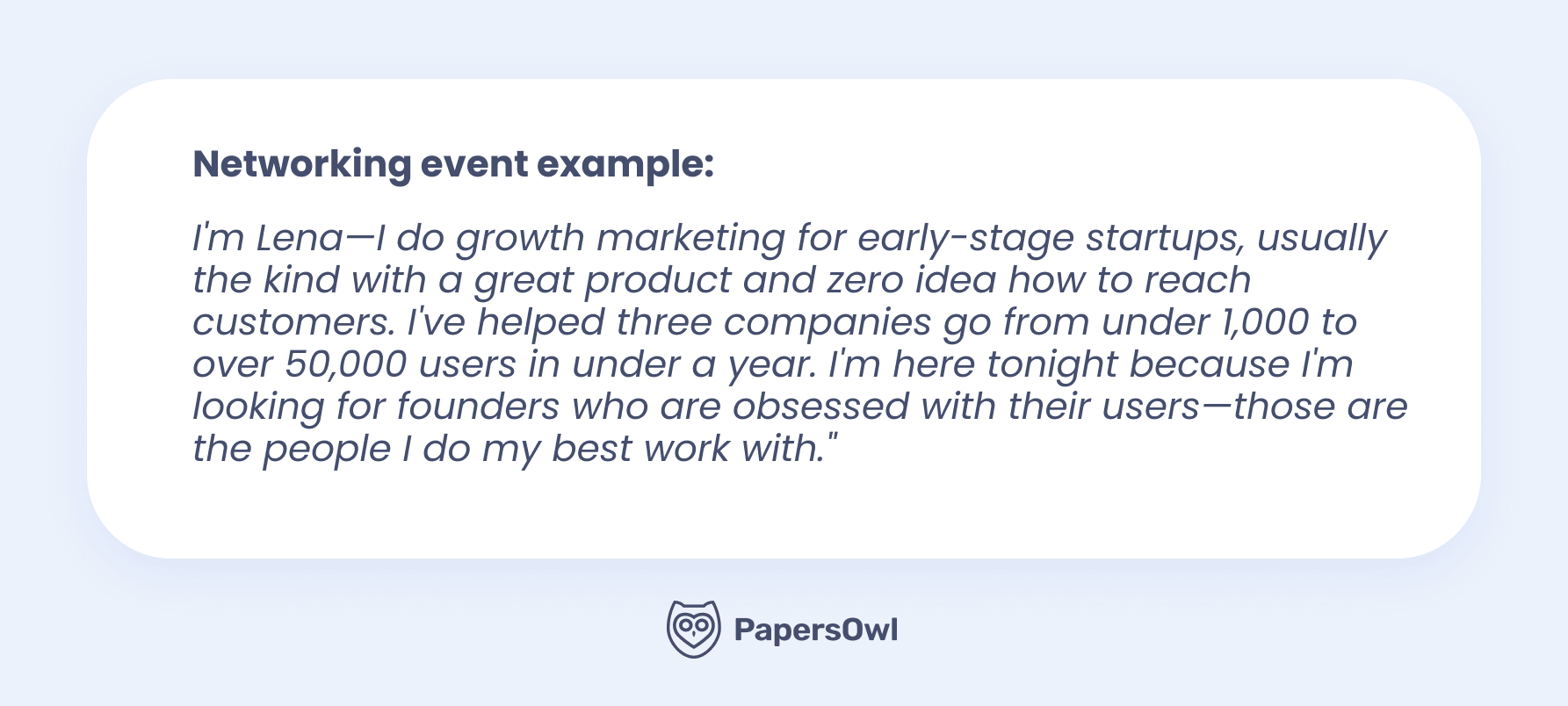
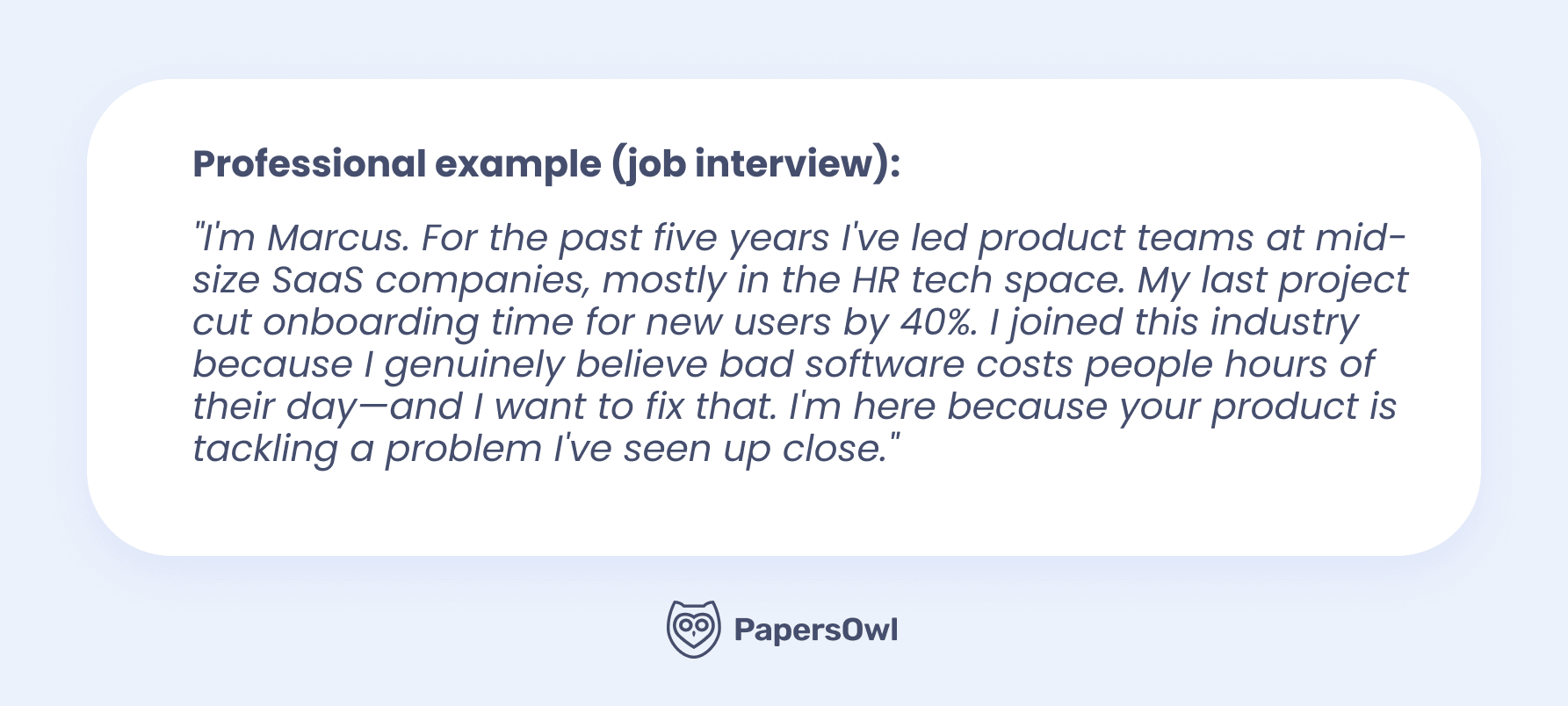
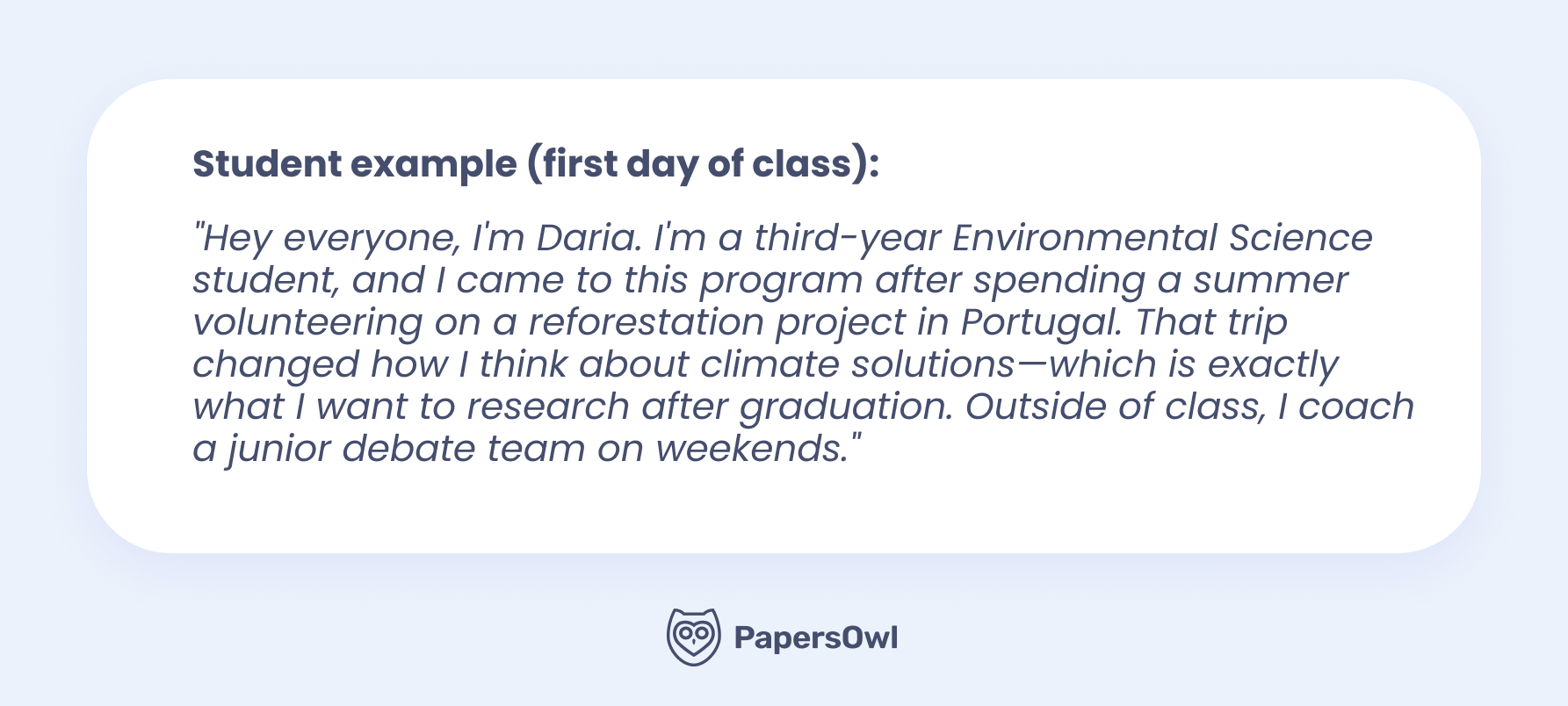
Notice that each one is brief, specific, and tailored to the setting. That’s exactly what writing a speech about yourself is about—not cramming in everything, but choosing the right details for the right room.
Common Mistakes You Must Avoid At All Cost
Avoid these common mistakes to ensure your speech about yourself is clear, engaging, and tailored to your audience.
These errors tank otherwise solid speeches. Don’t let that happen to you.
1. Not tailoring the speech for your audience
This is mistake number one, and it kills more speeches than stage fright ever will.
You can’t use the same speech for your family reunion and a job interview. The tone, content, and focus need to shift based on who’s listening.
Ask yourself: What does this audience care about?
If you’re speaking to professors, emphasize your academic achievements and intellectual curiosity. If it’s a business event, focus on professional skills, results, and future goals.
2. Using too much data
Yes, facts matter. But providing too much irrelevant information overwhelms your audience and obscures your main message.
Keep it simple. Share highlights, not your entire résumé or life timeline.
If you feel tempted to list every single project you’ve ever worked on, stop yourself. Pick the top two or three that are most relevant to this specific audience and occasion.
3. Sounding too formal or robotic
Sounding excessively formal or stiff makes your speech difficult to follow. Use natural language that connects with your audience.
Write the way you talk. If you wouldn’t say a phrase in casual conversation, cut it from your speech. Your listeners should feel like they’re getting to know a person—not reading your LinkedIn bio.
4. Presenting a speech that doesn’t inspire
Your speech needs energy and purpose. If you sound bored, your audience will be too. Simple as that.
Use body language intentionally. Vary your tone and pace. Pause for effect at key moments. Make eye contact with different people in the room.
These techniques turn a flat, forgettable speech into a memorable one that people actually talk about later.
5. Lacking a clear structure
A speech without clear structure confuses your audience. They lose the thread and stop listening.
Make sure your ideas are organized with a clear introduction, body, and conclusion. Each section should flow naturally into the next, with smooth transitions that guide the listener.
6. Not making pauses
Pauses are powerful tools, but most beginners rush right past them. Pauses give your audience time to absorb what you just said. They also make you sound more confident, thoughtful, and in control.
Don’t rush through your speech like you’re being chased. Slow down. Breathe. Pause after important points to let them sink in.
Your audience will appreciate the breathing room, and you’ll come across as far more polished.
Let’s Sum Up
Your speech should be detailed yet simple and easy to follow. Include these essential elements:
- A brief, engaging introduction (name, background, one interesting fact that hooks people)
- A summary of your past achievements or experiences that matter to this audience
- Your current situation or what you’re working on right now
- Your future goals and ambitions that show where you’re headed
Once you have those elements working together, your audience will walk away with a clear, memorable picture of who you are and what you bring to the table.
Keep it short and punchy. Don’t overload it with unnecessary details or complicated language. Your audience wants to get to know you—not decode a dense academic thesis.
Practice your speech until it feels natural and conversational. Then practice some more until you can deliver it with genuine confidence, not fake bravado.
And remember: confidence comes directly from thorough preparation, not from faking it.