
Technology, health, science, history, culture, business, and more — organized by category, grade level, and speech length. With writing guidance, outlines, and topic selection tips.
A good informative speech topic does one thing: it teaches the audience something they didn’t already know. Not “climate change exists” — they know that. But “how melting permafrost releases trapped methane and why that creates a feedback loop” — that’s a topic. The difference is a specific angle, not just a subject.
The best topics come from genuine curiosity. Students who care about their topic write better speeches and deliver them with more confidence. That matters more than picking something that sounds impressive. If your assignment is a personal tribute or biographical talk, see our guide on how to write a speech about someone for a different approach.
Need a title right now? Use our Title Generator to get a customized informative speech topic in seconds — free, no account needed.
This guide covers 300+ informative speech topics organized by category and level. It includes good informative speech topics for every skill level, fun informative speech topics for more creative assignments, and unique informative speech topic ideas for students who want to stand out. You’ll also find a definition of informative speech, a topic selection guide, four speech types explained, three ready-to-use outlines, and a full FAQ.
What Is an Informative Speech?
An informative speech aims to educate the audience — not to change their opinion. It gives facts, explains a process, describes a concept, or walks through how something works. The goal is clarity and understanding, not persuasion.
Informative speeches fall into four types:
- Definition — Explains what something is. Example: “What is a deepfake?”
- Description — Paints a detailed picture of a person, place, or phenomenon. Example: “What the surface of Mars looks like.”
- Demonstrative — Shows how to do something step by step. Example: “How to start a small business as a student.”
- Explanatory — Explains causes, effects, or how a system works. Example: “How social media recommendation algorithms decide what you see.”
A good informative speech respects what the audience already knows. It fills gaps without talking down. It uses specific facts and examples — not vague generalities. According to APSU communication guidelines, using clear definitions and concrete examples is what makes complex topics actually land with a general audience. The same principle applies to written work — see our guide on how to write an informative essay introduction for the written equivalent of these techniques.
How to Choose a Good Informative Speech Topic
Picking the right topic saves hours of struggle later. A topic that excites you will produce a better speech than a “safe” pick that bores you. Use this checklist before committing.
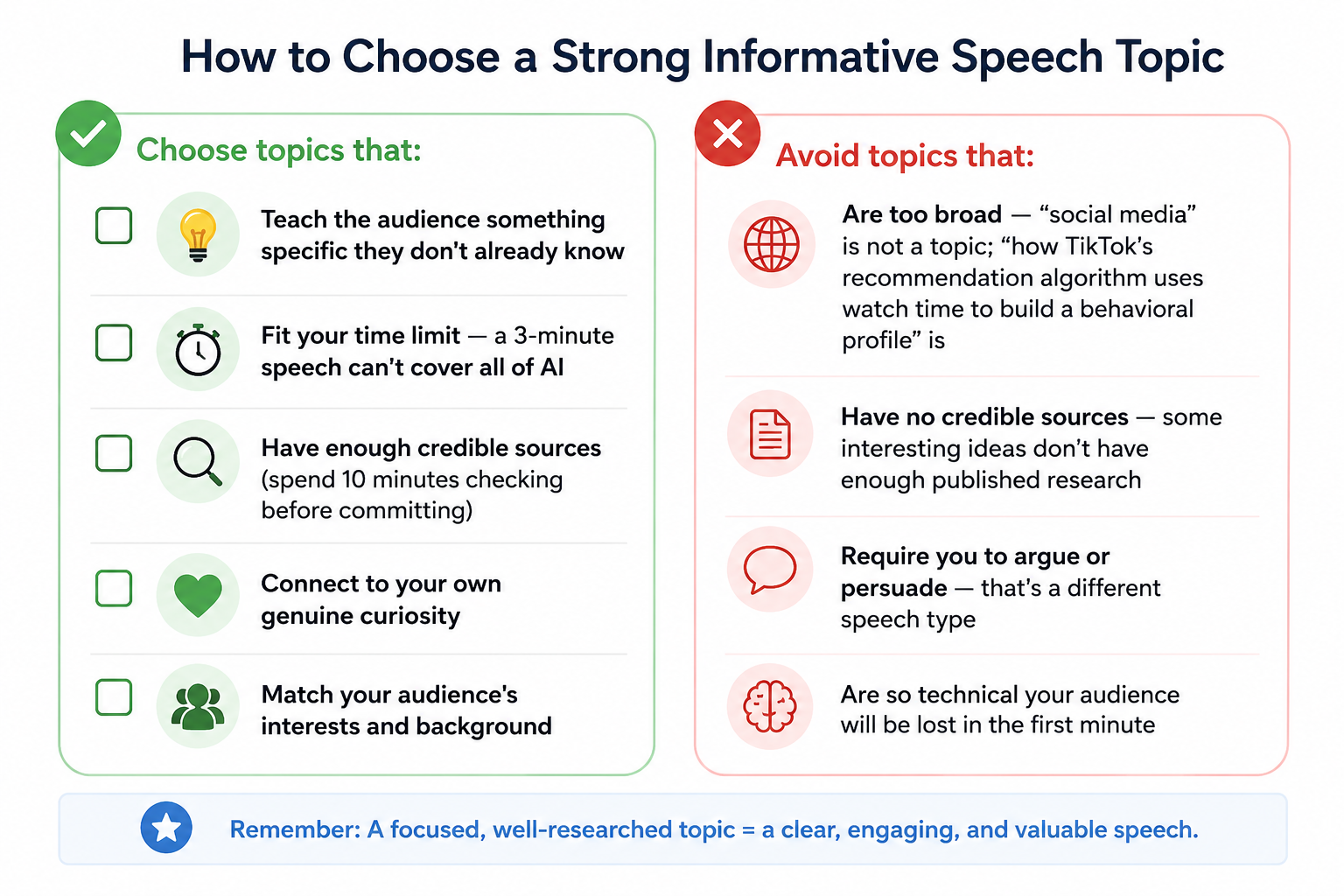
The fastest test: Can you explain your topic in one sentence that tells someone something specific they didn’t know? If yes, you have a topic. If your sentence sounds like a headline from a general news site, narrow it down. If you need a topic that inspires action rather than just informs, browse our list of motivational topics — the selection criteria are similar but the angle is different.
Topic Selection by Time Limit
Different speech lengths require different scope. Match your topic to your time.
| Time Limit | Ideal Scope | Example |
|---|---|---|
| 2–3 minutes | One concept, defined and illustrated | “What is bioluminescence and which animals use it?” |
| 5 minutes | One concept with 2–3 supporting points | “How deepfake technology works and why it’s hard to detect” |
| 8–10 minutes | A system or process with causes and effects | “How the gut microbiome affects mood through the gut-brain axis” |
| 15+ minutes | A complex topic with historical context and policy implications | “The economic, environmental, and social impact of fast fashion” |
Technology and AI Informative Speech Topics
Technology speech topics work best when they go one layer deeper than what students already know. “AI exists” is not a topic. “How large language models generate human-like text — and why they sometimes produce confident wrong answers” is.
For high school:
- How social media algorithms decide what you see — and why they show you more of what you already believe
- What cybersecurity basics every student needs — passwords, phishing, and what cloud storage actually means
- How mental health apps track your mood — and what happens to that data
- Why self-driving cars aren’t everywhere yet — the gap between the technology and real-world safety
- How recommendation algorithms on streaming platforms create filter bubbles
For college:
- How large language models like GPT work — tokens, training data, and why hallucination happens
- The bias problem in AI hiring tools — documented cases and what it means for job applicants
- How deepfakes are made — the technology behind synthetic media and why detection is hard
- What “explainable AI” means and why it matters for medical and legal decisions
- How agentic AI systems plan and complete tasks without human input — and the accountability gaps this creates
- How AI is changing drug discovery — from protein folding to clinical trial prediction
- The environmental cost of training large AI models — energy use, water, and carbon footprint
- How facial recognition works — and what error rates mean for civil liberties
- What zero-trust cybersecurity architecture is and why it’s replacing traditional network security
- How quantum computing could break current encryption — and what post-quantum cryptography proposes
For any level — 5-minute picks:
- What a VPN actually does (and what it doesn’t)
- How roller coasters use physics — g-forces, gravity, and speed
- Why passwords get hacked — and how password managers work
- How streaming services use viewing data to decide what to produce
- The history of the internet — from ARPANET to the modern web
Health and Science Informative Speech Topics
Health topics perform best when they move from “this is a problem” to “here is the specific mechanism.” “Sleep deprivation is bad” is common knowledge. “How sleep deprivation impairs memory consolidation in the hippocampus” gives the audience something new.
For high school:
- Why teenagers need more sleep than adults — and what happens cognitively when they don’t get it
- How stress hormones affect the brain and body — the science of cortisol and the fight-or-flight response
- How vaccines trigger immune memory — the biology behind herd immunity
- The food-mood connection — how diet affects serotonin and mental health
- What eating disorders actually do to the body — biology beyond the stereotypes
- Why exercise reduces anxiety — the neurological mechanisms
- How caffeine blocks adenosine — and why the energy crash happens
For college:
- How the gut microbiome communicates with the brain — the gut-brain axis and mood regulation
- What ADHD and autism look like in the brain — neurological differences, not deficits
- How CRISPR gene editing works — and the ethical debate over heritable changes
- Deep sleep and memory consolidation — what happens in the brain during slow-wave sleep
- The science of chronic pain — why pain persists after injury heals
- How stem cell therapy works — current applications and what’s still experimental
- The biology of addiction — how substances hijack the brain’s reward system
- Traditional Chinese medicine in modern research — what studies show and where evidence is limited
For any level — 5-minute picks:
- How vaccines work — explained simply
- The science of dreams — what the brain is doing while you sleep
- Why water matters — hydration and cognitive performance
- What mindfulness does to the brain — measurable changes in structure and function
- How sunscreen actually protects skin — UV radiation and DNA repair
Environment and Climate Informative Speech Topics
Environmental topics earn more engagement when they connect the science to human stakes. Not just “glaciers are melting.” Try “how glacial melt in Greenland is slowing ocean circulation — and what that means for European weather patterns.”
For high school:
- How the urban heat island effect makes cities hotter than surrounding areas — and what cities are doing about it
- Why wildfires are getting larger and more frequent — the climate-drought connection
- How microplastics enter the food chain — from ocean to fish to human tissue
- What happens to recycled materials — the actual process of municipal waste sorting and global commodity markets
- Why some climate refugees don’t qualify as refugees under international law
For college:
- The permafrost methane problem — how warming releases trapped carbon and accelerates climate change
- How orbital debris is growing — the crisis of space junk and proposed cleanup technologies
- The lifecycle environmental cost of electric vehicles — battery mining, production, and disposal compared to emissions savings
- How carbon capture and storage works — the technology, the cost, and the scale challenge
- The water-energy nexus — how power generation consumes water, and why this matters in drought regions
- How smart grid technology works — and the cybersecurity vulnerabilities of a digitized power system
- The political economy of climate agreements — why countries under-commit and what enforcement looks like
For any level — 5-minute picks:
- How rainforests produce rain — the water cycle and deforestation
- What climate change does to coral reefs — bleaching explained
- How solar panels convert light to electricity
- Why soil health matters — the biology beneath our feet
- The story of the ozone hole — a rare environmental success story
History and Culture Informative Speech Topics
History topics work best with a specific analytical angle. The difference shows: instead of “the Civil Rights Movement was important,” try “how SNCC’s nonviolent direct action forced legal confrontation — and why it worked in some contexts and not others.”
For high school:
- The lessons of WWII for international institutions — how the war created the United Nations and what its limits have always been
- How the printing press changed power — from Church authority to the Protestant Reformation
- The story of voting rights — who has been excluded throughout US history and how those exclusions were fought
- Why the Civil Rights Movement succeeded when it did — strategy, timing, and legal pressure
- The history of vaccines — from variolation to mRNA technology
- How fashion trends repeat — the 20-year cycle and its cultural roots
For college:
- The history of the Geneva Convention — how international humanitarian law developed from the Battle of Solferino
- How colonialism shaped modern borders — and why so many post-colonial conflicts follow those lines
- The history of the concept of privacy — from ancient Rome to GDPR
- How propaganda techniques compare across different historical regimes — and what makes them effective
- The history of mental illness diagnosis — how the DSM evolved and what it reveals about cultural assumptions
- The Nuremberg Trials and international criminal law — precedents that still govern accountability today
- How the Cold War shaped science — the space race, nuclear physics, and the politics of research funding
For any level — 5-minute picks:
- The history of emojis — from Japanese mobile culture to Unicode
- How language changes over time — a brief history of English
- The story of chocolate — from Mesoamerican ritual to global commodity
- How handshake traditions vary across cultures — and what they signal
- Great women in science — five figures whose contributions were overlooked
Business and Economics Informative Speech Topics
Business speech topics get more interesting when they move from general (“startups are risky”) to specific mechanism (“why 90% of startups fail in the first year — the most common causes and what the data shows”).
For high school:
- What compound interest actually does — the math behind long-term investing
- Why financial literacy isn’t taught in most schools — and why that gap costs people money
- How inflation works — what the consumer price index measures and why prices rise
- The gig economy and labor rights — what “independent contractor” classification means for workers
- How small businesses affect local economies — multiplier effects and community anchoring
For college:
- How central banks control inflation — the mechanics of interest rate policy
- The economics of fast fashion — who pays the real cost and what supply chain transparency reveals
- How ESG investing works — and the debate over whether it outperforms conventional portfolios
- What the gig economy does to retirement security — the pension gap for platform workers
- How algorithmic pricing works — and the ethical questions it raises for consumers
- The history of cryptocurrency — from Bitcoin’s whitepaper to institutional adoption and regulatory risk
- How behavioral economics explains why people make predictably bad financial decisions
- Corporate governance and accountability — how board structure affects company behavior
Business ethics topics (from recommendations):
- The role of whistleblowing in corporate accountability — cases, protections, and outcomes
- How transparency requirements reduce corporate fraud — Sarbanes-Oxley and its effects
- The ethics of data collection — what companies know about you and what consent actually means
- Emotional intelligence in leadership — what research shows about its effect on team performance
- How servant leadership differs from traditional management — and what the evidence shows
For any level — 5-minute picks:
- How mutual funds work — pooled investing explained simply
- What a credit score measures — the five factors and how to improve them
- The story of a product — from raw material to retail shelf
- How startups get funded — seed rounds, venture capital, and what investors look for
- The basics of supply and demand — illustrated with a real example
Psychology and Human Behavior Informative Speech Topics
Psychology topics connect well to student experience. The best ones explain a mechanism — not just name a phenomenon.
For high school:
- Why people procrastinate — the psychology behind intention-action gaps
- How social comparison on social media affects self-esteem — the research evidence
- The science of habits — how cues, routines, and rewards wire the brain
- Why humans believe in superstitions — cognitive explanations for magical thinking
- How peer pressure works psychologically — conformity research from Asch to TikTok
For college:
- The psychology of persuasion — Cialdini’s six principles and where they show up in daily life
- How groupthink happens — the conditions that suppress dissent in organizations
- The neuroscience of memory — how encoding, storage, and retrieval actually work
- Why people fall for scams — cognitive vulnerabilities and social engineering
- The psychology of procrastination — temporal discounting and why deadlines feel distant
- How implicit bias works — the evidence, the limits of implicit association tests, and what it means for behavior
- The psychology of conspiracy belief — what makes some people more susceptible and why
For any level — 5-minute picks:
- What short-term memory actually is — and its limits
- The four learning styles — visual, auditory, reading/writing, kinesthetic
- Why we remember emotional events better — the amygdala and memory encoding
- What cognitive dissonance feels like — and how we resolve it
- The science of first impressions — how fast they form and how hard they are to revise
Social Issues and Media Informative Speech Topics
Social issues make strong informative topics when you explain the mechanism or history — not just describe that a problem exists.
For high school:
- How media bias works — techniques for detecting slant in news coverage
- Why fake news spreads — the psychology and platform incentives behind viral misinformation
- The history of social media — from MySpace to algorithmic feeds
- How cancel culture works — the social mechanics of public accountability and mob reaction
- What the digital divide means for education — how internet access gaps affect learning outcomes
For college:
- How recommendation algorithms create political polarization — the research evidence
- The history of the free speech doctrine — how US First Amendment law differs from European approaches
- How influencer marketing works — the psychology of parasocial relationships and consumer trust
- The economics of attention — how platforms monetize user behavior and what that incentivizes
- What deepfakes mean for trust in visual evidence — implications for journalism and law
- How misinformation spreads differently on different platforms — mechanisms and platform design choices
For any level — 5-minute picks:
- What memes actually are — memetics, virality, and cultural transmission
- How TikTok’s algorithm works — what signals it uses and what it optimizes for
- The history of internet culture — from early forums to short-form video
- Why comedy works as social criticism — the history of satire from Jonathan Swift to political memes
- How photo filters affect self-perception — the research on augmented reality beauty standards
Education Informative Speech Topics
For high school:
- Why standardized testing doesn’t measure what it claims to — what validity research shows
- How bilingual education affects cognitive development — the science of language and the brain
- Why the school-to-prison pipeline exists — the policies and data behind it
- What financial literacy education actually changes — evidence from state-level programs
- How gap years affect college performance — what the data shows
For college:
- How grade inflation happened — the historical trend and its effects on hiring and graduate admissions
- The neuroscience of learning — spaced repetition, retrieval practice, and interleaving
- Online learning vs. in-person — what the COVID-19 natural experiment revealed about outcomes
- How AI tutoring tools work — and the equity implications of access gaps
- The history of standardized testing — from Army Alpha to the SAT
Science and Space Informative Speech Topics
For high school:
- How rockets launch — Newton’s third law, fuel chemistry, and staging
- The science of black holes — spacetime, event horizons, and what happens inside
- How volcanoes form — tectonic plates, magma chambers, and eruption types
- What the James Webb Space Telescope has revealed — and why infrared matters for seeing early galaxies
- The science of rainbows — light refraction, wavelength, and why they’re circular
For college:
- How CRISPR works — guide RNA, Cas9, and the gene editing mechanism
- The search for extraterrestrial life — SETI, the Drake equation, and what “biosignatures” means
- Quantum entanglement explained — and why Einstein called it “spooky action at a distance”
- How mRNA vaccines work — the mechanism and why it took decades to develop
- The orbital debris crisis — the Kessler syndrome and why space junk is a growing threat
- How the gut microbiome affects mood — the vagus nerve, serotonin production, and current research
Topics by Level: Quick Reference Lists
Middle School (25 Ideas)
- Fun facts about different languages around the world
- Why space exploration inspires new technology
- How pets improve mental health
- How cartoons are made step by step
- The science of laughter — why humans laugh
- How music helps concentration
- How roller coasters work — physics explained simply
- Myths about dinosaurs — what movies got wrong
- Why libraries still matter in the digital age
- The story of chocolate
- How volcanoes erupt
- How rainbows form
- The history of bikes
- How seeds become trees — plant biology for beginners
- The science of bubbles
- Different New Year traditions around the world
- Famous young activists and what they achieved
- How the internet was invented
- What emojis are and where they came from
- How video games are made
- Why exercise makes you feel better — simple brain chemistry
- The history of the Olympic Games
- How recycling works
- Why we have seasons
- How dogs communicate with humans
High School (35 Ideas)
- Why social media shapes teen identity
- How mental health days reduce stress — the research
- The rise of artificial intelligence — what it can and can’t do
- The debate over school uniforms — arguments on both sides
- The role of music in memory
- Why teens need financial literacy
- The history of the printing press and why it changed everything
- The ethics of cloning
- How fashion trends spread
- The science of fireworks
- How caffeine works in the brain
- The truth about fast fashion
- How sports shape character
- Why voting rights matter
- How photo filters affect self-esteem
- Teen sleep cycles — what happens when they’re disrupted
- The psychology of habits
- The rise of esports
- The science of nutrition labels
- Why fake news spreads
- The link between poverty and education outcomes
- How music genres evolve
- What the Civil Rights Movement achieved — and what was left unfinished
- How books become movies — adaptation and what gets changed
- The history of social media platforms
- Why group projects often fail — the social psychology of collaboration
- How charities use social media
- The story of NASA — key missions and what they discovered
- How stress impacts grades
- The science of dreams
- What the school-to-prison pipeline is
- How algorithm-driven feeds affect what teenagers believe
- The role of debate clubs in building leadership skills
- Social justice in sports — historical and current examples
- The ethics of genetic testing
College (45 Ideas)
- The ethics of gene editing with CRISPR
- How climate policy affects labor markets
- The psychology of procrastination — temporal discounting explained
- The neuroscience of memory consolidation
- Green energy myths — what the evidence actually shows
- The rise of plant-based meat — science, market, and resistance
- Why college athletes should be paid — the economics argument
- The history of pandemics — patterns and responses
- Why people fall for scams — cognitive vulnerabilities
- The truth about data privacy — what companies collect and why
- The impact of the gig economy on recent graduates
- Gender bias in STEM — where it shows up in data
- How to fact-check research — evaluating sources critically
- How deepfakes are made and detected
- The future of space exploration — Artemis, commercial launch, and Mars plans
- How music affects focus — the research on background noise and cognition
- Tech and human rights — facial recognition, surveillance, and civil liberties
- Why grades may be overrated — what predicts success better
- The psychology of color in marketing
- How robotic surgery works
- Virtual reality in education — what outcomes research shows
- Climate refugees — the legal gap between displacement and protection
- The rise of cybercrime — types, scale, and what organizations do about it
- Why groupthink is dangerous — historical and organizational examples
- The future of electric vehicles — infrastructure, supply chain, and adoption rate
- The science of persuasion — Cialdini’s principles applied
- Minimalism as a social movement — the psychology behind it
- Mental health on campus — what research shows about prevalence and barriers
- The sleep-memory connection — slow-wave sleep and hippocampal replay
- What happens when people take social media breaks — the evidence
- Why young people vote less — structural barriers vs. disengagement
- Gamification in learning — when it works and when it backfires
- Art therapy — mechanisms and evidence
- Social justice in sports — pay equity, protest, and institutional response
- The history of feminist movements — waves, differences, and debates
- How music therapy works — clinical applications
- The value of internships — what the research actually shows about career outcomes
- The dark side of hustle culture — burnout, identity, and the limits of productivity
- How recommendation algorithms shape political belief
- The economics of attention — how platforms monetize behavior
- What corporate governance actually changes — evidence on board structure
- The gut microbiome and mental health
- How behavioral economics explains bad financial decisions
- The history of the concept of privacy
- What implicit bias research shows — and its limits
5-Minute Informative Speech Topics (30 Ideas)
These work across all levels. Each is narrow enough for 5 minutes, with a clear teaching angle.
- What a deepfake is and how to spot one
- How the gut microbiome affects mood
- Why we procrastinate — one-minute psychology
- How a vaccine trains the immune system
- What sleep deprivation does to memory
- How social media algorithms work
- The science of fast fashion — from cotton field to landfill
- How compound interest builds wealth over time
- What orbital debris is and why it’s growing
- How caffeine works — and why the crash happens
- The history of emojis
- How TikTok decides what to show you
- What a credit score measures
- Why memes go viral — the psychology of sharing
- How rockets launch — Newton’s third law explained
- What CRISPR is — gene editing in one minute
- How recycling actually works — the economics behind it
- The science of rainbows
- Why trees are important for climate — beyond carbon storage
- What the Geneva Convention is and why it matters
- How streaming services use data to make content decisions
- Why fake news spreads faster than corrections
- What the gut-brain axis is
- How bias enters AI systems
- The history of the internet — in five minutes
- What financial literacy means — three skills everyone needs
- How groupthink happens and how to prevent it
- The science of laughter — why humans laugh at all
- What bioluminescence is and which organisms use it
- How the ozone hole formed — and why it’s healing
How to Write an Informative Speech: Three Outlines
Outline 1: Five-Step Structure (3–5 Minutes)
This works for most informative topics at any level.
1. Hook — Open with a specific fact, question, or brief story that creates immediate curiosity. Not “Today I’m going to talk about…” — start with the interesting thing. Example: “In 2023, a deepfake audio of a US senator was used to spread false information to 200,000 people before it was identified.”
2. Purpose statement — One sentence: what the audience will know by the end, and why it matters. Example: “By the end of this speech, you’ll understand how deepfakes are made, why they’re hard to detect, and what tools exist to identify them.”
3. Key points — Three clear, ordered points. Each should add something new. Don’t repeat the same idea in different words.
4. Evidence — For each point, one specific fact, study, or real example. Not “research shows” — name the study or source.
5. Wrap-up — Restate what the audience now knows and why it matters now, not in the abstract. End with something memorable — a statistic, a call to awareness, or a return to your opening hook.
If you need a fully written, structured speech on your chosen topic, our speech writer service can deliver a complete script ready for delivery.
Outline 2: Process / How-To Speech (5–8 Minutes)
Use this when explaining how something works or how to do something.
Introduction: What process you’re explaining and why understanding it matters.
Step 1: First stage — what it is, what happens, what’s needed.
Step 2: Second stage — how it follows from step 1, what changes.
Step 3 (and beyond): Continue sequentially. Add a note about what can go wrong at each stage if relevant.
Common mistakes: One paragraph on what people get wrong about this process.
Conclusion: What the audience can now do or understand that they couldn’t before.
Example topic: “How a vaccine works — from injection to immune memory.”
Outline 3: Definition / Concept Speech (3–5 Minutes)
Use this when explaining what something is — especially for terms that are often misunderstood.
Hook: A misconception or surprising fact about the concept.
Definition: What it actually means — precise, not a dictionary quote.
Why it matters: The real-world stakes of understanding this correctly.
How it works: One concrete example that makes the definition tangible.
Common confusion: What people get wrong, and why.
Close: What you’d want your audience to remember in six months.
Example topic: “What algorithmic bias is — and why it’s not just a tech problem.”
Organizational Patterns Reference
| Pattern | When to Use | Example Topic |
|---|---|---|
| Chronological | History, processes, timelines | The history of the internet from ARPANET to today |
| Topical | Themes or categories within a subject | Types of renewable energy and how each works |
| Causal | Cause-and-effect relationships | How sleep deprivation impairs memory consolidation |
| Spatial | Geographic or physical arrangement | How smart city sensors work across different zones |
| Problem-solution | Issues with practical responses | The orbital debris problem and proposed cleanup methods |
| Comparative | Similarities and differences | Online learning vs. in-person — what the evidence shows |
Some students balance speech preparation with heavy coursework and tight deadlines. If you need professional writing support, our essay service covers speeches, essays, and research papers across all subjects and levels.
Last updated: June 2026. Topic lists reviewed and updated for current research availability and student search patterns.