
I’ve worked with thousands of students on their essays. The conclusion part?
That’s where most people stumble hard because they don’t know how to conclude a paragraph.
You’ve done all the research, built solid arguments, gathered evidence, and then you rush the ending like it doesn’t matter.
Well, it matters.
Let me show you exactly how to write a conclusion paragraph for an essay that actually lands. No fluff. Just what works.
- Instead of merely saying what you've already said, synthesize ideas.
- To make your essay feel comprehensive and polished, tie back to your introduction.
- Don't use fresh information, clichés, or ambiguous wording that makes your ending weaker.
- Keep it short: 50 to 75 words for short essays and up to 200 words for lengthier ones.
- Use questions or quotes to leave readers thinking after they finish.
If you’re still struggling with your whole paper, not just the ending, you should hire someone to write your essay. Sometimes a fresh perspective is exactly what you need.
Why Your Conclusion Actually Matters?
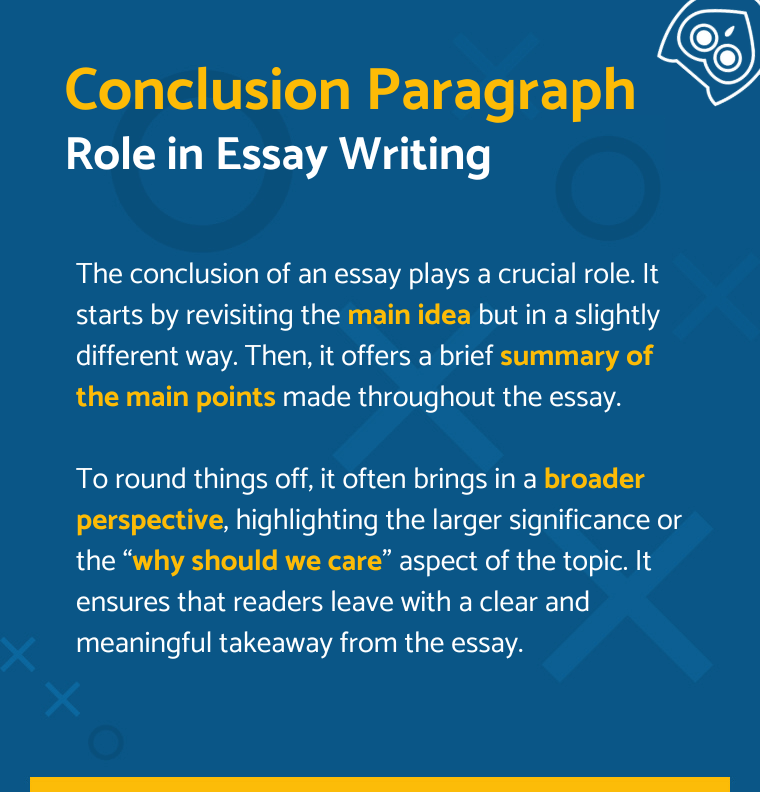
The conclusion paragraph summarizes the essay’s main points and restates the thesis to provide closure. Understanding what is a conclusion in an essay helps clarify its role for readers.
Your conclusion is your final word. The last thing readers remember. It’s where you tie everything together and remind people why your essay matters.
Think of it as the bow on a gift — it signals you’re done, and you’ve delivered something complete.
A strong conclusion does three things:
- Reinforces your main arguments.
If you made specific points in your body paragraphs, now’s the time to echo them. Not word-for-word is just enough to jog memory.
Your closing sentence should clearly highlight your core insight or main argument. Use concluding statement examples to make it memorable.
- Creates a lasting impression.
Your intro hooks readers. Your conclusion seals the deal. I tell students constantly: your ending is what sticks.
A forgettable conclusion means a forgettable essay. Make it count.
- Provides real closure.
Readers need to feel like the essay is finished. No loose ends. No unanswered questions (unless you’re deliberately leaving one for effect).
A solid conclusion wraps up your central idea cleanly and confidently.
Proven Strategies for Strong Conclusions
Knowing how to write a conclusion for an informative essay is helpful for any type of paper.
To craft an effective summary paragraph, restate your thesis and synthesize key ideas without a simple recap.
Also, there’s no universal template for conclusions. What works depends on your topic, your argument, and your essay type.
That said, I’ve found several strategies that consistently produce strong endings.
Let me walk you through them!
Restate your thesis (but make it fresh)
Always circle back to your thesis statement.
Just don’t copy-paste it word-for-word. Rephrase it so it feels new. This reminds readers of your essay’s core message without boring them.
Using a conclusion outline can help organize your thoughts.
Synthesize ideas instead of just summarizing
Here’s where most students really mess up. A conclusion isn’t a recap. It’s a synthesis.
Take the ideas you explored and show how they connect or point somewhere new.
Merge perspectives. Offer a unique takeaway. Show you’ve actually thought deeply about the topic.
This is part of learning how to make a conclusion paragraph that adds value.
Drop a thought-provoking question
Questions stick in people’s minds. A well-placed question at the end can turn a decent conclusion into a memorable one.
Just make sure it’s relevant and open-ended, so no simple “yes or no” answers.
Here’s what works:
- Keep it on-topic. Your question should tie directly to your argument.
- Avoid yes/no answers. Make readers think, not just nod.
- Don’t go too broad. Stay focused on your essay’s theme.
- Use prompts like “Imagine if…” or “What if we considered …”
- Ask one powerful question, not five weak ones.
- Let readers sit with it. Don’t answer your own question immediately.
End with a quotation
A great quote can amplify your message powerfully. Choose one that fits your topic perfectly and put it in a good place.
It backs up your point and gives readers something else to think about. This is also a subtle way to learn how to end an essay example well.
Say you wrote an essay about resilience. You might close with:
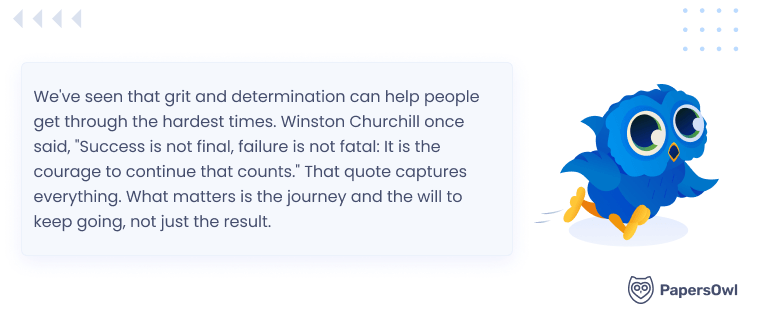
See how the quote doesn’t just sit there awkwardly? It ties directly into the argument and adds real weight.
Point toward future research
If your topic invites more exploration, say so clearly. This works especially well for informative or research-based essays.
It shows you understand the bigger picture and leaves room for further discussion.
Following how to structure a conclusion paragraph helps keep your suggestions clear.
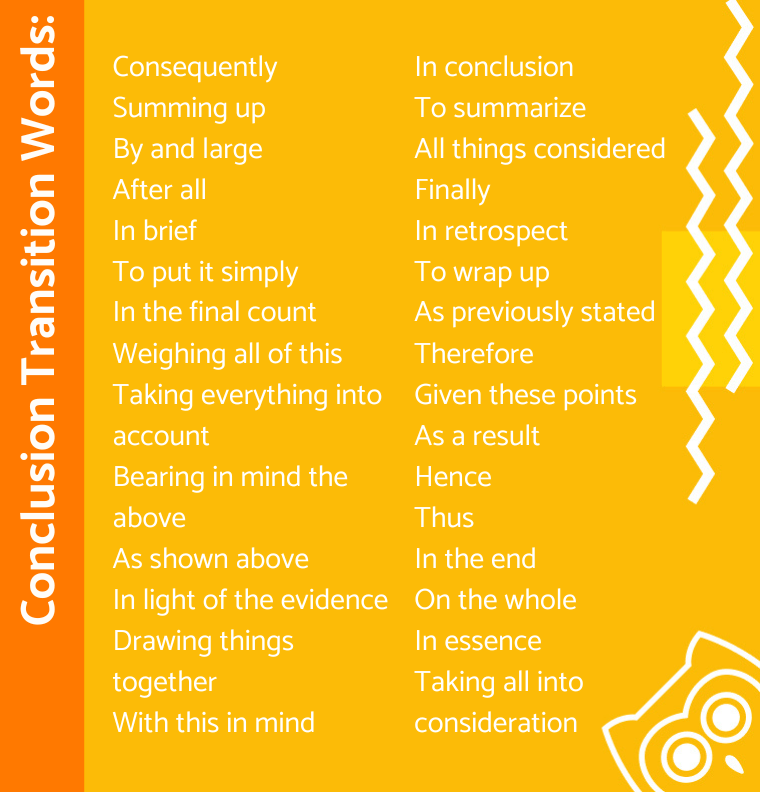
Use natural transitions
Your conclusion will flow better if the transitions are smooth. They connect your ideas without sounding stiff or robotic.
Natural transitions are very important when writing an essay conclusion.
No need for big words; just be clear and have a goal.
Close the Loop
This is one of my favorite ways to do things.
To bring the essay full circle, refer back to something you said in the introduction. It gives readers a satisfying sense of closure and ties the whole thing together perfectly.
Let’s say your intro starts like this:
Then your conclusion might loop back:
Closing the loop makes your essay feel polished and intentional. Readers notice that kind of care.
Another example.
Introduction:
Conclusion:
When you close the loop like this, your essay doesn’t just end — it completes itself naturally.
Now that you know what to do, let’s talk about what to avoid.
What NOT TO DO in Your Conclusion
Avoid introducing new information, clichés, and vague statements in your conclusion paragraph.
Your conclusion should be tight and purposeful.
No rambling. No padding with unnecessary words. I’ve read thousands of student essays, and the same mistakes keep popping up repeatedly.
Here’s what to steer clear of.
- Don’t suddenly add new ideas to your conclusion. It makes readers feel like the essay isn’t really done and makes them confused. Stick to finishing what you’ve already talked about in detail.
- Don’t use tired phrases like “To sum up,” “To summarize,” or “All things considered.” They are boring and don’t add anything. Don’t give away your conclusion with obvious signs that say “I’m ending now!” Let it speak for itself.
- Don’t be vague. Every sentence should be clear and direct. Vague conclusions feel weak and unconvincing. Be specific. Be confident. Show readers you know exactly what you’re talking about.
- Don’t undermine yourself with phrases like “I might be wrong, but…” or “This is just my opinion.” You’ve spent the entire essay building an argument carefully, so own it. Confidence matters more than you realize.
- Avoid weak endings or unsupported claims. Your final sentence should hit hard. Make it count. And ensure every claim you include is backed by what you’ve already written. No weak endings. No random statements that come out of nowhere without support.
Writing a conclusion can feel overwhelming. You want to get it right, but you also just want to be done already.
If you’re stuck, you can always get expert help with your essay and let someone with experience handle the heavy lifting. Sometimes that’s the smartest move you can make.
Real-World Conclusion Examples
Here is an example of a strong conclusion paragraph structure that effectively closes the essay.
Examples help clarify things quickly. Let me show you what polished conclusions actually look like in practice.
These aren’t textbook samples — they’re real-world closings that work.
Example 1:
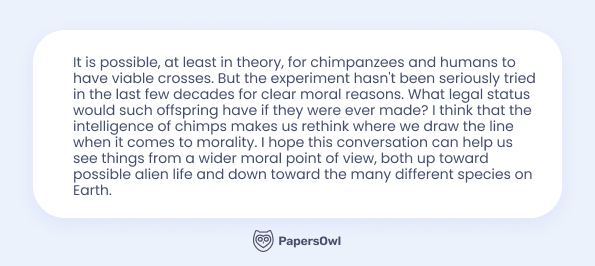
This conclusion restates the main question, gives a personal opinion, and points to bigger issues. It doesn’t just sum things up; it makes you think deeply.
Example 2:
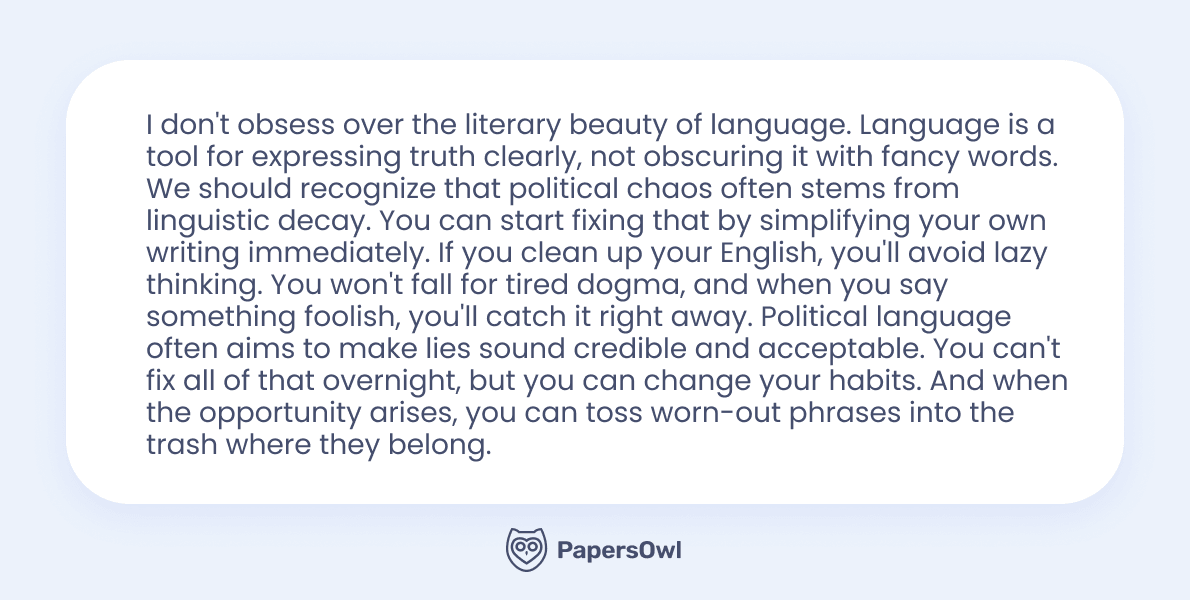
This example uses first-person voice, direct language, and a clear call to action. It’s personal, confident, and memorable. That’s what makes it stick.
Bringing It All Together
Every part of your essay matters. Your conclusion is the most important part because it’s the last thing readers experience. Get it wrong, and your entire essay feels incomplete and unsatisfying.
If writing conclusions still feels challenging or overwhelming, that’s completely normal. You can always reach out for professional help.
Our team will match you with an expert who can guide you or handle the conclusion for you. All you need to do is trust the process and meet your deadline!