
To format an essay, use 1-inch margins, double spacing, a readable 12-pt font, and 0.5-inch paragraph indents, then follow the citation rules of your assigned style — APA, MLA, or Chicago.
All essays also follow the same a core structure: introduction → body → conclusion, regardless of which style guide you use.
In short:
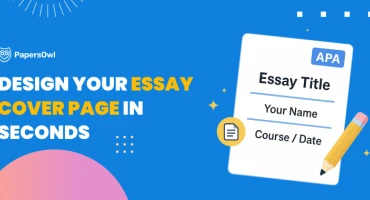
- APA → Used in social sciences; requires a title page, year-focused parenthetical citations, and a clear structure that follows the standard APA essay format.
- MLA → Used in humanities; no title page unless required, author–page citations, simple layout.
- Chicago → Common in history and arts; uses either footnotes (NB) or author-date citations; title page usually required in Chicago style papers.
Different essay types (argumentative, expository, narrative, analytical, cause-and-effect, compare/contrast) use variations of the intro-body-conclusion structure depending on purpose.
Page numbers go in the upper right-hand corner (APA/MLA), and every style requires consistent citations with a reference/bibliography page in alphabetical order.
Special structures like IMRaD, Toulmin, Rogerian, and compare–contrast models help organize complex academic writing when a straightforward structure isn’t enough.
For college applications (Common App), keep formatting simple — no headers, no title page, no academic citation styles unless necessary.
Before submitting, review margins, spacing, fonts, titles, page numbers, citations, and paragraph flow to ensure your essay is polished and professional.
APA vs MLA vs Chicago
| Element | APA (7th Edition) | MLA (9th Edition) | Chicago (17th / Turabian 9th) |
|---|---|---|---|
| Fonts | 11 Calibri / 11 Arial / 12 Times New Roman / 10 Lucida Sans / 11 Georgia | 12 Times New Roman / readable | 12 Times New Roman / recommended |
| Spacing | Double | Double | Double |
| Margins | 1 inch all sides | 1 inch all sides | 1 inch all sides |
| Header / Page Number | Page number top-right; no running head for students | Last name + page number top-right | Title page unnumbered; first page of text numbered “1” |
| Title Page | Required (student version centered) | Usually not required | Required (optional in some assignments) |
| In-text / Footnotes | (Author, Year) | (Author page) | NB: superscript numbers + footnotes; Author-Date optional |
| List of References | References (hanging indent) | Works Cited (hanging indent) | Bibliography or References |
| Preferred For | Social sciences, psychology | Humanities, languages, literature | History, arts, philosophy |
Definition of a Perfect Essay Format
Students find the proper essay format time-consuming since various options and standard essay examples exist. Common essay format types you’ll need to master are:
- Argumentative;
- Narrative;
- Comparison;
- English basics.
PapersOwl knows it can be tricky to figure out how to write an essay. That’s why we’ve compiled this how-to guide to ensure you are prepared for any type of academic work, even when you decide to use a write my paper for cheap service for a college application essay or research paper!
These guides will instruct you on the following:
- How to title your papers;
- How to format an essay;
- Have font requirements;
- Reference your sources;
- Plan a good essay outline;
- And many other things;
Some writing formats for essays may carry a particular theme or style to support the goal and include specific sections to meet your essay formatting requirements.
There are several aspects of the structure to discuss, so let’s dive right in!
Essay Format Structure
Essays and research papers must follow the standard introduction, body, and conclusion format.
In the opening of your essay, the goal is to establish what you will discuss, making it easy to follow. It should include the hook and the background information! Most introductions will conclude with a thesis statement that encapsulates the body of your paper.
- In the first paragraph, introduce your subject and include a thesis statement!
- The body of your paper may differ. Research papers, for instance, will include information related to the methods and results of your work. Typical academic essays have three body paragraphs highlighting a few points supporting your thesis.
- All academic papers must conclude with a summary of the body and a few key points to take away. The conclusion ties together the arguments in the body paragraphs and restates the thesis in light of the evidence presented.
When plotting out the different essay formats, there are some tricks to improve your workflow:
- Using lists is a great way to break up long-winded text into scannable information that jumps out to the reader. Lists are also good for highlighting the main points.
- Write the primary headings first: an introduction, thesis statement, body of your essay, and conclusion.
- You can also use lists to set definitions.
- It is essential to provide a terminology list to ensure that everyone in your audience is informed and can understand the terms you are using. This is vital when writing college essays for money. It helps ensure that your audience can follow along, regardless of their level of expertise.
- Identifying complex terms and providing concise explanations prevents miscommunication, ensuring your reader fully grasps your argument. This is crucial if you publish your essay on social media platforms or must comply with formal MLA guidelines for academic submissions.
- To create a terminology list, identify any terms that may be unfamiliar to your reader and briefly explain each. This will help avoid confusion and ensure that your message is communicated effectively.
Alternative Essay Structures
While traditional introduction–body–conclusion organization works for most types of essays, some college writing formats require specialized structures to strengthen clarity, focus, and purpose.
IMRaD Structure
Common in scientific and technical disciplines, IMRaD is ideal when your goal is to present measurable findings, experiments, or data-driven insights.
Use IMRaD when your assignment involves reporting procedures, describing research steps, and interpreting results. Its basic requirements include:
- Introduction: Defines the problem and establishes focus.
- Methods: Explains what you did so readers can replicate the process.
- Results: Objectively present data without interpretation.
- Discussion: Interprets the results, connects them to the broader field, and suggests future work.
This structure keeps ideas clear and ensures each subsequent paragraph builds logically on the previous one.
Argumentative Models
For an argumentative essay, two respected frameworks help you convince readers:
Toulmin Model
Best for academic debate, policy issues, or analytical topics. Basic scheme:
- Claim (your position).
- Data (evidence).
- Warrant (why the evidence supports the claim).
- Backing (support for the warrant).
- Rebuttal (acknowledging opposing claims).
- Qualifier (limits of your argument).
Choose Toulmin when your topic sentence must assert a strong stance supported by logical reasoning.
Rogerian Model
Best when the subject is sensitive, personal, or polarizing. Short scheme:
- Present the opposing viewpoint fairly.
- Show understanding of shared concerns.
- Introduce your perspective.
- Propose a compromise or balanced solution.
Use Rogerian structure when your aim is not confrontation but cooperation — especially useful in effective essays dealing with social issues.
Compare/Contrast
When analyzing two subjects, you’ll typically choose one of two organizational patterns:
Block Method
You discuss Subject A entirely, then shift to Subject B on a new page or in a clear next paragraph.
Template:
- Introduction.
- Body Paragraphs on Subject A.
- Body Paragraphs on Subject B.
- Conclusion.
This method works well when each subject requires a detailed explanation or when using figurative language to describe contrasting perspectives.
Point-by-Point Method
You alternate between the subjects in each paragraph. Template:
- Introduction.
- Paragraph 1: Point 1 (A vs B).
- Paragraph 2: Point 2 (A vs B).
- Paragraph 3: Point 3 (A vs B).
- Conclusion.
Choose this format when the comparison depends on direct, side-by-side evaluation.
Common Essay Types
Understanding different types of essay formats helps you decide what is standard essay format for your specific assignment.
Below are concise definitions, the typical structure, and one sample thesis for each. These follow guidance from major university writing centers (Harvard, UNC, Purdue OWL).
Argumentative Essay
- Definition: Presents a strong claim and uses evidence to defend it.
- Structure: Introduction with claim → body paragraphs with evidence and counterargument → conclusion.
- Example Thesis: Social media improves civic participation by increasing political awareness among young voters.
Expository Essay
- Definition: Explains a concept or process clearly and objectively.
- Structure: Topic sentence → explanation → examples → brief concluding remark.
- Example Thesis: Renewable energy systems reduce long-term environmental impact by lowering carbon emissions and operational waste.
Analytical Essay
- Definition: Breaks a text, idea, or problem into parts and evaluates how they work together.
- Structure: Introduction → analytical claims → evidence with analysis → conclusion.
- Example Thesis: Shakespeare uses weather imagery to intensify Macbeth’s psychological descent.
Narrative Essay
- Definition: Tells a story to illustrate a theme or personal insight.
- Structure: Scene-setting introduction → chronological events → reflection.
- Example Thesis: My first day in a computer science lab taught me the value of persistence and problem-solving.
Compare/Contrast Essay
- Definition: Examines similarities and differences between two subjects.
- Structure: Block method or point-by-point (depending on clarity).
- Example Thesis: Online learning and traditional classrooms both support academic growth, but they differ in flexibility, interaction style, and cost.
Definition Essay
- Definition: Explores a complex term or concept beyond its dictionary meaning.
- Structure: Term introduction → historical/academic perspectives → real-world examples.
- Example Thesis: “Success” in college is less about grades and more about developing resilience and time-management skills.
Cause-Effect Essay (Effect Essays)
- Definition: Explains the reasons something happened or analyzes its consequences.
- Structure: Causes first → effects next, or vice versa.
- Example Thesis: Excessive screen time contributes to decreased sleep quality, reduced attention span, and higher stress levels.
Extended Essay (IB Style)
- Definition: A long, independent research project requiring argument, analysis, and citing sources.
- Structure: Abstract → introduction → research methodology → analysis → conclusion.
- Example Thesis: Machine-learning optimization improves energy efficiency in autonomous systems.
Essay Format Requirements
Getting used to essay formatting styles takes time – be patient! We’ve broken down some of the common requirements that vary by discipline. Below are some typical formatting elements that are compliant with the APA or MLA essay format.
Warning : We’re talking about standard five paragraph essays here – intro, body, and conclusion – so don’t get too caught up in the detail.
- Size of paper: Your essay length is going to be given to you in a word count. In business, a standard page is 500 words, but in academia, a page is usually a mere 275 words if the text is double-spaced.
- Font type and font size: We recommend sticking with a 12 point Times New Roman font – it’s the usual choice, and you’ll see this referred to in different style guides as the “suggested” font. Do yourself a favour and check what your university wants.
- Spacing: As both APA and MLA dictate double-spaced text you ‘ll see why the average word count per page is so low. It makes it a lot easier for your professor to scribble away in the margin and leave notes galore.
- Margins: Both of these formats require one inch margins all around the page.
- Header: Now, MLA doesn’t get hung up about what you put at the top of the page, but APA does expect a running head. That’s just a shortened title (under 50 characters) and a page number.
We’re also going to go through each style guide individually. First up is MLA format.
Formatting styles can be tough to get your head round. Trying to picture an MLA essay format in your head can be really tricky, so we do recommend grabbing a few examples to look at before you attempt to craft your own.
When formatting an essay in MLA style, it’s essential to ensure you match the format. Follow these rules:
- Font Size: 12pts Times New Roman
- Spacing: Use double spaces. No double spacing between paragraphs.
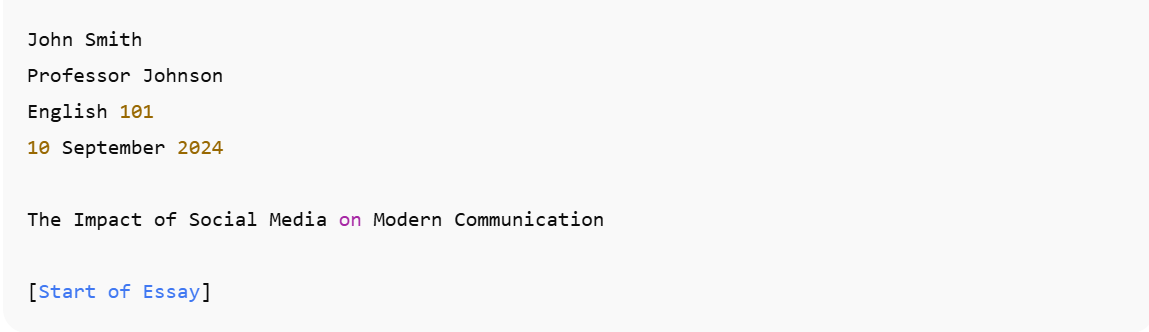
- Heading: Put the heading on the first page of the essay. Your essay prompt, your name, your Professor’s name, your class for this essay, and the date.
- Margins: The top, bottom, left, and right margins of the page must be one inch.
- Page Numbers: Add the header to write your last name and the page number.
- Title: Format it by entering the title centered and above the first line of your paper.
- Indentation: A half inch, and you can press “tab” to indent with each new paragraph.
- Align: Alignment is to the left side of the page and even throughout.
MLA and APA Essay Formats: Differences
Now we will discuss the formatting styles of the Modern Language Association (MLA) and the American Psychological Association (APA). Both formats share many similarities and have the means to cite references. However, there are also differences. Let’s review the correct format for your college essay.
The critical difference is that the APA format is concerned with the sequence of events. You’ll find the APA citation is stricter regarding dates. This is because, in the social sciences, research can be rendered obsolete.
Imagine a study on homosexual relationships from the 19th century, for example. Academic writing formats from this period differ, and as a result, readers may be led on a hunt for information that isn’t relevant. Adding the date of publication helps fellow scholars reference the modern era.
MLA format, on the other hand, considers essay formats to be timeless, focusing on the author and the location. This is typical for English-format scholarly articles. Much literature is considered timeless, and little significance is given to the era in which it was written.
APA 7 Essay Format
APA is commonly used in the social sciences, psychology, and education. This format emphasizes the timeliness of sources and a clear structure for research papers.
General Guidelines
- Running head / Header: Student papers do not require a running head unless requested by an instructor. Page numbers appear at the top right of every page.
- Font: Use an accessible font, such as 12-point Times New Roman, 11-point Calibri, 11-point Georgia, 10-point Lucida Sans Unicode, or 11-point Arial.
- Spacing: Double-space all text, including references — no extra spacing between paragraphs.
- Margins: 1-inch margins on all sides.
- Paragraphs: Indent the first line 0.5 inch.
- Alignment: Left-align text; do not justify.
Title Page (Student Version)
- Title: Centered, bold, and in title case on the upper half of the page.
- Author Details: Include your full name, institutional affiliation, course number, instructor name, and submission date.
- Page Number: Top-right corner, beginning with page 1.
In-Text Citations
- Use parenthetical format: (Author, Year).
- Include page numbers for direct quotes: (Smith, 2022, p. 45).
- Use in-text citations to direct readers to the References page.
References Page
- Begin on a separate page at the end of your essay.
- Arrange entries alphabetically by author’s last name, using a hanging indent.
- Include all sources cited in-text with full publication information.
Example Reference Entries:
Brown, T. (2024). Cognitive health and social media. Academic Press.
Johnson, M. (2022). Social media and cognitive development: A review. Journal of Educational Psychology, 45(2), 123-134.
Smith, J. (2023). Attention and overload: The cognitive impact of social media. Cognitive Science Review, 12(4), 567-580.
Example Thesis (Argumentative Essay)
Social media improves civic engagement among young adults by increasing political awareness and participation.
MLA Essay Format
Modern Language Association is commonly used in humanities, English, and literature studies. Unlike APA, MLA emphasizes author attribution and timeless relevance over publication dates.
General Guidelines
- Header: Last name + page number in the top-right corner of every page.
- Font: Use 12-pt Times New Roman (or other readable fonts).
- Spacing: Double-space the entire essay; do not add extra spaces between paragraphs.
- Margins: 1-inch margins on all sides.
- Paragraphs: Indent the first line 0.5 inch.
- Title: Centered, in title case on the first page; do not bold, italicize, or underline unless referencing another work.
- First Page Details: Include your name, instructor’s name, course number, and date in the upper-left corner. No separate title page is required.
In-Text Citations
- Use brief parenthetical references with the author’s last name and page number: (Smith 23).
- Direct quotes, paraphrases, and summaries must include page numbers when available.
- Citations direct readers to the Works Cited page at the end of the essay.
Works Cited Page
- Begin on a separate page at the end of your essay.
- Double-space all entries with a hanging indent.
- Arrange entries alphabetically by author’s last name.
- Include all sources cited in-text.
Example Works Cited Entry:
Smith, John. The Digital Age of Communication. Harvard University Press, 2022.
Example Thesis (Argumentative Essay)
The rise of social media has transformed modern communication by increasing connectivity while simultaneously challenging privacy and critical thinking.
Chicago Essay Format
Chicago style is widely used in the humanities, history, and arts, and it offers two distinct citation systems: Notes & Bibliography (NB) and Author-Date. Select one system for your essay and use it consistently throughout.
General Guidelines (Both Systems)
- Font: 12-pt Times New Roman or another readable font.
- Spacing: Double-space the main text; single-space block quotations, footnotes, and bibliography entries.
- Margins: 1-inch margins on all sides.
- Paragraphs: Indent the first line 0.5 inch.
- Page Numbers: Top-right of each page (except the title page if using NB).
- Title Page: Required for formal essays; include the essay title, your name, course, instructor, and date, centered on the page.
Notes & Bibliography (NB) System
- Citations: Use superscript numbers in the text that correspond to footnotes or endnotes.
- Footnotes/Endnotes: Provide full bibliographic details the first time a source is cited. Subsequent citations can use a shortened form.
- Bibliography: Separate page at the end, alphabetically by author’s last name, with hanging indents.
Example Footnote (NB):
- John Smith, The Digital Age of Communication (Cambridge: Harvard University Press, 2022), 45.
Example Bibliography Entry (NB):
Smith, John. The Digital Age of Communication. Cambridge: Harvard University Press, 2022.
Author-Date System
- Citations: Include the author’s last name and publication year in parentheses in the text: (Smith 2022, 45).
- Reference List: Place at the end of the essay; list entries alphabetically by author’s last name. Include full publication details.
Example In-Text Citation (Author-Date):
(Smith 2022, 45)
Example Reference List Entry (Author-Date):
Smith, John. 2022. The Digital Age of Communication. Cambridge: Harvard University Press.
Example Thesis (Argumentative Essay)
Social media reshapes historical narratives by amplifying the voices of marginalized individuals while challenging traditional sources of authority.
Minor Accuracy Rules Frequently Asked
- APA: Use one space after a period (unless your instructor requires otherwise).
- MLA: Header includes last name + page number; double-spaced text with 1″ margins.
- Chicago: Page numbering — do not display the number on the title page; the first page of text usually has an Arabic “1”; explain options based on Turabian or instructor requirements.
ASCII Layouts for MLA, APA, and Chicago
MLA First Page — ASCII Layout

Paragraph Template (MLA):
Topic sentence → context → evidence (short quotes) → analysis → transition.
APA 7 Student Title Page — ASCII Layout

Paragraph Template (APA): Topic sentence → define key term → summarize study/theory → analyze significance → cite sources (author, year).
Chicago NB First Page — ASCII Layout

Paragraph Template (Chicago NB): Topic sentence → historical context → evidence with footnote → interpretation → link to broader argument.
College Essay Formatting Tips
College application essays follow a different logic than academic essay style format rules.
While MLA or APA title page format matters in school assignments, the Common App focuses on clarity, readability, and storytelling — especially if you are writing a narrative essay. Below are practical tips for both pasting text into the Common App editor and uploading a file.
If You Paste Into the Common App Text Box
The text editor is limited, and many academic features from an MLA format essay or APA paper will not transfer perfectly.
- Tabs and indents don’t work. Begin each paragraph with a clear first word that visually signals a new section.
- Italics and bold text sometimes disappear; re-add formatting using the built-in toolbar.
- Preview before submitting. Check that paragraph spacing, direct quotes, and line breaks still appear correctly.
- Pre-clean your text in Notepad (Windows) or TextEdit (Mac) to remove hidden formatting that may break the layout.
- Avoid complex formatting, such as block quotations — simplify for readability.
If You Upload a File
When uploading, treat the essay like a polished school assignment — but without the academic extras.
- Use school-standard formatting:
- 12-pt readable font
- 1-inch margins
- 1.5–2 line spacing
- No headers or footers with your full name, student ID, or course number.
- File name: Use simple, hyphenated names (e.g., CommonAppEssay-JSmith.pdf). Avoid spaces.
- Keep citations minimal. If you must reference sources, follow a simple alphabetical order in a short list — you do not need to use American Medical Association style, MLA, or Chicago style.
- This is not the place for formal academic structures. Although there are many types of essays, your application essay should focus on voice and clarity, rather than rigid structure.
Common App Checklist
Before submitting, confirm:
- Paragraph spacing looks clean in preview
- No tabs/indentation were lost
- Special characters display correctly
- The essay answers the prompt clearly
- Each paragraph opens with a strong topic sentence
- Word count fits the 650-word limit
- No stray academic elements (page numbers, headers, running heads, etc.)
- Formatting supports storytelling rather than strict academic rules
Mini-FAQ: Common App Formatting
Do I need a title in the Common App essay?
Usually no. Most students skip the title to save word count and start directly with a compelling opening line.
Should I cite sources as I do in school essays?
Rarely. If you must cite, brief in-text attribution is enough. A full MLA or Chicago bibliography is unnecessary.
Can I use different types of essay formats?
Yes — as long as the structure enhances your story. Many students use a loose narrative essay structure, but reflective, analytical, or hybrid effect essays also work.
What is the format of an essay for the Common App?
Simple, readable, personal, and clean. School rules do not judge it — it’s judged by clarity and voice.
How to Format a Title Page in an Essay?
The title page is a key element of many academic essays, but requirements vary by style. Below is a clear breakdown for MLA, APA, and Chicago formats.
MLA Format
- Title Page: Not required unless your instructor specifically asks for one.
- If included: Place the following details on the first page of your essay, in the upper-left corner:
- Your full name
- Instructor’s name
- Course number and name
- Date of submission
- Title: Centered above the text in title case. Do not bold, italicize, or underline unless citing another work.
Example (First Page Layout):
APA 7 Format (Student Papers)
- Title Page: Required for all student papers.
- Header / Page Number: Page number in the top-right corner. The running head is optional and is only included if requested by the instructor.
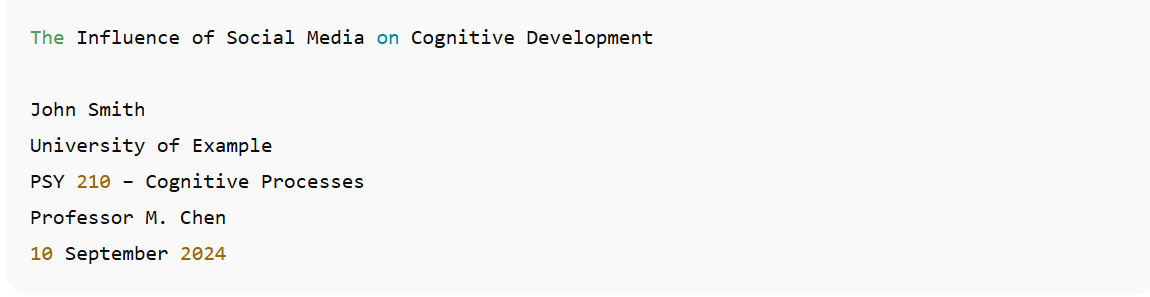
- Center of Page: Include the following details, centered in the upper half of the page:
- Title of the paper (bold, title case)
- Author’s name
- Institutional affiliation
- Course number and name
- Instructor’s name
- Submission date
Example Title Page:
Chicago 17th / Turabian 9 Format
- Title Page: Required for formal essays and research papers.
- Pagination: Title page unnumbered; first page of text usually starts at 1 (confirm with instructor).
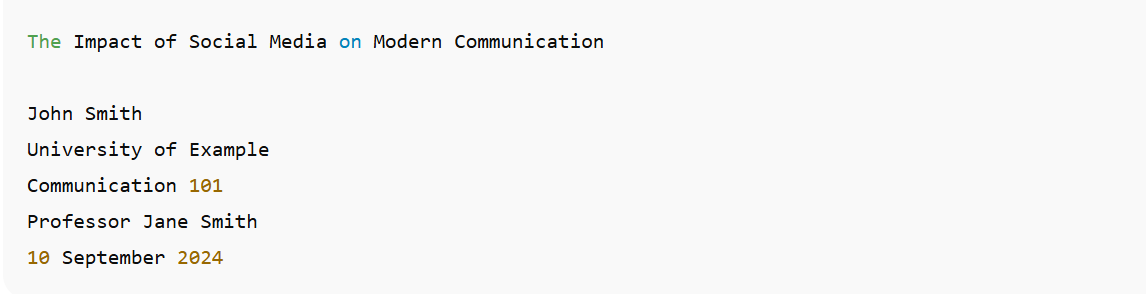
- Format: Similar to APA — include the essay title centered on the page, followed by your name, course, instructor, and date, each on separate lines.
Example Title Page:
Different Fonts in Essay
It is essential to use the correct font! When selecting your font, ensure it complies with the academic paper format. We may highlight any points we want to reinforce or use italics to make words stand out.
For instance, according to the APA style guide, you should use italics for the work titles and never use quotation marks.
You should also be careful with bold-faced text and reserve it for your paper’s organizational headings. You may also use italics when using technical words where the meaning of a word may be confused.
Citing Sources in an Essay
Depending on your paper, you may need to reference various resources. Your text should always identify the content owner whenever possible. Here are some examples of citations in APA format:
How to format song titles in an essay?
Songwriter F.M. (Copyright year). Song title [Recorded by F.M. Last (performer’s name/musical group)]. On Album title [Medium of recording]. City, State of label: Record label name.
Turner, T. (1987). Where do we go? [Recorded by Tina Turner]. On Cassette Tape. Los Angeles, California: Do Right Records.
Format of movie titles
Producer, A. (Producer), & Director, A. (Director). (Release Year). Title of motion picture [Motion Picture]. Country of Origin: Studio
Roanoke, J. (Producer), & Mills, A. (Director). (2004). First Strike [Motion Picture]. United States: Miramax
Citing the title of a book in your essay
Last, F. M. (Year Published) Book. City, State: Publisher
Cortez, H. (1967). The Liquidators. New York, NY: Penguin House.
Format a poem
Cleveland, J. (1972). To the state of love or the senses festival. In H. Gardner (Ed.), The metaphysical poets (pp. 218-220). Harmonsworth: Penguin
Hardy, T. (1930). The collected poems of Thomas Hardy (4th ed.). London: Macmillan
Play title format
Playwright last name, First initial. (Year published). Play title. In Editor’s first initial. Last name (Ed.), Publication Title (Page numbers). Publication City: Publisher.
Miranda, L. (2016). Hamilton: an American musical. In J. McCarter (Ed.), Hamilton: the revolution (pp. 11-18). New York: Grand Central Publishing
How to Format Quotes in Essay?
Formatting quotes is another excellent resource for your paper essay writing format. When referencing other research, you can include direct quotes and cite them properly to give your work more authority.
APA and MLA differ in their methods for quotes in an essay, so be sure to look at examples before writing your perfect academic essay. Short quotes in MLA format should be enclosed in quotation marks, indicating the author and page number.
With APA, you should not use quotes and italicize the text with a lead-in statement, as Jones stated in a 2009 direct quotation.
In conclusion, understanding essay formatting styles is a large part of the university experience. Follow the advice in this guide to improve your skills and get better grades.
Feel free to use this essay format example as a template when asking yourself how to format an essay. You’ll get started quickly and have more time to fine-tune your work.
Moreover, here, you can find original essays for sale written by professional writers ready to help you with your academic needs. In the end, if you need a hand, professional writers for hire are here to serve your academic needs.
Pre-submission Checklist
Learning how to format essays correctly saves you time later. Instructors notice when a paper looks neat and follows style rules. A clean layout also helps your ideas stand out.
Before sending your essay, pause for a moment. A few quiet minutes can save you from losing marks for simple mistakes. Here’s a concise list to help you double-check every detail. It works for any format of essay and aligns well with most academic standards.
- Margins: Use 1-inch margins on all sides. This rule applies across APA, MLA, and Chicago formats.
- Spacing: Keep the entire paper double-spaced, including block quotes and the reference list.
- Font: Choose a readable font, such as 12-point Times New Roman or 11-point Arial. Avoid playful fonts — they distract.
- Header: Include your last name and page number in the upper right corner. MLA and Chicago usually require this.
- Indentation: Start every new paragraph with a 0.5-inch indent. This signals clear transitions between ideas.
- Title Page:
- APA: needs a title page with running head, title, and author details.
- MLA: no title page unless your instructor asks for one.
- Chicago: optional, but use it for formal research papers.
- Page Numbers: Begin numbering from the first page of text. Do not restart numbering at the bibliography.
- Headings: Follow the system required by your style guide — APA has five levels, MLA usually none, and Chicago is flexible.
- Citations: Keep citation style consistent. Don’t mix MLA in-text with Chicago footnotes.
- Reference Titles: Use the right label — “References” for APA, “Works Cited” for MLA, and “Bibliography” for Chicago.
- Spaces After a Period: In APA, one space after a period; MLA and Chicago accept one or two, but stay consistent.
- Alignment: Left-align the text. Avoid full justification — it can create uneven spacing that distracts readers.
- Paragraph Flow: Read one paragraph, then the next paragraph aloud. The rhythm should sound natural, not abrupt.
- Main Points Check: Make sure every section supports your thesis. Trim sentences that drift away from the focus.
- Proofread: Read backward from the last sentence to the first. It helps you catch typos that your eyes skip over.