
For years, I’ve been teaching students how to write a good body paragraph. What I’ve learned is that using big words to impress people isn’t the point. It’s about making things clear, organizing them, and keeping your reader interested from start to finish.
Putting sentences together isn’t all there is to writing an essay.
The body paragraphs are the main part of your argument. They make your thesis stronger and show that you’re not just giving your opinion.
- A body paragraph expands on one main point that backs up your thesis with proof and analysis.
- To start a body paragraph, think of it as a flexible foundation you can adjust to meet your needs. Start with a clear topic phrase that summarizes your key idea and connects to your thesis.
- For each paragraph, try to write 5–7 sentences or about 100–150 words.
- Body paragraph format: Topic sentence → Supporting details → Evidence → Concluding sentence.
- Common mistakes: adding irrelevant information, insufficient evidence, and awkward transitions.
Purpose of a Body Paragraph
A body paragraph has one key point that backs up the thesis of your essay.
Think of your essay as a house:
- The introduction is your foundation.
- The conclusion is your roof.
- Body paragraphs? They’re the walls holding everything up.
Each paragraph focuses on one part of your topic. It provides proof, examples, or analysis that supports your main point.
Regardless of the specific topic, the goal remains the same: keep your reader’s attention as you move from point A to point B.
Indeed, readers stay interested when the body paragraph is well-organized. It makes a strong case for your thesis without going into too much detail.
Key Elements in the Structure of a Body Paragraph
A typical body paragraph consists of a topic sentence, supporting sentences, evidence, and a concluding sentence.
Let me break down how to write a body paragraph:
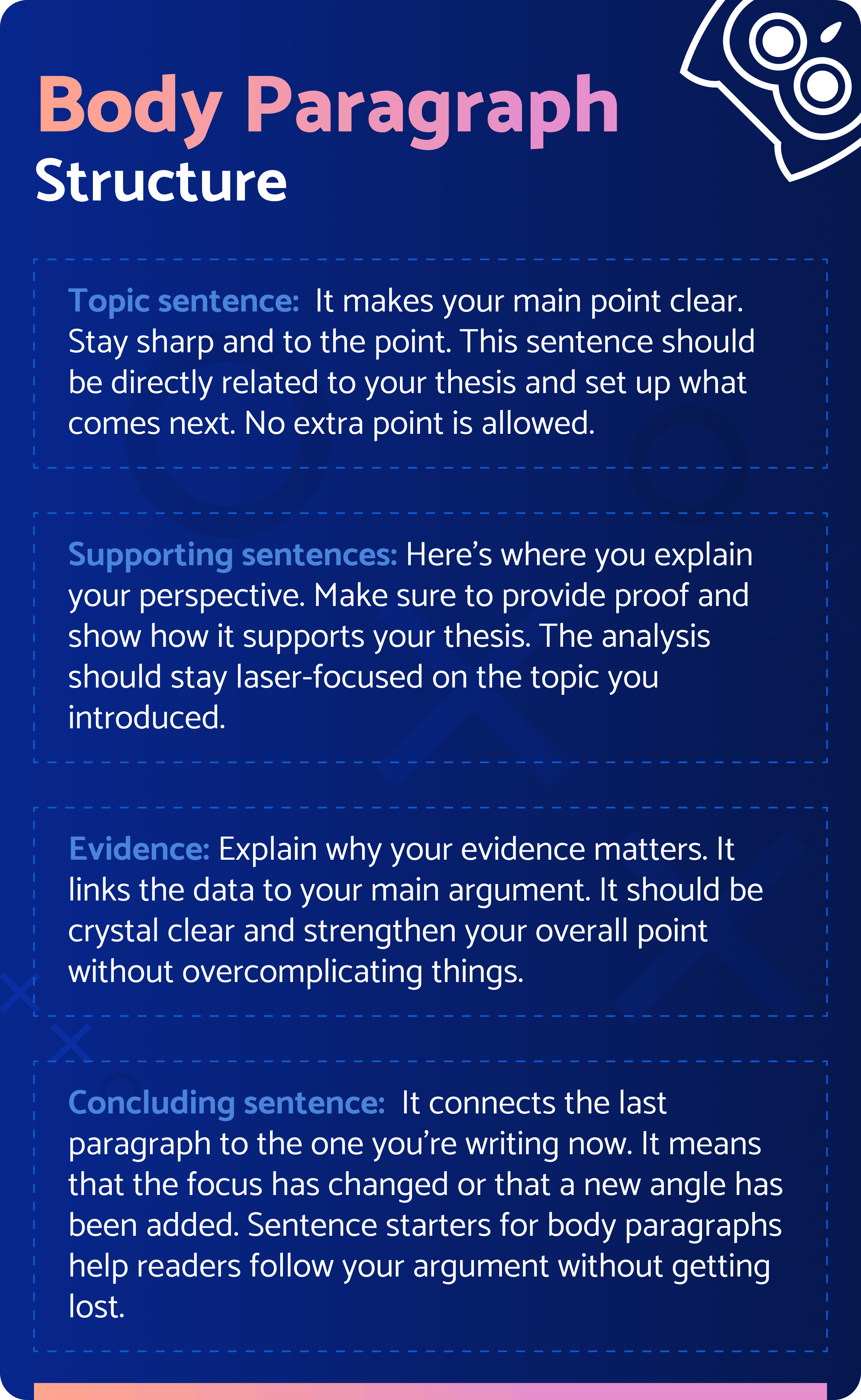
I’ve seen too many students treat this essay body paragraph structure like it’s set in stone. But you shouldn’t — it is a flexible framework that you can change to meet your needs.
Topic sentence
How to write a topic sentence for a body paragraph?
It is one of the smartest ways to start a body paragraph. As a rule, it should be a focused statement that captures your main argument in a single sentence.
It connects your introduction paragraph in the essay with your thesis and provides a roadmap for what’s ahead. You can often grab attention immediately by posing a question.
Supporting sentence
Add information that supports your main idea after your topic sentence. These give proof and analysis to support your main point without going off on a tangent.
Make sure they are clear and to the point. Use language that is easy to understand; don’t use a lot of jargon unless your audience asks for it.
Evidence
This is your proof. Facts, statistics, quotes, or examples all work here, depending on your topic.
Make sure your data is reliable and relevant.
Research-based proof helps convince readers that your position holds water. Don’t just drop a quote and run — explain why it matters and how it ties to your argument.
Concluding sentence
This ends your paragraph and moves on to the next one. I advise you to end each paragraph with a sentence that summarizes the main point and leads into the next paragraph.
Think of it as the mic-drop moment before you pivot to your next point. It keeps the flow smooth and logical.
This way, you don’t let plagiarism ruin your grade!
Transition Sentences of a Body Paragraph
Transition words connect ideas smoothly between paragraphs and sections.
I can’t repeat this enough: transitions are what hold your article together. Use them carefully; otherwise, your writing will sound jagged and disjointed.
Here are three main types you must know:
1. Bridging the introduction to body paragraphs
- To begin with
- Initially
- As an introduction
- Turning to
- Now that we’ve established
2. Connecting body paragraphs
- Furthermore
- What’s more
- Additionally
- Similarly
- Likewise
- Another key point
- Besides that
- On top of that
3. Linking the final body paragraph to the conclusion
- Finally
- To sum up
- Ultimately
- Concluding
- To wrap things up
- As a final point
- All things considered
These words help your reader understand what you’re saying. Use them to start a body paragraph to make your ideas clear and interesting without sounding like a robot.
How Do You Write a Body Paragraph of an Essay?
To write a body paragraph, start with a clear topic sentence followed by supporting details, and end with a conclusion.
How long should a body paragraph be? Try to write 5–7 sentences or about 100–150 words. That’s enough room to examine one idea without losing your reader’s interest or making them bored.
Here’s my step-by-step approach:
| Action | Key Instructions |
|---|---|
| 1. Start with a concise topic sentence. | Be clear, direct, and specific. Your reader should get what you’re going to talk about right away. It should support your idea as well. Use appropriate body paragraph sentence starters. |
| 2. Add supporting sentences. | Add further information and analysis to support your main claim. Use facts, figures, expert opinions, or instances that are important. Make sure the information is correct and helpful. Don’t just add random things to fill space; make sure they relate to your topic. |
| 3. Use transition words. | Connect your thoughts to the paragraphs before and after them. Transitions let readers follow your primary point without getting lost or confused. |
| 4. Keep your language simple. | Don’t use big words or technical terms that can confuse your audience. Be clear when you write a body paragraph. It’s always preferable to be clear rather than to be complicated. Remember, simple doesn’t mean dumbed down — it means accessible and precise. |
| 5. End with a conclusion sentence. | It should summarize your main statement and offer a smooth transition to the next section. This sentence wraps up your point and prepares readers for what’s coming next without leaving them hanging. |
Essential Tips to Write Flawless Body Paragraphs
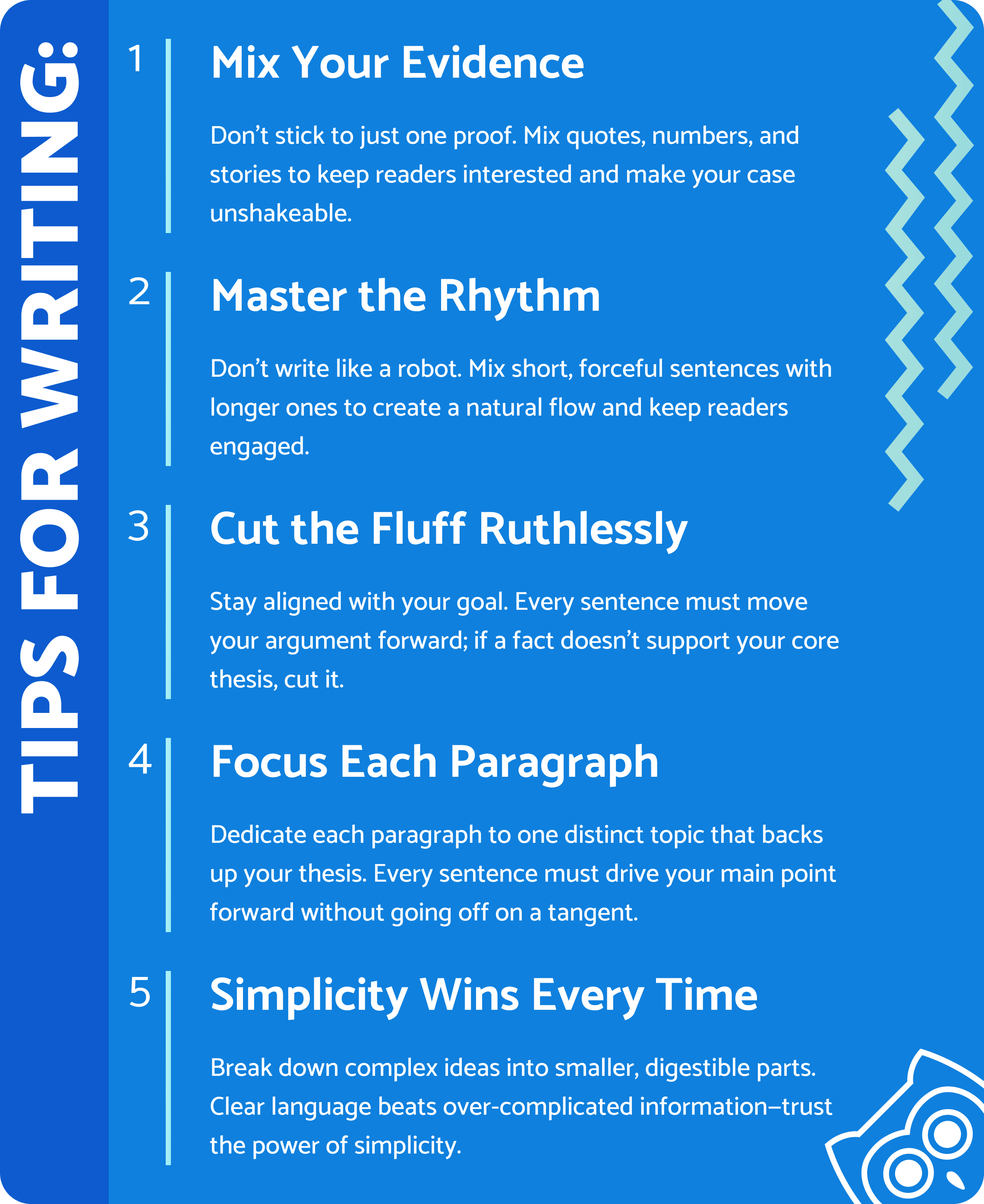
Use varied evidence, sentence structures, and maintain focus to write effective body paragraphs.
Here are my best tips for writing body paragraphs that work:
Essay Body Paragraph Example
Here is an example illustrating how to structure a body paragraph effectively. Let me show you what a solid body paragraph looks like in action:
Notice how each sentence builds on the last? That’s the magic of a well-constructed paragraph in action.

Conclusion
Learning how to write a good body paragraph is what makes great essays stand out from the rest. I’ve given you the tools you need to make your writing work: structure, evidence, transitions, and clarity that actually work.
These tips will help both new and experienced writers.
When you write, keep in mind that a well-organized body of an essay helps you get your point across clearly, keep readers interested, and convince them of your point of view without overwhelming or confusing them.
Now put everything you’ve learnt to use. With each try, your writing will get better and better!