

Learning how to write a good topic sentence for an essay changed my entire approach to academic writing. It’s the single skill that separates organized, persuasive essays from wandering, unfocused ones.
Your topic sentence sets the direction. It tells your reader what’s coming next.
Without it, paragraphs drift off course. With it, your writing stays sharp and focused.
Let’s jump in!
- A topic sentence clearly states the main idea of a paragraph. It's your reader's guide to what each section covers.
- Effective topic sentence ideas are clear, relevant, complete, and engaging, and they capture attention without causing confusion.
- There are three types of topic sentence: interrogative (asks a question), reinforcement (supports your thesis), and transitional (connects paragraphs smoothly).
- Keep it brief: aim for 25-40 words, typically one to two sentences maximum.
- Position matters, so the start of the paragraph usually works best, though middle- or end-placement can create stylistic impact.
What Is a Topic Sentence?
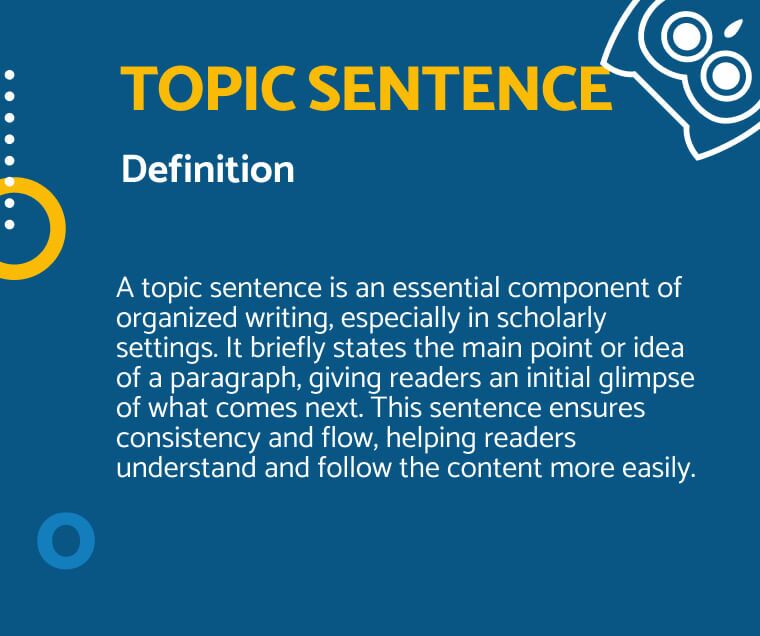
A topic sentence clearly states the main idea of a paragraph and guides the reader through your essay.
Think of it as your paragraph’s announcement. It tells your reader: “Here’s exactly what this section will cover.”
Now, here’s where many writers get confused. A topic sentence isn’t the same thing as your thesis statement. Your thesis covers your entire essay’s central argument and sits in the introduction.
A topic sentence? That’s for one specific paragraph.
Let me break down the difference:
| Thesis Statement | Topic Sentence |
|---|---|
| Covers your entire essay | Covers one paragraph |
| Located in the introduction | Located in body paragraphs |
| Broad, overarching argument | Focused, specific point |
I recommend thinking of your topic sentence as having two essential parts: the topic (what you’re discussing) and the controlling idea (your specific angle on it).
Example of topic sentence:
Topic: Remote work
Controlling idea: Increases productivity for tech professionals
Topic sentence: Remote work increases productivity for tech professionals by eliminating commute time and offering schedule flexibility.
See how that works? You immediately understand the paragraph’s direction.
In my experience, a strong topic sentence accomplishes two goals. First, it creates a clear roadmap for your reader.
Second, it keeps you focused as the writer. Without it, paragraphs tend to wander into unrelated territory.
What Makes a Topic Sentence Effective?
An effective topic sentence is clear, relevant, complete, and engaging to capture the reader’s attention.
I’ve written (and rewritten) thousands of paragraphs throughout my career. What separates weak topic sentences from powerful ones?
Four essential traits.
1. Clarity
Your reader shouldn’t need to decode your meaning. A good topic sentence is direct and specific.
Avoid vague language or jargon that muffles your point.
Weak:
Strong:
Notice the difference? The strong version tells you exactly what to expect.
2. Relevance
Stay on topic with what your paragraph will talk about. Don’t say one thing in your topic sentence and then switch to something else.
If your topic sentence says you’ll talk about how social media affects teens’ mental health, don’t suddenly start talking about Instagram algorithms without making a direct link between them and teen health.
3. Completeness
Here’s where it gets challenging. Your topic sentence needs to express a full, standalone thought.
I tell my students to try this test: extract every topic sentence from your essay and read them in sequence. You should get a solid summary of your complete argument.
4. Engagement
How to make a good topic sentence? Make it worth your time to read.
Add a surprising fact, a strong statement, or interesting data. Don’t make your reader bored right from the start.
Boring:
Engaging:
See how the second version grabs attention? That’s what you’re aiming for.
Types of Topic Sentences
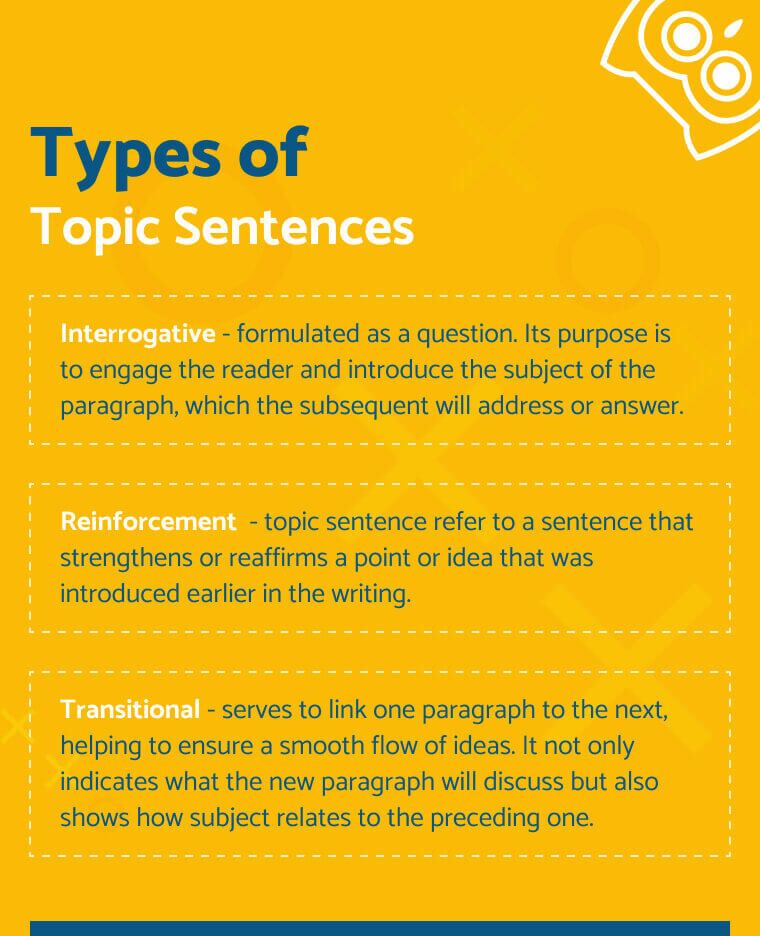
There are three main types of topic sentences: interrogative, reinforcement, and transitional. Each serves a unique purpose.
You don’t need to stick with one type throughout your entire essay. Mix them strategically based on what each paragraph needs.
Interrogative
This type opens with a question. The rest of your paragraph delivers the answer.
I love using interrogative topic sentences to immediately hook attention. Questions naturally spark curiosity. They pull readers into your argument.
Example:
Topic: Fast fashion
Topic sentence: What changes must the fashion industry make to stop environmental destruction?
Just remember: never leave the question hanging. Answer it clearly and directly in your paragraph.
Otherwise, you’ve just frustrated your reader.
Reinforcement
This kind of support goes directly against your thesis statement. It shows that you are not veering off track and that you are building your main argument step by step.
Example:
Thesis statement: The growth of AI will lead to the creation of thousands of new jobs.
Topic sentence: AI specialists will be in high demand as companies increasingly adopt automation tools.
This approach keeps your essay cohesive. Your reader sees you’re staying focused on your central message. Each paragraph feels like it’s advancing your argument forward.
Transitional
Transitional topic sentences make it easy for paragraphs to flow into each other. They connect ideas in a logical way.
Example:
Last sentence of previous paragraph: School uniforms are still a hot topic of debate after decades of discussion.
Topic sentence: Uniforms help students stay focused by getting rid of distractions that have to do with how they look.
Do you see the link? You’re making your thoughts flow logically.
This method makes your essay feel more like a whole than a bunch of separate parts.
How to Write a Good Topic Sentence or 8 Steps to Follow
How to write a topic sentence for an essay? Focus on clarity, conciseness, and include a controlling idea.
Here’s my step-by-step process. I’ve refined this approach over years of writing and teaching, and it consistently works.
Step 1. Identify the paragraph’s main idea
Before writing anything, ask yourself: What is this specific paragraph actually about?
Let’s say you’re writing about renewable energy. What precise angle are you covering? Wind power efficiency? Solar installation costs? Government incentive programs? Battery storage technology?
Get laser-focused on one specific point.
Here’s my test: If I extracted all your topic sentences and read them consecutively, would they form a clear outline of your essay?
If not, your topic sentences need refinement.
Step 2. Keep it brief
I understand the temptation to pack everything into that opening sentence. Resist it.
A topic sentence is used to bring to a paragraph a clear main idea that guides the reader through the rest of the content.
A topic sentence should be one to two sentences maximum. Usually 25-40 words. Anything longer loses its punch. Your reader’s attention span is limited. Respect that reality.
Too long:
Better:
See the dramatic difference? Get to your point quickly.
Step 3. Choose the right position
Most of the time, I place my topic sentence at the beginning of the paragraph. It’s the safest, clearest approach. Your reader knows immediately what’s ahead.
Sometimes, though, I’ll position it in the middle or at the end for deliberate stylistic effect.
Middle placement works when you need to establish context first. You provide background information, then reveal your main point.
End placement works when you want to build suspense or deliver a powerful conclusion. You guide your reader through evidence, then land your key insight.
Example (end placement):
The topic sentence lands at the end — and it creates a stronger impact because of the buildup.
Step 4. Make it interesting without overcomplicating
Here’s where I see writers frequently stumble. They try too hard to sound sophisticated and end up sounding robotic instead.
Add a hook when possible. A striking statistic. A bold assertion. A surprising fact.
Something that makes your reader lean forward with interest.
Don’t twist yourself into linguistic knots, though. Simple and strong consistently beats complex and confusing.
Overcomplicated:
Simple and strong:
Which would you rather read? Be honest.
Step 5. Use active voice
Passive voice kills writing momentum. It makes your prose feel distant and lifeless. Academic in the worst possible way.
Passive:
Active:
The active voice is punchier. It’s clearer. It keeps your reader awake and engaged.
I recommend scanning your topic sentences specifically and rewriting any that rely on passive constructions. You’ll notice an immediate improvement in your writing’s energy level.
Step 6. Back it up with evidence
A topic sentence sets expectations. Thus, your supporting sentences must deliver proof.
If your topic sentence claims, “Electric vehicles significantly reduce carbon emissions,” the rest of your paragraph needs hard data, concrete examples, or expert testimony to support that assertion.
Otherwise, you’re making empty claims.
I always include at least one solid piece of evidence per paragraph. Statistics work exceptionally well. So do case studies, research findings, or expert quotes.
Whatever you choose, make certain it directly supports your topic sentence.
Step 7. Repeat keywords or phrases
I got this idea from poetry. Repetition, strategically used, creates a rhythm and strengthens your main point. It makes the paragraphs flow together perfectly.
If your last paragraph ended with “educational equity,” start your next one with the same phrase. It creates an echo that strengthens the flow.
Example:
Do you see how that echo works?
It’s not obvious, but it makes your essay feel much more connected.
Step 8. Use transition words
Transition words are absolute lifesavers. They signal logical shifts and keep your essay moving smoothly from one idea to the next without jarring interruptions.
You may ask how to start a topic sentence. Start your topic sentences with words like:
- “Now,”
- “What’s more,”
- “Actually,”
- “On the other hand,”
- “The reality is,”
- “Here’s the thing:”
- “Consider this:”
These small linguistic connectors make an enormous difference. They guide your reader through your argument without creating awkward transitions.
7 Examples of Topic Sentences
Here are practical examples of topic sentences to help you understand their structure and use.
I’ve pulled these from actual writing scenarios. Notice how each one immediately establishes the paragraph’s direction.
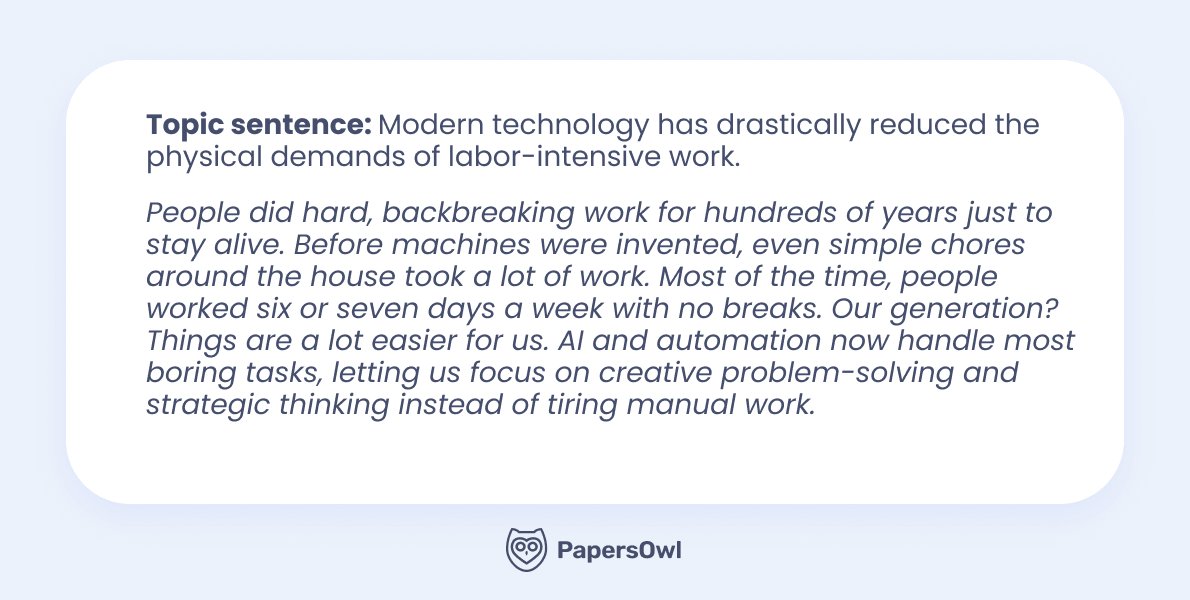
Example 1. Technology and work
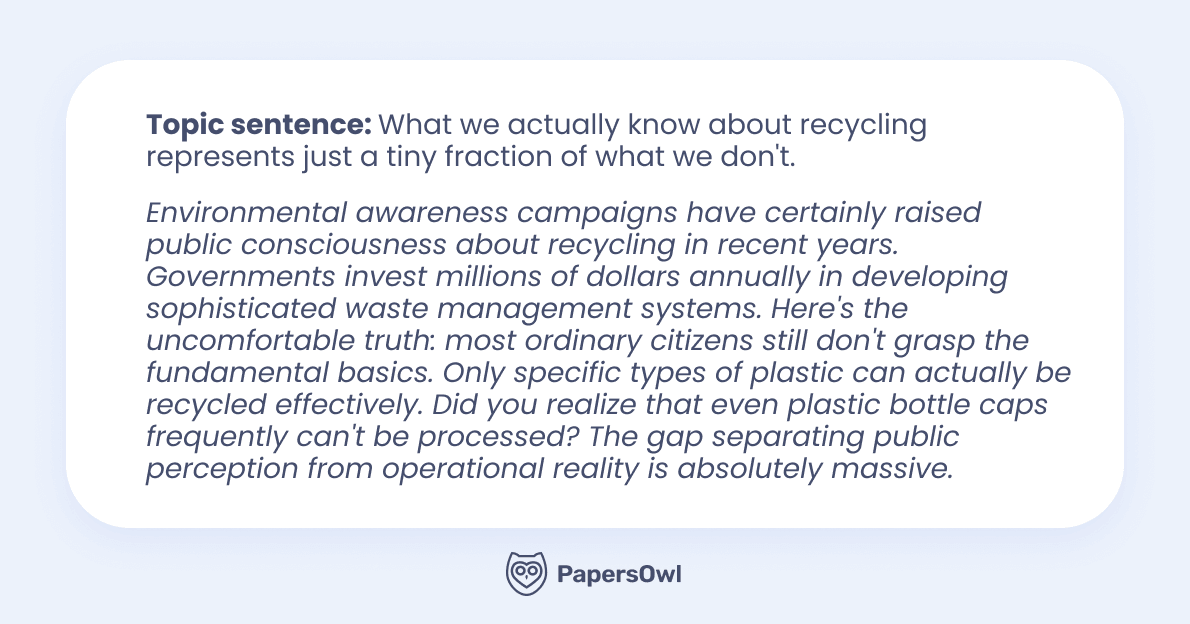
Example 2. Recycling misconceptions
Example 3. Digital society

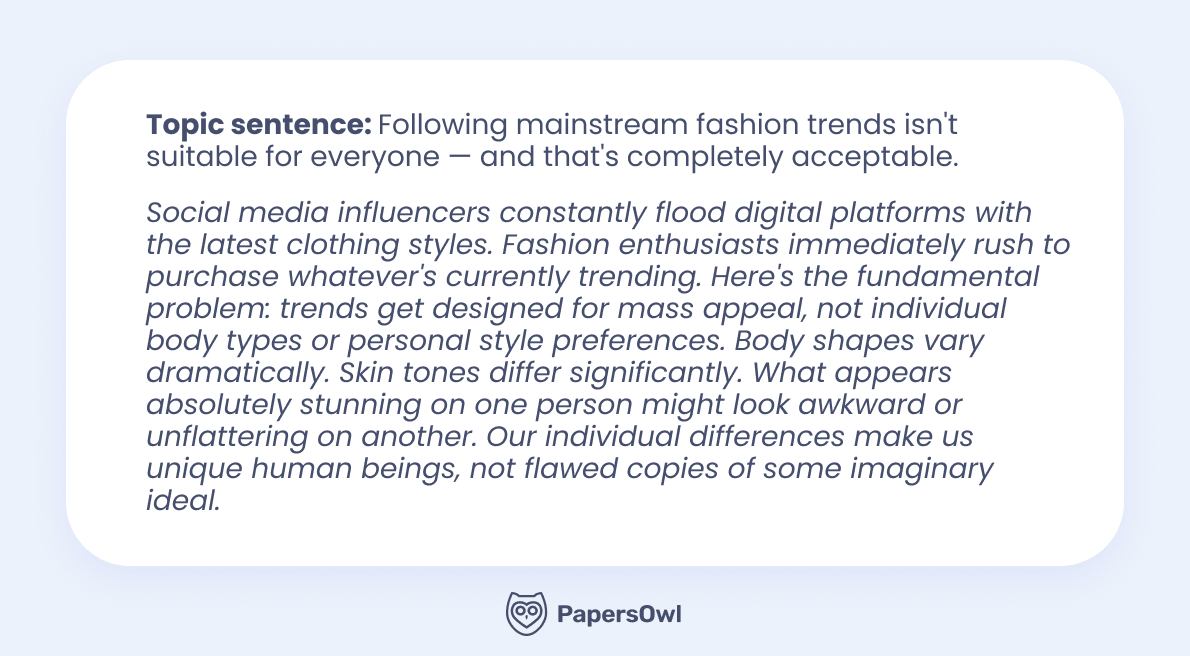
Example 4. Fashion trends
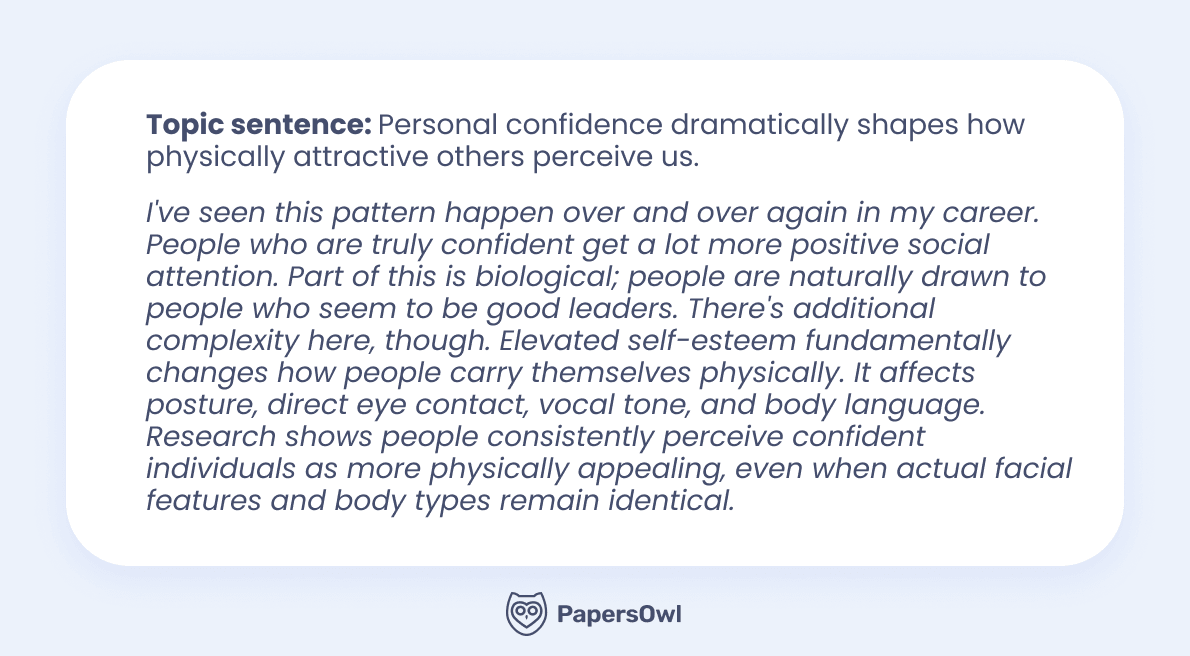
Example 5. Confidence and attraction
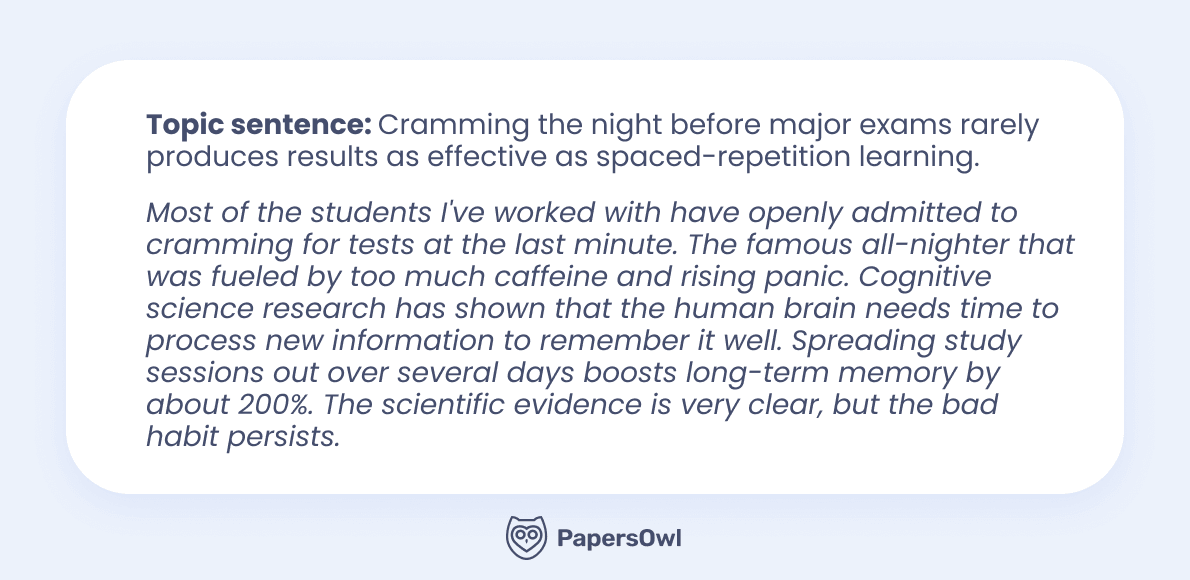
Example 6. Study habits
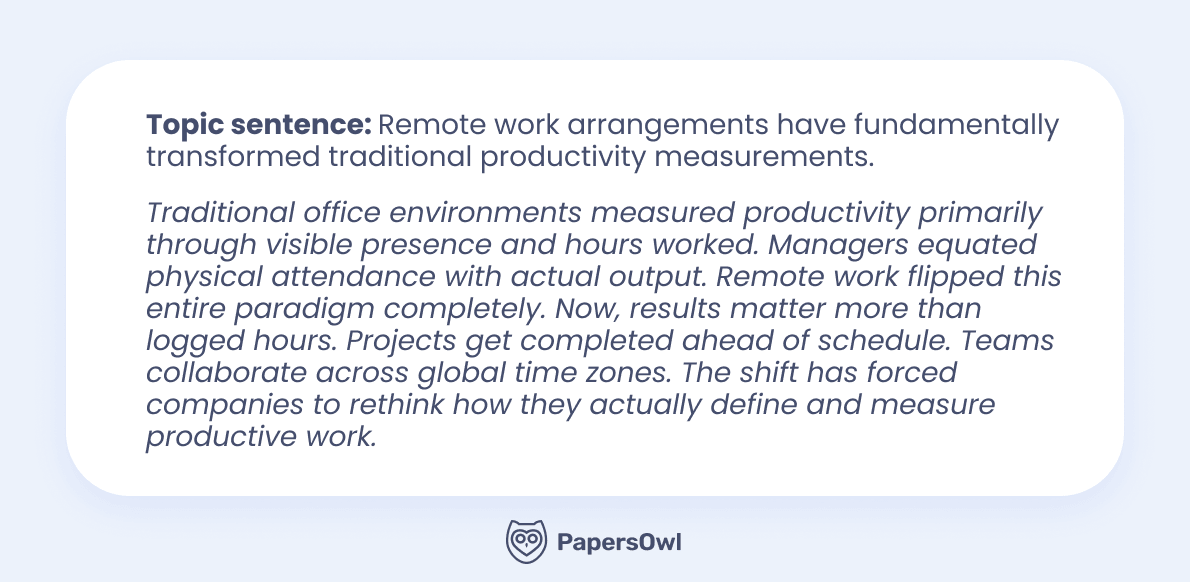
Example 7. Remote work productivity
Finally, Why Do Topic Sentences Matter in Every Paragraph?
Your creative ideas form the heart of academic writing. Without proper topic sentence structure, though? Those brilliant ideas get completely lost.
Readers lose track of your argument. Your persuasive power evaporates. That’s why:
- Topic sentences provide essential structure.
- They organize complex thoughts into digestible sections.
- They guide readers smoothly from one point to the next without confusion or frustration.
Think about it this way:
- your essay is a carefully planned journey;
- your thesis statement is the final destination.
Your topic sentences?
They’re the detailed turn-by-turn directions that successfully transport your reader there.
The bottom line: topic sentences aren’t optional decorative flourishes. They are critical parts of the structure.
Once you master this basic technique, your writing will be much clearer, crisper, and more convincing right away!