
To understand how to write an informative essay, begin with a focused subject, explain it objectively, and organize credible evidence around a clear thesis without trying to persuade the reader. Research the topic, prepare an outline, develop each body paragraph with facts and explanation, then revise and cite the final draft.
This guide also covers informative essay types, audience-specific requirements, examples, and self-assessment criteria.
What Is an Informative Essay?
When dealing with an informative essay, you should know its main features.
The purpose of an essay is not to persuade an audience by adding interesting information. Instead, its focus is on educating a reader on a specific topic by offering a how-to, analyzing data, and comparing controversial viewpoints about a particular topic (Purdue OWL, “Expository Essays”).
Additionally, other types of essays can be quite similar to informative ones. It is crucial to differentiate between them and point out their specific features (UNC Writing Center, “Understanding Assignments”).
Variations of an Informative Essay
In academic practice, many essays can also be classified as informative. It happens because they share the same goal: to communicate information to their audiences (Purdue OWL, “Common Types of Writing Assignments”).
They include the following:
- Expository Essay;
- Narrative Essay;
- Cause-and-Effect Essay;
- Process Essay;
- Compare-and-Contrast Essay;
- Descriptive Essay;
- Problem-Solution Essay.
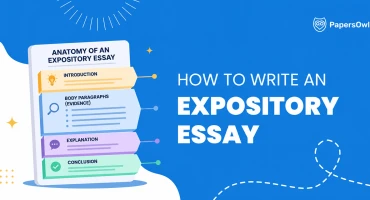
Expository Essay
This essay type is almost identical to informative essays. Their similarity lies in their purpose — to provide readers with information.
However, while writing an expository essay, you must add supporting evidence to explain specific points, which goes beyond providing readers with information.
Narrative Essay
A narrative essay aims to inform readers about a specific topic in a comprehensive manner. Typically, such an essay is used to uncover a single theme.
A narrative essay is informative, as it is not focused on convincing the audience about a point.
Cause-and-Effect Essay
This essay focuses on describing how a cause occurs and what effect it might have on another thing. Therefore, it is considered informative if it discloses the main idea of the similarities connecting two things.
However, this essay must determine a cause or effect. It is also considered an argumentative essay.
Process Essay
The name of a process essay tells itself. It is used to uncover a detailed description of the operational mechanism of something. That’s why it is also considered informative. While writing this type of essay, you must clarify each step comprehensively (UNC Writing Center, “Transitional Words and Phrases”).
Compare and Contrast Essay
A compare and contrast essay focuses on differentiating and highlighting the likenesses between multiple subjects.
In other words, it could be either an argumentative or informative essay depending on the essay’s motive.
For instance, “The similarities and differences between football and basketball” is an informative essay. On the other hand, “Why is football better than basketball?” is an argumentative essay.
Descriptive Essay
In a descriptive essay, you need to provide an accurate description of the topic’s object. It can be everything: a situation, a particular person, an occasion, and so on.
While writing a descriptive essay, you must make it realistic enough to capture the reader’s imagination. This essay could either be written to give information or with an eventual objective.
Problem-Solution Essay
Such an essay aims to examine a suggested problem and offer several solutions. This essay is informative because it provides several solutions to a raised issue.
However, you will need to apply specific writing tools to convince a reader that one solution is superior to the rest (University of Manchester, Academic Phrasebank).
Thus, all the types of essays mentioned above are informative because of their nature to provide some information.
Of course, what format of the message is used in each kind is another topic for discussion. But if you prefer writing a persuasive essay, you can approach our service and receive an excellent piece of writing.
Select Your Topic
So, how to start an informative essay? Writing an informative essay begins with defining a topic. It is challenging to select a topic, as this essay’s type must be original, impressive, and meaningful.
With this in mind, you should pick a topic that can explain new aspects of known phenomena or innovative approaches used in various life spheres.
Where to Get Informative Essay Ideas?
To ensure you have enough to write about and your paper will be interesting, it’s important to farm out some ideas. Reading the news is a great way to start generating perspectives on an informational topic.
Newsworthy topics will be of current interest and can cover a wide range of subjects. This will help you apply what you see in the real world to the theoretical work you’re putting together.
You can also browse popular sites, such as Quora or Reddit, to see the most frequently asked questions. In our digital age, a wealth of information is available to anyone with an Internet connection.
Good Informative Essay Topics
Now that we’ve identified some methods for generating a good idea, we need to determine which one is the most effective.
First, ensure that sufficient information is available for research. If your topic is too narrow or outdated, you’ll have trouble finding credible sources to give weight to your position. On the other hand, if your topic is too broad, you won’t be able to dive into specifics to present anything worthwhile.
I, Pencil: My Family Tree as Told to Leonard E. Read (L. Read, 1958). In this informational topic, the simple process of making a pencil had a significant influence on the leading economists of the day. Analyzing the ways and means we do things, no matter how basic, can bring much value to the academic community.
Informative essay topics can help you write a college essay by informing you of the essential facts, ideas, and arguments. Furthermore, they provide an opportunity to think critically, organize a topic from multiple perspectives, and develop an argument that will help you write a compelling and convincing college essay.
If you need guaranteed quality and persuasive content, hiring professional college essay writers is often the best choice for a crucial application essay.
Moreover, an informative essay topic can allow you to learn about a range of topics, making it easier for you to connect new information to the topic and use it to formulate your essay.
How to Start Conducting Research?
Like any other essay, you must gather the required information for your work through research.
Creating a concept map that incorporates words and phrases related to your central topic is a good idea. This will help you stay focused on the main aspects of your paper (UNC Writing Center, “Brainstorming”).
Ensure you only use reliable websites, books, and articles to impart accurate information. Also, it is useful to note valuable citations and research details, so as not to overlook important facts. As soon as you have all the material wrapped up, it is time to structure it and bring it into a presentable form.
7 Steps to Write an Informative Essay
Choose a Focused Topic
Before writing, define a clear and manageable subject. A focused topic prevents your essay from becoming too broad or superficial.
How to narrow down a general idea:
- Technology → The impact of AI on college learning
- Health → Benefits of Mediterranean diet for heart health
- History → Causes of the fall of the Roman Republic
A strong topic guides your research and keeps your informative essay purposeful.
Research & Evaluate Source Quality
Informative essays depend on accurate, verifiable information. When researching, prioritize reliable sources such as:
- Peer-reviewed journals
- Academic books
- Government or educational websites
- Credible news outlets
Avoid personal blogs, unverified statistics, and opinion-based sources. Take structured notes as you research — highlight definitions, evidence, quotes, and data you may use later.
Build an Outline
Creating an informative essay outline helps you organize ideas logically and maintain smooth transitions.
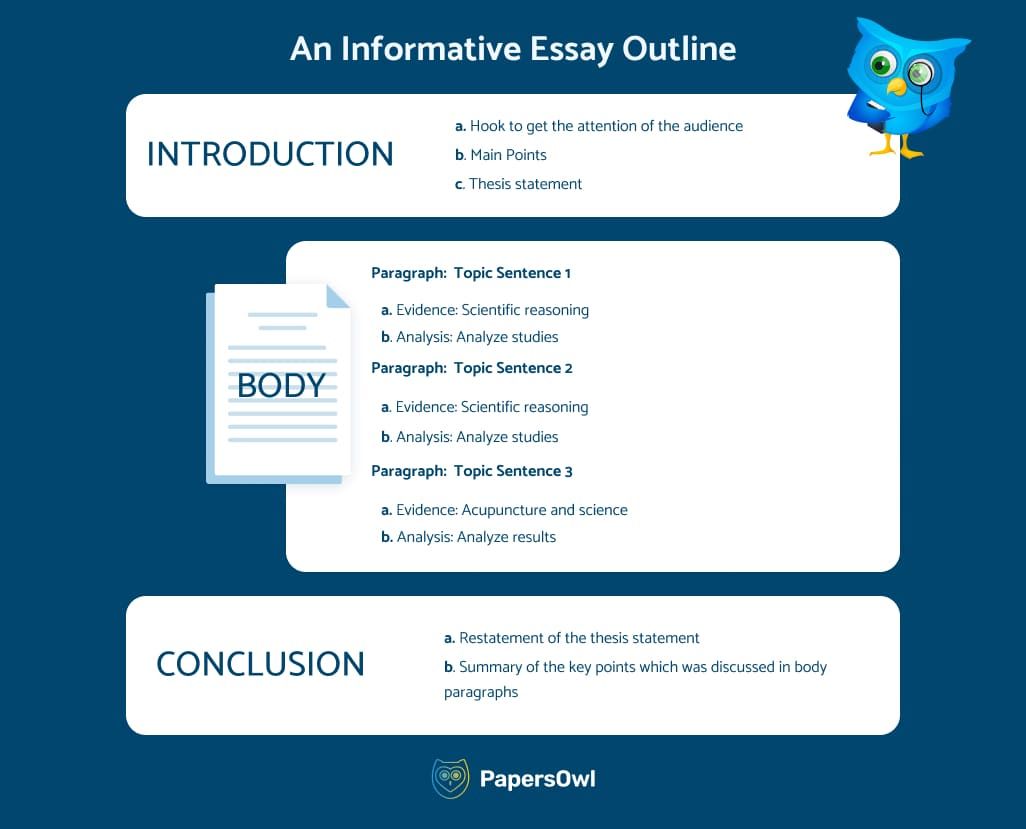
A simple 5-paragraph outline might look like this:
- Introduction
- Hook
- Background context
- Thesis statement
- Body Paragraph 1 → Main point + evidence
- Body Paragraph 2 → Main point + evidence
- Body Paragraph 3 → Main point + evidence
- Conclusion → Restate thesis + final insight
Having an outline before writing saves time and reduces the need for major revisions.
Draft the Introduction
An effective informative essay introduction sets the stage for your topic. Use this structure:
- Hook – something that grabs interest
- Bridge – general background connecting the hook to the thesis
- Thesis – the central idea you will explain
Examples of hooks:
- Statistic: “Over 60% of college students now rely on digital tools for daily learning.”
- Question: “Have you ever wondered why some study methods work better than others?”
If writing feels overwhelming, you can always ask for help and say, “write my essay please.”
Write the Body Paragraphs
Each body paragraph should explain one main idea supported by credible evidence. Use the TEEL model:
| T | Topic Sentence – Introduce the paragraph’s idea |
| E | Evidence – Facts, data, research, examples |
| E | Explanation – Show how the evidence supports the idea |
| L | Link – Transition to the next point |
Keep paragraphs balanced and avoid overloading them with unrelated details.
Conclude Effectively
A conclusion should reinforce, not repeat, what the reader has learned.
- Restate your thesis in fresh wording.
- Summarize the key points from the body.
- End with a final insight or broader implication.
Avoid introducing new information — your goal is to wrap up the essay, not add more topics.
Edit, Proofread & Cite Sources
The final step is polishing your essay for clarity, grammar, and academic accuracy.
Quality checklist:
- Clear, concise sentences
- Logical flow between paragraphs
- Correct grammar and punctuation
- Accurate facts and properly integrated evidence
- Consistent tone and formatting
Citing your sources: Use the citation style required by your instructor.
- MLA: Author + page number
- APA: Author + year
- Chicago: Notes and bibliography
Proper citations protect you from plagiarism and show academic credibility.
Mini-Rubricator for Student Self-Assessment
A quick rubric students can use before submitting their informative essay.
1. Clarity of Purpose:
- Excellent: Purpose is explicit; thesis is precise and easy to identify.
- Satisfactory: Purpose is present but slightly broad or vague.
- Needs Work: The Reader cannot easily determine the essay’s main purpose.
2. Quality of Evidence:
- Excellent: Utilizes credible and diverse academic sources; evidence is well-integrated.
- Satisfactory: Evidence is relevant but limited or inconsistently integrated.
- Needs Work: Sources are weak, outdated, or missing.
3. Organization & Flow:
- Excellent: Paragraphs follow a clear structure; transitions are smooth.
- Satisfactory: Organization is mostly logical with minor gaps.
- Needs Work: Paragraphs feel disconnected; unclear structure.
4. Explanation & Depth:
- Excellent: Ideas are fully explained; analysis deepens the reader’s understanding.
- Satisfactory: Some explanation present, but depth varies.
- Needs Work: Essay reads like a list of facts; little analysis.
5. Mechanics & Formatting:
- Excellent: Few or no errors; style is appropriate; citations are correct (MLA/APA/Chicago).
- Satisfactory: Minor errors but still readable.
- Needs Work: Frequent grammar, punctuation, or citation mistakes.
Writing an Informative Essay for Different Audiences
Informative essays come in many forms depending on the audience’s age, skill level, and expectations.
Although the core informative essay format remains consistent — introduction, body paragraphs with evidence and clear topic sentences, and a conclusion — the level of depth, structure, and research requirements will vary.
Below are guidelines tailored for middle school and high school/college writers.
Middle School (Grades 6–8)
Middle school writers typically use the 5-paragraph model because it provides a simple and clear structure for organizing ideas.
Typical Expectations:
- Length: 3–5 paragraphs
- Structure:
- Intro with a clear main topic
- Three body paragraphs, each with one topic sentence and straightforward examples
- Short conclusion
- Examples: Simple facts, definitions, short explanations
- Sources: Usually optional; if required, 1–2 kid-friendly sources
- Purpose: Explain a concept or event clearly
Middle School 8-Point Checklist:
- Did I clearly state the main topic?
- Does each body paragraph begin with a topic sentence?
- Did I define or explain key ideas?
- Did I give at least one example in each paragraph?
- Is the writing organized in logical order?
- Is my conclusion a summary, not new information?
- Did I check spelling and punctuation?
- Is my writing easy for a classmate to understand?
Middle School Topic Examples:
- How earthquakes happen
- Why recycling matters
- A historical event that changed your city
- How bees help the environment
- The invention of the telephone
High School & College
High school and college students expand beyond the 5-paragraph model and use a more detailed, research-supported structure.
Typical Expectations:
- Length: 1,500–2,000 words (approx. 6–8 paragraphs)
- Structure:
- Extended introduction with context
- Multiple body paragraphs guided by topic sentences
- Evidence from credible sources
- Clear transitions and synthesis of ideas
- Sources: 3–8 scholarly sources (depending on rubric)
- Purpose: Explain a concept, process, theory, or event using research and analysis
Components of an Extended Outline:
- Introduction: Context, thesis, significance
- Body Paragraph 1: Foundational concepts
- Body Paragraph 2: Key evidence or data
- Body Paragraph 3: Explanations, comparisons, or case studies
- Body Paragraph 4: Implications or examples
- Conclusion: Reinforce significance, restate insights
High School/College Topic Examples:
- The neurological impact of sleep deprivation
- How renewable energy technologies work
- The rise and influence of social media algorithms
- The causes and effects of a major historical event
- Informative speech topics for research:
- Artificial intelligence in healthcare
- Water scarcity and global conflict
- Cybersecurity threats in modern society
Examples & Downloads
| Section | What It Should Include | Example Content |
| I. Introduction | Hook, background, thesis statement | Hook: “Most students sleep less than recommended.” Background: Short context on the importance of sleep. Thesis: “Adequate sleep improves memory, concentration, and overall academic performance.” |
| II. Body Paragraph 1 – Explanation of Concept | Define key term(s), present foundational information | Explain what sleep is, its stages, and its role in cognitive health. |
| III. Body Paragraph 2 – Evidence or Effects | Research, statistics, expert findings | Studies show that sleep deprivation lowers GPA and reduces concentration. |
| IV. Body Paragraph 3 – Practical Application | Strategies, examples, actionable steps | Fixed sleep schedule, reduced screen time, improved study habits. |
| V. Conclusion | Restate thesis, summarize key points, final insight | Reinforce that sleep has measurable academic benefits and should be prioritized. |
Tips for Writing an Informative Essay
Provide your plan well, select an appropriate topic, and know the informative essay structure – all these steps will make your essay writing process more manageable.
If you know how to write a 500 word essay, composing a proper informative essay will be easy.
However, we listed some refined tips and techniques to help you in writing a clear, structured, and insightful piece.
Core Tips for Success:
- Dive into the instructions for your assignment and understand the informational essay format.
- Think of a unique essay title and a surprising fact to capture attention.
- Conduct extensive research and include reliable statistics and examples.
- Create an impressive and clear thesis statement that focuses on one main point.
- Prepare an outline before you start writing — plan your introductory paragraph, body paragraph, and conclusion.
- Each topic sentence should connect logically to the background information.
- When analyzing two or more subjects, use comparison and contrast to maintain focus.
- In your body paragraph, provide specific evidence, examples, and analysis for clarity.
- Avoid adding new sentences or claims in the conclusion that weren’t discussed earlier.
Use the TEEL method to organize paragraphs clearly:
- T (Topic Sentence): Present the main idea of the paragraph.
- E (Evidence): Support with data, statistics, or credible sources.
- E (Explanation): Explain how the evidence supports your main point.
- L (Link): Connect to the next paragraph or to your overall argument.
Mini-Guide to Writing a Haiku (Creative Break)
Even academic writers benefit from creative exercises. A haiku can help you practice brevity and focus. Structure: three lines with 5-7-5 syllables. Example:
Facts unfold in light,
Knowledge bridges every mind,
Words bloom into truth.
3 Ways to Connect Paragraphs Smoothly:
- Use transitional words (e.g., furthermore, however, consequently).
- Repeat a key term or idea from the previous paragraph.
- Pose a question or context that the next section will answer.
Safe Paraphrasing Techniques:
- Replace phrases with synonyms while retaining context.
- Change the sentence structure and rephrase the main point order.
- Use your own interpretation instead of copying expressions.
- Always double-check with your sources to ensure accuracy.
Quick Reference Guide on Citations:
- MLA: Author Last Name, First Name. Title of Source. Publisher, Year.
- APA: Author, A. A. (Year). Title of work. Publisher.
- Chicago: Author Last Name, First Name. Title of Book. Publisher, Year.
Sum Up
Knowing how to write an informative essay will be useful to you academically and professionally. Although it may seem difficult, learning the appropriate tips for writing it and utilizing the skills of experts will help you navigate it effectively.
Writing this type of essay requires you to pass information through the reader without persuasion. However, it would be helpful if you learned how to capture readers’ interest using effective thesis statements.
By following these simple insights, you can craft a successful and informative essay.

Works Cited
- Purdue OWL. “Common Types of Writing Assignments.” Purdue Online Writing Lab, Purdue University, https://owl.purdue.edu/owl/general_writing/common_writing_assignments/index.html.
- Purdue OWL. “Expository Essays.” Purdue Online Writing Lab, Purdue University, https://owl.purdue.edu/owl/general_writing/academic_writing/essay_writing/expository_essays.html.
- UNC Writing Center. “Brainstorming.” The Writing Center, University of North Carolina at Chapel Hill, https://writingcenter.unc.edu/tips-and-tools/brainstorming/.
- UNC Writing Center. “Transitional Words and Phrases.” The Writing Center, University of North Carolina at Chapel Hill, https://writingcenter.unc.edu/tips-and-tools/transitions/.
- UNC Writing Center. “Understanding Assignments.” The Writing Center, University of North Carolina at Chapel Hill, https://writingcenter.unc.edu/tips-and-tools/understanding-assignments/.
- University of Manchester. Academic Phrasebank. University of Manchester, https://www.phrasebank.manchester.ac.uk/.