


From artificial intelligence and cybersecurity to renewable energy and autonomous vehicles, this curated practical guide offers topic clusters, writing tips, and everything you need to pick an arguable angle and write a paper that stands up to scrutiny.
Technology doesn’t sit still long enough for most research papers to keep pace. By the time you pick a topic, find sources, and write your first draft, the field has moved. That’s not a reason to panic. It’s actually an advantage. Technology research paper topics at the edge of current developments generate the most interesting arguments because the answers aren’t settled yet.
I’ve worked with enough students on technology papers to know where the real difficulty lies. It’s almost never the writing. It’s the moment before writing—staring at a list of 200 possible topics without a framework to decide which one is workable. Which have enough published research? Which are specific enough to argue in fifteen pages without becoming a surface-level survey? Which will still feel relevant by submission?
This guide is built to solve that problem. It covers 100+ technology research topics organized into twelve thematic clusters — AI, cybersecurity, blockchain, autonomous vehicles, medical technology, green energy, social media, virtual and augmented reality, quantum computing, facial recognition, transportation, and environmental computing. Each cluster includes a short overview explaining what makes it a productive research area and why, followed by a curated list of specific, arguable research questions rather than bare noun phrases.
Beyond the topic lists, you’ll find a stepwise guide to choosing the right technology research topic, practical advice on writing a strong technology research paper, and a dedicated section on computer science topics, since that category is what most students need and most guides skim over.
One thing worth stating upfront: technology research papers aren’t just about describing how something works. They’re about arguing why a technology creates new ethical problems, how a development changes an industry in ways that aren’t obvious, and what evidence suggests about a technology’s risks versus benefits. That argumentative frame separates a paper that earns a strong grade from one that just summarizes Wikipedia.
Let’s get into it.
What Are Technology Research Topics?
Technology research topics are specific, arguable questions or angles within the technology field that provide researchers a focused framework for analysis, evidence gathering, and academic argument. A strong technology research topic goes beyond “how does AI work” to ask a debatable question: how AI bias in facial recognition creates discriminatory outcomes in law enforcement, or how the environmental cost of cryptocurrency mining compares to emissions reductions from blockchain supply chain applications. Good technology research paper questions are current, specific, well-sourced, and tied to real-world implications—ethical, social, economic, or scientific. They appear across disciplines from computer science to public policy to medicine.
Characteristics of Good Technology Research Topics
Not every technology subject makes a workable research paper topic. The same five-point framework used for history papers applies here, with one extra consideration specific to fast-moving fields like technology.
| Specificity | Narrow enough to argue within your word count | Can you write a one-sentence thesis right now? |
| Source availability | Enough peer-reviewed research to build an argument | Find 3 credible sources in 10 minutes — if you can’t, reconsider |
| Arguability | Debatable interpretation, not just a description of how something works | Would two researchers disagree about your claim? |
| Relevance | Fits your course, assignment prompt, or disciplinary focus | Does it match what you’ve been studying? |
| Recency | The technology and its scholarly coverage are current enough to matter | Is there published research from the last 2–3 years you can cite? |
| Manageable scope | You can cover the topic thoroughly within your page limit | Could you go deep rather than just broad? |
✅ Quick selection checklist:
- Is my topic specific enough to argue in a single thesis sentence?
- Are there at least 3 peer-reviewed sources published in the last 5 years?
- Is the scope manageable for my assignment length?
- Does the topic connect to real-world implications I can analyze?
- Is there a genuine scholarly debate I can engage with?
If you check all five, you’re ready. If you can’t pass “arguability,” you likely have a description topic rather than a research topic. Add an ethical, economic, or societal dimension and try again.
How to Choose a Technology Research Topic
Here’s the practical process. When selecting technology research topics, three factors matter most: source availability, genuine personal interest, and a specific arguable angle. Without all three, you get a topic you can’t properly source, a paper you can’t sustain interest in for three weeks, or a paper that reads like a product description rather than an academic argument. Stay flexible. The angle often shifts once you start reading, and adjusting early is better than forcing a bad frame for twenty pages.
Step 1: Identify your disciplinary context. A technology research paper in computer science looks different from one in public policy, business, or ethics. The same topic—autonomous vehicles—generates different research questions depending on whether you analyze AI architecture, insurance liability, or urban planning implications.
Step 2: Browse the clusters below and notice your reaction. Which section makes you want to keep reading? That genuine interest matters. Students curious about their topic write noticeably better papers than those who pick something for convenience.
Step 3: Find the argument inside the subject. “Artificial intelligence in healthcare” is a subject. “Whether AI diagnostic tools should be permitted to override physician judgment in emergency triage settings” is an argument. For each subject below, ask: What’s debatable? Where do researchers disagree?
Step 4: Check source availability before committing. Spend ten minutes on Google Scholar, IEEE Xplore, or PubMed (for medical tech). Can you find at least three peer-reviewed articles directly relevant to your angle? If not, the topic may be too narrow or too new for academic sourcing.
Step 5: Scope the topic against your word count. A 12-page paper can’t cover “all of AI ethics.” It can cover “how explainable AI requirements in the EU AI Act affect the deployment of clinical decision support tools.” Match specificity to length.
Step 6: Refine the angle with a disciplinary frame. Apply an ethical, economic, policy, or technical lens to your subject. That frame turns an interesting subject into a researchable argument.
Artificial Intelligence Research Topics
Artificial intelligence is the single most active area of technology research right now, which means both excellent source availability and significant risk of choosing a topic that’s too broad or already oversaturated. The best AI research paper topics focus on a specific application domain (healthcare, law, hiring, education), a specific problem (bias, explainability, accountability), or a specific technology (large language models, computer vision, reinforcement learning) — not “AI in general.” AI is increasingly reshaping daily life and industries worldwide, and the most compelling papers engage with the friction points: where AI’s capabilities create ethical, legal, or social problems that remain unresolved.
Topic ideas:
- How do algorithmic biases in AI systems compare to human cognitive biases in high-stakes decision-making environments — and which poses a greater risk in clinical or judicial contexts?
- To what extent can explainable AI (XAI) address transparency concerns in automated decision-making, and where does explainability fall short?
- How should regulatory frameworks balance AI innovation with the protection of human decision-making rights and privacy?
- How are agentic AI systems — capable of autonomously planning and completing complex workflows without human intervention — changing enterprise operations, and what accountability gaps do they create?
- What are the ethical implications of deploying AI in criminal justice, from risk scoring at sentencing to predictive policing?
- How does the integration of AI into healthcare decision-making improve patient outcomes while raising questions about clinical responsibility and patient trust?
- How do large language models generate human-like natural language, and what are the documented risks of misinformation, hallucination, and misuse?
- How does machine learning improve performance by learning from data — and what categories of problems remain resistant to machine learning approaches?
- To what degree has the shift toward smaller, domain-specific AI models (in legal, medical, and financial compliance contexts) improved reliability compared to general-purpose large models?
- How does AI-powered drug discovery accelerate pharmaceutical research, and what validation challenges arise when moving from AI-generated candidates to clinical trials?
Cybersecurity Research Topics
Cybersecurity research paper topics are among the most consistently relevant in technology because the threat landscape never stops evolving. The field is defined by an arms race: every defensive innovation generates a new class of attack, and every new technology (cloud infrastructure, IoT, AI, quantum computing) introduces new vulnerabilities. The best cybersecurity research paper topics focus on a specific tension — between security and privacy, between innovation and vulnerability, between organizational capability and the scale of threat. Zero Trust Architecture, post-quantum cryptography, and AI-driven threat detection are all active research frontiers.
Topic ideas:
- How does Zero Trust Architecture — which requires continuous verification for every user and device — change security posture in large enterprises compared to traditional perimeter-based models?
- To what extent can artificial intelligence improve cyber threat detection in real time, and what new attack surfaces does AI itself introduce?
- How do cybersecurity strategies differ between governments, private companies, and individual users — and what does that disparity mean for collective security?
- What are the primary challenges in securing data in cloud-based systems and distributed networks, particularly around access control and data integrity?
- How might quantum computing disrupt current encryption standards, and what is the current state of post-quantum cryptographic solutions?
- What role does human error play in cybersecurity breaches, and what organizational and technical interventions most effectively reduce it?
- How are enterprises using authentication frameworks and provenance-verification technologies to counter deepfakes and automated disinformation campaigns?
- How does the trend toward localizing critical tech infrastructure — such as onshore semiconductor fabs and isolated cloud architectures — reflect concerns about supply chain vulnerability?
- How should organizations balance robust security measures with user privacy and operational convenience?
- What are the ethical and civil liberties implications of government-mandated data access for national security and cybersecurity purposes?
AI in Healthcare Research Topics
AI in healthcare is one of the richest and most ethically complex intersections in current technology research. The applications range from early disease detection and medical imaging analysis to electronic health records management, personalized medicine, mental health support, and drug discovery. The most interesting technology research topics in this cluster engage with the friction between what AI can technically accomplish and what clinical, ethical, and regulatory frameworks permit. Telemedicine’s expansion during COVID-19 created a massive natural experiment that’s still being analyzed.
Topic ideas:
- How are emerging medical technologies improving early diagnosis in oncology and cardiovascular disease — and what are the limitations of AI-assisted screening compared to specialist review?
- To what extent can AI enhance clinical decision-making without replacing human physician judgment — and where should the legal responsibility sit when AI recommendations lead to harm?
- What ethical challenges arise from gene editing technologies like CRISPR in human medicine — and how do current regulatory frameworks address them?
- How is telemedicine changing access to healthcare in rural and underserved communities, and what infrastructure gaps limit its reach?
- What are the documented risks and benefits of relying on wearable health technologies for continuous monitoring — and how accurate are consumer devices compared to clinical-grade equipment?
- How do the high costs of cutting-edge medical technology affect healthcare equality across different income levels and national health systems?
- How are electronic health records and electronic medical records changing the way clinical data is shared, and what privacy and interoperability problems remain unresolved?
- How does personalized medicine — using genetic and molecular data to tailor treatments — challenge the traditional one-size-fits-all pharmaceutical model?
- What role can AI play in mental health treatment, from early identification of at-risk individuals to automated therapy tools, and what are the ethical boundaries?
- How is robotic surgery changing precision and recovery outcomes — and what does the evidence say about its cost-effectiveness compared to conventional surgical approaches?
Green Technology and Renewable Energy Research Topics
Green technology and renewable energy research topics sit at the intersection of environmental science, engineering, economics, and public policy, which makes them naturally interdisciplinary and well-suited for strong argumentative papers. Renewable energy technologies, including solar panels and wind energy, have moved past proof-of-concept into large-scale deployment, which means the interesting research questions have shifted from “can this work?” to “what are the real-world obstacles and tradeoffs?” Green computing — designing energy-efficient data centers to minimize the environmental impact of AI and cloud infrastructure — is an emerging sub-area with growing availability of sources.
Topic ideas:
- How can green technologies reduce carbon emissions at an industrial scale while remaining economically viable — and what evidence exists from early large-scale deployments?
- What role do government policies and financial incentives play in accelerating the adoption of renewable energy globally, and which policy models have proven most effective?
- How effective are solar and wind energy in replacing fossil fuels at the regional grid level — and what storage and intermittency challenges remain unresolved?
- What are the social and ethical challenges of implementing large-scale renewable energy infrastructure in developing countries — including land rights, labor conditions, and energy access inequality?
- How do emerging sustainable technologies like carbon capture and storage affect climate change mitigation — and what does the current evidence say about their scalability?
- How can businesses integrate green technology into operations without sacrificing competitiveness — and what do successful corporate sustainability transitions have in common?
- How has the rise of power-consuming AI data centers prompted the technology industry to develop sustainable computing approaches, and what are the most promising energy-efficiency innovations in cloud infrastructure?
- What is the actual lifecycle environmental cost of electric vehicles, including battery production and end-of-life disposal — and how does it compare to the emissions reduction achieved during use?
- How does smart grid technology improve the reliability and efficiency of power distribution — and what cybersecurity vulnerabilities does grid digitization introduce?
- What are the real-world tradeoffs between hydroelectric power and its environmental and social costs — including dam displacement of communities and ecosystem disruption?
Social Media Technology Research Topics
Social media technology research topics are among the most accessible for students because primary sources are everywhere — the platforms themselves, their public APIs, published algorithmic research, congressional testimony, and a growing body of peer-reviewed psychology and political science literature. Social media platforms like Instagram, TikTok, and X have transformed communication by making it faster, more visual, and more immediate. The most productive research angles engage with specific mechanisms: how recommendation algorithms shape political belief, how misinformation spreads differently across platform architectures, and how engagement-optimization incentives create documented harms. Avoid topics that are purely descriptive (“how social media works”) in favor of those that argue something about its effects.
Topic ideas:
- How do algorithm-driven feeds on social media platforms shape users’ political beliefs and perceptions of social reality — and what does the research say about the magnitude of this effect?
- In what ways does prolonged social media use affect cognitive development, attention span, and emotional well-being in adolescents, and how strong is the causal evidence?
- How has social media transformed interpersonal communication — and what are the documented long-term effects on empathy, social comparison, and loneliness?
- To what extent does the rapid spread of misinformation on social media undermine public trust in traditional media and democratic institutions?
- What regulatory approaches could effectively balance free expression with the mitigation of harmful content on social media platforms — and what do implemented models (EU DSA, Australia’s eSafety) reveal about tradeoffs?
- How do influencer culture and digital communities shape consumer behavior and identity formation among young adults — and what are the implications for advertising ethics?
- How does constant exposure to highly curated social media content affect self-perception and psychological resilience — and what interventions show evidence of effectiveness?
Blockchain Technology Research Topics
Blockchain research has matured significantly since the early Bitcoin era. The most academically productive topics now focus on specific applications beyond cryptocurrency: supply chain transparency, digital identity verification, academic credential authentication, decentralized finance, and voting systems. Blockchain technology enhances security and transparency in financial transactions compared to traditional banking systems — but the evidence for its advantages in other domains is more contested, making it an excellent topic for argumentative papers. Decentralized finance (DeFi) has the potential to disrupt traditional financial institutions, but the regulatory and security challenges are substantial and well-documented.
Topic ideas:
- How does blockchain technology enhance security and transparency in financial transactions compared to traditional banking systems — and where does it fall short?
- What are the documented environmental impacts of cryptocurrency mining, and how do proposed mitigation approaches (proof-of-stake, renewable-powered mining) compare in effectiveness?
- To what extent can decentralized finance (DeFi) disrupt traditional financial regulatory frameworks — and what consumer protection gaps does decentralization create?
- How can blockchain be practically applied in supply chain management to verify provenance and reduce fraud — and what do real-world implementations reveal about its limitations?
- How might blockchain-based digital voting systems improve election security and accessibility — and what technical and political obstacles prevent adoption?
- What factors contribute to extreme cryptocurrency volatility — and how does that volatility affect institutional adoption and long-term investor trust?
- How can blockchain technology protect academic credentials and reduce degree fraud — and what privacy concerns arise from immutable public ledgers of personal records?
- What are the realistic prospects for privacy-enhancing cryptographic blockchain applications — and what new risks emerge alongside improved privacy?
Autonomous Vehicles Research Topics
Autonomous vehicles represent one of the most studied intersections of AI, transportation infrastructure, public safety, and law. Emerging transportation technologies, such as autonomous vehicles and high-speed rail, are reshaping urban planning and infrastructure development. The research questions in this cluster are particularly strong for argumentation because the technology is deployed — real accidents have happened, real liability questions have arisen, real cities have grappled with regulatory frameworks — while also being far from mature. The gap between what the technology currently does and what companies claim it can do is itself a rich research subject.
Topic ideas:
- What are the safety, ethical, and legal implications of deploying fully autonomous transportation systems — and what do real-world incident records reveal about their readiness?
- How should legal liability be allocated when an autonomous vehicle causes injury — between the manufacturer, software developer, fleet operator, and vehicle owner?
- How does AI integration in autonomous vehicles handle edge cases and ethical dilemmas that human drivers navigate intuitively — and what does the “trolley problem” applied to AV programming reveal about how these decisions are actually being made?
- To what extent can electric vehicles reduce global carbon emissions — and what infrastructure, economic, and supply chain challenges limit their widespread adoption?
- How is smart transportation technology — including traffic management systems and connected vehicles — improving urban efficiency, and what privacy implications arise from continuous vehicle tracking?
- How might future transportation technologies like hyperloop or urban air mobility transform logistics and travel — and what does the history of failed transportation innovations suggest about adoption barriers?
- How does autonomous vehicle deployment affect employment in transportation-dependent industries — and what retraining and economic transition programs have been proposed?
- What cybersecurity vulnerabilities exist in connected and autonomous vehicle systems — and how are manufacturers addressing the risk of remote attacks on safety-critical software?
Virtual Reality and Augmented Reality Research Topics
AR and VR research has expanded well beyond gaming into healthcare, education, military training, architecture, and therapy. Augmented Reality (AR) overlays digital content onto real-world environments, while Virtual Reality (VR) creates fully immersive digital environments that can simulate real or imagined experiences. AR and VR technologies are increasingly used in education, allowing students to engage with interactive learning experiences that improve understanding and retention. In healthcare, VR is being used for surgical training and patient therapy, providing risk-free environments for practitioners and patients alike. Spatial computing — which integrates physical and digital worlds — is the broader technology trend that AR and VR sit within, and it’s generating active research across multiple fields.
Topic ideas:
- How are AR and VR transforming education — and what does the evidence say about their effects on learning outcomes and student engagement compared to traditional instruction?
- How does VR improve surgical training and patient therapy in healthcare — and what ethical and practical constraints limit its adoption in clinical settings?
- How does extended AR/VR use affect human perception, cognition, and behavior — and what does the emerging research on presence, dissociation, and reality confusion suggest?
- What challenges do developers face in creating AR/VR experiences that are accessible across diverse populations, including users with disabilities or limited access to hardware?
- How can AR and VR enhance remote professional collaboration — and how does the research on presence and engagement in virtual environments compare to video conferencing?
- What societal implications arise from increasingly realistic VR entertainment and gaming — including addiction, social isolation, and the ethics of immersive violent or sexual content?
- How can AR/VR be used to simulate policy problems or disaster scenarios for training and decision-making — and what are the limitations of simulation fidelity?
- How is spatial computing changing human-computer interaction beyond screen-based interfaces — and what does this shift mean for UI design, accessibility, and digital equity?
Quantum Computing Research Topics
Quantum computing is transitioning from theoretical research into early practical deployment, with quantum-as-a-service (QaaS) ecosystems pairing hybrid quantum-classical hardware with AI models. This transition makes the research landscape particularly interesting right now — there’s genuine uncertainty about timelines, capabilities, and risks that generates strong scholarly debate. Hybrid classical-quantum solutions are being explored for complex logistical, cryptographic, and pharmaceutical problems, and the implications for current cybersecurity infrastructure are both real and near-term. The most productive research paper topics in this cluster focus on specific applications or risks rather than describing quantum computing in general.
Topic ideas:
- How does quantum computing fundamentally differ from classical computing — and for which categories of problems does it offer proven advantages?
- How could quantum algorithms revolutionize cryptography, materials science, and drug discovery — and what is the realistic timeline for each application?
- What are the primary technical challenges in building scalable, fault-tolerant quantum computers — and how close are current systems to practical utility?
- How might quantum computing break current encryption standards — and how prepared are governments and critical infrastructure operators for the post-quantum transition?
- To what extent could quantum computing accelerate AI and machine learning applications — and what hybrid classical-quantum approaches are showing the most promise?
- How are governments and private companies investing in quantum technology — and what are the geopolitical implications of quantum supremacy for national security and economic competition?
- What ethical and societal considerations arise from the potential widespread use of quantum computing — including inequitable access, dual-use risks, and the concentration of capability in a small number of actors?
Facial Recognition Technology Research Topics
Facial recognition technology is one of the most contested areas in applied AI, combining technical questions about accuracy with legal questions about privacy and civil liberties. Current facial recognition systems exhibit documented biases, particularly in accuracy across different demographic groups. The use of facial recognition in public spaces has sparked ongoing debates about the balance between security and individual privacy rights. This makes facial recognition ideal for argumentative papers: the technology is deployed widely, the harms are documented, and the regulatory responses vary dramatically between jurisdictions — giving you multiple competing frameworks to analyze and evaluate.
Topic ideas:
- How accurate and reliable are current facial recognition systems across different demographic groups — and what explains the documented disparities in error rates by race and gender?
- To what extent should governments be permitted to use facial recognition for surveillance and law enforcement — and how do different regulatory models (US, EU, China) reflect different values about privacy and security?
- How does facial recognition technology impact privacy rights in practice — and what legal frameworks have proven most effective at protecting citizens from misuse?
- What are the ethical implications of deploying facial recognition in schools, workplaces, and public spaces — and what consent and oversight mechanisms should be required?
- How can facial recognition systems be designed to minimize errors and prevent discriminatory outcomes — and what do current technical solutions achieve in practice?
- How does the commercial use of facial recognition by private companies differ from government surveillance applications — and should different standards apply?
- How has the deployment of facial recognition technology in developing countries been shaped by governance gaps and the influence of technology exporters — and what accountability frameworks are needed?
Computer Science Research Topics
Computer science research paper topics span from theoretical foundations to applied systems engineering. This cluster is specifically for students in computer science, software engineering, or computing-adjacent programs who need topics with technical depth alongside analytical argument. The most productive research questions in this area combine a specific technical domain (distributed systems, programming languages, computational complexity, network security) with a practical application or a contested methodological question. Thanks to advances in computer hardware and more seamless management systems, both classic areas of CS and entirely new subfields (edge computing, IoT, generative AI architecture) now have substantial research literature.
Topic ideas:
- How does edge computing — processing data closer to the source rather than relying on distant cloud servers — change the performance and privacy profile of IoT applications?
- What are the primary security challenges in IoT networks, and how do current authentication and encryption protocols address the scale and heterogeneity of connected devices?
- How does cloud-native architecture for building scalable applications in dynamic cloud environments differ from traditional server architectures — and what are the tradeoffs in cost, performance, and resilience?
- How do generative AI systems — which create text, images, and code using massive data models — challenge existing intellectual property frameworks, and what governance models are emerging?
- What are the most effective approaches to robotic process automation for handling repetitive, rule-based enterprise tasks — and where do current RPA systems fail?
- How does the integration of 5G and 6G networks, offering ultra-low latency and massive device capacity, change what’s technically possible for autonomous vehicles, remote surgery, and industrial IoT?
- How do privacy-enhancing technologies that use cryptographic methods to protect personal data during processing address the tension between data utility and individual privacy?
- How has the shift from experimental digital tools to mature automated physical systems — including polyfunctional robots and autonomous drones — changed logistics and manufacturing operations?
- What are the architectural tradeoffs between different machine learning system designs for real-time decision-making in safety-critical environments?
- How do data visualization tools change the way researchers and policymakers interpret and act on complex datasets — and what cognitive biases do visualization choices introduce?
Environmental and Agricultural Technology Research Topics
Environmental computational research and agricultural technology represent an emerging convergence between computer science, environmental monitoring, climate modeling, and food production. Drones and precision agriculture are reshaping crop management, while data analytics and AI environmental monitoring systems are changing how scientists track and respond to climate change. These topics work well for interdisciplinary papers that span technology and environmental science, policy, or economics. They’re also less saturated than mainstream AI or cybersecurity topics, which gives students a better opportunity to write something original.
Topic ideas:
- How has drone technology changed precision agriculture — including crop monitoring, targeted pesticide application, and yield optimization — and what are its implications for farm labor and rural employment?
- How are AI and data analytics being used to monitor environmental change in real time — and what are the limitations of current remote sensing and modeling approaches?
- How does IoT-enabled smart agriculture change water management and resource efficiency — and what barriers prevent adoption by smallholder farmers in developing countries?
- What role does satellite technology play in environmental monitoring and climate science — and how has the commercialization of satellite infrastructure changed research access?
- What are the scientific, ethical, and regulatory challenges of applying synthetic biology — engineering biological systems — to environmental problems like pollution remediation and carbon sequestration?
- How can computational modeling of climate systems improve predictions of extreme weather events — and what data inputs most significantly affect model accuracy?
- How are agricultural drone applications changing the economics of small versus large-scale farming — and what does the evidence say about their net environmental impact?
- What are the most promising applications of data-driven environmental monitoring in tracking air and water quality at the urban scale — and what governance frameworks ensure data transparency and public access?
Tips for Writing Technology Research Papers
Most technology papers fail not because the topic is weak, but because the analysis stays descriptive. A paper that explains how blockchain works, lists its applications, and mentions some challenges is a summary. A paper that argues that blockchain’s transparency benefits are systematically overstated by advocates because they ignore the privacy-utility tradeoff in specific use cases — that’s a research paper. If the full process of choosing a topic, finding sources, and building an argument feels like too much, you can buy a research paper from professional writers instead.
Understand the assignment before choosing a topic. Know whether you’re writing an argumentative paper, comparative analysis, literature review, or technical proposal. Each requires a different topic and thesis. The best technological research topics are those the writer fully understands—knowing what kind of argument to make before starting.
Find the scope, not just the subject. Technology topics tend to sprawl. Narrowing the scope is not a weakness; it’s the mechanism of quality. “AI in healthcare” is a subject you could write a textbook about. “Whether AI-assisted diagnosis tools should meet FDA regulatory standards before clinical deployment” is a scope you can cover in twenty pages. Identify which questions you want to answer and focus your research on them.
Use technical and peer-reviewed sources. For technology research papers, the best databases are IEEE Xplore and ACM Digital Library for computer science and engineering; PubMed and ClinicalTrials.gov for medical technology; SSRN for tech policy and economics; and Google Scholar as a broad starting point. Conference proceedings—especially from NeurIPS, ICML, USENIX, and IEEE Security & Privacy—often contain more current research than journals because review cycles are faster.
Include at least one recent technology. A thesis topic engaging with current technology is more likely to generate an original argument than one based solely on established applications. The most interesting papers in technology research engage with developments from the last 2–3 years, where scholarly consensus is still forming.
Argue causes, consequences, and ethical stakes. For every technology you discuss, push past description: Why is this development happening now? Who benefits and who bears the costs? What assumptions does this technology embed about human behavior, privacy, or social organization? Those questions produce analytical depth. Listing features and capabilities produces product documentation.
Cite consistently. APA is standard in social science-adjacent technology papers. The IEEE format is standard in technical computer science papers. MLA appears in humanities-adjacent technology ethics papers. Whatever your program requires, apply it uniformly. A citation generator can handle the mechanical formatting — just verify outputs, especially for conference papers, preprints, and software documentation, where automated tools sometimes make errors.
How to Find Reliable Sources for Technology Research
Technology research has some source-specific considerations that general research guides miss. The field moves fast enough that a 2019 paper on AI capabilities may already be outdated — but a 2023 preprint on arXiv may be cutting-edge even before formal peer review.
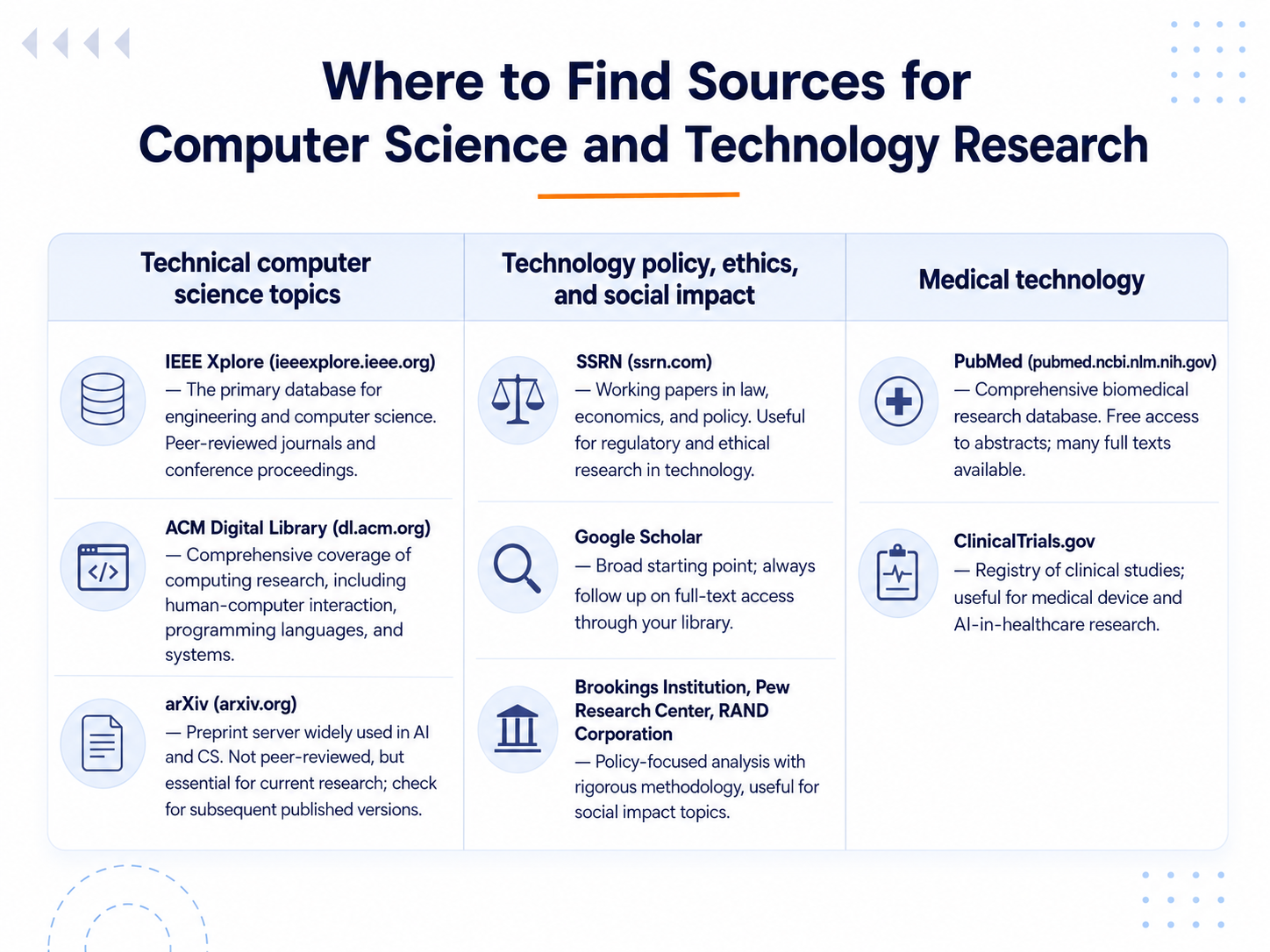
One practical note on Wikipedia and tech news: Wikipedia is not a source, but it’s a useful orientation tool — follow its citations. Tech journalism (Wired, MIT Technology Review, The Verge) is not peer-reviewed, but it provides context and points toward primary research. Use it for context, not as evidence for technical claims. If sourcing feels overwhelming, experienced research paper writers can handle sourcing and writing from scratch.
For citation formatting, a citation generator handles the mechanical work across IEEE, APA, MLA, and Chicago styles. Always double-check outputs for conference papers, preprints, and software citations, where automated tools are most likely to produce errors.
Last updated: June 2026. Topic clusters reviewed and updated to reflect current technology research literature, audit recommendations, and student search patterns.