


From social inequality and gender roles to urban sociology and health disparities — a curated, practical guide with topic clusters, research methods, and everything you need to pick a focused angle and write a sociology paper that makes a real argument.
Sociology research papers fail for a specific reason that most writing guides don’t name directly: students pick topics that are too large to argue and too familiar to be interesting. “Social media and mental health” sounds like a topic in sociology. So does “immigration and identity” and “gender inequality in the workplace.” The problem isn’t that these subjects are bad — it’s that they’re subjects, not arguments. A subject tells you what you’re writing about. An argument tells you what you’re claiming.
I’ve seen this pattern enough times to recognize it: a student spends two weeks reading about inequality, generates a paper that describes it from several angles, cites ten sources, and still earns a mediocre grade. The feedback is always some version of “lacks a clear thesis.” The real issue is that the topic was never narrow enough to make one.
Sociology is the systematic study of human society, social relationships, and the structures that shape everyday life — from family dynamics and gender norms to mass media influence and economic inequality. What makes sociology distinct from related fields like psychology or political science is its focus on social structures and collective patterns rather than individual behavior. A sociological research paper isn’t asking “why does this person behave this way?” It’s asking “what social conditions make this behavior common, and what does that pattern reveal about how society is organized?”
This guide covers 150+ sociology research topics organized into ten thematic clusters — social inequality, race and ethnicity, education, urban sociology, gender, economic sociology, health and illness, social movements, research methods, and organizations and work. Each cluster includes an overview explaining what makes it a productive research territory, followed by specific, arguable research questions. Beyond the topic lists, you’ll find a practical section on sociology research methods, a guide to writing a sociology research paper, a dedicated section on sociological questions, and a full FAQ that closes long-tail queries.
One thing worth stating clearly before we begin: sociology research topics span every level from high school projects to doctoral dissertations. The same subject scales depending on the depth of sourcing, the complexity of your theoretical frame, and how much you engage with competing scholarly interpretations. A high school paper on peer pressure and academic performance looks very different from a college paper on how socioeconomic status mediates the relationship between peer networks and college access — but both are grounded in sociology. The difference is rigor, not subject matter.
Let’s get into it.
What Is a Sociology Research Paper?
A sociology research paper is an academic analysis of social structures, human behavior, group dynamics, or social phenomena, grounded in documented evidence and organized around a clear, arguable thesis. Unlike an essay that offers personal opinion, a sociology research paper uses statistical analysis, interviews, surveys, ethnographic observation, or secondary data analysis to support specific claims about how social factors shape human life. Good sociology research topics address significant social issues — inequality, gender norms, race, health disparities, and education systems — and contribute insights that can inform policy or social change. The most productive research questions focus on a specific population, a specific social pattern, and a specific claim about causation, correlation, or significance.
Characteristics of Good Sociology Research Topics
Choosing a workable sociology research topic requires more than finding something interesting — it requires finding something arguable, feasible, and grounded in available research. A well-chosen sociology research topic should address significant social issues, contribute new insights to the field, and be realistic in scope given the assignment’s constraints.
| Specificity | Focused on one social group, institution, or pattern | Can you write a one-sentence thesis right now? |
| Arguability | Makes a debatable claim about cause, effect, or significance | Would two sociologists disagree about your claim? |
| Source availability | Enough peer-reviewed research to build an argument | Find 3 credible sources in 10 minutes — if you can’t, reconsider |
| Social relevance | Addresses a real pattern or problem in contemporary society | Does this connect to how groups actually interact or experience inequality? |
| Theoretical grounding | Can be approached through a recognized sociological framework | Does conflict theory, functionalism, symbolic interactionism, or feminist theory apply? |
| Manageable scope | Fits the word count and timeframe of the assignment | Can you go deep on one question rather than broadly across five? |
✅ Quick selection checklist:
- [ ] Is my topic specific enough to argue in a single thesis sentence?
- [ ] Are there at least 3 peer-reviewed sources directly relevant to my angle?
- [ ] Does the topic connect to a recognizable sociological concept or debate?
- [ ] Is the scope manageable for my page limit?
- [ ] Does this address a real social issue or pattern, not just an abstract concept?
If you check all five, you’re ready to start. If you can’t pass “arguability,” you probably have a description topic — add a causal claim, a population, or a policy implication and try again.
Understanding Sociological Questions
Before picking a topic, it helps to understand what makes a question sociological rather than just social or psychological. A sociological question focuses on social structures, group patterns, and collective behavior — not individual motivation. It asks how social conditions produce outcomes, not why one specific person behaves a certain way.
What makes a question sociological:
- It focuses on patterns across groups rather than on individual cases.
- It asks about social structures, institutions, or norms as explanatory factors.
- It can be investigated using sociological methods—surveys, interviews, ethnography, or secondary data analysis.
- It connects to broader debates about inequality, social change, or group dynamics.
Examples of weak vs. strong sociological questions:
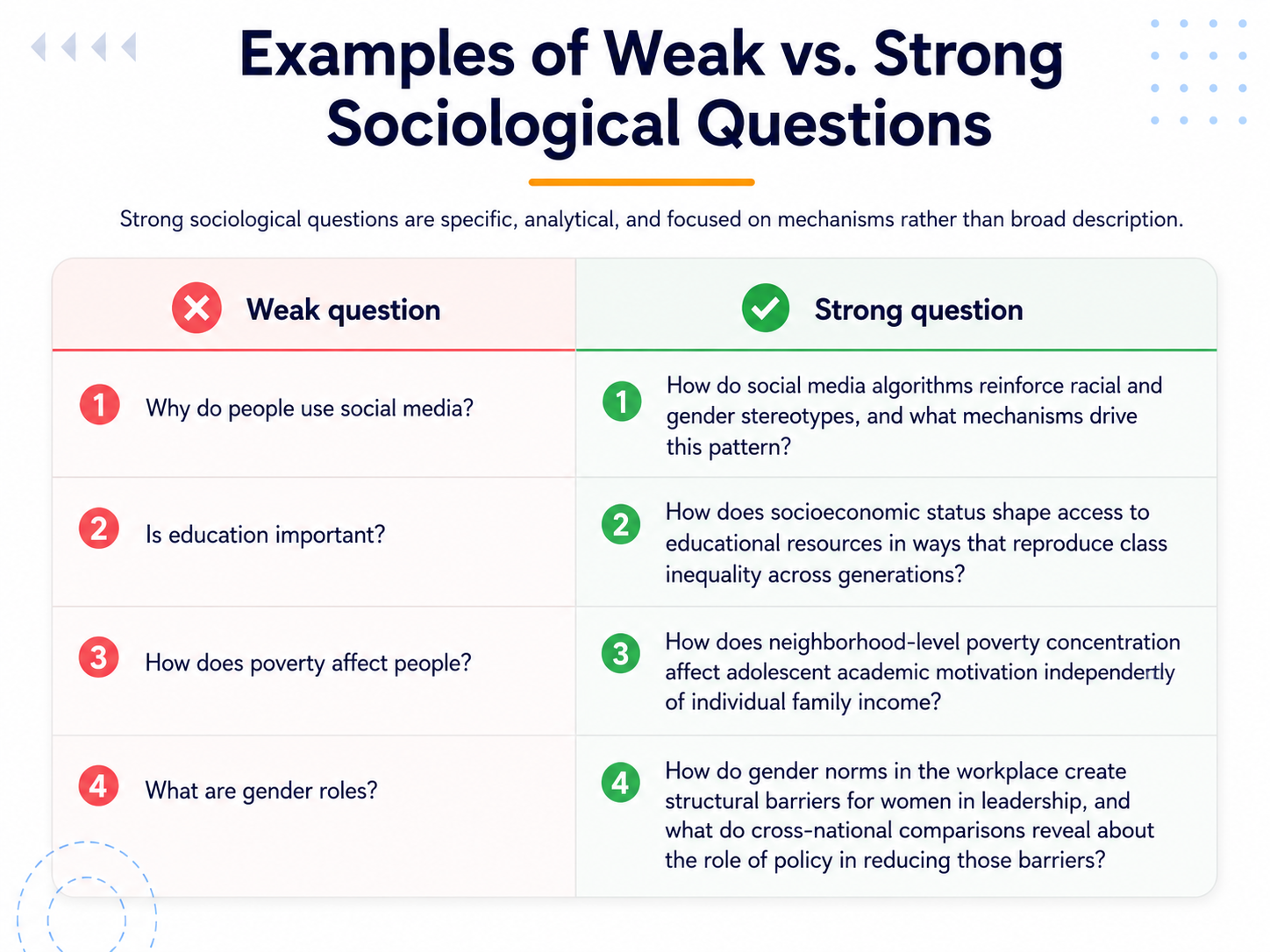
The shift from weak to strong is usually the addition of a specific population, a specific mechanism, and a specific direction of effect. That structure is what makes a question researchable.
Sociology Research Methods
Understanding research methods is essential not just for designing your own study, but for evaluating the evidence you cite and explaining why the sources you use are credible. Choosing a research methodology in sociology should align with your research question, the nature of your data, and the theoretical framework guiding your study.
Sociological research methods can be categorized into seven main types:
1. Social Surveys — Structured questionnaires administered to large samples of a population. Best for measuring the prevalence of attitudes, behaviors, or experiences across a defined group. Adds quantitative data from large social groups and allows for statistical generalization.
2. Identifying Causal Connections — Comparative analysis designed to study causes and effects related to a specific social problem. Often uses large existing datasets (census data, administrative records) to test hypotheses about social patterns.
3. Interviews — In-depth conversations with individuals or specialists to collect detailed, qualitative information. By collecting information from people directly affected by a social issue, interviews make research more reliable and grounded in lived experience.
4. Observation and Participation — Systematic collection of data through watching and sometimes participating in a social group or context. Usually involves generating statistics or field notes from a particular group being studied.
5. Ethnography — A qualitative methodology focused on social interactions, beliefs, perceptions, and behavioral patterns within a specific cultural or social context. Requires extended engagement with the group being studied; produces rich, contextual data.
6. Longitudinal Studies — Research conducted over an extended period to track changes in a social phenomenon or group over time. Particularly valuable for studying social mobility, health disparities, or the long-term effects of policy changes.
7. Secondary Data Analysis — Synthesis and reanalysis of data that has already been collected by other researchers or organizations. Allows access to large datasets (national surveys, government statistics, historical records) without the cost of primary data collection.
Qualitative research methods in sociology — including interviews, focus groups, and participant observation — allow researchers to gather in-depth insights into social phenomena that can’t be captured by numbers alone. Quantitative methods provide statistical power and generalizability. Most strong sociology research papers engage with both — using quantitative evidence to establish patterns and qualitative evidence to explain mechanisms.
How to Choose a Good Sociology Research Topic
When selecting a sociology research topic, it’s important to consider its significance within the broader field and its potential to influence public policy or contribute to social change. Here’s a practical process that works at every level from high school to graduate research.
Step 1: Think over good ideas as you research. Don’t commit to the first subject that seems interesting. Read broadly in the areas that interest you before settling on a specific question. Good ideas often emerge from noticing what’s missing from existing explanations — what a source doesn’t account for, or where two studies seem to contradict each other. For a broader starting list across disciplines, browse our research paper topics examples to see what arguable angles look like in practice.
Step 2: Choose something that genuinely inspires you. Sociology research takes time. A topic you find genuinely compelling will sustain your engagement through the research and writing process. Sociology projects about subjects you’re personally invested in — whether that’s mental health stigma, immigration policy, or gender inequality in sports — consistently produce better papers.
Step 3: Address relevant social issues. The strongest sociology topics connect to real, current patterns in social life. Engaging sociology research topics focus on how social structures, technology, and cultural shifts shape human behavior — not abstract theoretical debates disconnected from contemporary society.
Step 4: Compose a list of keywords related to your topic idea. This step is practical and often skipped. Before committing, list 5–10 related terms and search them in Google Scholar or a sociology database. If you find fewer than three peer-reviewed sources, the topic may be too narrow or too underdeveloped in the literature.
Step 5: Always narrow your topic down to reflect the precise problem. “Family structure and child outcomes” is too broad. “How single-parent household structure correlates with academic motivation in low-income urban adolescents” is arguable. Narrowing isn’t a weakness — it’s how you ensure your paper can make a real contribution rather than skimming the surface of a large subject.
Step 6: Identify the sociology research methodology for your paper. Different questions require different methods. A question about prevalence (“how common is X?”) needs survey data. A question about lived experience (“how do people experience X?”) needs interviews or ethnography. A question about change over time needs longitudinal data or secondary analysis. Knowing your method before you start shapes what sources you need.
Step 7: Think over relevant sources as you compose your thesis statement. Your thesis and your sources should develop together. If you can’t find peer-reviewed literature to support a claim, the claim needs to change — or the topic needs to be reframed around what the evidence actually shows. If sourcing and thesis alignment feel consistently difficult, you can pay for a research paper and have a professional writer handle both from scratch.
Social Inequality and Stratification Research Topics
Social inequality and stratification are foundational areas of sociological research, examining how resources, power, and social status are unequally distributed across different groups in society. The most productive research topics in this cluster engage with specific mechanisms of inequality — not just that it exists, but how it’s reproduced through institutions, cultural norms, and economic structures. The American Sociological Association has identified a major discipline-wide shift toward putting sociology to work for a more equitable society, which means solutions-oriented research questions are increasingly valued alongside descriptive ones. Income inequality, socioeconomic status, class mobility, and their intersections with race and gender are all active areas with strong source availability.
Topic ideas:
- How does socioeconomic status shape access to educational resources — and through what specific institutional mechanisms does class inequality reproduce itself across generations?
- How has the rise of app-based gig work shifted traditional working-class dynamics, job security, and unionization efforts — and what does this shift reveal about changing class structures?
- What is the relationship between neighborhood-level income inequality and adolescent academic motivation, controlling for individual family income?
- How does the cost of sustainable living function as a form of social stratification and gatekeeping — effectively making environmentally responsible consumption a class privilege?
- How do healthcare disparities reflect systemic biases in telehealth adoption and maternal health outcomes across racial and socioeconomic lines?
- What structural and cultural barriers do marginalized or immigrant communities face when accessing preventative care — and how do those barriers differ by community type?
- How does the digital divide in education exacerbate existing inequalities among students from different socioeconomic backgrounds — and what policy interventions show evidence of effectiveness?
- How do economic factors influence social cohesion in post-industrial communities where traditional employment structures have collapsed?
- How has remote and hybrid work changed the blurring of work/personal life boundaries — and who bears the greatest social cost of that blurring?
- What does cross-national comparison of social mobility rates reveal about which institutional factors (education access, labor market regulation, tax policy) most strongly predict intergenerational mobility?
Race, Ethnicity, and Immigration Research Topics
Race and ethnicity are major categories in sociology that significantly influence social interactions and structures. Research in this cluster examines how racial and ethnic categories shape individual identities and group dynamics — and how those categories are socially constructed, politically contested, and materially consequential. Immigration and its social dimensions — assimilation, cultural retention, legal status, community formation — generate some of the most actively debated questions in contemporary sociology. The intersection of immigration law, policing, and the rising challenge of climate-driven internal migration is an emerging research area with growing availability of sources.
Topic ideas:
- How does racial profiling in policing produce documented disparities in arrest and incarceration rates — and what structural factors sustain those disparities despite reform efforts?
- How does cultural assimilation among immigrant populations change identity and social behavior — and at what cost to cultural retention and community cohesion?
- What sociological mechanisms explain the persistence of racial and ethnic wage gaps in labor markets where overt discrimination is legally prohibited?
- How do media representations of different racial and ethnic groups shape social attitudes and reinforce or challenge stereotypes?
- How does racial and ethnic diversity in educational settings affect academic outcomes, social integration, and civic participation — and what conditions determine whether diversity produces these effects?
- How are communities responding to the growing category of climate refugees — people displaced by environmental changes rather than political persecution — and what legal and social frameworks govern their integration?
- How does the intersection of immigration law and policing create differential vulnerability for undocumented communities — and how does that vulnerability affect social behavior and civic participation?
- How do interracial and interethnic relationships challenge or reproduce social stratification — and what does research on social attitudes toward such relationships reveal about the persistence of racial hierarchy?
- How has the Black Lives Matter movement changed public discourse, policing policy, and social attitudes toward racial justice — and what evidence exists about the durability of those changes?
- How do first and second-generation immigrants navigate the tension between cultural identity and assimilation demands — and how does that navigation differ by ethnicity, class, and receiving community context?
Sociology of Education Research Topics
Educational sociology examines the role of education as both a social institution and a site of social reproduction. Education plays a crucial role in shaping social dynamics and inequalities, particularly among young people, as it influences their access to resources and opportunities. Research in this cluster addresses the gap between education’s promise of meritocracy and the documented reality that educational attainment is closely linked to socioeconomic status. The school-to-prison pipeline, standardized testing’s role in college access, and the digital divide in online education are all areas with substantial peer-reviewed literature.
Topic ideas:
- How does socioeconomic status shape academic achievement — and through what specific mechanisms (school funding, peer networks, teacher expectations, extracurricular access) does this relationship operate?
- How do standardized college admissions tests reflect socioeconomic privilege rather than academic potential — and what evidence from test-optional admission policies supports or complicates this claim?
- What is the school-to-prison pipeline, and what evidence exists that zero-tolerance disciplinary policies disproportionately affect Black and Latino students?
- How does the digital divide in education exacerbate existing inequalities — and what does COVID-19’s rapid shift to online learning reveal about which students were most disadvantaged?
- How do teacher expectations and academic tracking decisions affect student outcomes — particularly for students from minority or low-income backgrounds?
- How does parental involvement in education vary by socioeconomic class and cultural background — and how do those differences shape children’s academic trajectories?
- What is the relationship between multicultural curriculum development and students’ civic participation and social attitudes in diverse school settings?
- How does the transition from high school to college affect students’ social identity, peer relationships, and mental health — and how do those effects differ by first-generation college student status?
- How do gender disparities in academic performance and subject preferences emerge in early education — and what structural and cultural factors explain them?
- How has the growth of homeschooling and alternative education models changed the sociological landscape of schooling — and what does the evidence say about their effects on social integration and civic engagement?
Urban and Community Sociology Research Topics
Urban sociology examines how cultural dynamics shape social interactions and community identity, reflecting the complexities of modern urban life. As urbanization continues globally, the social consequences of city living — gentrification, housing inequality, community displacement, immigrant neighborhood formation, and the transformation of public space — generate rich research questions. Urbanization creates new forms of both community cohesion and social fragmentation, and the most productive research papers in this cluster engage with the tension between those tendencies. The intersection of urban policy, environmental conditions, and social inequality is particularly active in current scholarship.
Topic ideas:
- How does gentrification change community composition and social cohesion — and who bears the social and economic costs of neighborhood transformation?
- How do urban planning decisions about public space, transportation access, and zoning reproduce racial and economic segregation?
- How does neighborhood gentrification affect the family dynamics, social networks, and cultural identity of long-term residents who remain after displacement?
- What is the relationship between neighborhood poverty concentration and residents’ social behavior, civic participation, and health outcomes?
- How do immigrant communities form distinct social enclaves in urban settings — and what are the social trade-offs between cultural preservation and broader social integration?
- How do environmental conditions in urban neighborhoods — including air quality, green space access, and noise pollution — affect public health outcomes and reinforce social inequality?
- How has the shift to remote and hybrid work changed urban neighborhood dynamics — including the blurring of residential and commercial boundaries and the transformation of public space use?
- What social mechanisms sustain racial segregation in American cities decades after formal desegregation — and what policy instruments have proven most effective in reducing it?
- How does urban density affect social interaction, community formation, and collective action — and what does cross-city comparison reveal about the relationship between urban form and social cohesion?
- How are cities in developing countries managing rapid urbanization’s social consequences — including informal housing, public health strain, and the erosion of traditional community structures?
Sociology of Gender Research Topics
The sociology of gender analyzes how gender operates as a social structure — not just an individual identity — shaping access to resources, institutional treatment, interpersonal interaction, and cultural representation. Gender norms, gender stereotypes, and gender inequality are all active areas of sociological research with strong empirical literature. Research on gender roles, workplace gender inequality, transgender and non-binary identities, and the intersection of gender with race and class produces some of the most theoretically rich and socially relevant papers in contemporary sociology. Social media algorithms have been documented as reinforcing gender stereotypes, making platform design itself a sociological research subject.
Topic ideas:
- How do gender norms in the workplace create structural barriers for women in leadership positions — and what cross-national comparisons reveal about the role of parental leave and pay transparency policies?
- How do social media algorithms reinforce gender stereotypes — and through what design and monetization incentives do these patterns emerge?
- How does the sociology of transgender and non-binary identities challenge traditional binary models of gender — and how are institutions (healthcare, law, education) adapting, or failing to adapt, to non-binary identity?
- How do gender stereotypes in media representation shape gender norms among adolescents — and what evidence exists for the causal direction of this relationship?
- How do gender and racial wage gaps interact — and what does the evidence say about whether they reflect discrimination, occupational segregation, or both?
- What are the sociological causes and social consequences of gender-based violence — and how do cultural factors shape both its prevalence and community responses?
- How have feminist movements in the 21st century changed public discourse about gender equality — and where do generational differences in feminist politics create strategic tensions?
- How do gender dynamics in family structures and parenting roles reproduce or challenge traditional gender norms across different class and cultural contexts?
- How does masculinity’s social construction create barriers to men seeking mental health treatment — and what institutional interventions show evidence of effectiveness?
- How does political leadership representation of women affect policy outcomes in areas like healthcare, childcare, and social welfare — and what does cross-national evidence suggest about the mechanisms?
Economic Sociology Research Topics
Economic sociology investigates how social structures, cultural norms, and institutional relationships shape economic behavior and outcomes — and how economic forces, in turn, reshape social life. This cluster is distinct from economics because it treats markets, corporations, and work not as neutral mechanisms but as social institutions embedded in power relationships, cultural meanings, and historical contexts. The rise of platform capitalism, the gig economy, income inequality, and the social consequences of economic precarity are all areas where sociological analysis adds distinctive value. Economic factors in social life — from consumer culture to the sociology of financial markets — are generating increasingly active research.
Topic ideas:
- How does the gig economy’s shift away from traditional employment relationships affect job security, unionization, and the social contract between workers and employers?
- How does income inequality affect social cohesion, civic trust, and political participation — and what does cross-national evidence reveal about the threshold effects of inequality on democracy?
- How does consumer culture drive environmental degradation — and what sociological factors explain why individually rational consumption choices produce collectively irrational outcomes?
- How do social networks shape economic opportunity — and through what mechanisms do network advantages compound for already-privileged groups while disadvantaging others?
- What is the sociology of financial markets — and how do social conventions, institutional trust, and cultural narratives about wealth shape investment behavior beyond what rational-actor models predict?
- How does the transition to platform capitalism change the relationship between corporations, workers, and consumers, and who bears the risks that traditional employment relationships distributed more broadly?
- How does economic precarity affect family formation decisions, social behavior, and mental health among young adults in post-industrial economies?
- How do global supply chains connect economic decisions in wealthy countries to labor conditions in developing countries — and what governance mechanisms have proven most effective at enforcing labor standards across supply chains?
- How does the rise of automated employee monitoring in remote work settings affect mental health, job satisfaction, and union organizing capacity?
- How do corporations shape cultural norms and social attitudes through advertising, sponsorship, and political lobbying — and what sociological frameworks best capture this influence?
Sociology of Health and Illness Research Topics
The sociology of health and illness examines how social structures, cultural factors, and economic conditions shape health outcomes, healthcare access, and the experience of illness. Medical sociology research topics in this cluster go beyond clinical questions to ask why health disparities exist, how social stigma affects illness trajectories, and how healthcare institutions both reflect and reproduce social inequalities. Healthcare disparities influenced by systemic biases in telehealth adoption and maternal health outcomes across racial and socioeconomic lines are among the most actively researched questions in the field. The intersection of cultural background and mental health help-seeking is an emerging area with growing source availability.
Topic ideas:
- How do racial and socioeconomic disparities in maternal health outcomes reflect systemic biases in clinical practice and healthcare institutions — and what evidence-based interventions show the most promise?
- How does social stigma surrounding mental illness vary across cultural backgrounds — and how does that variation affect rates of diagnosis, treatment-seeking, and social support?
- How do cultural backgrounds and generational differences influence the likelihood of seeking professional therapy or psychiatric help — and what are the implications for culturally adapted mental health services?
- How do social determinants of health — including housing stability, food access, neighborhood safety, and social networks — predict health behaviors and outcomes beyond individual clinical factors?
- How does the sociology of chronic illness shape patients’ social identity, relationships, and economic participation — and how do different healthcare systems respond to the social dimensions of chronic conditions?
- How do healthcare policies in different countries produce varying levels of health equity — and what do the most effective systems have in common in terms of social and institutional design?
- How does the doctor-patient relationship reflect and reproduce social hierarchies of race, class, and gender — and what training interventions most effectively address these dynamics?
- How do elderly care systems vary across societies — and what do those variations reveal about cultural norms regarding family responsibility, the role of the state, and the social status of aging?
- How does the sociology of addiction reframe substance use as a social and structural problem rather than an individual moral failure — and what policy implications follow from that reframing?
- How has COVID-19 changed long-term social attitudes toward public health authority, vaccine confidence, and the relationship between individual freedom and collective health responsibility?
Social Movements and Advocacy Research Topics
The sociology of social movements examines how collective action forms, how movements mobilize participants and resources, how they engage with institutions and media, and what conditions determine whether they achieve policy change or social transformation. Social movements are one of the primary mechanisms through which social change happens in democratic societies, and understanding how they work is essential for understanding both historical and contemporary politics. The role of social media platforms in both enabling and constraining movement mobilization is an active research area, as is the study of how environmental movements are navigating the tension between urgency and democratic legitimacy.
Topic ideas:
- How has social media changed the mobilization capacity of social movements — and what evidence exists for whether online activism translates into offline political change?
- What organizational structures and leadership models are most effective at sustaining social movements over time — and why do most movements fail to achieve their stated goals?
- How do environmental movements navigate the tension between radical policy demands and the compromises required for legislative success?
- How does the political climate shape which social movements emerge, gain media attention, and achieve policy influence — and what does comparison across different political systems reveal?
- How has the Black Lives Matter movement changed policing policy, public discourse, and social attitudes toward racial justice — and what evidence distinguishes durable change from short-term shifts in polling?
- How does feminist activism in the 21st century differ from earlier waves — in goals, tactics, organizational forms, and the role of digital communication?
- How do transnational social movements coordinate across national borders — and what organizational and technological factors determine their effectiveness?
- How does the media frame social movements — and how does that framing affect public attitudes, movement strategy, and ultimately policy outcomes?
- What role does youth activism play in contemporary social movements — and what sociological conditions produce high rates of youth political engagement?
- How do labor movements adapt their strategies in response to the gig economy’s erosion of traditional collective bargaining frameworks?
Sociological Research Methods for Students
A sociology research paper is only as strong as its methodological foundation. Understanding not just what you’re studying but how you’re studying it — and why that method is appropriate for your question — is what distinguishes a genuine research contribution from a literature summary. Engaging with methodology explicitly in your paper demonstrates the critical thinking skills that distinguish sociology research from general writing about social issues.
Choosing the right method for your question:
The fundamental choice in sociology research methodology is between quantitative approaches (surveys, statistical analysis of existing datasets, experiments) and qualitative approaches (interviews, ethnography, focus groups, content analysis). Most strong research papers either use mixed methods or explicitly acknowledge what a single-method study can and cannot demonstrate.
- Surveys work best for questions about prevalence (“how common is X across a defined population?”) and for testing relationships between variables at scale. They require careful sampling to be representative.
- Interviews work best for questions about lived experience, meaning-making, and social processes that can’t be captured by tick-boxes. They produce depth, not breadth.
- Ethnography works best for understanding how social norms, group dynamics, and cultural practices operate in natural settings over time. It requires extended field presence and produces contextually rich data.
- Secondary data analysis works best when large existing datasets (census data, national health surveys, administrative records) can answer your question. It’s powerful but limited to what the original dataset measured.
- Content analysis works best for questions about media representation, discourse, and cultural patterns in texts, images, or social media posts.
Key methodological concepts to engage with:
- Validity — Does your method actually measure what you claim it measures?
- Reliability — Would the same method, applied again, produce the same results?
- Generalizability — Can findings from your sample be applied to a broader population?
- Reflexivity — How does your own social position as a researcher shape what you observe and how you interpret it?
How to Write a Sociology Research Paper
Most sociology papers earn weak grades, not because the research is insufficient, but because the structure is wrong. A well-written sociology research paper follows a specific logic that most first-time writers don’t learn explicitly. If you need a fully structured paper rather than guidance on how to write one, an essay writer service can deliver a complete, properly cited paper on your topic.
1. Establish the social problem clearly. Your introduction should demonstrate why this topic matters sociologically — not just that it’s interesting, but what social pattern or inequality it reveals. The opening should show the reader what’s at stake.
2. Situate your work in existing research. A literature review isn’t just a summary of what others have found — it’s an argument about what’s missing or contested. Identify where sociologists disagree, what populations or contexts have been understudied, and where your paper fits.
3. State a clear, specific thesis. Not “this paper will examine gender inequality in the workplace” but “gender-based promotion disparities in professional services firms persist even after controlling for performance ratings, suggesting that informal sponsorship networks function as a structural barrier distinct from explicit discrimination.” That’s a thesis — specific, debatable, and falsifiable.
4. Analyze causes, consequences, and implications. For every empirical finding you discuss, push past description: what social structures explain this pattern? Who benefits from its persistence? What policy implications follow from the evidence?
5. Engage with counter-arguments. Provide not only your own interpretation but counter-arguments as well. Acknowledging and responding to alternative explanations demonstrates genuine scholarly engagement and strengthens your argument rather than weakening it.
6. Use the right citation format. ASA (American Sociological Association) style is standard for sociology. APA is also widely accepted. Compose your bibliography in advance as you encounter each useful source — don’t reconstruct it after the paper is drafted. If managing sources, citations, and structure feels like too much at once, an online research paper writer can take over the full process.
Current Trends in Sociology Research
Contemporary sociological research is moving toward actionable, solutions-oriented analysis — examining not just what problems exist but what interventions work and under what conditions. The American Sociological Association has explicitly called for sociology that contributes to a more equitable society, which has shifted funding priorities and publication emphasis toward applied and policy-relevant research.
Several thematic trends are generating particularly active research:
Technology and social life — How platform capitalism, algorithmic governance, social media, and surveillance technology are reshaping social interactions, group dynamics, and political behavior. Automated employee monitoring, gig work platforms, and AI-driven hiring decisions are all generating new sociological questions about power, inequality, and consent.
Climate change and environmental justice — How the social consequences of climate change — displacement, resource scarcity, public health impacts — fall disproportionately on marginalized communities, and how environmental movements are incorporating intersectional analysis.
Health and mental health — How social determinants of health — including structural racism, economic precarity, and community conditions — produce health disparities that clinical interventions alone cannot address.
Identity and recognition politics — How claims for social recognition by LGBTQ+ communities, ethnic minorities, and non-binary gender identities are reshaping cultural norms, legal frameworks, and institutional practices.
Remote work and organizational change — How the shift to hybrid and remote work is changing class dynamics, work-life boundaries, gender divisions of domestic labor, and urban community structures.
Immigration and belonging — How increasingly restrictive immigration enforcement intersects with community cohesion, ethnic identity formation, and the political mobilization of immigrant communities.
Sociology of Gender Research Topics: Dedicated Section
This dedicated section addresses the Fan-Out query “sociology research topics on gender roles” directly. Gender roles — the socially prescribed behaviors, attributes, and activities considered appropriate for men and women — are among the most studied and most contested topics in contemporary sociology. The research literature on gender spans everything from organizational behavior and media studies to health sociology and global development.
What makes gender a distinctively sociological topic:
Gender roles are not fixed biological facts — they vary across cultures, historical periods, and social contexts in ways that demonstrate their social construction. A sociological approach to gender doesn’t just describe what roles exist; it asks how they’re maintained, who enforces them, what functions they serve for social institutions, and what costs they impose on individuals who don’t conform.
Additional topic ideas specifically on gender roles:
- How do gender norms in elementary school classrooms shape children’s academic subject preferences and self-assessed ability before formal tracking begins?
- How has the COVID-19 pandemic affected the gender division of domestic labor in dual-income households — and what evidence exists for whether these shifts have persisted?
- How do gender roles in religious communities differ from those in secular contexts — and how do women navigate the tension between religious identity and gender equality commitments?
- How do media portrayals of gender roles in children’s programming shape gender-typed behavior and social attitudes among young people?
- How does gender role conformity pressure affect the mental health of adolescents — particularly those whose gender expression doesn’t align with dominant norms?
- How do gender norms in professional sports shape the career trajectories, compensation, and media coverage of women athletes?
- How does gender socialization differ across cultural contexts — and what do cross-cultural comparisons reveal about which aspects of gender roles are culturally universal versus culturally specific?
Organizations and Work Research Topics
The sociology of organizations and work examines how workplaces function as social institutions — shaping inequality, identity, power, and social behavior in ways that extend well beyond individual employment. Organizations reproduce social hierarchies of race, class, and gender; they create and enforce cultural norms; and they mediate between individual workers and broader economic structures. The rise of platform firms, automated monitoring, and remote work has fundamentally changed the organizational landscape, generating new research questions about worker agency, institutional power, and the social contract of employment.
Topic ideas:
- How do informal organizational cultures — including after-work socialization, mentorship networks, and unwritten norms — reproduce racial and gender inequality even when formal HR policies prohibit discrimination?
- How does automated employee monitoring in remote work settings affect workers’ autonomy, mental health, and perceived fairness — and what legal frameworks are emerging to regulate surveillance?
- How has the transition to platform-based employment changed the balance of power between workers and employers — and what labor organizing innovations are emerging in response?
- How do workplace hierarchies and organizational culture shape the communication styles, confidence, and career trajectories of employees from different racial and class backgrounds?
- How does organizational culture in healthcare institutions affect patient outcomes — particularly for marginalized patients navigating institutions whose norms were designed around different patient populations?
- What organizational factors explain why diversity and inclusion programs fail to produce lasting changes in workforce composition or organizational culture — and what evidence-based alternatives show more promise?
- How does the gig economy’s classification of workers as “independent contractors” rather than employees affect access to benefits, legal protections, and collective bargaining?
- How do corporations use corporate social responsibility framing to manage reputational risk while avoiding structural changes to labor practices or environmental impact?
Last updated: June 2026. Topic clusters reviewed and updated to reflect current sociological literature, audit recommendations, and student research patterns.