


This guide covers everything from democratic backsliding and AI in governance to conflict resolution and public law. Inside, you’ll find organized topic clusters, advice on structuring your paper, and tips to help you choose a focused topic and make a strong argument.
Political science papers have a specific failure mode that other disciplines don’t share: the topic sounds important but turns out to be unargued. “The role of the United Nations in global conflicts.” “Democracy and its challenges.” “The influence of social media on politics.” These are subjects, not arguments. A student can write ten pages on any of them without ever making a single claim that someone could actually disagree with.
The fix is simple in principle and genuinely hard in practice. A good topic isn’t a subject — it’s a question with a defensible answer. “Whether economic sanctions are an effective tool of foreign policy” is better than “economic sanctions.” “How digital platforms influence voter behavior in American elections” is better than “social media and politics.” The question forces a thesis. The thesis forces evidence. The evidence forces analysis. That chain is what a political research paper actually is.
Political science usually includes four or five main subfields, each with many topics to explore: comparative politics, international relations, political theory, public administration, and public policy. Knowing which subfield your assignment fits into shapes your argument, the sources you use, and your analytical approach. For example, comparative politics papers compare political systems or institutions across countries. International relations papers look at how states, organizations, and non-state actors interact globally. Political theory papers discuss philosophical debates about justice, power, rights, and the state. Public administration papers focus on how government institutions carry out policy and manage public services.
This guide covers 150+ political science research topics organized into 10 thematic clusters: conflict resolution, international relations, democracy and governance, technology and politics, public administration, public law, globalization, immigration, race and ethnicity, and gender and LGBTQ+ politics. Each cluster includes an overview explaining what makes it a productive research territory, followed by specific, arguable research questions. Beyond the topic lists, you’ll find a section on choosing the right political questions, a guide to the structure of political research papers, and a full FAQ that addresses long-tail queries, including research question examples.
One note before the lists: trending political research questions for 2026 include AI in governance, climate diplomacy, TikTok’s political influence, refugee policy, and democratic backsliding. If you want your paper to engage with current debates in the field, those are the areas generating the most new scholarship right now.
Let’s get into it.
What Is a Political Science Research Paper?
A political science research paper is an analytical essay focused on government, political institutions, political behavior, or international relations — organized around a clear, arguable thesis and grounded in documented evidence. Unlike a general opinion piece, it uses academic sources, empirical data, and a structured argument to support specific claims about how political systems work, why political events happened, or what policies are most effective. Political topics span local governance and global politics, from voting rights and civil liberties to international law and authoritarian regimes. The goal is not to describe politics but to argue something about it — about causes, consequences, effectiveness, or normative implications.
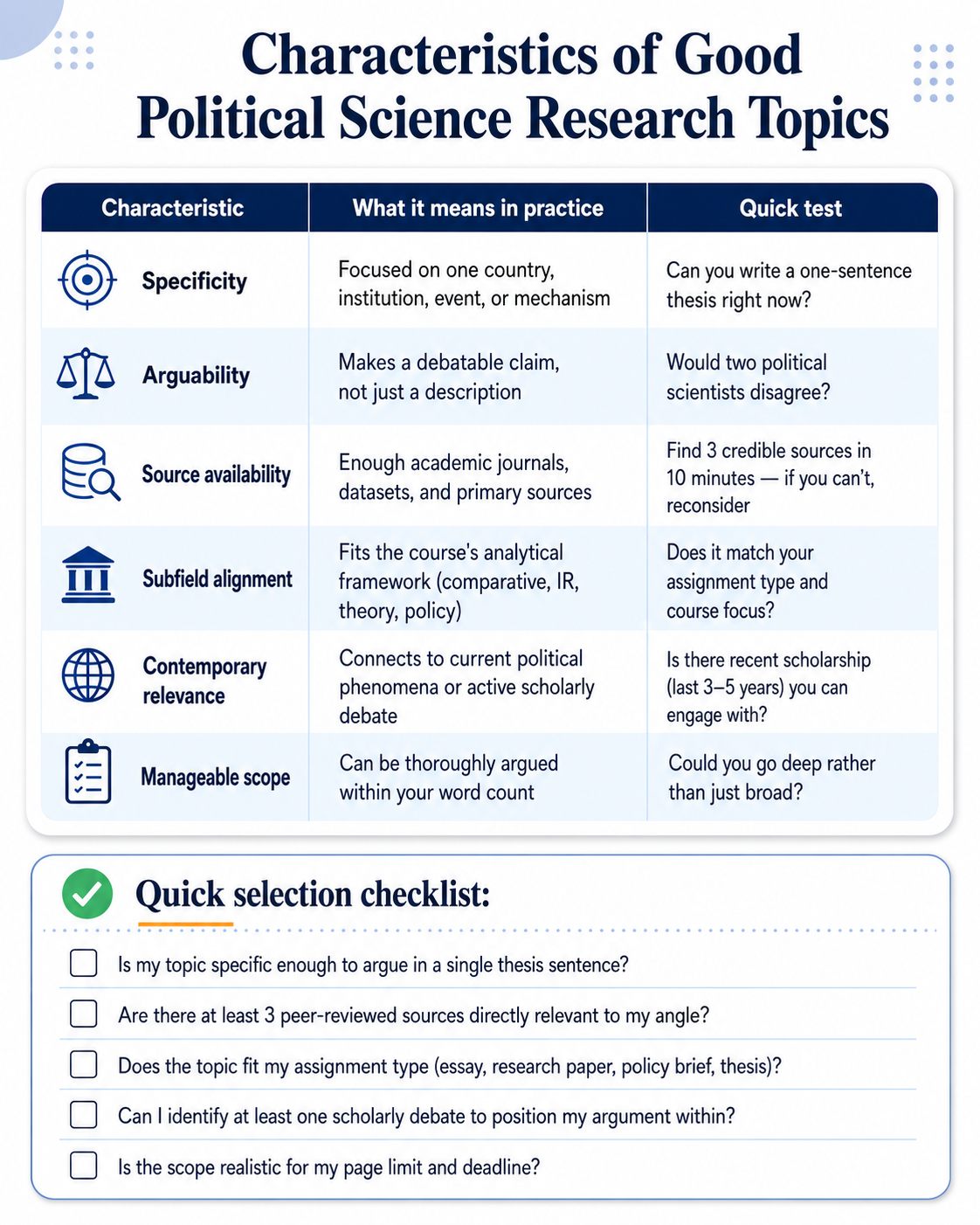
Characteristics of Good Political Science Research Topics
Political ideas range from highly accessible (electoral systems, voting behavior, local governance) to deeply specialized (post-conflict state-building, democratic theory, international legal frameworks). A good political research topic works at whatever level you’re writing — the key is that it’s specific enough to argue and broad enough to source.
How to Select a Political Science Research Topic
Picking the right political science topic is half the work — a well-chosen question guides everything that follows. Here’s a practical six-step process that works at every level.
Step 1: Follow your genuine interest. Political issues covers everything from local elections to global governance. Start in the area that genuinely engages you — your analytical commitment will show in the writing. Choosing a topic purely because it sounds impressive is a surefire way to write a weak paper.
Step 2: Check the scope. Avoid topics that are too broad or too narrow. “International relations” is too broad. “Whether the UN Security Council veto structure undermines collective security in the post-Cold War era” is workable. The test: Can you state your argument in one sentence? If not, narrow further.
Step 3: Do quick source research. Before committing to a topic, spend ten minutes on Google Scholar, JSTOR, or your university database. Are there enough credible sources — academic journals, government data, peer-reviewed books — to support a substantial argument? No sources means no paper.
Step 4: Match the format. A political essay, a research paper, a policy brief, a thesis, and a capstone project are different genres with different requirements. Make sure your topic fits the assignment type. Policy analysis paper topics need an evaluative framework. Thesis-level political science dissertation topics require engagement with substantial theoretical literature.
Step 5: Stay current. Current research topics in politics — AI in governance, climate diplomacy, democratic backsliding, digital disinformation — generate strong papers because the scholarship is active and the debates are live. Trending topics also demonstrate engagement with the field’s contemporary concerns.
Step 6: Ask your professor. If in doubt, a short conversation with your instructor can clarify scope, methodology expectations, and whether your angle is distinctive enough to be worth pursuing.
Conflict Resolution Research Topics
Political conflicts often arise from disputes over territory, resources, and differing social issues — making conflict resolution one of the most practically significant areas of political science. Analyzing political conflicts helps understand their roots and implications, which is crucial for identifying opportunities for peaceful resolution. Conflict resolution explores peaceful strategies for addressing disputes ranging from local tensions to international crises, combining diplomatic theory with empirical case analysis. The most productive research papers in this cluster engage with specific conflicts, specific mechanisms (mediation, sanctions, peacekeeping), or specific outcomes — rather than describing “conflict” in the abstract.
Topic ideas:
- How effective is UN-led mediation in resolving interstate conflicts — and what structural features of the Security Council limit its effectiveness in cases involving permanent member interests?
- What factors explain why post-conflict reconstruction succeeds in some countries (Rwanda, Mozambique) and fails in others (Libya, Iraq) — and what do these cases reveal about the role of external actors?
- How does the effectiveness of economic sanctions as a conflict de-escalation tool vary by target regime type, and what conditions make sanctions most likely to change political behavior?
- What role have women played in peacebuilding and conflict resolution processes — and how has their inclusion or exclusion from formal negotiations affected agreement durability?
- How do regional organizations (ASEAN, African Union, ECOWAS) compare to the UN in mediating intrastate conflicts — and what comparative advantages do regional bodies hold?
- What are the political and humanitarian consequences of the Yemen conflict — and how have competing international interventions prolonged rather than resolved the crisis?
- How does climate-driven resource scarcity contribute to political conflict — and what governance mechanisms show the most promise for preventing resource conflicts before they escalate?
- What is the role of Track II diplomacy in de-escalating political tensions where official state channels have failed — and what cases demonstrate its effectiveness?
- How effective are truth and reconciliation commissions in post-conflict societies — and what conditions determine whether they produce genuine reconciliation or political performance?
- How does foreign power intervention in internal conflicts affect conflict duration, civilian casualties, and the likelihood of negotiated settlement?
International Relations Research Topics
International relations focus on relationships between countries, global organizations, and multinational corporations — examining how states cooperate, compete, and build the institutional frameworks that govern global political life. Research in IR spans hard security (nuclear proliferation, territorial disputes, military alliances), economic interdependence (trade agreements, sanctions, development finance), and normative frameworks (human rights law, climate agreements, refugee protection). The most interesting current questions sit at the intersection of traditional state-centric analysis and newer dynamics: the rising influence of non-state actors, the geopolitical implications of AI, and the challenge of maintaining multilateral cooperation under rising nationalism.
Topic ideas:
- How is China’s rising influence reshaping the post-Cold War international order — and what strategic responses from existing powers are most likely to produce stable accommodation rather than open conflict?
- How effective are economic sanctions as a foreign policy tool — and what does comparative evidence suggest about the conditions under which they produce policy change rather than regime entrenchment?
- How has the AUKUS security pact changed the geopolitical balance in the Indo-Pacific — and what are its implications for existing alliance structures and regional stability?
- How does climate change diplomacy work as an international coordination problem — and why do countries with the most to lose from climate inaction consistently under-commit to binding agreements?
- What is the role of soft power in shaping international public opinion — and how do authoritarian states use state-controlled media and information operations to contest liberal democratic narratives?
- How has social media transformed international political communication — and what does “TikTok diplomacy” reveal about the changing relationship between public opinion and foreign policy?
- How do international trade agreements affect national policy autonomy — and what political conflicts emerge between trade liberalization commitments and domestic social protection goals?
- How does nuclear proliferation challenge existing international security frameworks — and what do the cases of Iran and North Korea reveal about the limits of diplomatic and coercive non-proliferation strategies?
- What role do non-state actors — including NGOs, transnational corporations, and terrorist networks — play in shaping global policy outcomes beyond what interstate diplomacy produces?
- How have post-Brexit relations between the UK and the European Union evolved — and what lessons do they offer about the political and economic costs of disintegration from regional institutions?
- What are the geopolitical dynamics of Arctic governance — and how are competing national interests among Arctic Council members shaping the future of the region as it becomes more accessible?
Democracy and Governance Research Topics
Democracy and governance research examines the trends and challenges facing democratic political systems — including democratic backsliding, voter behavior, political participation, and the impact of economic inequality on political representation. Research themes in political science include digital disinformation and elections, social identity and voting, and political psychology. Political behavior studies how citizens and groups engage in politics, helping scholars understand political phenomena such as voting, participation, and public opinion dynamics. Current political debates focus on the influence of social media on political engagement, the implications of climate change on global governance, and the rise of populism in various democracies.
Topic ideas:
- What are the primary mechanisms of democratic backsliding — the gradual erosion of democratic norms through legal rather than violent means — and what do Hungary and Turkey reveal about how liberal democracies can be dismantled from within?
- How do digital platforms significantly impact voter behavior and influence political decision-making in American elections — and what evidence distinguishes actual behavioral change from engagement-metric manipulation?
- How does political polarization affect legislative gridlock in presidential systems — and what comparative evidence suggests whether institutional design can reduce polarization’s effects on governance?
- How does economic inequality affect political participation — and through what specific mechanisms (reduced resources, lower political efficacy, geographic segregation) does inequality translate into reduced democratic voice for lower-income citizens?
- How does political psychology explain why voters support candidates whose policies conflict with their economic interests — and what role do identity, threat perception, and emotional appeals play?
- How do gender quotas in legislatures affect women’s substantive political representation — and what does cross-national evidence show about the conditions under which descriptive representation produces policy change?
- How has the rise of populist movements in Western democracies changed the structure of party systems — and what does the comparative evidence suggest about whether populism is a temporary disruption or a lasting transformation?
- How effective is the Voting Rights Act in protecting minority voting access — and what does the evidence from recent Supreme Court decisions suggest about the future of federal voting rights protection?
- How does political socialization among youth populations shape long-term political participation — and what role do digital platforms, family, and educational institutions each play?
- How do political scandals affect electoral behavior and institutional trust — and under what conditions do scandals produce accountability through elections versus being absorbed without consequence?
Technology and Politics Research Topics
Technology and politics are among the fastest-growing areas of political science research, generating active scholarly debate and strong source availability. Research topics are increasingly examining the effects of digital misinformation on public opinion and electoral processes, as well as the role of cybersecurity in national security. Trending political questions include AI in governance, cybersecurity and election security, the political implications of cryptocurrency, and deepfake governance. Digital platforms significantly impact voter behavior and influence political decision-making across political systems.
Topic ideas:
- How is artificial intelligence reshaping global political governance — and what regulatory frameworks are emerging to address AI’s implications for surveillance, electoral manipulation, and autonomous weapons?
- How does social media radicalization work — and what platform design choices, recommendation algorithms, and content moderation failures most consistently drive users toward extreme political content?
- How does cybersecurity intersect with democratic elections — and what evidence exists for the effectiveness of current election security measures against state-sponsored interference?
- What are the regulatory and political implications of cryptocurrency — and how are governments balancing innovation incentives against financial stability, tax enforcement, and sanctions evasion concerns?
- How do government strategies to combat disinformation conflict with free speech protections — and what regulatory models show the most promise for reducing harm without enabling censorship?
- What are the implications of deepfake technology for political communication — and what governance mechanisms are technically feasible and politically achievable for managing AI-generated misinformation?
- How does the political impact of artificial intelligence on governance manifest in specific policy domains — and what does algorithmic decision-making in social benefits, immigration enforcement, and criminal justice reveal about accountability gaps?
- How has TikTok’s role in youth political engagement changed the relationship between social media platforms, governments, and political campaigns — and what does TikTok diplomacy reveal about the changing nature of public diplomacy?
- What are the political dimensions of deep-sea resource exploitation — and how are existing international law frameworks failing to govern new technological capabilities for resource extraction in ungoverned spaces?
- How does cyber warfare challenge traditional concepts of political sovereignty — and what new norms of state behavior are emerging in response to state-sponsored cyberattacks on critical infrastructure?
Public Administration Research Topics
Public administration examines how state and local governments implement policies and manage public services within contemporary political systems. It’s the discipline that asks not just what government should do, but also how it actually functions — the bureaucratic structures, resource-allocation decisions, crisis-management protocols, and accountability mechanisms that determine whether policy intentions translate into real outcomes. Research in this cluster connects directly to real-world governance challenges and works well for policy analysis paper topics, government research papers, and public policy research topics.
Topic ideas:
- How does e-government and digital transformation change the efficiency and accessibility of public service delivery — and what equity problems emerge when digital-first government disadvantages citizens with limited digital access?
- What determines whether public-private partnerships in infrastructure and service delivery create genuine value or primarily benefit private partners at public expense — and what governance structures produce better outcomes?
- How does the structure of bureaucratic systems in different countries affect their capacity to implement complex policy initiatives — and what does cross-national comparison of COVID-19 responses reveal about bureaucratic effectiveness?
- How do ethics and accountability mechanisms in public administration prevent corruption — and what evidence exists for which anti-corruption institutional designs are most effective?
- How does political leadership affect public administration efficiency — and through what mechanisms do partisan appointments, political interference, and leadership instability undermine institutional performance?
- How have public sector reforms in developing countries affected service delivery capacity — and what lessons from successful reforms are transferable across different institutional contexts?
- How does decentralization of government functions to local and regional levels affect policy outcomes — and under what conditions does decentralization improve responsiveness versus creating coordination failures?
- How has crisis management capacity varied across governments in response to major shocks — and what institutional features distinguish governments that responded effectively to COVID-19 from those that did not?
- What role does public administration play in environmental policy implementation — and what gaps exist between policy ambition and administrative capacity in executing climate commitments?
- How do human resource management practices in the public sector affect performance — and what reforms to recruitment, retention, and accountability have produced measurable improvements in government effectiveness?
Public Law Research Topics
Public law governs the relationship between the state and its citizens, encompassing constitutional frameworks, administrative law, and criminal law. Public law plays a crucial role in shaping public policy and ensuring that government actions comply with legal standards and principles. The study of public law includes examining how laws are created, interpreted, and enforced — impacting governance and societal norms — and is analyzed by legal scholars alongside political scientists. The most interesting political science research questions in this area engage with the political determinants of legal change and the political consequences of legal decisions.
Topic ideas:
- How does judicial review function as a check on executive and legislative power — and what do cross-national comparisons of strong versus weak judicial review reveal about its effects on democratic governance?
- How is constitutional law evolving in emerging democracies — and what factors determine whether new democratic constitutions produce genuine rights protection or remain aspirational documents without enforcement?
- How does public law regulate artificial intelligence and emerging technology — and what gaps exist between the pace of technological development and the legal frameworks governments have created to govern it?
- What are the legal and political limits of government surveillance under civil liberties protections — and how have post-9/11 security expansions been rolled back, maintained, or extended in democratic systems?
- How does freedom of speech doctrine differ across legal systems — and what do comparative cases reveal about how democracies balance protection of political speech with the prevention of hate speech and incitement?
- How effective are anti-corruption laws in different government systems — and what determines whether formal legal anti-corruption frameworks translate into actual reductions in corrupt behavior?
- How does international humanitarian law protect civilians in armed conflict — and what accountability mechanisms exist when state and non-state actors systematically violate its provisions?
- How does public law’s regulation of immigration reflect and shape national identity and political values — and how have different legal systems balanced rights protection for non-citizens against state sovereignty claims?
- How do lobbying regulations attempt to balance democratic access with the prevention of undue corporate influence on lawmaking — and what evidence exists for which regulatory approaches are most effective?
- What is the role of international courts in resolving territorial disputes — and what political conditions determine whether states comply with international legal judgments they disagree with?
Globalization and Politics Research Topics
Globalization and politics research explores how increasing economic, cultural, and political interdependence affects national political systems — creating new opportunities for cooperation while also generating backlash from those who experience its costs as greater than its benefits. Research themes in this cluster address political sovereignty, national identity, the political consequences of trade liberalization, and the rise of nationalist movements as responses to globalization’s disruptions. The most productive research papers engage with the tension between globalization as a structural process and the persistent importance of national political institutions.
Topic ideas:
- How does economic globalization affect national policy autonomy — and what evidence exists for whether governments have genuinely lost the capacity to pursue redistributive economic policies?
- What explains the political backlash against globalization in wealthy democracies — and to what extent are economic grievances (job displacement, wage stagnation) versus cultural anxieties driving anti-globalization politics?
- How has resource nationalism — states reasserting control over natural resources against foreign corporate interests — become a foreign policy tool in energy-rich countries?
- How does globalization affect welfare state sustainability — and does evidence support the “race to the bottom” thesis that mobile capital forces governments to reduce social protection?
- How do global trade agreements affect democratic governance — and what mechanisms allow international economic agreements to override domestic democratic decisions?
- How has China’s Belt and Road Initiative changed the political economy of infrastructure development in recipient countries — and what political dependencies does debt-financed development create?
- How does the rise of nationalism create tension with existing international institutions — and what evidence exists for whether nationalist governments are undermining or merely reshaping multilateral frameworks?
- How does globalization affect cultural identity and political mobilization around national identity — and what political movements have most successfully channeled globalization anxiety into electoral success?
- How do multinational corporations exercise political influence across national borders — and what governance gaps allow corporate actors to shape public policy without the accountability that democratic institutions require?
- What is the political economy of global health governance — and what does COVID-19 reveal about the distribution of power, resources, and political will in international public health institutions?
Immigration and Migration Research Topics
Immigration and migration generate some of the most politically contested research questions in contemporary political science — combining empirical questions about migration’s economic and social effects with normative questions about sovereignty, human rights, and national identity. Immigration policy sits at the intersection of international relations, domestic politics, and public law, making it ideal for papers that draw on multiple analytical frameworks. Current immigration and migration research increasingly addresses climate-driven migration, the politics of integration, and the relationship between immigration politics and democratic backsliding.
Topic ideas:
- How do economic and cultural explanations for anti-immigration political attitudes differ — and what does survey evidence suggest about which factors most strongly predict support for restrictive immigration policy?
- How effective are EU asylum and immigration policies at balancing member state interests against protection obligations under international law — and what political conflicts has this tension produced?
- How does immigration politics drive political polarization — and what evidence exists for whether immigration salience is a cause or consequence of broader political polarization trends?
- What are the conditions under which immigrant integration policies produce strong social cohesion — and what policy design choices distinguish successful from unsuccessful integration programs?
- How are states responding to climate-driven migration — and what legal and political gaps exist between the scale of climate displacement and the frameworks designed to govern it?
- How does the politics of immigration affect welfare state design — and what evidence exists for the “welfare chauvinism” thesis that anti-immigration sentiment drives support for restricting social benefits to citizens?
- How do refugee crises affect host country politics — and what evidence exists for the conditions under which large refugee inflows produce political backlash versus political accommodation?
- What is the relationship between immigration enforcement strategies and immigrant community trust in public institutions — and what are the political consequences of that trust erosion?
- How do diaspora communities influence the foreign policy of their countries of origin — and through what mechanisms (financial remittances, political lobbying, cultural influence) does diaspora political power operate?
- How does undocumented immigration status affect political participation and civic engagement — and what policy changes most effectively address the democratic exclusion of long-term resident non-citizens?
Race, Ethnicity, and Identity Politics Research Topics
Race and ethnicity in political science examines how racial and ethnic identities shape political behavior, institutional treatment, policy outcomes, and power distribution. Identity politics — political mobilization organized around shared identity characteristics — is one of the most contested concepts in contemporary politics, generating active debate about whether identity-based coalitions strengthen or fragment democratic politics. Research in this cluster connects to political behavior, comparative politics, and American politics, with strong source availability across all three.
Topic ideas:
- How does racial identity shape political participation and vote choice — and what mechanisms explain the documented gap between racial group interests as defined by political elites and the actual policy preferences of group members?
- How has the Black Lives Matter movement changed policing policy, public opinion, and institutional behavior — and what evidence distinguishes durable policy change from short-term political attention?
- How does race affect access to political representation — and what electoral system designs most effectively address the underrepresentation of racial minorities in legislatures?
- What is the political sociology of white nationalist movements — and what conditions predict their growth in democratic societies that formally prohibit racial discrimination?
- How do minority groups navigate the tension between identity-based political mobilization and coalition-building across racial and ethnic lines?
- How does the racial and ethnic composition of police forces affect community relations and use-of-force patterns — and what does the evidence suggest about the policy effectiveness of diversification?
- How has immigration changed the racial and ethnic composition of the American electorate — and what are the political consequences for party alignment and electoral competition?
- How does media representation of racial and ethnic minorities shape political attitudes — and what evidence exists for the causal relationship between representation and political trust?
- How do authoritarian regimes use racial and ethnic divisions to consolidate power — and what strategies do multi-ethnic societies use to prevent ethnic political mobilization from destabilizing democratic governance?
- What role does language policy play in shaping national identity and political conflict in multilingual states — and what cases illustrate both successful and failed management of linguistic diversity?
Gender and LGBTQ+ Politics Research Topics
Gender and LGBTQ+ politics examines the intersection of gender identity, sexuality, and political power — including the structural barriers women face in political representation, the political organization of LGBTQ+ rights movements, and the backlash politics that have emerged against gender equality gains in several democracies. The contributions of feminist political thought — from Simone de Beauvoir to contemporary intersectionality theorists — have fundamentally changed how political science analyzes power, representation, and political participation. Research in this cluster is well-sourced and connects easily to comparative politics, political behavior, and public policy.
Topic ideas:
- How does gender bias in political institutions create structural barriers for women in leadership — and what institutional reforms (quotas, mentorship programs, campaign finance rules) show the most evidence of effectiveness?
- How have LGBTQ+ rights movements achieved policy success in some democracies while facing intensifying backlash in others — and what political conditions explain the divergence?
- How does intersectionality change political analysis — and what do women of color’s political experiences reveal that single-axis gender analysis misses?
- How does gendered media coverage of political candidates affect voter attitudes — and what evidence exists for whether this coverage disadvantages women candidates in electoral competition?
- How do women in political leadership affect foreign policy — and what does comparative evidence suggest about whether women leaders govern differently, and under what conditions?
- How has the global anti-gender movement — coordinated backlash against feminist and LGBTQ+ political gains — organized transnationally, and what political conditions make countries vulnerable to anti-gender mobilization?
- How does the politics of reproductive rights interact with party competition — and what does cross-national comparison reveal about the conditions under which abortion becomes a dominant electoral issue?
- How have transgender rights become a focal point of political conflict — and what political and legal frameworks are different democracies using to navigate competing claims about rights, recognition, and inclusion?
- How do gender norms in political culture affect women’s likelihood of seeking political office — and what evidence exists for whether increasing the number of visible women in politics changes gender norms over time?
- How does feminist international relations theory reframe traditional IR concepts like security, sovereignty, and power — and what does this reframing reveal that mainstream IR analysis misses?
Comparative Politics Research Topics
Comparative politics involves comparing the political systems, institutions, and cultures of different countries to understand their functionality — asking why some democracies are stable while others collapse, why similar policies produce different outcomes in different contexts, and what institutional designs most effectively balance competing political values. It is arguably the most methodologically distinctive subfield of political science, using structured comparison as both method and argument. Research in this cluster works particularly well for papers that use case studies, natural experiments, or systematic cross-national datasets.
Topic ideas:
- How does the choice between presidential and parliamentary democratic systems affect governmental stability, coalition formation, and policy responsiveness — and what does the comparative evidence suggest about which system performs better in new democracies?
- What explains cross-national variation in political corruption levels — and what institutional factors (judicial independence, press freedom, electoral competition, civil society strength) most consistently predict lower corruption?
- How do federal systems manage ethnic and regional diversity compared to unitary states — and what design features of federalism most effectively prevent regional grievances from escalating to separatist conflict?
- How does political culture affect policy outcomes across countries with similar institutional frameworks — and what comparative evidence supports cultural versus institutional explanations for policy variation?
- How do welfare state models differ between Scandinavian, Southern European, and Liberal regimes — and what political coalitions sustain each model against reform pressures?
- How have authoritarian regimes in the 21st century adapted to survive international pressure for democratization — and what tools of authoritarian resilience have proven most durable?
- How do electoral systems shape party system fragmentation, voter turnout, and minority representation — and what does comparative evidence suggest about the tradeoffs between different electoral designs?
- How does civil society strength affect democratic consolidation — and what comparative evidence supports the claim that robust civil society is a precondition for stable democracy?
- What explains divergent democratization trajectories in Eastern Europe following 1989 — and what does the comparison between Poland, Hungary, and the Baltic states reveal about the conditions for democratic consolidation?
- How do environmental policy outcomes differ between majoritarian and consensus democracies — and what does cross-national analysis reveal about which political system designs produce stronger long-term environmental commitments?
Political Theory Research Topics
Political theory explores philosophical ideas about justice, power, rights, and the state — adapting classic debates to modern challenges including extreme economic inequality, AI governance, climate ethics, and the political rights of marginalized groups. Political theory research can investigate the ethical limits of free speech in digital spaces, explore justifications for political resistance by excluded groups, or examine what contemporary political ideologies — liberalism, conservatism, socialism, nationalism — actually stand for beyond their electoral rhetoric. The most productive political theory research papers don’t just summarize a theorist’s ideas — they apply or evaluate those ideas against a specific contemporary political problem. If you’re working at the intersection of political science and natural science questions, science research topics covers adjacent empirical research angles. For the philosophical foundations that underpin political theory, philosophy research topics addresses ethics, epistemology, and political philosophy directly.
Topic ideas:
- How does John Rawls’ theory of justice as fairness apply to contemporary debates about economic inequality — and what does it imply about the justice of current distributions of wealth and political power?
- How does Hannah Arendt’s analysis of totalitarianism offer lessons for understanding contemporary authoritarian movements — and where do the differences between historical totalitarianism and modern authoritarianism require updating her analysis?
- How does social contract theory from Hobbes to Rawls address the political obligations of citizens in unjust societies — and what do these frameworks say about the justification for political disobedience?
- What are the ethical limits of free speech in digital spaces — and how should political theory navigate the tension between expressive freedom and the documented harms of online hate speech and disinformation?
- How does Michel Foucault’s concept of disciplinary power apply to contemporary surveillance states — and what political implications follow from understanding power as diffuse rather than centralized?
- How do common political ideologies — liberalism, conservatism, socialism, nationalism — differ in their foundational assumptions about human nature, the role of the state, and the proper scope of individual freedom?
- How does Frantz Fanon’s political philosophy address the psychological and political dimensions of colonialism — and what does his analysis offer for contemporary debates about decolonization and postcolonial political identity?
- What is the relationship between democratic theory and political representation — and do current representational institutions actually satisfy the requirements of democratic legitimacy that political theorists have identified?
- How does feminist political theory challenge traditional political philosophy’s separation of public and private spheres — and what does this challenge reveal about how power operates in domains political theory traditionally excluded?
- What are the political philosophy foundations of climate justice — and how do different theories of intergenerational and international distributive justice produce different policy recommendations for allocating the costs of climate action?
How to Write a Political Science Research Paper
A political science research paper follows a specific logic that most first-time writers don’t learn explicitly. Understanding the structure before you start writing prevents the most common failure: a paper that describes politics rather than arguing about it. If you’d rather have a professional handle the full paper, a fast essay writing service can deliver a structured, sourced paper on your topic with a quick turnaround.
1. Introduce the political problem and its significance. Your opening should establish why this question matters politically — not just that it’s interesting, but what political pattern, dispute, or institutional problem it illuminates. The best introductions connect the specific topic to a broader political science debate.
2. State a clear, specific, arguable thesis. Not “this paper will examine the effectiveness of economic sanctions” but “economic sanctions against authoritarian regimes are most effective when targeted at individual elites rather than broad economic sectors, because elite vulnerability to asset freezing creates political incentives to negotiate that broad economic pain does not.” Specific, debatable, and guiding.
3. Review the relevant scholarly literature. A political science literature review isn’t a summary of everything written on the topic — it’s an argument about what the existing scholarship has and hasn’t established, and why your paper’s question and approach add something. Identify the key debates and position your thesis within them.
4. Present and analyze your evidence. Political science uses different evidence types depending on subfield: quantitative datasets (voting data, economic indicators, cross-national surveys) for empirical claims; case studies for process-tracing causal mechanisms; legal documents and treaties for public law; primary texts for political theory. Your analysis should explain what the evidence shows and why it supports your thesis — not just describe what happened.
5. Address counterarguments. Your paper must include the opposite opinion. This isn’t a weakness — it demonstrates that you understand the full debate and strengthens your thesis by showing why alternative explanations are less persuasive. Don’t focus on just one side.
6. Draw policy or theoretical implications. The strongest political science papers don’t just answer the research question — they explain what the answer means for political practice, institutional design, or theoretical understanding.
7. Use consistent, accurate citation. Facts must be backed by academic sources only. The standard citation styles are Chicago Author-Date (most common), APSA (American Political Science Association style), and APA. Apply whichever your program requires uniformly throughout. A citation generator handles the mechanical formatting — verify outputs for primary sources, government documents, and international treaties, where automated tools are most likely to produce errors.
Need the paper itself, not just a framework? Use our write paper service to get a fully written, properly cited political science paper on your chosen topic.
Political Science Research Questions: Examples
Understanding what a strong political science research question looks like is as important as choosing the right topic. Here are examples of clearly formulated, researchable questions across the main subfields.
| Comparative politics | “What is democracy?” | “How does the choice between presidential and parliamentary systems affect democratic consolidation in post-authoritarian states?” |
| International relations | “What does the UN do?” | “How effective is UN Security Council mediation in interstate conflicts, and how does veto power limit its effectiveness?” |
| Political theory | “What is justice?” | “How does Rawls’ difference principle apply to wealth inequality in contemporary liberal democracies?” |
| Public policy | “Is climate policy important?” | “What institutional factors explain variation in carbon pricing policy adoption across OECD democracies?” |
| American politics | “How does social media affect politics?” | “How do algorithm-driven social media feeds affect political polarization among American voters — and what does the evidence say about causal direction?” |
| Political behavior | “Why do people vote?” | “How does economic inequality affect turnout among low-income voters — and through what specific mechanisms?” |
| Public law | “What is free speech?” | “How do European and American free speech doctrines differ — and what do hate speech regulation outcomes reveal about the political trade-offs of each approach?” |
Current and Trending Political Science Research Topics
Trending topics for 2026 reflect the discipline’s engagement with the most pressing political challenges of the moment. These topics have active scholarly debate, strong source availability, and genuine policy relevance.
- AI and algorithmic governance — How artificial intelligence systems are making consequential decisions in immigration enforcement, criminal justice, social benefits, and electoral targeting — and what accountability gaps existing frameworks fail to address
- Democratic backsliding — The mechanisms through which legally elected governments undermine democratic institutions — is examined through Hungary, Turkey, Poland, India, and the United States
- Climate diplomacy — The political science of international climate agreements: why countries under-commit, what enforcement mechanisms exist, and how domestic politics constrain international climate ambition
- Digital disinformation and elections — The documented effects of state-sponsored and domestic disinformation on electoral behavior and political trust
- Populism and party system change — How populist movements have restructured party competition in Western democracies — and whether they represent a temporary disruption or lasting transformation
- TikTok and political communication — How short-form video platforms are changing political campaigning, youth political engagement, and international public diplomacy
- Refugee and migration politics — The political consequences of large-scale migration for host country party systems, welfare state politics, and civil society
Last updated: June 2026. Topic clusters reviewed and updated to reflect current political science literature, audit recommendations, and student research patterns.