

From ancient civilizations to Cold War geopolitics — a curated, practical guide with topic clusters, writing tips, and everything you need to pick the right angle and write a paper that actually holds up.
Every history paper starts the same way: you open a blank document, and the entire past stares back at you. Ancient empires. World wars. Revolutions. Massacres. Inventions. The scope is almost paralyzing. I’ve watched students spend two full days choosing a topic — only to pick something either so enormous it couldn’t fit in fifty pages, or so obscure there were barely three sources to work with.
The good news? Picking a strong history research topic is a skill you can actually learn. And once you know what to look for, the list of interesting history topics to research stops feeling like a wall and starts feeling like a menu.
So — what makes a topic actually work? Three things, in my experience. First, it has to be specific enough to argue. “World War II” is not a topic. “How American isolationist policy shifted between 1937 and 1941” is. Second, it needs accessible sources — primary documents, peer-reviewed articles, books you can actually find. Third, and honestly most importantly, it has to be something you can stay interested in for the weeks it takes to write the thing. A student who’s genuinely curious about the Salem Witch Trials will outwrite a bored student who picked “The French Revolution” because it sounded safe.
This guide covers 150+ history research paper topics organized into clear clusters — ancient history, the Middle Ages, WWI and WWII, US history, European history, modern world history, and more. History research paper topics can be categorized across dozens of themes and eras, which is actually useful: once you know which category fits your course, the search space shrinks dramatically. Each cluster below has a short description of what makes it a productive research area, plus a curated list of specific, arguable topic ideas (not just noun phrases — actual angles you can build a thesis around).
Beyond the list, you’ll find a checklist for choosing the right topic, a practical section on how to write a history research paper that goes beyond Wikipedia-level analysis, and guidance on finding reliable sources. In other words: this isn’t just a topic dump. It’s a complete starting point for the whole research process.
One more thing before we get into the lists. A history research paper is different from a history essay. Essays are personal interpretations. Research papers are built on documented evidence — primary sources, scholarly articles, and academic books — synthesized into an original argument. You’re not just describing what happened; you’re arguing why it matters and how it connects to something larger. That distinction shapes everything from how you choose your topic to how you structure your argument.
Let’s get into it.
What Is a History Research Paper?
A history research paper is a college or high school assignment where you analyze historical events, figures, or periods to support a clear, arguable thesis. Unlike a simple report, it requires both primary and secondary sources, engagement with scholarly interpretations, and original analysis. The goal is not to describe history — it’s to argue something about it. Strong history research papers answer not just what happened, but why it mattered and how it connects to broader historical patterns. Most assignments run 8–15 pages at the undergraduate level, with high school papers typically falling in the 5–8 page range. History research paper topics can span every era, from ancient history through modern events — what matters is that you choose a specific, arguable angle and build your argument from documented evidence.
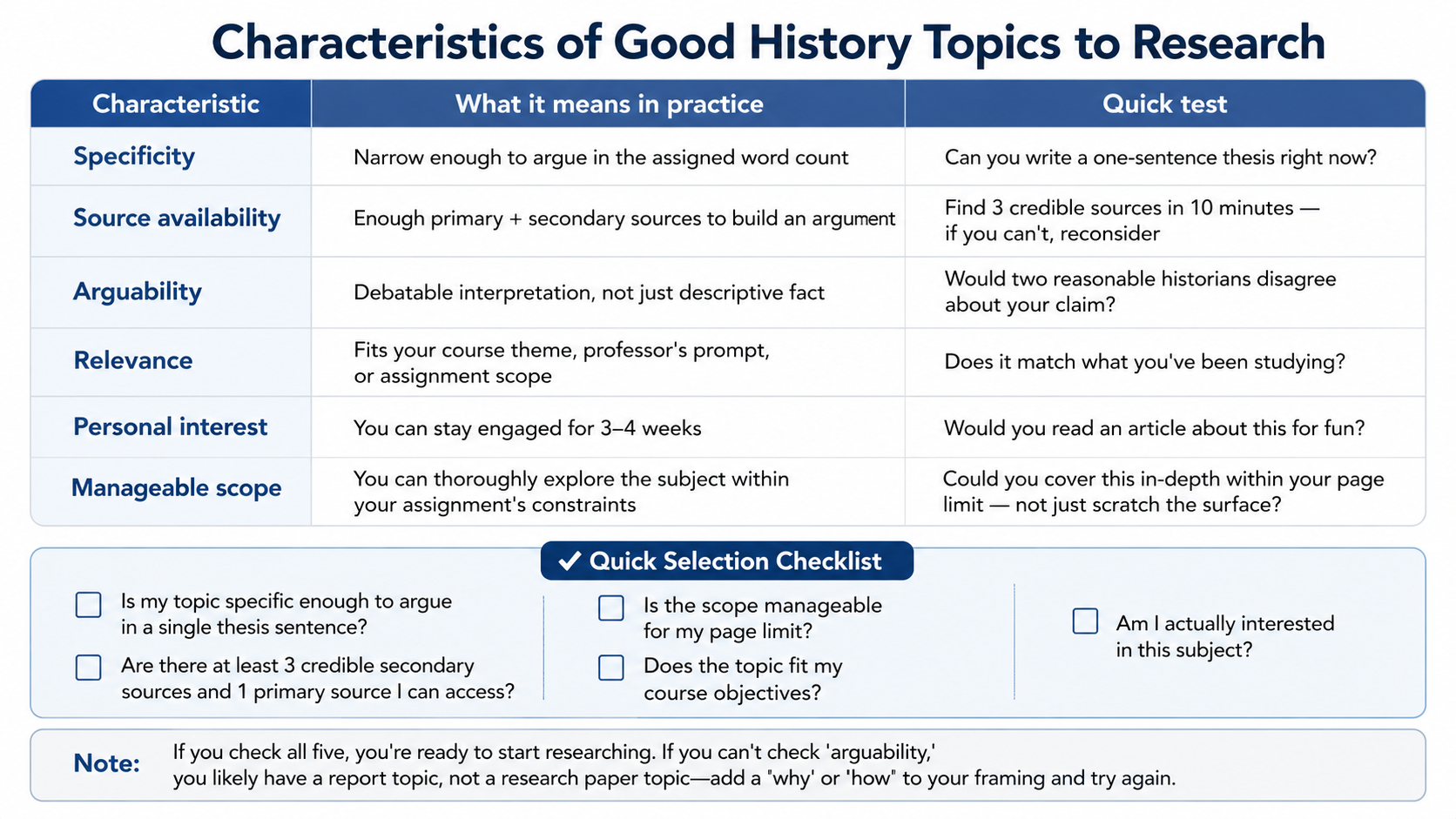
Characteristics of Good History Topics to Research
Not every subject makes a workable research topic. Before committing to any of the ideas below, run your candidate through this checklist. I’ve seen students skip this step and spend three weeks writing themselves into a corner — so it’s worth the five minutes. To be clear about the standard: a good history topic should be interesting to you personally, manageable in scope, relevant to your course, and supported by sufficient reliable sources. When selecting a topic, it also helps to brainstorm a few options first, do a quick scan of background information for each, and stay flexible — sometimes the angle you think you want shifts once you start reading.
Ancient History Research Paper Topics
Ancient history covers roughly 3000 BCE through 500 CE and includes the civilizations of Mesopotamia, Egypt, Greece, Rome, China, and the Americas. It’s a favorite area for college students because primary sources — inscriptions, papyri, legal codes, philosophical texts — are often digitized and accessible. The challenge is that many topics have been covered extensively, so finding a specific angle matters more here than almost anywhere else. The best ancient history research paper topics focus on one civilization, one time period, and one clear analytical question.
Topic ideas:
- How did the concept of divine kingship function as political legitimacy in New Kingdom Egypt?
- Was the fall of the Western Roman Empire primarily economic, military, or political in cause — and which modern historians make the most persuasive case?
- How did Athenian democratic institutions in Ancient Greece exclude women and enslaved people — and what does that exclusion tell us about Athenian values?
- How did the Silk Road change religious practice across Central Asia between 100 BCE and 400 CE?
- What role did agricultural innovation play in the rise of the Mesopotamian city-state?
- How did Roman law establish precedents that shaped medieval European legal systems, and which elements of the Roman legal system survive in modern civil law traditions?
- Did the Trojan War happen? What archaeological and literary evidence supports or contradicts the historical account?
- How did Ancient Egyptian mortuary practices reflect beliefs about the afterlife, and how did those beliefs shift across dynasties?
- What was the political function of Babylonian religious mythology, and how did rulers use it to justify authority?
- How did the Iron Age transformation of farming technology reshape social hierarchies in prehistoric Britain?
- How did Ancient Rome’s republican institutions break down between 133 BCE and 27 BCE — and was the shift to empire inevitable, or the product of specific, avoidable decisions?
- What does the political structure of the Roman Republic reveal about how ancient societies balanced elite power, popular participation, and military authority?
Middle Ages Research Paper Topics
Medieval history (roughly 500–1500 CE) offers rich terrain for examining religion, feudal economics, gender, warfare, and the slow transformation of European political structures. It’s also a period where primary sources range from illuminated manuscripts and church records to legal charters and personal correspondence — making original source analysis very achievable. Topics in this cluster work well for analytical papers because the period is full of genuine historical debates: Was the Church a stabilizing or destabilizing force? Were the Crusades primarily religious or economic? What actually caused the Black Death’s social upheaval?
Topic ideas:
- How did the Black Death restructure labor relations and social hierarchies in 14th-century Europe?
- Were the Crusades motivated primarily by religious faith or economic ambition? Examining the First Crusade (1095–1099)
- How did the House of Medici use banking and cultural patronage to consolidate political power in Florence?
- What role did chivalric ideology play in justifying and regulating medieval warfare?
- How did medieval universities change the relationship between Church authority and intellectual inquiry?
- How did Islamic expansion between 700–1000 CE affect trade, science, and culture in the Mediterranean?
- What does the legal status of women in medieval England reveal about gender and property rights?
- How did the Norman Conquest of 1066 reshape English language, law, and aristocratic culture?
- Was medieval witch persecution primarily about religious deviance, gender politics, or social control — and how does that analysis compare with the Salem Witch Trials of 1692?
- How did Gothic cathedral architecture function as both spiritual expression and political statement?
- How did the Salem Witch Trials of 1692 reflect specific tensions in Puritan New England society — and what do they reveal about the role of fear, accusation, and community conflict in historical events?
World War I Research Paper Topics
WWI (1914–1918) remains one of the most argued-over conflicts in modern history, which makes it ideal for research papers — there’s no shortage of scholarly debate. The most compelling historical research paper topics in this area focus on causation, experience, and consequence rather than just military chronology. The war’s origins, the psychology of trench warfare, the role of colonial troops, propaganda, and the catastrophic peace settlement at Versailles are all areas where historians actively disagree, giving you plenty of room to build an original argument.
Topic ideas:
- Was the assassination of Archduke Franz Ferdinand the cause of WWI, or merely the trigger? What underlying factors made war almost inevitable by 1914?
- How did trench warfare reshape the psychological experience of soldiers, and how did literature respond to that experience?
- How did WWI propaganda in Britain and Germany construct images of the enemy — and what does that tell us about nationalism?
- What role did colonial troops from Africa, India, and the Caribbean play in WWI, and how were they treated differently from European soldiers?
- How did the use of chemical weapons at Ypres change the ethics and laws of warfare?
- Was the Treaty of Versailles (1919) a cause of WWII? Evaluating the “war guilt” clause and reparations
- How did the Eastern Front differ from the Western Front in strategy, scale, and human cost?
- What was the impact of WWI on women’s roles and suffrage movements in Britain and the United States?
- How did the Russian Revolution of 1917 change the course and outcome of WWI?
- How did air warfare in WWI signal a transformation in military technology that would define 20th-century conflict?
World War II Research Paper Topics
WWII is the most documented conflict in history, which is both an advantage and a trap. The abundance of sources is helpful; the risk is writing a paper that restates what everyone already knows. The best WWII history research paper topics go beyond the standard narrative — they examine ethics, decision-making, propaganda, the experience of marginalized groups, and the war’s long aftermath. WWII lasted from 1939 to 1945 and was a genuinely global conflict that reshaped political and social structures worldwide, including leading directly to the establishment of the United Nations. That institutional legacy — the creation of international law and multilateral governance — is one of the most underexplored angles for a research paper. Topics focused on the Holocaust, the Pacific Theater, resistance movements, and post-war consequences tend to produce more analytical papers than broad overviews of battles.
Topic ideas:
- How did the policy of appeasement by Britain and France between 1935 and 1939 contribute to the outbreak of WWII?
- How did Nazi propaganda construct and maintain public support for antisemitic policy between 1933 and 1945?
- What was the strategic and moral reasoning behind the atomic bombings of Hiroshima and Nagasaki — and does that reasoning hold up under historical scrutiny?
- How did the Holocaust proceed through stages of escalation, and what role did ordinary bureaucracy play in enabling genocide?
- What was the military and symbolic significance of D-Day (June 6, 1944) in the European theater?
- How did African American soldiers experience WWII — fighting racism abroad and at home simultaneously?
- What role did women play in WWII — in manufacturing, espionage, and military service?
- How did resistance movements in Nazi-occupied France and Poland operate, and how effective were they?
- What were the long-term geopolitical consequences of the Marshall Plan on Western European reconstruction?
- How did the Nuremberg Trials establish legal precedents for international war crimes prosecution?
US History Research Paper Topics
American history research paper topics are among the most heavily assigned in high school and college courses, which means the risk of writing a generic paper is high. The key is specificity and a clear analytical angle. US history offers exceptional source availability — the National Archives, Library of Congress, and countless digitized newspaper archives make primary source research very accessible. Topics in this cluster work best when they engage with race, power, economics, or the gap between American ideals and historical reality.
The American Civil War (1861–1865) is probably the single most researched event in US history — and for good reason. It resulted in the abolition of slavery and triggered fundamental social and political changes that the country is still working through today. However, that popularity also means a generic paper on “causes of the Civil War” won’t stand out. The topics below push toward more specific, argumentative angles.
Topic ideas:
- What were the primary economic and social causes of the American Civil War, and how did they differ between the North and South?
- How did the Emancipation Proclamation function as a military and political document, not just a moral statement?
- What does the failure of Reconstruction (1865–1877) reveal about the limits of legislative reform without enforcement?
- How did the Gilded Age consolidate economic inequality, and what social movements emerged in response?
- What role did African American soldiers play in WWI and WWII, and how did their service affect the Civil Rights Movement’s momentum?
- How did the Great Depression reshape the relationship between the federal government and American citizens?
- What were the causes and consequences of the internment of Japanese Americans during WWII?
- How did McCarthyism exploit Cold War fear to suppress political dissent, and what were its long-term effects on civil liberties?
- How did the Civil Rights Movement’s strategy of nonviolent direct action work — and where did it reach its limits?
- How has US immigration policy reflected and reinforced racial and economic hierarchies from the Chinese Exclusion Act to the present?
- How did the Weimar Republic’s collapse in 1930s Germany inform American policymakers’ understanding of democratic fragility during the Cold War?
- How did the Industrial Revolution’s spread from Britain to the United States between 1790 and 1860 transform American labor, urbanization, and regional economic inequality?
- How did the printing press’s introduction in Europe in the 15th century reshape religious authority, literacy, and political communication — and what parallels does that transformation have with the internet’s arrival in the late 20th century?
- How did the development and use of nuclear weapons in 1945 permanently alter the ethics and strategy of warfare, and how did the US and Soviet Union manage that reality during the Cold War?
European History Research Paper Topics
European history research paper topics span from the classical world through the 21st century, making this one of the broadest clusters on this page. The most productive areas for research involve the French Revolution, the rise of nationalism, industrialization, fascism, and post-WWII reconstruction. European history has exceptional scholarly literature in English, and primary source archives (British National Archives, French National Archives, Europeana) are increasingly digitized and accessible. Topics that examine the intersection of politics, economics, and ideology tend to yield the strongest papers.
The French Revolution, which began in 1789, is one of the defining events of modern European history — it produced radical social and political change in France and inspired revolutionary movements around the world, establishing liberty, equality, and fraternity as political ideals that governments still invoke today. However, it also generated the Reign of Terror, Napoleon, and a century of instability, which gives you plenty of argumentative angles. Similarly, the collapse of the Weimar Republic in 1930s Germany stands as one of history’s most instructive case studies in democratic failure — a democracy that was legally, procedurally dismantled from within, with implications that historians still debate.
Topic ideas:
- What were the social, economic, and ideological causes of the French Revolution, and which factor was most decisive?
- How did Napoleon Bonaparte consolidate revolutionary gains while also reversing many of them?
- How did the Industrial Revolution transform urban life, labor conditions, and class structure in 19th-century Britain?
- What role did nationalist ideology play in the unification of Germany and Italy in the 1860s–1870s?
- How did fascism rise in Italy, Germany, and Spain, and what social conditions made authoritarian movements appealing?
- What was the significance of the Congress of Vienna (1814–1815) in shaping European political stability for the next century?
- How did the Cold War shape West German identity and the politics of the Federal Republic between 1949 and 1989?
- What does the Dreyfus Affair reveal about antisemitism, nationalism, and justice in Third Republic France?
- How did the Protestant Reformation reshape political authority and social life in 16th-century Europe?
- What were the long-term social and economic consequences of the Black Death on European feudalism?
- How did the collapse of the Weimar Republic (1919–1933) serve as a case study in democratic breakdown — and what conditions made it possible?
- How did the Little Ice Age’s prolonged cooling periods between the 14th and 19th centuries contribute to agricultural collapse, political uprisings, and shifts in European trade?
- How did propaganda techniques in ancient Rome compare with those of early 20th-century totalitarian states — and what does that comparison reveal about the psychology of political control?
- How were psychological and cultural technologies — propaganda, ritual, myth — used to control populations and rewrite national narratives in 20th-century Europe?
Modern History Research Paper Topics
Modern history research paper topics (roughly 1945 to the present) present a different challenge than earlier periods: sources are abundant, but scholarly consensus is still forming on many events. That makes these topics great for argumentative papers — there’s genuine debate to engage with. The Cold War, decolonization, the digital revolution, globalization, and the rise of populism are all areas with strong primary sources, active historiographical debate, and clear real-world relevance. Topics in this cluster work especially well for students interested in political science, international relations, or contemporary policy.
Topic ideas:
- How did the Cold War shape post-colonial state formation in Africa and Southeast Asia?
- What were the root causes of the Arab Spring, and why did democratic transitions succeed in some countries but not others?
- How has economic globalization since 1990 affected labor rights and income inequality in both developing and developed countries?
- What role did social media play in the political mobilization of the 2010s, from Occupy Wall Street to the Arab Spring?
- How has the rise of China as an economic and military power reshaped the post-Cold War international order?
- What were the causes and consequences of the 2008 global financial crisis, and how did different governments respond?
- How did the COVID-19 pandemic expose and worsen existing inequalities in healthcare systems across the world?
- How has climate change begun to function as a historical force — reshaping migration, conflict, and state capacity?
- What explains the resurgence of nationalist and populist movements in Europe and the United States since 2010?
- How did the War on Terror reshape civil liberties, surveillance, and American foreign policy after 2001?
- How did the Space Race between the United States and Soviet Union function as both a technological competition and a Cold War propaganda battle — and which side gained more from it?
- Why did the United States escalate its military involvement in Vietnam between 1964 and 1968, and how did that escalation affect domestic politics and the Civil Rights Movement simultaneously?
- How did the Cuban Missile Crisis of 1962 bring the world to the edge of nuclear war — and what does the decision-making process reveal about the role of individual judgment in avoiding catastrophe?
- How did the Berlin Wall’s construction in 1961 and fall in 1989 function as both physical and symbolic markers of the Cold War’s arc?
- How did the Soviet Union’s collapse in 1991 reshape global politics, European security, and the former Soviet republics’ paths toward democracy or authoritarianism?
Niche and Underexplored History Research Paper Topics
Some of the most original history papers come from areas that aren’t covered in standard survey courses. Environmental history, the history of emotions, comparative colonialism, and climate-driven social change are all active areas of scholarly research with strong source availability — but most students don’t think to look there. Topics in this cluster tend to stand out precisely because professors don’t read twenty versions of them every semester. They also lend themselves naturally to interdisciplinary approaches, drawing on economics, geography, psychology, and anthropology alongside traditional historical analysis.
Topic ideas:
- How did the eruption of Mount Tambora in 1816 trigger global crop failures and famine — and what were the political and migration consequences of that climate shock?
- How did the Little Ice Age drive agricultural collapse and political instability in Europe between the 14th and 19th centuries, and how did different societies adapt?
- What does the history of emotions — how fear, shame, grief, and love were perceived and expressed in specific historical contexts — reveal about social norms in medieval Europe?
- How did British and French colonial economic policies leave different infrastructure legacies in sub-Saharan Africa, and how do those differences shape development today?
- How did psychological and cultural technologies — state propaganda, public ritual, controlled mythology — function as tools of population control in 20th-century authoritarian regimes?
- How do propaganda techniques compare between ancient Rome and early 20th-century totalitarian states, and what does that parallel reveal about the durability of political manipulation?
- How did the Weimar Republic’s democratic collapse between 1919 and 1933 follow patterns that political scientists now use to identify democratic backsliding in contemporary states?
- What role did environmental factors — drought, disease, climate shifts — play in the collapse of complex ancient societies like the Maya, the Bronze Age Aegean, or the Akkadian Empire?
- How has the history of emotions as a field challenged traditional political and military-focused historiography?
- How did colonialism’s economic extraction model differ between settler colonies and extraction colonies — and what were the long-term consequences for post-colonial governance?
World History Research Paper Topics by Country and Region
History doesn’t just happen in textbooks — it happens in specific places, shaped by local memory, national identity, and the particular stories each culture chooses to preserve and argue over. A thread on r/AskHistory asked people from different countries which historical topics their communities “geek out” over, and the answers are genuinely instructive for anyone looking for interesting world history topics to research that go beyond the standard Western-centric syllabus.
The upvoted responses reveal something important: every country has its equivalent of Americans obsessing over the Civil War — a set of historical events so embedded in national identity that people read about them in depth, join reenactment societies, and argue about them at the pub. Understanding those patterns not only gives you great research paper topics; it also reminds you that history looks completely different depending on where you’re standing.
China and Greater China — The Three Kingdoms Period (三國時代, roughly 220–280 CE) is arguably the most discussed era in Chinese popular history, comparable to WWII in the English-speaking world. The Ming Dynasty and early Communist Party history are also heavily studied. The Northern and Southern Dynasties (420–589 CE) have recently gained traction, partly through popular video creators who’ve made the era’s political chaos — and its vivid personalities — accessible to general audiences. What makes this period compelling for academic research is the contrast between the relatively brief Sanguozhi chronicle and the more detailed institutional records of the Eastern Jin era.
England/Britain — Naval and military history dominate, with particular intensity around WWII, WWI’s local Pals battalions, and the English Civil War (often reenacted through organizations like the Sealed Knot). The Anglo-Saxon period draws significant scholarly and amateur interest. Henry VIII’s wives — and more broadly, Tudor political history — remain reliable “serious historian” territory. British naval history, from Nelson to the Dreadnought race, draws interest that extends well beyond the UK.
Australia — The Eureka Stockade (1854), the Anzac campaigns of WWI, convict settlement history, and the story of bushrangers like Ned Kelly are the core obsessions. Australian history has a distinct character: it’s often about identity, frontier violence, and the experience of building a society under difficult conditions — themes with strong parallels in American frontier history but in an entirely different context.
Canada — Canada’s history geeks tend to cluster around the War of 1812 (which Canadians, Americans, and British all remember differently), the Riel Rebellions, the construction of the transcontinental railroad, the Klondike Gold Rush, WWI and WWII contributions, and the Avro Arrow — a cancelled jet interceptor that became a symbol of Canadian technological ambition and political frustration. The Confederation period and the fur trade era also have dedicated audiences.
Ireland — The Great Famine (1845–1852), the Easter Rising (1916), the Irish War of Independence, the Troubles in Northern Ireland, and Viking-era invasions are the dominant historical obsessions. Irish literary history — particularly figures like Wilde and Joyce as windows into late 19th and early 20th century Irish culture — bridges history and literature in ways that generate interesting interdisciplinary papers.
Brazil — The monarchical period (the Brazilian Empire, 1822–1889), the Vargas dictatorship (Estado Novo, 1937–1945), and the military dictatorship of 1964–1985 are the most intensely debated chapters in Brazilian historical memory. Like Germany’s relationship with its Nazi past, Brazil’s relationship with its period of military rule is still actively contested in public discourse — which makes it fertile territory for research papers on democratic transition, memory, and justice.
Türkiye — Ottoman history, Seljuk history, the Islamic Caliphates, the legacy of Atatürk and the founding of the Turkish Republic, and pre-Islamic Turkic history (Göktürks, Hunnic Empire) all attract passionate communities of interest. The divide between those who center Islamic history and those who center secular Turkish nationalism creates active historiographical debate — which is exactly the kind of contested terrain that produces strong research papers.
World history research paper topics from this cluster:
- How did the Three Kingdoms Period’s military strategy and political fragmentation shape Chinese political philosophy for subsequent dynasties?
- What does the Eureka Stockade of 1854 reveal about class conflict, democratic aspirations, and settler identity in colonial Australia?
- How did the Great Famine transform Irish society, emigration patterns, and the relationship between Ireland and Britain between 1845 and 1855?
- How did the Easter Rising of 1916 function as both a military event and a foundational myth for Irish national identity?
- What were the historical roots and long-term consequences of Brazil’s military dictatorship (1964–1985) for democratic institutions?
- How did the Vargas Estado Novo (1937–1945) use populism, nationalism, and corporatism to consolidate power in Brazil?
- How does Canadian memory of the War of 1812 differ from American and British accounts — and what does that divergence reveal about how nations construct historical narratives?
- How did Ottoman state structure change between the 16th and 19th centuries, and what forces drove the empire’s eventual fragmentation?
- How did the Anzac mythology that emerged from WWI shape Australian and New Zealand national identity through the 20th century?
- How did Britain’s naval dominance between 1805 and 1914 shape global trade, empire, and the international balance of power?
- How did the Ming Dynasty’s decision to halt oceanic exploration in the 15th century affect China’s relationship with global trade networks for centuries afterward?
- What does the history of the Irish Troubles (roughly 1968–1998) reveal about the limits of political violence as a strategy for national self-determination?
Here’s the practical version — not a philosophy lecture, just a process that works. When selecting history research topics, students should consider source availability, course relevance, and genuine personal interest — all three together, not just one. I’d also add: stay flexible. The angle you think you want sometimes shifts once you start reading background material, and that’s fine. Changing direction early is far better than forcing a bad angle for twenty pages.
Step 1: Start with genuine interest. Look at the clusters above. Which one makes you want to keep reading? That reaction matters more than you might think. A student who’s curious about their topic writes a noticeably better paper than one who picked something safe. Interest is fuel.
Step 2: Brainstorm two or three options before committing. Don’t go with the first idea. Generate a short list, then spend five minutes checking source availability for each. You’ll often find that your second or third option has better materials than your first.
Step 3: Find the argument, not just the subject. “The French Revolution” is a subject. “Why the Reign of Terror undermined the Revolution’s own ideals” is an argument. For every subject on this list, ask: what’s debatable here? What would two historians argue about?
Step 4: Check source availability before committing. Spend ten minutes on Google Scholar, JSTOR, or your university library database. Can you find at least three credible secondary sources and one primary document? If not, the topic may be too obscure for the assignment.
Step 5: Test the scope against your word count. A 10-page paper can’t cover “all of WWII.” But it can cover “how the Manhattan Project’s scientists responded to the ethical implications of the bomb in 1945.” Match scope to length. The goal is thorough coverage of a narrow question — not a shallow overview of a broad one.
Step 6: Refine the angle. Take your broad topic and add a specific time frame, geographic focus, or analytical frame. That refinement is usually what transforms a mediocre topic into a strong one.
How to Write a History Research Paper That Actually Works
Most history papers fail not because the topic is bad, but because the analysis stays at the surface. Here’s what separates papers that get strong grades from papers that don’t. If you’re short on time or need a model to work from, you can also buy history essay help from professional writers — but the framework below is worth understanding regardless.
Start with a real thesis. Not “The Cold War was an important period,” but “The CIA’s covert operations in Latin America between 1954 and 1973 prolonged authoritarian regimes in ways that contradicted stated American democratic values.” One specific, debatable claim. Everything else — your evidence, your analysis, your structure — serves that claim.
Use primary sources. This is where most students stop short. Secondary sources (books, articles) tell you what historians think. Primary sources (letters, diaries, government records, newspapers, photographs) tell you what people at the time said, believed, and did. That’s where your most original analysis comes from. In my experience, a paper with even two well-analyzed primary sources will outperform one that relies entirely on textbooks.
Analyze causes, consequences, and significance. For every event you discuss, push past description. Why did it happen? Who benefited? What changed as a result? How did contemporaries understand it, and how do historians interpret it differently now? Those questions produce analysis. Listing events produces reports.
Engage with competing interpretations. On almost any interesting topic — the causes of WWI, the morality of colonialism, the legacy of Reconstruction — historians disagree. Strong papers acknowledge those disagreements and explain why they find one interpretation more persuasive. That’s what historiography means in practice.
Cite consistently and correctly. Chicago style is the standard for history. MLA and APA are accepted in many courses. Whatever format your professor requires, apply it uniformly. A free citation generator can save time — just verify the outputs, especially for primary sources and archival materials, where automated tools sometimes make formatting errors. If your assignment requires APA specifically, APA paper writing services can help you format and structure your paper correctly from the start.
How to Find Reliable Sources for History Research
This is the step most guides skip. It’s also where a lot of otherwise good papers fall apart. Here’s where to actually look. If the research process feels overwhelming, an online research paper service can help you build a fully sourced paper from scratch.
For secondary sources (scholarly analysis):
- JSTOR and Project MUSE — The most reliable databases for peer-reviewed history articles and book chapters. Most universities provide free access.
- Google Scholar — Broad and free. Use it to identify key scholars in your area, then find the full text through your library.
- Your university library catalog — Don’t overlook this. Academic books are often the most thorough treatment of a topic you’ll find anywhere.
For primary sources (original documents):
- Library of Congress (loc.gov) — Digitized American newspapers, photographs, government documents, personal correspondence, and historical maps going back to the colonial era. It’s one of the best free archives for localized US source material, and its geographic map collections are especially useful for topics involving westward expansion, the Civil War, or regional political history.
- National Archives (archives.gov) — Federal records, military service files, census data, and policy documents for US history topics.
- Europeana (europeana.eu) — Aggregates digitized primary materials from European libraries, archives, and museums.
- The British Library and Bibliothèque nationale de France — For European history topics, both have extensive digitized collections.
One practical note on Wikipedia: It’s not a citable source, but it’s a legitimate starting point. Follow its footnotes. Find the actual sources it cites. Use those.
For citation formatting across Chicago, Turabian, MLA, or APA styles, a citation generator handles the mechanical work — but always double-check outputs against the style guide before submitting. Automated tools occasionally mis-format archival sources, government documents, and non-English materials.
Revolutions and Political Transformations as Research Topics
Revolutions and political transformations are among the most generative categories in historical research because they sit at the intersection of ideology, economics, social pressure, and individual agency. What makes them especially useful for academic papers is the density of debate: historians rarely agree on what caused a revolution, and even less on whether it succeeded. That built-in disagreement gives you room to build a real argument rather than just summarize events.
The French Revolution (1789), the American Revolution (1776), the Russian Revolution (1917), and the decolonization revolutions of the 20th century are the obvious starting points — but in many ways they’re also the most crowded. Consider instead the Haitian Revolution (1791–1804), the only successful slave revolution in history, which has received far less classroom attention than it deserves. Or the Iranian Revolution of 1979, which transformed regional geopolitics and is still shaping international relations today.
What all successful revolution research papers have in common is a clear thesis about why the transformation happened when it did — not just a description of what changed. The structural conditions were often present for years or decades before the actual break. The interesting question is always: why then?
Topic ideas in this cluster:
- How did the ideology of liberty and equality articulated in the French Revolution of 1789 conflict with the Revolution’s own practice of violence and exclusion?
- Why did the Russian Revolution of 1917 produce a Bolshevik state rather than a liberal democratic one — and what does that outcome reveal about the limits of revolutionary idealism?
- How did the Haitian Revolution challenge and reshape Atlantic world assumptions about race, slavery, and self-governance?
- What made the Iranian Revolution of 1979 a genuinely popular mass movement — and how did it produce outcomes that most of its participants didn’t want?
- How did the collapse of European colonial rule after WWII unfold differently in British versus French Africa, and why?
- How did the Chinese Revolution of 1949 draw on and diverge from Marxist theory in its actual implementation?
Historical Figures as Research Paper Topics
Research on historical figures works best when it moves past biography and into analysis of influence, decision-making, and legacy. A paper that simply recounts Julius Caesar’s military campaigns is a biography. A paper that argues Caesar’s use of popular politics permanently altered how Roman aristocrats legitimized authority — that’s a history research paper. Many historical figure assignments are essentially case studies in leadership, ideology, or consequence; if that format suits your assignment, a case study writing service can help you structure the analysis correctly.
The most productive historical figures for academic research are those whose decisions had large-scale consequences, whose motivations historians still debate, or whose legacies are actively contested. Napoleon, Lincoln, Gandhi, Catherine the Great, Cleopatra, Frederick Douglass, and Mao Zedong all fit this description. What they have in common is that reasonable historians can — and do — disagree about how to evaluate them.
First-person experience note: I’ve found that students who pick historical figures often struggle with the transition from narrating to arguing. The fix is simple — ask not “what did this person do?” but “what does this person’s career reveal about the historical forces of their era?” That reframe almost always produces a better thesis.
Topic ideas in this cluster:
- How did Frederick Douglass use his personal narrative as both autobiography and political argument — and how did his rhetorical strategy evolve between 1845 and 1881?
- Was Napoleon Bonaparte a consolidator of the French Revolution’s achievements or its betrayer? Evaluating the evidence on both sides
- How did Catherine the Great’s use of Enlightenment rhetoric differ from her actual governance practices — and what does that gap reveal about the limits of enlightened absolutism?
- How did Gandhi’s philosophy of nonviolent resistance draw on both Hindu tradition and Western liberalism, and how did that combination shape its reception internationally?
- What does Cleopatra VII’s actual political record — as opposed to her cultural mythology — reveal about gender and power in the late Ptolemaic period?
- How did Abraham Lincoln’s views on race and reconstruction evolve between 1858 and 1865, and what do those changes suggest about the direction of Reconstruction had he survived?
Scientific and Technological Advancements in History
The history of science and technology is one of the most underused research areas in standard coursework — and one of the most generative for original argument. Technology doesn’t just change what people can do; it reshapes social hierarchies, economic systems, and the way people understand themselves and their world. The printing press didn’t just spread information; it undermined the Church’s monopoly on textual authority. The steam engine didn’t just move goods faster; it created industrial capitalism and the modern working class. If you’re looking for a related creative angle, music history paper topics sit at a similar intersection of cultural and technological change — the invention of recording technology, for example, transformed how music was composed, distributed, and experienced as profoundly as the printing press transformed literacy.
Strong papers in this cluster tend to argue that a specific technology had unexpected or underappreciated social consequences — the kind of claim that requires analysis of both the technology itself and the social context into which it was introduced.
Topic ideas in this cluster:
- How did the development of the printing press in 15th-century Europe reshape the relationship between ecclesiastical authority and popular religious practice?
- How did the introduction of steam-powered machinery between 1760 and 1840 transform labor relations, urbanization, and class consciousness in Britain?
- What role did the telegraph play in centralizing political and military command during the American Civil War — and how did that change the nature of the conflict?
- How did the Manhattan Project’s development of nuclear weapons between 1942 and 1945 transform the ethics of warfare and the structure of post-war international relations?
- How did the Green Revolution’s agricultural technologies of the 1960s affect food security, land ownership, and political stability in South and Southeast Asia?
- How has the digitization of historical archives changed what historians can study, and what new methodological questions does that change raise?
Originality in Historical Research: Why a Unique Perspective Matters
Here’s something most writing guides don’t say directly: the difference between a good history paper and a forgettable one is usually not research depth — it’s perspective. Two students can read the same five books about the Civil War and write completely different papers, one of which makes the reader think differently about something they thought they already understood, and one of which doesn’t.
Originality in historical research doesn’t mean inventing new facts. It means bringing a genuinely analytical angle to existing evidence. It means asking a question that hasn’t been asked this way before, or applying a framework from a different field (economics, psychology, environmental science, gender studies) to illuminate events that have been explained only through political or military lenses.
Actually, the most original history papers I’ve encountered usually come from students who found a tension — something that doesn’t fit the standard narrative — and then tried to explain it. Why did this revolution fail when the conditions looked identical to one that succeeded? Why did this leader make a decision that historians agree was strategically counterproductive? Those friction points are where the best arguments live.
A few practical ways to find an original angle:
- Read the historiography first. What have historians already argued about your topic? Where do they disagree? Pick a side — or argue that both sides are missing something.
- Look for the counterintuitive. What’s surprising about this event when you look closely? What does the conventional narrative leave out?
- Apply an unexpected lens. Economic history, environmental history, gender history, and the history of emotions all offer frameworks that can generate fresh arguments about well-worn topics.
- Focus on the margins. The experiences of people who are not at the center of standard historical narratives — women, enslaved people, colonial subjects, ordinary soldiers — often reveal things that top-down political history misses entirely.
Thesis Development in History Research
A history research paper lives or dies on its thesis. Not the topic — the thesis. I’ve seen students pick brilliant topics and write weak papers because they never committed to a specific, debatable claim. Conversely, a seemingly ordinary topic like “the role of propaganda in WWI” can produce an outstanding paper if the thesis is sharp: “British WWI propaganda was more effective at suppressing domestic dissent than at recruiting soldiers, and this distinction is crucial for understanding why the government expanded its propaganda apparatus after conscription began.”
What makes a history thesis strong:
- It’s specific. It names a time period, a place, an event, or an actor — not “throughout history.”
- It’s debatable. A reasonable, informed person could disagree with it. If everyone would agree, it’s a fact, not a thesis.
- It argues causation, significance, or interpretation. Why did something happen? Why did it matter? How should we evaluate it? Those are the three moves a thesis typically makes.
- It’s falsifiable. You can imagine evidence that would disprove it. If nothing could disprove your thesis, it’s not a real claim.
- It guides the paper. Every paragraph, every piece of evidence, every analysis connects back to defending the thesis.
Common thesis mistakes to avoid:
- Too broad: “The Cold War had many effects on international relations.” — This says nothing specific.
- Too descriptive: “The French Revolution began in 1789 and ended in 1799.” — This is a fact, not an argument.
- Too obvious: “Slavery was a terrible institution.” — No reasonable person disagrees; there’s nothing to argue.
- Too sweeping: “Technology always changes society.” — You can’t prove “always.”
One more thing: your thesis can change as you research. That’s normal and healthy. Start with a working thesis, do your research, and revise it based on what the evidence actually supports. The thesis at the end of your drafting process is often quite different — and much better — than the one you started with.
Using Sources Effectively in History Research
The quality of a history paper is directly proportional to the quality and range of its sources. This sounds obvious, but in practice it has specific implications that aren’t always taught clearly.
Primary vs. secondary sources — the real distinction:
Primary sources are materials created during or close to the historical period you’re studying: letters, diaries, government documents, newspaper articles, photographs, court records, speeches. They give you direct evidence of what people did, said, and believed. Secondary sources are analyses written after the fact by historians, scholars, and researchers. They tell you how those events have been interpreted.
Strong history papers use both. Primary sources provide the evidence. Secondary sources provide the context and scholarly framework. A paper that only uses secondary sources is essentially summarizing other people’s arguments. A paper that only uses primary sources without scholarly context risks misinterpreting the evidence.
How to evaluate a source:
- Who wrote it, and why? A government document, a private diary, and a newspaper editorial all have different rhetorical purposes — and those purposes affect how you interpret the content.
- When was it written? A source written decades after an event carries different weight than one written during or immediately after.
- Is it peer-reviewed? For secondary sources, peer-reviewed articles and academic presses (university press publications) are held to higher standards of evidence than general-audience books or websites.
- Does it have citations? Scholarly sources cite their evidence. Sources that make claims without citations are harder to verify and should be used with caution.
Digital archives and what they change:
The digitization of historical archives has genuinely transformed what’s possible in undergraduate research. Newspapers from the 1850s, government correspondence from WWI, photographs from the Civil Rights Movement — materials that required a research trip to a physical archive twenty years ago are now searchable from a laptop. The Library of Congress, National Archives, Europeana, and the British Library’s digital collections make primary source research accessible to students who wouldn’t otherwise have access. That access raises the bar for what a strong paper can actually accomplish.
Historiography: How Historians Study History
Historiography — the study of how history has been written and interpreted — is its own academic discipline, and understanding it makes you a significantly better history researcher. The reason is simple: historians don’t just discover facts. They construct arguments from evidence, and those arguments reflect the concerns, methods, and blind spots of their own time and place.
The same event can look completely different depending on who’s writing about it, when, and from what perspective. The causes of the American Civil War were interpreted very differently by historians in 1900, 1960, and 2020 — and understanding why those interpretations changed tells you something important both about the Civil War and about American society in each of those periods.
Key concepts in historiography:
- Revisionism — When historians challenge the dominant interpretation of an event, often incorporating new evidence or perspectives. Almost all historical progress is revisionist in this sense.
- Whig history — The tendency to interpret the past as an inevitable progress toward the present — a narrative framing that most modern historians consciously resist.
- Social history vs. political/military history — Traditional history focused on states, leaders, and wars. Social history, which emerged strongly in the 1960s–70s, shifted attention to the experiences of ordinary people, marginalized groups, and everyday life.
- Postcolonial historiography — Examines how colonial power relations shaped what was recorded, what was ignored, and whose perspectives were treated as authoritative.
- Digital history — The use of computational methods, digitized archives, and data visualization to ask historical questions at scale. An emerging field with significant methodological debates about what these tools can and can’t prove.
Why this matters for your paper:
When you engage with historiography, you’re demonstrating to your reader — and to your professor — that you understand history as an interpretive practice, not just a set of facts to be reported. That understanding is what separates undergraduate-level work from high school-level work. Citing two historians who disagree about the same event and explaining why you find one argument more persuasive is one of the most reliable moves for a strong history paper.
Last updated: June 2026. Topic clusters reviewed and updated to reflect current scholarly literature, student search patterns, and real-world historical interest data from r/AskHistory.