
We’ve organized current social questions by theme and included writing tips, topic clusters, and helpful tools to make choosing a strong essay topic easier.
Some essays feel like busy work, but social issues essays are different. These topics connect to real life: Can someone afford housing? Get mental healthcare? Face discrimination at work? Find clean water? Their real-world impact makes them important and challenging to write about.
Looking for a title right now? Our essay title generator creates focused social issues essay ideas for your assignment — free, no account needed.
The hardest part isn’t picking a topic; it’s finding your angle. For example, “climate change” is too broad, but “whether carbon trading lets corporations pay to keep polluting instead of changing behavior” is more focused. The key is to make a specific argument, not just name a subject.
Social issues are problems that harm people, communities, or society as a whole. They often come from gaps in education, healthcare, government, or the economy. Some are easy to spot, like high housing costs or gun violence, while others, like the digital divide, develop more slowly. In 2026, important topics include income inequality, rising authoritarianism, school bullying, and the youth mental health crisis.
Writers on r/writing say that economic disparity, fascism, social isolation, and media addiction are the most urgent issues right now. One commenter put it simply: “The rise of fascism and authoritarianism across the world. All other social problems bleed into this one, eventually.”
This guide includes over 150 essay topics, grouped into ten clusters. Each cluster has a brief introduction, a numbered list of topics, and key terms. After the topics, you’ll find advice on choosing your topic, a writing framework, and a full FAQ.
What Are Social Issues?
Social justice is about sharing resources, rights, and opportunities fairly to reduce inequality. The United Nations’ Universal Declaration of Human Rights (1948) lists the basic rights everyone should have. A strong social issues essay topic picks a real problem, takes a clear stance, and uses solid evidence. The best essays link specific examples to the bigger systems behind them.
What Are the Most Important Social Issues Today?
These issues sparked the most debate in 2026. They are well-documented, widely discussed, and make great essay topics.
| Economic inequality | The wealth gap keeps growing. A small group now shapes political institutions. |
| Housing affordability | Rising costs, stagnant wages, and corporate landlords push more families into insecurity. |
| Mental health crisis | Social isolation and housing stress drive up anxiety and depression among young people. |
| Climate change | Environmental harm falls hardest on low-income and minority neighborhoods. |
| AI ethics and bias | AI systems in hiring, healthcare, and criminal justice carry biases that hurt marginalized groups. |
| Digital divide | Poor tech access leaves students and workers behind as more of life moves online. |
| Social atomization | Weakening community bonds fuel loneliness, addiction, and political polarization. |
| Rise of authoritarianism | Democratic backsliding threatens civil liberties and institutional trust globally. |
Climate Change and Environmental Social Issues Topics
Climate change isn’t just an environmental issue; it’s a social one too. It harms public health, puts pressure on economies, and affects the poorest communities the most. Environmental racism happens when polluting industries and climate risks are placed near low-income and minority neighborhoods. This part of the climate crisis is often overlooked, even though it’s well-documented.
Floods, wildfires, and changes in ecosystems cause real humanitarian crises. More than 770 million people don’t have safe water. People forced to move by rising seas and extreme weather face growing legal and political problems, and there’s still no clear system to protect them. Key topics include climate change, global warming, rising sea levels, renewable energy, food production, marine life, developing countries, and indigenous communities.
Essay topics:
- Is carbon trading a real solution to emissions, or does it let corporations pay to keep polluting?
- How does environmental racism put the health costs of industrial pollution on low-income communities — and what legal remedies exist?
- What are the social and political consequences of climate-driven displacement, and how should international law protect climate refugees?efugees?
- How well do youth climate movements produce policy change versus awareness, and what determines which outcome they achieve?
- How does the rise of climate technology change who benefits from the shift away from fossil fuels?
- Should large corporations face legal liability for past contributions to climate change, and what would that look like?
- How do rising sea levels threaten coastal communities in developing nations, and who should pay for adaptation?
- Is sustainable agriculture a realistic way to feed a growing global population, or does it require trade-offs that industrial food systems have avoided?
- How does deforestation harm indigenous communities who depend on forest ecosystems, and what governance structures best protect their rights?
- Does the global push for electric vehicles actually reduce carbon emissions when battery production and grid energy sources are considered?
Economic Inequality and Housing Social Issues Topics
Economic inequality is higher now than it has been in centuries. A small group holds enough wealth to influence politics and weaken democracy. Many families struggle to find affordable housing. Inflation, high land prices, and flat wages make it even harder. Corporate landlords add to the problem. Big investment firms buy many homes, raise prices, and force out long-term residents. These issues are all connected. They show the same crisis from different sides: who owns property, who can live where, and who is excluded.
Key entities: social inequality, income inequality, housing crisis, economic factors, developing countries, consumer culture, labor exploitation, and tax policies.
Essay topics:
- How does the rise of corporate landlords contribute to housing costs and community displacement?
- Is universal basic income a practical answer to job loss from automation, and what do pilot programs show?
- What is the link between the gig economy’s use of “independent contractor” status and the loss of labor rights?
- Does billionaire wealth accumulation challenge democratic principles, and what policies have worked to redistribute it?
- Why does the gender pay gap still exist in 2026, even after decades of legal protections?
- How does economic inequality limit access to quality education, and how does poverty continue across generations?
- What happens to people experiencing housing insecurity beyond homelessness, including effects on mental health and civic participation?
- How does automation make income inequality worse, and who carries the cost of technological job displacement?
- Should progressive taxation be the main tool for reducing wealth concentration, and what does cross-national evidence show?
- How does the informal economy in developing countries complicate standard inequality metrics, and what does that mean for policy?
Racial and Ethnic Inequality Social Issues Topics
Racial injustice blocks access to education, healthcare, and steady jobs. It’s one of the oldest and most debated social issues today. Discrimination based on both race and class can combine, making the impact even worse. Systemic racism isn’t always obvious. It can show up in algorithms, funding rules, and sentencing guidelines that seem neutral but lead to unfair results. These patterns affect millions daily.
Key entities: racial inequality, racial discrimination, racial profiling, minority communities, social inequality, justice system, racial stereotypes, immigration policies.
Essay topics:
- How does systemic racism work through race-neutral institutions — like AI hiring tools, school funding formulas, and sentencing guidelines — and what reforms can address it?
- What has the Black Lives Matter movement actually changed in policing policy — and what evidence tells durable reform from short-term shifts?
- Is racial profiling an effective law enforcement tool or a civil rights violation — and what does the evidence show?
- How does media coverage of racial and ethnic minorities shape public attitudes — and what connects representation to racial bias?
- Should the United States pursue reparations for slavery — and what form would the strongest case support?
- How does racism affect mental health in minority communities — and which culturally specific interventions show the best results?
- How does racial bias in the justice system — from policing through sentencing — produce mass incarceration of minority populations?
- What explains racial gaps in healthcare access and outcomes — and which policy interventions have narrowed them?
- How do microaggressions function as racial exclusion in professional settings — and how should workplaces respond?
- What is the link between immigration enforcement and racial profiling — and how do current immigration policies hit specific ethnic communities hardest?
Gender Equality and Women’s Rights Social Issues Topics
The gender pay gap, fights over reproductive rights, and threats to women’s safety are still major social problems. Gender inequality shows up in formal ways, like unequal pay, unfair laws, and too few women in leadership. It also appears in informal ways, such as domestic violence, beauty standards, and expectations around emotional labor. The best essays on gender link specific patterns to the bigger forces behind them. Beauty standards pushed by social media filters aren’t just personal—they’re a public health issue, connected to more cases of body dysmorphia and eating disorders among teenage girls.
Key entities: gender equality, gender pay gap, domestic violence, reproductive rights, gender disparities, sexual harassment, female genital mutilation, teenage pregnancy, and younger generations.
Essay topics:
- Why does the gender pay gap still exist in 2026 — and how much comes from occupational segregation, discrimination, and unpaid domestic work?
- What is the link between toxic beauty standards, social media filters, and rising rates of body dysmorphia and eating disorders among young women?
- How do reproductive rights restrictions affect women’s economic participation, education, and health — and what does US state-level evidence show?
- What institutional responses to workplace sexual harassment have worked — and has the #MeToo movement produced lasting structural change?
- How does domestic violence connect to economic dependence — and what interventions most effectively help victims leave?
- Is the corporate glass ceiling mainly caused by explicit discrimination, implicit bias, or structural barriers like inflexible work arrangements?
- How does female genital mutilation persist in communities that use modern healthcare in other areas — and what approaches show real results?
- Should women’s sports keep sex-based eligibility rules for transgender athletes — and how should governing bodies handle competing rights claims?
- How does gender inequality in STEM education and hiring repeat itself across career stages — and what interventions break the cycle?
- How does the rise of female entrepreneurship both challenge and reproduce gender norms — and what structural barriers do women founders still face?
Mental Health Social Issues Topics
Social media, isolation after the pandemic, and barriers to care are making mental health problems worse, especially for young people. Mental health issues like anxiety, depression, and substance abuse affect how people work, connect, and participate in modern society. Writers on r/writing pointed out several related crises: media addiction, suicidality, falling birth rates linked to young people’s pessimism, shrinking friendship circles, and more apocalyptic thinking. These aren’t separate problems—they’re all signs of social atomization, where community bonds weaken and individualism grows.
Essay topics:
- How does social media addiction affect teen mental health — and what does the best evidence say about whether the relationship is causal?
- What is the link between social isolation, loneliness, and falling friendship rates among young adults — and what does this predict for public health?
- How does mental health stigma work differently in minority communities — and which culturally adapted approaches best increase treatment-seeking?
- Why is there a growing mental health crisis among healthcare workers — and what institutional factors drive burnout and staff loss?
- How does poverty raise the risk of mental illness — and how does untreated mental illness raise the risk of poverty, creating a cycle that treatment alone cannot break?
- What is the evidence linking climate anxiety to mental health outcomes among young people — and how should educators and clinicians respond?
- How does remote work affect mental health — and how do its benefits and costs fall unevenly across income groups?
- What is the link between opioid addiction and community-level social breakdown — and what does evidence say about harm reduction versus criminalization?
- How does falling literacy and the shift to short-form digital content affect long-term mental health and cognitive development?
- Should mental health services be built into primary care as standard practice — and what do countries that have done this show about outcomes?
Education and Technology Social Issues Topics
Education shapes opportunity, but millions of students still face barriers to good schooling. Technology is making these gaps wider, not smaller. The digital divide means students without reliable internet or devices fall further behind as more learning goes online. AI is also changing education faster than most schools can keep up. Tools like AI tutors, automated grading, and adaptive learning systems promise better results, but they aren’t available everywhere. Often, the schools that need them most can’t afford them.
Essay topics:
- How does the digital divide reproduce educational inequality — and which interventions (devices, broadband, school infrastructure) show the best results?
- Should AI tutors and automated grading be used in schools — and what are the equity implications of schools that can and cannot afford them?
- Is online learning a real substitute for in-person education — and for which students and subjects does the evidence show it works?
- How does standardized testing both reflect and reproduce educational inequality — and what do test-optional admissions experiments show?
- What is the link between student debt, higher education access, and long-term economic mobility — and which reforms have the strongest evidence?
- How does the school-to-prison pipeline target minority students — and which disciplinary policy changes break this pathway?
- Should digital literacy — including media literacy and data privacy awareness — be a required subject in schools?
- How does technology help students with learning disabilities — and what stops these tools from reaching the students who need them most?
- What role does public education play in dismantling racism — and which curricular approaches reduce bias and improve intergroup understanding?
- How does the growth of homeschooling affect social development and civic education — and what are the equity implications of public funding for private educational choices?
Digital Privacy and Technology Ethics Social Issues Topics
Technology is changing daily life and brings up big questions about privacy, equality, and power. Digital tools offer new chances but also new risks, especially when it comes to access and fairness. Hidden biases in AI and machine learning can harm marginalized groups in hiring, healthcare, and criminal justice, often without people realizing it. Data privacy laws haven’t kept up with how companies collect and use personal data. Plus, without universal internet access, most benefits of the digital economy go to those who already have an advantage.
Essay topics:
- Should governments use AI surveillance tools — including facial recognition and predictive policing — and what oversight would make that acceptable?
- How do AI hiring tools disadvantage minority job applicants — and what regulations require algorithmic accountability?
- What are the ethics of data collection by major tech platforms — and do current privacy laws protect users or just look like they do?
- How does online harassment affect young people’s mental health and participation in public digital spaces — and which platform design choices reduce it?
- Should children and teenagers have specific legal protections from social media data collection and algorithmic targeting?
- What does the “right to be forgotten” mean in practice — and how do different legal systems balance personal privacy against the public interest?
- How does misinformation on social media affect public health outcomes — and what responsibilities do platforms have to intervene?
- Is blockchain a viable tool for protecting personal data — and what are the tradeoffs between privacy and accountability?
- Should broadband access be treated as a public utility and a human right — and what would that change in practice?
- What are the ethical duties of AI companies when their systems cause documented harm — and what liability frameworks are being proposed?
Healthcare and Public Health Social Issues Topics
Access to healthcare is a key social issue. Unequal access to medical care leads to big differences in health outcomes. These gaps are caused by social factors like income, housing, race, and location—not just medical issues. Young people are dealing with more mental health problems. Healthcare workers are burned out and face system failures. LGBTQ+ people often face discrimination in healthcare, adding to their challenges. Most healthcare systems focus on treating symptoms, not the social causes of poor health.
Essay topics:
- Is universal healthcare a moral duty for wealthy societies — and which models best balance cost, access, and quality?
- How does vaccine hesitancy vary by community and vaccine type — and which approaches increase vaccination rates without raising distrust?
- What are the healthcare consequences of the opioid crisis — and does evidence support treating addiction as a criminal justice issue or a public health one?
- How does healthcare discrimination against LGBTQ+ individuals affect health outcomes — and what institutional changes create more affirming care?
- What is the link between food insecurity and childhood obesity — and how does food access vary by income and geography in ways that make personal-choice explanations fall short?
- How does climate change affect global health — from expanding infectious disease ranges to heat mortality?
- What are the ethical concerns with personalized medicine — and who actually has access to treatments based on individual genetic profiles?
- How does the healthcare system’s treatment of aging populations reflect and reinforce ageism — and what structural changes would improve care for elderly patients?
- How effective are community health programs in rural areas at closing the gap between urban and rural health outcomes?
- Should telemedicine be expanded as a standard care option — and which populations benefit most, and which face new access barriers?
LGBTQ+ Rights Social Issues Topics
LGBTQ+ rights still face many challenges for lesbian, gay, bisexual, transgender, queer, and other gender-diverse people. Writers on r/writing said that public safety for LGBTQ+ people is one of the most personal and urgent issues they see. One person described how the sexualization of women-loving-women relationships causes real, daily harm. This highlights what makes LGBTQ+ issues different from other civil rights debates—the harm is not just legal or economic, but also about daily safety, visibility, and dignity. Anti-LGBTQ+ laws have increased in several countries, making these issues even more urgent in 2026 than before.
Essay topics:
- What is the link between anti-LGBTQ+ legislation and the mental health of LGBTQ+ youth — and what does research show about laws targeting gender-affirming care?
- How does conversion therapy cause psychological harm — and why does it remain legal in some places despite this evidence?
- What is “rainbow washing” — and how do corporations balance real LGBTQ+ advocacy with performative inclusion for marketing?
- How does LGBTQ+ media representation affect the social attitudes and mental health of young LGBTQ+ people?
- What legal and practical challenges do same-sex couples face in adoption, inheritance, and custody where protections are incomplete?
- How do homophobia and transphobia in sports affect LGBTQ+ athletes’ participation, mental health, and careers?
- Should inclusive education about LGBTQ+ history and relationships be a required part of public school curricula — and what evidence exists for its effects on school climate?
- How does the conflict between religious freedom and LGBTQ+ rights create legal tensions — and what frameworks have courts used to resolve them?
- What mental health challenges do LGBTQ+ youth in rural areas face — including isolation, lack of community, and limited access to affirming care?
- How does the global anti-LGBTQ+ legislative movement operate across borders — and what political conditions make countries vulnerable to this backlash?
Human Rights and Social Justice: Social Issues Topics
Human rights apply to everyone, no matter their nationality, race, religion, sex, or other status. Social justice is about sharing resources and opportunities fairly to reduce inequality. Crime and public safety affect both community stability and personal well-being. Law enforcement and community programs both help build trust. Writers on r/writing pointed to the rise of fascism and authoritarianism as a major threat that makes other social questions harder to solve. They also mentioned disability justice, immigration rights, and extractive capitalism as important but often overlooked concerns.
Essay topics:
- What is the rise of authoritarianism as a global trend — and how does it erode the legal protections that other social justice movements depend on?
- How does human trafficking work as a global industry — and which legal, economic, and social interventions have the best evidence of disrupting it?
- What are the rights of indigenous peoples today — and how do land rights, cultural preservation, and political self-determination interact in current legal disputes?
- Should the death penalty be abolished globally — and what does evidence say about its deterrent effect, racial bias, and risk of executing innocent people?
- What is disability justice — and how does the shift from a medical model to a social model change how we think about accessibility?
- How does child labor persist in global supply chains that serve wealthy-country consumers — and which accountability mechanisms work best?
- How does the global refugee crisis reflect failures of international political cooperation — and what obligations do wealthy nations have toward displaced people?
- What is the link between corporate exploitation and human rights violations — and which governance frameworks hold corporations accountable for supply chain abuses?
- How does mass incarceration in the US function as a social justice issue — including its racial dimensions, economic costs, and effects on families?
- How does anti-intellectualism and anti-science sentiment work as a political force — and what are its social consequences for public health and democratic governance?
Niche and Underexplored Social Issues Topics
These public issues were mentioned in the r/writing thread. They may not make headlines, but they spark strong personal reactions. One commenter listed emotional and economic dependence, social media addiction, and social isolation, along with the pressure for physical and emotional perfection in modern society. Another pointed to social atomization—the breakdown of community and rise of extreme individualism—as the root problem that makes other social challenges harder to fix.
Essay topics:
- What is social atomization — the weakening of community bonds alongside rising hyper-individualism — and how does it drive loneliness, addiction, polarization, and mental illness?
- How do toxic beauty standards and social media filters affect body image among teenagers — and what platform design or regulatory changes could reduce the harm?
- What is the link between falling birth rates in wealthy countries and young people’s economic insecurity, pessimism, and mental health?
- How does social media addiction work as a public health issue — and what does evidence say about its link to suicidality and self-harm among adolescents?
- What is “groupthink and mob mentality” in digital environments — and how do platforms design for virality in ways that punish dissent and amplify conformity?
- What is the social and psychological impact of rising apocalyptic thinking among young people — and how should educators, therapists, and policymakers respond?
- How does falling literacy — the shift from deep reading to short-form digital content — affect civic participation, empathy, and democratic discourse?
- What is the link between economic dependence in relationships or employment and vulnerability to abuse and exploitation?
- How does late-stage capitalism turn human relationships, attention, and identity into transactions — and what are the documented social costs?
- What happens when shared public space disappears — and how do digital substitutes fail to provide the community interactions that keep social bonds alive?
How to Choose a Social Issues Essay Topic
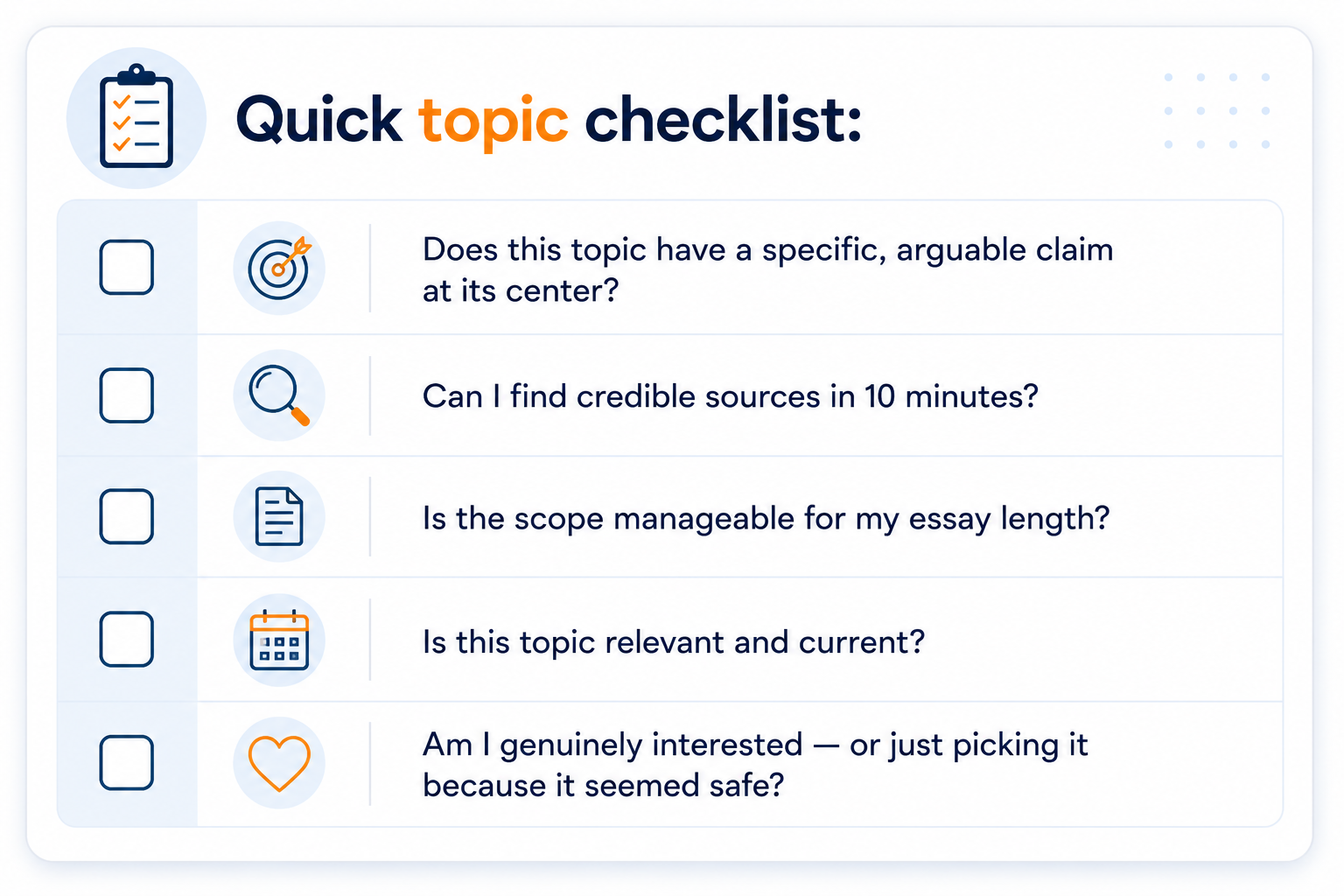
Choosing a social issues essay topic can be tougher than it seems. These five steps will help make it easier.
Step 1: Begin with what matters to you. The best public issues essays come from genuine interest. Don’t choose a trendy topic if it doesn’t interest you. Pick something that makes you feel strongly or sparks your curiosity. That energy will show in your writing. Look through the topic clusters above and see which ones grab your attention.
Step 2: Choose something you can argue. For example, “climate change is real” isn’t an essay topic, but “whether corporations should be legally responsible for past emissions” is. Your topic should make a specific claim that can be debated and needs real analysis, not just description.
Step 3: Make sure you can find sources. Spend ten minutes searching Google Scholar, news databases, or your school library. If you can’t find recent, credible sources, the topic will be hard to write about. You need facts and expert opinions to support your claims—personal opinion isn’t enough.
Step 4: Match your topic’s size to your essay length. “Economic inequality” is too broad for an essay, but “whether the minimum wage should be tied to inflation” is just right. If your topic is too broad, your essay will be shallow. If it’s too narrow, you might run out of things to say. Use the checklist below to help you decide.
Step 5: Keep your topic current. The best topics relate to what’s happening now and have enough evidence to support them. Check recent news, new research, and ongoing public debates to find fresh angles.
How to Write a Social Issues Essay
A social issues essay is not a summary of a problem. It is an argument about a problem — what causes it, what should be done, whether current approaches work, or who is responsible. Here’s how to write one that holds up.
1. Pick a specific angle, not just a subject. “Racism” is a subject. “How AI hiring tools disadvantage Black applicants even without explicit human discrimination” is an angle you can argue and research.
2. Research before you write. Look for academic studies, government data, reputable journalism, and expert analysis. Opinions without evidence are just assertions. Your essay earns credibility through source quality — not the strength of your feelings, though genuine engagement matters.
3. Build your thesis around one supported claim. Not “income inequality is a serious problem” but “the decline of progressive taxation since the 1980s is the primary driver of the US wealth gap, as shown by the correlation between falling top tax rates and rising Gini coefficients.” Specific, arguable, tied to evidence.
4. Use real examples. Statistics, case studies, historical events, and specific policy comparisons persuade more than abstract claims. Writing about the digital divide? Cite actual broadband access gaps by income level. Show their documented effects on school outcomes.
5. Address counterarguments. Strong essays acknowledge the best case against their position. They explain why it is less persuasive. Ignoring counterarguments makes your essay look weak, not confident.
6. Keep a clear, steady tone. Don’t let emotion overwhelm your analysis. Let the evidence carry the weight. Be direct and clear. The facts will do more than rhetorical flourishes.
7. Proofread. Check your facts, verify citations, and read your essay aloud once to catch awkward sentences and logical gaps.
If any step in this process feels like too much, essay writers online can take your topic and produce a fully argued, properly cited essay from scratch.
Last updated: June 2026. Topic clusters reviewed and updated based on current literature, student search patterns, and social discourse from r/writing.