
The best way to study for biology in college is to stop rereading notes and start using active recall and spaced repetition instead.
These methods force your brain to retrieve information, which is what actually builds retention. Passive reading rarely moves the needle in a subject this dense.
In this guide, I’ll give you a structured weekly plan that includes class prep, post-lecture review, practice questions, and an error log.
By the way, practice questions alone should make up 40–50% of your study time before exams.
- Use active recall and spaced repetition instead of rereading notes.
- Review within 24 hours using practice questions and diagram recall.
- Follow a consistent weekly routine with short daily reviews.
- Prepare with timed exam-style questions and an error log.
- Use diagrams and compare-and-contrast tables to simplify complex biology topics.
Study Techniques for Biology
The best way to study biology is to follow a structured system rather than relying on long reading sessions or last‑minute memorization.
Biology is dense and interconnected, so your method must help you recall, connect, and apply information, not just store it.
There is a repeating cycle at the center of effective biology learning:
- Prepare before lessons.
- Participate in class.
- Review after the lesson.
- Reinforce weekly.
This process ensures that information is not simply seen once and then forgotten. Instead, it is actively processed multiple times in different ways to strengthen retention.
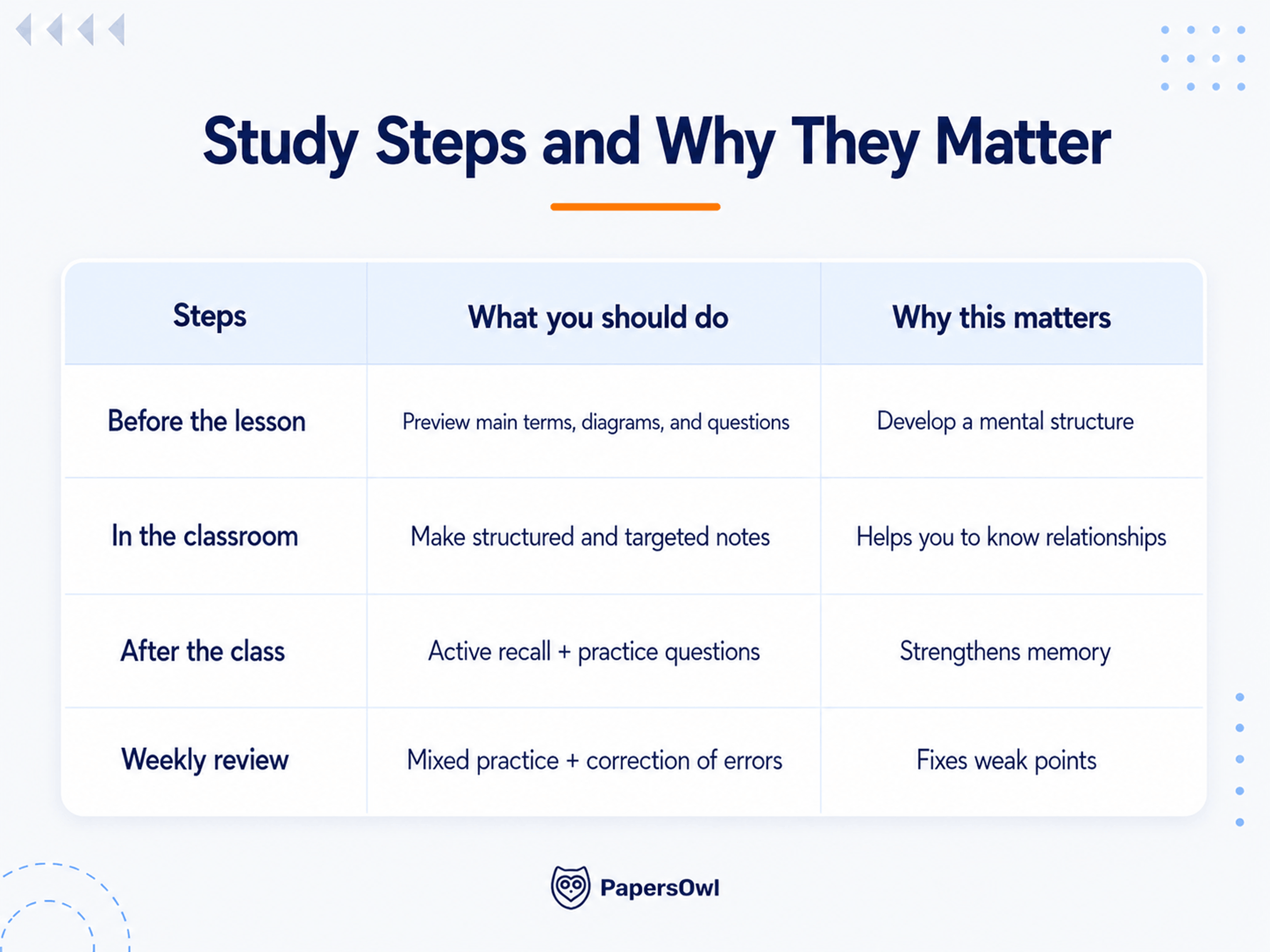
The goal is not to study hard with biology assignments but to study in a smarter sequence!
Before class (10–20 minutes)
A short preparation routine makes lectures significantly easier to understand.
You are not trying to learn everything in advance. Instead, you are building a mental “map,” so your brain knows where new information fits.
Let’s see what you can do before class.
| Step | Method | Example |
|---|---|---|
| 1. Skim structure (3-5 minutes) |
Read headings, subheadings, learning objectives, highlighted/bold terms, and end-of-chapter summaries. Try to get the general flow of the topic without going into details. | Overview of cellular respiration → overview of the different stages, e.g., glycolysis, Krebs cycle, electron transport chain |
| 2. Preview diagrams (5 minutes) |
Look at 1–2 important diagrams before reading or listening. Focus on labels, arrows, and the general process. Then, write a simple one-sentence explanation in your own words about what the diagram shows. | Mitochondria diagram → Illustrates the conversion of glucose to ATP and the stepwise release of energy |
| 3. Vocabulary scan (3-5 minutes) |
Scan the page quickly and mark technical or unknown words. Do not study them deeply yet. Instead, write them down and create very simple flashcards (term → plain-language meaning). Prioritize repeated or highlighted terms. | ATP → energy molecule of the cell
Glycolysis → first step of glucose breakdown |
| 4. Form questions (2-3 minutes) |
Turn headings and concepts into questions that start with how, why, or what’s the difference. Aim for 3–5 questions that guide your attention during class. Focus on mechanisms, not definitions. | Why do cells need ATP and not just glucose?
What is the difference between aerobic and anaerobic respiration? |
| 5. Mini recall (1 minute) |
Close everything down, and try to reconstruct the topic from memory in 30-60 seconds. Determine the main idea, key processes, and one central diagram. If it’s difficult, note what is missing and focus on it during class. | Main idea: energy production in cells.
Key parts: glycolysis, mitochondria, ATP production |
This process takes very little time but has a strong effect on understanding during the lecture. When you already know the general direction of the topic, you can focus on meaning instead of trying to catch every word.
During class
In biology, writing everything down is one of the least effective strategies. It usually creates a false sense of productivity while your actual understanding stays shallow.
The main goal during lectures is not to capture every word but to process information in real time and understand how ideas connect.
Instead of copying sentences, you should constantly ask yourself what is happening, why it happens, and how different parts of the process relate to each other.
- Structured note system (Cornell Style):
| Section | Purpose | How to use it in practice |
|---|---|---|
| Left side | Questions, keywords, prompts | Write quick cues like “enzyme inhibition?” or “steps of glycolysis?” before or during the lecture |
| Right side | Explanations and mechanisms | Summarize processes in your own words, focusing on cause-and-effect rather than full sentences. |
| Bottom summary | Key ideas in your own words | At the end of class, condense the lesson into 3–5 main points without looking at notes. |
This system works because it forces you to translate information rather than just record it. That translation step is where real understanding happens.
- What to focus on:
- How processes work step by step. Break everything into sequences. For example, instead of “cellular respiration,” think: glucose enters → is broken down → energy is released → ATP is formed.
- Why does something happen. Don’t just record facts. Always ask what drives the process. For example, “Why does oxygen increase ATP production?” or “Why does inhibition slow enzymes?”
- Connections between topics. Biology is interconnected. Link new ideas to old ones: DNA → protein synthesis → cell function → organism traits.
- Differences between similar concepts. Many exam mistakes come from confusion between similar ideas. Actively compare them as you learn.
- Simple note symbols:
- ? = unclear concept
- ★ = important for exams
- → = connection to earlier topic
These symbols help you stay active during lectures without slowing down your note-taking, which is especially useful when learning how to take notes for biology.
- Example in practice:
🚫 Do not write a passive statement like:
✅ Do transform it into a mechanism-based note:
This shift forces you to understand why something happens, not just remember that it happens.
- End-of-class 1-minute check. Before leaving class, pause and quickly test yourself:
- What were the 3 main ideas?
- What process was central?
- What is still unclear?
Even this brief reflection improves retention by activating recall immediately after learning.
After class (within 24 hours)
This stage is where most learning is either strengthened or lost.
Biology information fades quickly if it is not reviewed within a day, which is why timing matters just as much as technique — especially when thinking about how to learn biology effectively.
The goal here is simple: retrieve what you learned, test your understanding, and correct mistakes while the material is still fresh.
60–90 minute post-class routine:
| Step | Activity | Time |
|---|---|---|
| 1. Quick cleanup | Fix messy notes, complete missing labels, and clarify diagrams | 5 min |
| 2. Active recall | Answer questions from memory before checking notes | 15–20 min |
| 3. Flashcards | Turn difficult concepts into short Q&A cards | 10 min |
| 4. Diagram practice | Redraw key diagrams without looking | 10–15 min |
| 5. Practice questions | Solve problems + update error log | 20–30 min |
Why does this work?
Active recall is so effective because it forces your brain to retrieve information from memory rather than just recognize it.
Recognition is easy and familiar, but doesn’t establish strong memory pathways. Retrieval, on the other hand, is effortful. And that effort is exactly what makes learning stick.
Repeatedly trying to remember something before consulting your notes enhances long-term retention and alleviates exam anxiety at the same time.
Example error log:
| Mistake | Reason | Fix |
|---|---|---|
| Confused meiosis stages | Mixed up sequence of steps | Create a comparison table of stages |
| Wrong MCQ answer | Misread question wording | Highlight keywords like “except” or “not” |
| Forgot enzyme function | Weak memory association | Add flashcard + redraw enzyme diagram |
Over time, this log becomes a personalized roadmap of your weak areas. Instead of guessing what to study, you know exactly what needs improvement.
Weekly study routine
Biology doesn’t reward heroic all‑nighters. It rewards boring consistency (the academic equivalent of flossing).
A weekly routine keeps concepts fresh, prevents last‑minute panic, and makes exams feel like review, not survival.
A simple weekly routine (repeat every week!):
| Frequency | Duration | Components |
|---|---|---|
| Daily | 10–15 minutes of spaced review |
|
| 2–3 sessions per week | 45–75 minutes each |
|
| Weekly deep review | 60–120 minutes (once a week) |
|
A ready-to-use weekly schedule (example):
- Mon: Post‑lecture routine + 10–15 practice questions.
- Tue: Flashcards + error log retest (15–25 min).
- Wed: Active recall + practice set (60 min).
- Thu: Flashcards + redraw one diagram from memory (20 min).
- Fri: Mixed quiz + error log (45–60 min).
- Weekend: Weekly deep review (60–120 min).
If you follow this, studying biology stops being a mystery and becomes a repeatable workflow!
How each stage of this biology study routine works together
Biology becomes easier when you replace passive reading with structured cognitive learning systems. Thus, each stage supports learning in a different way:
- Preparation reduces cognitive overload.
- Structured notes improve comprehension.
- Active recall strengthens long-term memory.
- Practice questions simulate real exam conditions.
Together, these methods turn biology into a repeatable learning system rather than a matter of unpredictable memorization!
Biology often connects with other scientific areas, and exploring chemistry research topics can help you see how different processes interact on a molecular level. Some students also use “Do My Homework” resources for help with formulas, calculations, and biology-related problem-solving.
Exam Preparation: What Actually Raises Grades
When exams get close, the biggest mistake is “studying harder” by rereading more.
The fastest way to improve scores is to practice the way you’ll be tested: retrieval, application, and timed questions.
If you want a reliable answer to how to study for a biology test, here it is:
practice questions + targeted review + fixing mistakes
7–10 days before the exam: it’s time to build your scoring engine
Collect the test format:
- What’s tested: multiple choice, short answer, diagrams, lab/data interpretation?
- What topics repeat? (Your instructor’s “favorite children.”)
Turn your notes into questions:
- Convert each lecture into 10–20 prompts you can answer without looking.
- Keep them “mechanism-first”: how/why/what happens if…
Start mixed practice early: don’t block by chapter only. Mix topics (cell + genetics + ecology) to train switching (exactly what exams demand).
3–5 days before: practice > review
This is where most score gains happen. A good daily exam-prep session (60–120 minutes):
- Timed practice questions (40–60 min): aim for 30–60 questions or an equivalent set.
- Error log review (15–25 min): identify patterns in mistakes (concept gap vs. careless reading).
- Targeted repair (15–30 min): fix only what’s broken:
- 3–5 flashcards for weak terms;
- 1 diagram redraw from memory;
- 1 mini “compare vs. contrast” table (e.g., mitosis vs meiosis).
High-yield biology topics to drill (because they show up a lot)
- Core processes: photosynthesis, cellular respiration, DNA replication, transcription/translation, cell cycle, meiosis
- Mechanisms & regulation: enzyme kinetics, feedback loops, signal transduction
- Genetics: Punnett logic, inheritance patterns, gene expression basics
- Data interpretation: graphs, experimental design, controls. Ask yourself, “What does this result imply?”
Exam strategies by question type
Different types of biology questions also require different strategies. Instead of using the same approach for every problem, adjust your thinking based on the question’s format.
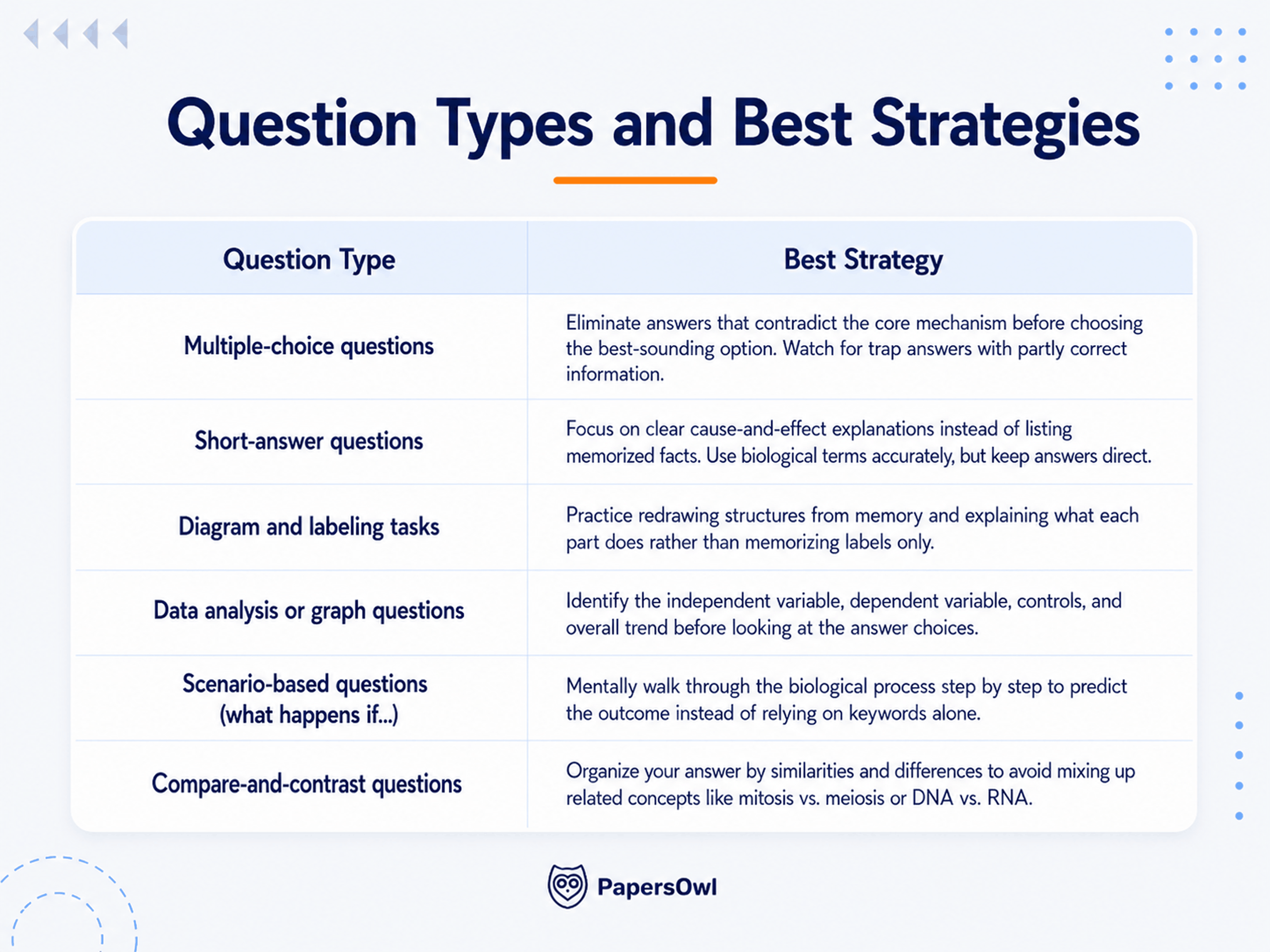
The more your practice matches the actual exam format, the more confident and accurate you’ll become under time pressure.
Last 24 hours: sharpen, don’t cram
- Do a final mixed quiz (30–45 min) to keep retrieval active.
- Review only your error log + hardest cards (the “pain list”).
- Redraw 1–2 must-know diagrams from memory and label them.
- Stop heavy studying early enough to sleep. Memory consolidation loves sleep more than it loves your panic.
Exam-day checklist (quick but real)
If you follow this exam routine, you’ll be using the best way to study biology for grades: consistent retrieval practice, timed application, and systematic correction of weaknesses.
No magic, just method!
8 Additional Tips That Will Make Learning Biology Easier
Biology gets easier when you stop treating it like a list of facts and start treating it like a system of mechanisms.
These practical habits help you learn faster, remember longer, and reduce silly mistakes on exams.
If you still find biology assignments overwhelming, a reliable assignment helper can provide targeted support to ensure you grasp the material and submit accurate work.
1) Make biology visual (even if you “hate drawing”)
You don’t need art skills — you need clarity. For any process-heavy topic (cell cycle, respiration, photosynthesis, gene expression), do this:
- Redraw the core diagram from memory.
- Label each step with one purpose word (e.g., “energy capture,” “signal,” “replication”).
- Add 1–2 “what changes if…” notes (e.g., What happens if oxygen is absent?).
If you can’t recreate the diagram, you don’t own the concept yet. You just recognize it.
2) Learn vocabulary in context, not in isolation
Memorizing terms without meaning is the fastest path to confusion. Instead:
- Use prefix/suffix logic (photo-, mito-, endo-, -lysis, -ase).
- Write one plain-English definition.
- Add one example or consequence (what it affects, where it happens, why it matters).
This makes terminology stick and prevents “I know the word but not the concept” syndrome.
3) Use compare-and-contrast tables for “similar” topics
Many exam questions focus on biology topics that are easy to confuse:
- Mitosis vs. meiosis.
- DNA vs. RNA.
- Prokaryotes vs. eukaryotes.
- Competitive vs. noncompetitive inhibition.
That’s why I create quick two-column tables that compare each topic’s purpose, key steps, outcomes, and common errors. This makes the differences easier to remember and helps you avoid common exam mistakes.
4) Ask mechanism questions (how/why/what-if)
The best way to study biology is to continuously shift from “What is it?” to:
- How does it work?
- Why does it happen that way?
- What changes if one step fails?
This turns passive study into exam-ready thinking — especially for application questions.
5) Use study groups only if they have a structure
Study groups can be great, or they can be social noise with highlighters. Keep them useful:
- One person teaches a subtopic for 5 minutes (no notes).
- The group asks “what-if” questions.
- Finish with 10–15 practice questions and discuss why the answers are right/wrong.
If nobody is being tested, nobody is learning. Harsh, but accurate.

6) Get help early and be specific
“Can you explain this chapter?” is too broad. Instead, bring:
- 2–3 questions you missed.
- Your error log entries.
- One diagram you can’t reconstruct.
Office hours, a tutor, a TA, or a strong classmate become far more effective when you show exactly where you’re stuck.
7) Avoid the biggest productivity traps
- Rereading and highlighting feel productive, but mostly train recognition, not recall. (Adult coloring books are cheaper.)
- Rewriting notes can be useful only if it ends in questions, diagrams, or practice — otherwise it’s busywork.
- Cramming creates short-term familiarity and long-term regret.
8) Protect sleep before exams
Sleep improves consolidation and recall. If you have to choose between one more hour of panicked reading and one more hour of sleep, sleep usually wins on test day.
If you get stuck, don’t just reread. Test yourself first. And if you use support tools like write my homework, treat them as help for understanding, not memorization.
Personal Study Experiences
I’ve always been more interested in study methods that can be tested than those that only feel effective. In biology, repeated reading can create familiarity without real understanding.
A useful analogy I often come back to is wine tasting. You identify the flavors first, then check the label and adjust. Learning biology works the same way.
One student once told me something simple but accurate:
💭 “I thought I knew the chapter until I tried explaining it without my notes — then everything fell apart.”
That moment is actually a good sign. It shows the difference between recognition and real understanding. Another common comment I hear is:
💭 “I can understand the lecture when I read it, but I forget everything in the exam.”
This usually happens when studying focuses on rereading rather than retrieval.
Biology exposes this gap very clearly. If you only reread chapters, you mostly train your brain to recognize information when it looks familiar.
But exams don’t reward recognition. They require recall under pressure. That’s a completely different skill.
The shift happens when students start doing three simple things consistently:
- Explaining a process without looking at notes.
- Redrawing key diagrams from memory.
- Checking answers only after attempting retrieval.
At that point, learning more closely resembles exam conditions.
It doesn’t feel flashy or exciting, but it mirrors how memory actually works. Over time, it shifts from passive reading to active training, which is what biology exams really test.
Preparatory Resources for Studying Biology
The best resources aren’t the “most popular” ones. They’re the ones that match your course level and let you practice retrieval (questions, quizzes, diagrams, explanations).
Use the list below to build a small, reliable toolkit instead of hoarding 27 tabs you’ll never open again.
Free textbooks + clear reference:
- OpenStax Biology (strong for foundations; great diagrams + end-of-chapter questions)
- CK-12 Biology (modular, easy to jump to specific topics)
- NCBI Bookshelf (good for deeper explanations when a concept won’t click)
Video lessons (useful when a topic feels “muddy”):
- Khan Academy Biology (concept clarity + practice)
- Crash Course Biology (fast overviews; best for big picture first)
- Bozeman Science (very exam-friendly explanations)
- Amoeba Sisters (excellent for intro level and visuals)
Interactive visuals + simulations:
- HHMI BioInteractive (high‑quality animations, case studies, data-based activities)
- Learn.Genetics (genetics concepts made concrete)
- LabXchange (interactive learning paths + virtual lab elements)
- PhET simulations (not strictly “bio-only,” but great for diffusion, membranes, and related concepts)
Practice questions (where grades are actually made):
- Your instructor’s past papers/quizzes/review sheets (highest relevance)
- Textbook question sets (especially if they resemble your exam style)
- Khan Academy practice (quick feedback loops)
- AP/IB/A‑Level past questions (if your course aligns with those standards)
Flashcards + spaced repetition:
- Anki (best for serious long-term retention; spaced repetition done right)
- Quizlet (easy to start; good for quick sets)
- RemNote (notes + flashcards in one system)
Keep cards specific and “testable.” If a card can’t be answered in one clean sentence, it’s probably two cards.
Note-taking + concept mapping:
- Notes: Google Docs / OneNote / Notion / Obsidian (pick one and stay loyal)
- Concept maps: CmapTools / Miro / Lucidchart (useful for pathways, cycles, systems)
Choose a few resources that fit your course, use them consistently, and turn what you learn into clear notes, practice questions, and concept maps for later review!
Last Words on Biology Success
The most practical way to study biology in college is to follow a consistent routine built on active recall, spaced repetition, and regular practice. Short, focused sessions work far better than occasional long cramming.
- Each day, review key ideas from memory and check your error log.
- After every class, complete a 60–90 minute cycle: recall what you learned, solve practice questions, and correct mistakes.
- Once a week, do a mixed review to keep older topics fresh and connected.
The real shift happens when studying becomes routine, not when it’s under pressure.
Stay consistent, even with small daily efforts. With time, biology becomes more structured, predictable, and much easier to master.