


This is a practical guide organized by questions. It includes topic lists, writing tips, and advice on finding sources for every level, from introductory courses to thesis projects.
Geology is one of the broadest sciences on Earth, with 4.6 billion years of history, from the first rocks to today’s earthquakes. Because the field is so wide,t this variety also makes geology a. But this variety also makes geology a great area of specialization. “Volcanoes” is not a topic. “How the Siberian Traps eruptions contributed to the Permian mass extinction” is a topic. One gives you nothing to argue. The other gives you a thesis, a debate, and three years of research questions.
This guide offers over 60 geology research paper topics and presentation ideas, organized by question type instead of subfield. Geology topics range from deep Earth processes to surface hazards and planetary science, so there is always something interesting to write about at any course level. Whether you need a topic for a short paper or a full-semester thesis, the structure below will help you find the right fit for your assignment.
What Is Geology?
Geology is the study of Earth’s materials, the processes that shape them, and the planet’s 4.6-billion-year history. It is a wide field with many branches. Topics in geology range from mineral chemistry to ocean floor spreading to the atmospheric effects of volcanic eruptions. Volcanology studies volcanoes and magma movement. Seismology monitors earthquakes and seismic waves. Geochronology uses radiometric dating to assign numerical ages to rock formations. Paleontology studies the history of life through the fossils of plants and animals. Hydrology covers the distribution and movement of water. Geomorphology studies how water, wind, and ice shape landscapes over time. Economic geology locates minerals and resources important for technology and the energy transition. Planetary geology studies the composition and processes of other planets and moons.
The rock cycle describes how rocks constantly transform through melting, cooling, eroding, and compacting. The Law of Superposition states that in undisturbed layers, older rock sits at the bottom. Deep time refers to the concept that Earth changes over billions of years, far beyond any human lifespan. These are the foundations every geology student works from.
What Makes a Strong Geology Research Topic?
Not every geological subject makes a good research paper or presentation topic. Use this table to evaluate your idea before committing.
| Specific focus | One process, region, or time period | “Rocks” or “Earth’s history” |
| Arguable claim | Two geologists could disagree | Pure description with no debate |
| Source availability | Peer-reviewed papers exist | Only general encyclopedias |
| Course relevance | Matches your syllabus level | Too advanced or too basic |
| Current significance | Connects to climate, resources, hazards | Purely historical with no modern link |
One rule that works for every level: The best geology topics connect a specific process or formation to a bigger question, such as hazards, resources, climate, or Earth’s history. For example, “How does karst formation create sinkholes, and which US cities face the greatest risk?” is a stronger topic than just “karst geology.” The question guides your research.
Topics About Geological Processes
These topics look at how Earth works and the mechanisms behind the features we see. They are good choices for papers that explain cause and effect.
- How does plate tectonics drive mountain formation — and what does the creation of the Himalayas reveal about collision zones?
- What causes soil liquefaction during earthquakes, and which types of soil are most vulnerable?
- How does the rock cycle operate — and what happens to rock that gets subducted into the mantle?
- What is coastal erosion, and how do wave action and sediment deposition shape barrier islands over time?
- How does geothermal energy work — and which geological conditions make a region suitable for geothermal power generation?
- How do mantle plumes form — and what is the evidence that Hawaii’s volcanic chain was created by a stationary hotspot?
- What is the difference between ductile and brittle deformation in rock, and how does structural geology map these features?
- How does groundwater move through different rock types — and what determines aquifer recharge rates?
- What causes a sinkhole to form suddenly — and how can geologists predict high-risk areas?
- How does glacial geology shape landscapes — from erosional features like fjords to depositional features like moraines?
Topics in Earth History and Deep Time
These topics explore geology history—what happened, when it happened, and how we know. Deep time is a key idea here: Earth has changed over billions of years, and understanding this record takes special tools and methods.
- What caused the Permian-Triassic extinction event — and what role did the Siberian Traps volcanic eruptions play?
- How do banded iron formations record the rise of oxygen in Earth’s early atmosphere?
- What does the geological record of the Great Oxygenation Event tell us about life’s impact on Earth’s chemistry?
- How did the breakup of Pangea reshape ocean circulation, climate, and the distribution of life?
- What is geochronology — and how do radiometric dating techniques assign numerical ages to rock formations?
- How does the fossil record help reconstruct past climates, ecosystems, and geological events?
- What do fossils found in specific regions reveal about the geological history and past environments of those areas?
- How did the Chicxulub impact event trigger the end-Cretaceous mass extinction — and what is the geological evidence?
- What is the geological history of the Great Lakes — how old are Lake Superior, Lake Huron, and Lake Michigan, and what formed them?
- How do glacial cycles recorded in ice cores and ocean sediments connect to orbital forcing (Milankovitch cycles)?
Topics in Environmental and Applied Geology
Environmental geology links Earth processes to human life. These topics are good for papers about real-world issues like water quality, natural hazards, resource use, and climate impacts.
- How does groundwater contamination spread — and what geological factors determine how quickly pollutants move through aquifers?
- What are the geological risks of coal mining — and how does it affect surrounding ecosystems and water quality?
- How does climate change alter geological processes — including permafrost thaw, glacial retreat, and coastal erosion rates?
- What is soil weathering, and how does it affect agricultural productivity and land use?
- How do natural hazards — landslides, eruptions, earthquakes, tsunamis — interact with urban development?
- What is hydrogeology, and how does it inform decisions about drinking water supply and contamination cleanup?
- How does deforestation accelerate erosion and sediment loading in river systems?
- What is the geological basis for carbon capture and storage — and what rock formations are best suited for sequestering CO₂?
- How does sea level rise driven by climate change interact with coastal geology to increase flood risk?
- What is the environmental impact of rare earth mineral extraction — and how does economic geology balance resource needs against ecological costs?
Topics in Volcanology and Seismology
Volcanoes and earthquakes are powerful examples of Earth’s internal energy. They also make great geology research topics because they combine historical records, field observations, and current monitoring.
- How does Yellowstone’s volcanic history compare to other supervolcanoes — and what does current monitoring tell us about future risk?
- What causes a volcanic eruption to be explosive versus effusive — and what determines lava viscosity?
- How do seismologists use P-waves and S-waves to image Earth’s interior?
- What is the geological structure of the Cascadia subduction zone — and what does historical evidence say about the frequency of megathrust earthquakes?
- How do hydrothermal vents form at mid-ocean spreading ridges — and what do they tell us about ore formation and extreme life?
- What is the relationship between volcanic activity and mass extinction events in Earth’s history?
- How do volcanoes affect climate — and what was the global impact of the 1815 Tambora eruption?
- What caused the eruption history of Mount St. Helens — and how has the landscape recovered since 1980?
Interesting and Niche Geology Topics
These are topics that geology students on Reddit often find truly exciting. They may not appear in standard textbooks, but they are well-researched and usually more memorable to present.
From the r/geology community (top-voted suggestions):
- Glacial geology — Landscape evolution, sea level changes, climate coupling, and drift prospecting for mineral deposits. One commenter called it “the icing on the cake” of Earth science.
- Karst systems — Underground cave networks, sinkholes, and the remarkable features formed by dissolving limestone worldwide.
- Banded iron formations — Ancient chemical records of the shift from an oxygen-free to an oxygen-rich atmosphere.
- Kimberlites — The volcanic pipes that bring diamonds to the surface and what they reveal about the deep mantle.
- The geology of the Great Basin — Basin and range extension that formed mountains through crustal stretching, described as forming “like stretch marks” on the landscape.
- Planetary geology of Europa — The ice-covered moon of Jupiter, its potential subsurface ocean, and what it suggests about life beyond Earth.
- The Permian extinction — The largest mass extinction in Earth’s history, likely triggered by the Siberian Traps.
- Mantle plumes and stagnant lid tectonics — Why some planets develop plate tectonics, and others don’t.
- Pleochroism in minerals — How certain crystals change color when viewed from different angles, and what this reveals about crystal structure.
- Gold mineralization in mid-ocean ridges — How ocean water carries gold through hot rock, concentrates it in quartz veins, and what Bowen’s reaction series explains about this process.
Other niche topics worth exploring:
- What is the Kola Superdeep Borehole — and what did drilling 12 km into Earth’s crust reveal?
- How does the geomorphology of your local region record the last ice age?
- What is pleochroism in minerals — and how does optical mineralogy use polarized light to identify rocks?
- How do banded iron formations record Earth’s oxygen history?
- What is stellar evolution — and how does nuclear physics connect to the origin of Earth’s heavy elements?
Geology Topics for Presentations
Some topics are better suited for a 5–7 minute presentation than for a full research paper. These topics should have a clear visual story, a “wow” factor, and enough content to fill the time without overwhelming your audience.
| Glacial geology | Breathtaking erosional features — fjords, drumlins, glacial lakes |
| Karst underground systems | Cave photography and 3D maps of underground rivers |
| Volcanic eruptions (Yellowstone, St. Helens) | Video footage, hazard maps, eruption comparisons |
| Plate tectonics and the Himalayas | Time-lapse animation of continental drift |
| Banded iron formations | Striking striped rock samples and atmospheric chemistry graphs |
| Hydrothermal vents | Deep-sea video footage and extreme ecosystem photos |
| The Permian extinction | Before/after species diversity charts |
| Geology of your local area | Maps, field photos, personal connection |
| Planetary geology (Europa, Mars) | NASA imagery and comparison with Earth features |
| The rock cycle | Clear diagrams with real rock samples |
A tip from the r/geology thread: The geology of your own area is often the most engaging topic for a presentation. Even the geologic history of a single street corner can be more interesting than you might expect, and your audience will have a personal connection to it.
How to Choose a Geology Research Topic
Geology is so broad that choosing a topic is genuinely hard. These five steps make it faster. For a broader look at research topic selection across disciplines, see our guide to choosing topics for a paper — the same principles apply here.
Step 1: Begin with what surprised you. The best geology assignments start with real curiosity. What in your course made you want to learn more? Was there a process you didn’t understand or a formation that seemed impossible? Use that as your starting point.
Step 2: Link your interest to a real question. Instead of just picking a phenomenon, ask a question about it. For example, rather than “glacial geology,” try “How does glacial geology explain the shape of the Great Lakes?” A question gives you something to explore and argue.
Step 3: Make sure you can find sources. Spend ten minutes searching Google Scholar or the USGS website. If you can’t find at least three peer-reviewed sources, your topic might be too narrow or too new. Try broadening it or choosing a different direction.
Step 4: Consider your course level. For an introductory geology paper, choose topics with clear concepts and data. For advanced papers, you’ll need to engage with original research and methods. Make sure your topic matches your assignment’s level.
Step 5: Talk to your instructor. Geology instructors know the literature in their field. A quick conversation can save you hours of wasted research. They can also point out which topics are overused and which ones have room for new ideas.
If you’ve gone through all five steps and the writing still feels like too much, you can purchase research papers from professional academic writers with subject-matter expertise.
How to Write a Geology Research Paper
A geology research paper uses the usual academic structure, but the content has some special requirements.
Introduction: Clearly state your geological question, explain why it matters, and give a brief preview of your argument. Avoid starting with general statements like “Geology is a fascinating science.” Instead, begin with a specific fact or an unsolved problem.
Literature review: What do geologists already know? Where do current theories disagree? Your paper should enter this conversation — not just summarize it. Cite primary research, not just textbooks. If writing the literature review section feels challenging, a literature review writing service can help you synthesize sources and structure the argument correctly.
Evidence and methods: Clearly explain what kind of evidence you are using, such as field data, rock samples, remote sensing, or published datasets. Describe how the evidence was collected and why it supports your claim.
Analysis: Explain what your evidence shows, then interpret it. What does it mean? Why does this pattern appear? Are there other possible explanations, and why are they less convincing?
Conclusion: Go beyond just summarizing. Explain what your findings mean. What do we now understand better? What questions are still open? What future research could help answer them?
Citation: Geology papers usually use APA or the style required by specific journals, such as GSA Bulletin or Journal of Geophysical Research. Always use a consistent format. Citation generators can help, but double-check the results for field reports, government surveys, and datasets.
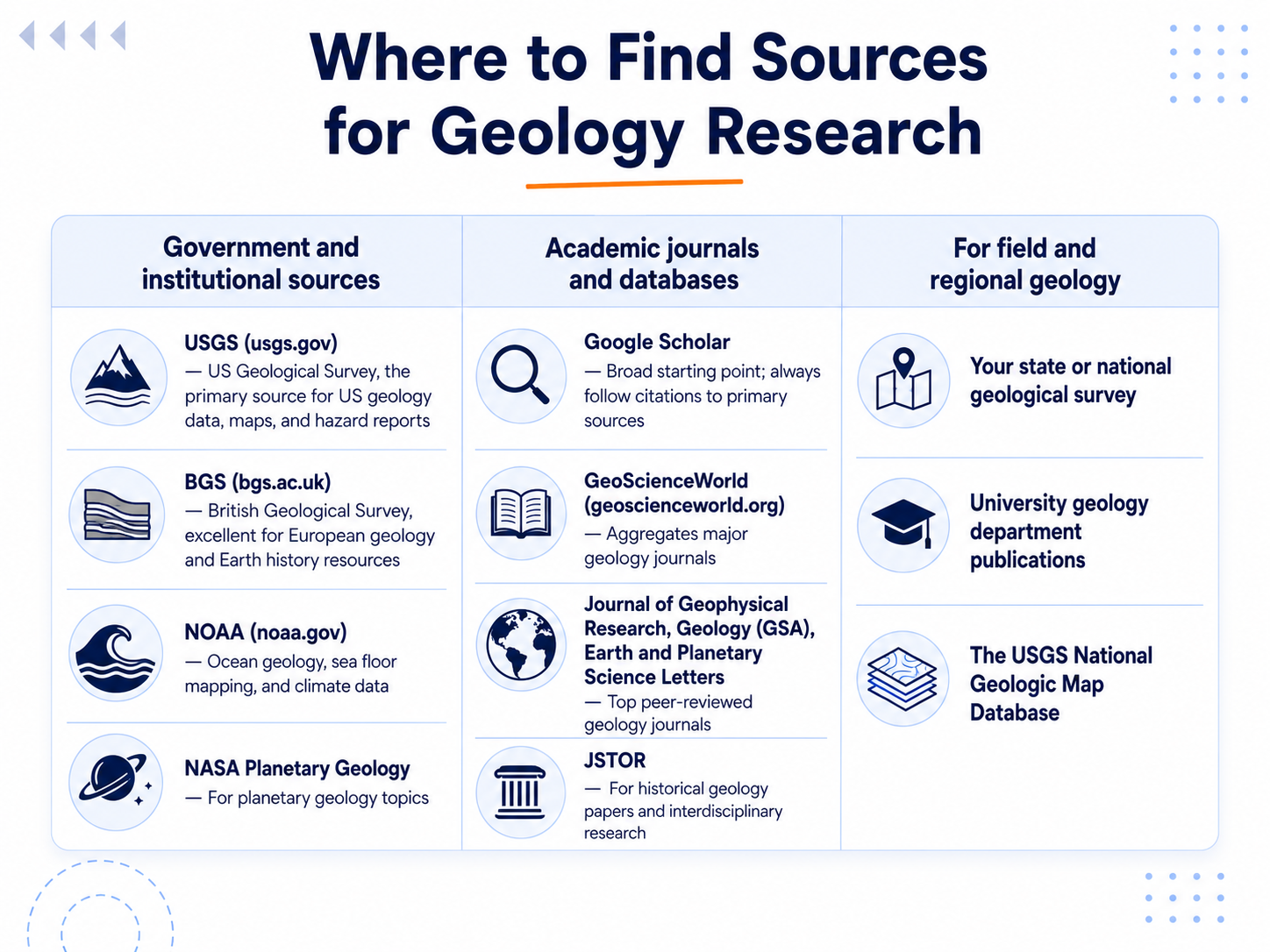
Where to Find Sources for Geology Research
Strong geology research relies on peer-reviewed journals, government surveys, and field data. Here are some good places to start your search.
Last updated: June 2026. Topic lists reviewed and updated for current geology research trends and student needs.