

Budgeting, debt, investing, insurance, and financial planning are organized by concept, not just by category. You’ll also find writing guidance and tips for finding sources.
Most personal finance mistakes are not just bad luck. They usually happen because people don’t know the basics, like how interest works, what a credit score means, or why an emergency fund is important. This knowledge gap makes personal finance a valuable subject to study and write about. Money topics, from budgeting basics to behavioral investing, appear in economics, psychology, business, and public policy courses.
Writing about money is also more challenging than it seems. Personal finance includes everything from daily budgeting to retirement planning and insurance. The real challenge is not just picking a topic, but finding a specific angle that leads to a strong argument.
This guide includes over 70 finance topics, organized by concept. Each section starts with a short definition, a useful fact, and a list of research angles you can argue. You’ll also find writing tips, a source guide, and an FAQ. Whether you need a topic for a short assignment or a semester-long project, you’ll find options for every level. The topics range from personal budgeting to systemic inequality, and each one offers real arguments to explore. Browse the sections and choose the topic that interests you most.
What Is Personal Finance?
Personal finance is the study of how people manage money throughout their lives. It covers six main areas: budgeting, saving, debt management, investing, insurance, and retirement planning. Finance topics range from simple money management to more complex ideas in behavioral economics. Topics like credit scores, emergency funds, and retirement accounts have real, measurable effects. The focus is on decisions made by individuals and households. Financial literacy, which means understanding and managing personal finances well, connects all these areas. It includes skills like budgeting, saving, investing, and managing debt. Over time, students build these habits, moving from basic cash flow management to more complex financial choices.
Personal finance topics for writing can cover anything from how a family budgets for groceries to how policies affect wealth over a lifetime. Personal finance is more than just a practical skill; it is also an academic subject that combines economics, psychology, and public policy. As a research field, it includes topics like how behavioral biases influence investment decisions and how student loan policies impact long-term wealth. These topics are well-sourced and often debated, making them great for research. This variety makes personal finance a flexible choice for academic writing, class discussions, or independent projects. Many finance topics also relate directly to decisions students face in their own lives.
What Makes a Good Finance Topic?
A good topic is specific, can be argued, and is supported by data. If your topic is too broad, your paper will be too general. Use this table to check your idea before you decide.
| Specific claim | Can you write a one-sentence thesis? | “Money is important” is not a thesis |
| Data availability | Government or academic data exists | Only blog posts and opinion pieces |
| Arguability | Two economists could disagree | Pure description with no debate |
| Recency | Connects to current conditions | Based only on pre-2010 research |
| Scope fit | Matches your page limit | Too broad for the word count |
A quick test: Can you name a specific statistic or finding that your paper will use? If you can’t, your topic is probably still too broad.
Personal finance concepts like compound interest, credit utilization, and tax deferral are not just textbook ideas. They can be measured, debated, and are linked to real results.Budgeting and Money Management Topics
Budgeting means assigning a purpose to every dollar you earn. It helps you control your spending and make changes on purpose, not just in reaction to problems. The 50/30/20 rule suggests putting 50% of your money toward needs, 30% toward wants, and 20% toward savings or paying off debt. This rule is often debated in personal finance education. Tracking your income and expenses is a key part of budgeting, helping you understand your cash flow and make better financial choices.
Facts to consider: The 50/30/20 rule is a popular way to budget, but some criticize it because low-income households often spend more than 50% of their income on basic needs. Also, payment history is the largest factor in your credit score, making up about 35% of the total.
- Does the 50/30/20 budgeting rule work for low-income households — and what alternative frameworks have evidence of effectiveness?
- How does tracking spending behavior change actual spending — and what does the research say about digital vs. paper budgeting tools?
- What is lifestyle inflation — and why does it erode savings even as incomes rise?
- How effective are automated savings transfers in improving financial outcomes compared to manual saving decisions?
- What are the barriers to budgeting in households experiencing financial stress — and what interventions address them?
- How do budgeting apps change financial decision-making among young adults — and do the effects last?
- What is the psychology of “mental accounting” — and how does treating money differently based on its source lead to financial mistakes?
Debt Management Topics
Bad debt involves high-interest loans used for depreciating consumer goods. The avalanche method means paying minimums to all creditors and directing extra money toward the highest-interest debt first. This saves money on interest and builds financial stability faster than other approaches. Student loan debt in the US exceeds $1.8 trillion, illustrating the scale of borrowing that often begins before adulthood.
Facts worth citing: Minimizing debt starts with understanding what is owed, to whom, and at what interest rate. The avalanche method consistently outperforms the snowball method in total interest paid, though research shows that psychological factors often lead people toward the snowball approach.
- How does the avalanche method compare to the snowball method in actual debt payoff outcomes — and which psychological factors explain the gap?
- What are the real costs of payday loans — and who uses them, and why?
- How does credit card debt affect long-term wealth accumulation among households earning under $50,000?
- What is the relationship between student loan debt and homeownership rates among millennials?
- How do debt consolidation loans affect long-term borrowing behavior — do they reduce debt or enable more borrowing?
- Should student loan forgiveness programs exist — and who bears the cost and who receives the benefit?
- How does medical debt differ from consumer debt in its effects on credit scores and financial stability?
- What is the financial impact of carrying a car loan versus paying cash, accounting for investment returns foregone?
Credit and Credit Score Topics
Your credit score works like a financial report card, showing how trustworthy you are as a borrower. It is based on your payment history, how much credit you use, how long you’ve had credit, the types of accounts you have, and recent credit checks. A higher credit score means you’ll pay less in interest on loans. Keeping your score high can save you money over your lifetime. Knowing your credit history and debt-to-income ratio is important if you want to borrow money at good or favorable rates.
- How do algorithmic credit scoring models reproduce racial and socioeconomic bias — and what regulatory frameworks address this?
- What is the actual financial cost of a low credit score over a 30-year mortgage versus a high one?
- How does “credit invisibility” — having no credit history — affect financial access for immigrants and young adults?
- Should credit scores be used in employment decisions — and what is the evidence for their predictive validity in that context?
- How does credit utilization actually affect credit scores — and is the commonly cited 30% threshold supported by data?
- What is the relationship between financial literacy education and credit score outcomes in young adults?
Investing and Wealth Building Topics
Asset allocation means spreading your investments among stocks, bonds, and cash, depending on your age and how much risk you can handle. Diversification means spreading your money within each type of investment to lower risk. The most important idea in investing is compound interest. Your returns grow not only on your original investment but also on the returns you’ve already earned. Starting to save for retirement early is important because compound interest helps even small amounts grow a lot over time.
Facts worth citing: The key to investing is understanding compound interest. Most actively managed mutual funds underperform their benchmark index over 10-year periods after fees. A Roth IRA grows tax-free, while a traditional IRA defers taxes until withdrawal, and which is better depends on current versus expected future tax rates.
- Why do most actively managed funds underperform index funds over a 10-year horizon — and why do investors still choose them?
- What is behavioral finance — and how do concepts like loss aversion and anchoring explain predictable investment mistakes?
- Roth IRA versus traditional IRA: which produces better long-term outcomes — and under what income and tax-rate conditions?
- How does access to employer-sponsored retirement plans differ between full-time employees and gig workers — and what are the policy implications?
- What is the “sequence of returns” risk in retirement — and how do different withdrawal strategies address it?
- How does socially responsible (ESG) investing compare in returns to conventional investing — and does the evidence support the premium?
- How do women and men differ in investment behavior — and what explains the gap, and what are its consequences?
- What is the financial impact of starting to invest at 22 versus 32 — using real market return data?
Saving and Emergency Fund Topics
Saving is the cash retained after spending, helping to provide for short-term goals and emergencies. Saving means keeping some of your money after you spend, so you have cash for short-term goals and emergencies. A common guideline is to keep three to six months of living expenses in a separate savings account. Emergency savings act as a financial safety net for things like medical emergencies, car repairs, or losing your job. Having this cushion can lower your stress and help you focus on other financial goals. Start by assessing monthly expenses and determining a realistic savings goal. Automatic transfers to a dedicated savings account make the process easier and more consistent. Experts suggest three to six months of living expenses. That covers your standard of living without resorting to high-interest loans or credit cards.
- What percentage of US households can cover a $1,000 emergency expense — and how has this changed over the past decade?
- How does the recommended “3–6 months of expenses” emergency fund guidance hold up for households with variable income?
- What is the relationship between emergency savings and mental health outcomes — and what does the evidence show?
- How do automated savings programs (like round-up apps or employer programs) compare to manual saving in producing emergency fund accumulation?
- Should emergency funds be held in cash, high-yield savings, or short-term investments — and what does the evidence say about the tradeoff?
- How does financial insecurity affect cognitive function and decision-making quality — and what are the policy implications?
Financial Planning and Goal-Setting Topics
Financial planning is important for anyone who wants to manage their financial future. Setting clear goals gives you a plan to guide your decisions and helps you stay focused. Checking your progress regularly keeps you on track and lets you adjust as your income, expenses, or situation changes. Being proactive and flexible helps you handle financial challenges and work toward long-term security.
- How does having written financial goals affect wealth accumulation outcomes — and what does the research show?
- What is the relationship between financial planning and retirement readiness across income quartiles?
- Does working with a certified financial planner produce measurable returns — and for which types of clients does the evidence show the most benefit?
- How should financial plans account for healthcare cost uncertainty in pre-retirement planning?
- What is the financial consequence of not planning for long-term care — and who bears the cost?
- How does financial planning education in high school affect adult saving and investment behavior?
- How do life events (divorce, disability, job loss) disrupt financial plans — and which strategies provide the most resilience?
Insurance Topics
Insurance is essential for protecting against low-probability events. Insurance protects you from rare but costly events. Common types to consider are health, auto, renters, and disability insurance. It’s important to understand your insurance policies, so you know what is covered and what isn’t. Many people are underinsured or have the wrong coverage because they don’t fully understand their policies. Single major medical event — and how does it compare to annual premium costs?
- How does disability insurance work — and why is it the most underused form of income protection?
- What is the relationship between renters’ insurance adoption rates and income level, and what barriers prevent uptake?
- Should employer-sponsored health insurance remain the dominant model in the US — and what does evidence from other systems show?
- How do insurance gaps affect financial stability for gig economy workers without employer-provided coverage?
- What is the financial case for term versus whole life insurance — and for whom does each product make sense?
Tax and Income Topics
Tax literacy means knowing about deductions, tax brackets, and ways to save on taxes. Knowing how tax brackets work, the benefits of deferring taxes, and the chance for tax-free growth can affect your long-term finances. Income is all the money you receive, such as salaries, bonuses, and dividends. When planning for retirement, you should use tax-advantaged accounts like 401(k)s and IRAs to lower your lifetime tax bill. These accounts help you save for retirement and manage your current taxes.
- How does the mortgage interest deduction actually work — and does it benefit middle-class homeowners or primarily the wealthy?
- What is the long-term financial impact of maximizing a Roth IRA starting at age 22 versus starting at 35?
- How do tax-advantaged accounts (HSA, FSA, 529) reduce lifetime tax burden — and which households benefit most?
- What is the relationship between marginal tax rates and saving behavior — and does evidence support “supply-side” arguments about taxation?
- How does the earned income tax credit affect financial outcomes for low-income working families?
- What are the financial consequences of not understanding tax-loss harvesting in an investment portfolio?
Financial Literacy and Education Topics
Financial literacy means understanding and managing your personal finances effectively. You don’t need a business degree to master personal finance—just a good grasp of the main ideas. Financial literacy includes money habits that develop over time, from managing cash flow to making complex financial choices. Today, financial education is seen as a public good and is often discussed as a policy tool.
- Does mandatory financial literacy education in high schools change adult financial behavior — and what does the evidence from state-level policy experiments show?
- What is the relationship between financial literacy levels and retirement savings outcomes — and is literacy a cause or a proxy for income?
- How does financial education quality vary by school funding — and what are the equity implications?
- What financial literacy topics are essential for high school graduates — and how do current curricula compare?
- How do nonprofit organizations and community programs fill gaps in formal financial education?
- Is financial literacy education enough to close the racial wealth gap — and what structural factors does it not address?
How to Choose a Finance Research Topic
A good topic is specific, can be argued, and is based on data. Here’s a quick way to choose one.
Step 1: Begin with a real question. Think about a money decision you or someone you know has faced. What was confusing? What seemed unfair? What outcome was unexpected? The best personal finance research questions come from real curiosity, not just trying to finish an assignment.
Step 2: Look for data to support your question. Finance relies on real evidence. Good topics use government data (like from the Federal Reserve, BLS, or Census Bureau), academic studies, or industry reports. If you can’t find three reliable sources in ten minutes, try a broader topic or change direction.
Step 3: Narrow to a thesis. “Credit card debt” is a subject. “How credit card interest rates trap low-income borrowers in long-term debt cycles compared to moderate-income borrowers” is a thesis. The test: can someone disagree with your claim?
Step 4: Ensure your topic aligns with your course level. An introductory paper should use simple ideas and clear data. An advanced paper should include academic research and methods. Choosing a topic that is too hard or too easy for your course is a common mistake.
Step 5: Make sure your information is current. Interest rates, tax laws, financial technology, and market conditions change quickly. A paper from 2013 about savings might not reflect today’s reality. Check that your main sources are up to date.
If you’ve picked a topic but the research and writing feel like too much, custom research paper writing services can take the project from outline to finished paper.
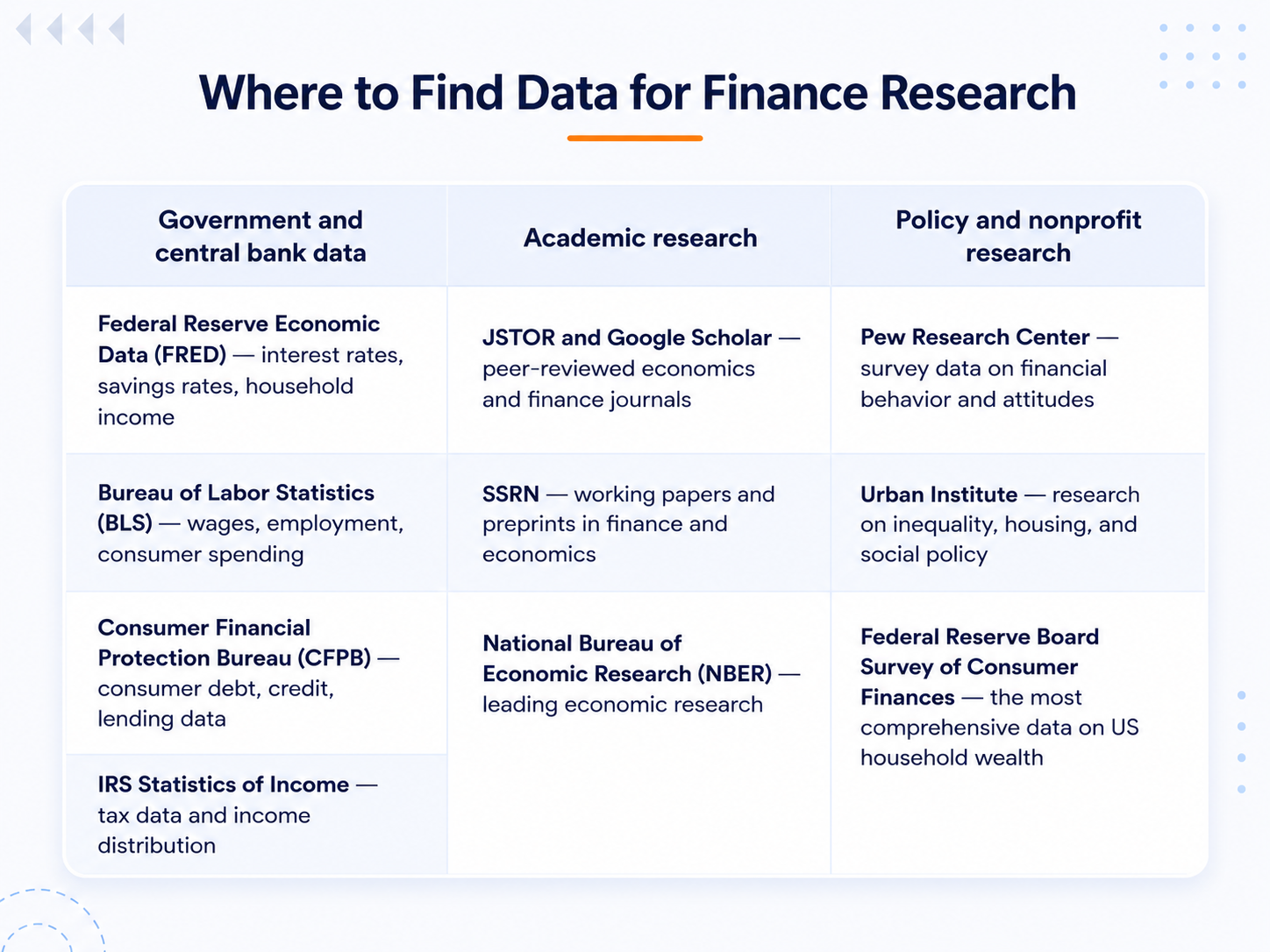
Where to Find Data for Finance Research
Good finance research papers use a mix of government data, academic studies, and reputable institutional sources.
Last updated: June 2026. Topic lists reviewed and updated for current financial research trends and student needs.