
To write a hypothesis in a research paper, state a clear, testable prediction. Show how your variables relate. A strong hypothesis names your independent and dependent variables. It points to one outcome. Data can prove it wrong.
Weak hypotheses share one problem. They’re too vague to test. “Social media affects teens” isn’t a hypothesis. It’s an opinion. Here’s a real one: “Teens who use social media more than three hours daily report lower self-esteem scores than teens who use it less.”
This guide shows you the exact format. You’ll see real hypothesis examples from different fields. You’ll also learn the mistakes that get hypotheses sent back by advisors and reviewers.
What Is a Hypothesis in Research?
Think of it as an educated guess with structure. You state what you expect to find. Then you design your study to check if you’re right. The goal of your research is to confirm or reject this hypothesis, not just describe a topic.
A hypothesis differs from a research question. Your question asks something open-ended. Your hypothesis answers it with one specific, testable claim you can measure.
If drafting your own prediction feels overwhelming next to the rest of the paper, some students choose to pay someone to write my research paper instead of getting stuck on this step.
Hypothesis in a sentence: basic format
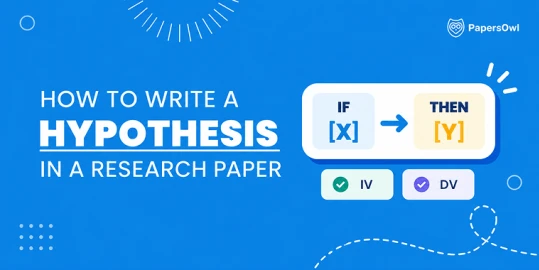
The simplest hypothesis in a sentence follows an if-then format. State your independent variable first. State your dependent variable second.
Example:
“If students increase their study time, then their exam scores will improve.”
Your independent variable is the factor you change or control. Your dependent variable is the outcome you measure. This format keeps your prediction focused and testable from the first draft.
Research Question vs. Hypothesis
A research question and a hypothesis play different roles in your paper. Research questions guide the study from its earliest stage. They open up the topic before you know the answer. Hypotheses state expected relationships between specific variables.
The research question comes before hypothesis in your process. You start broad, then narrow down to one testable claim.
| Research Question | Hypothesis |
|---|---|
| Asks what you want to explore | Predicts expected outcome |
| Written as a question | Written as a statement |
| Does not predict results | Makes a testable prediction |
Example question:
“Does sleep duration affect memory performance?”
Example hypothesis:
“Students who sleep less than 6 hours score lower on memory tests than students who sleep 8 hours.”
Hypothesis vs. prediction
A hypothesis and a prediction aren’t the same thing either. Your hypothesis is the general claim about your variables. Your prediction is the specific outcome you expect to see in your data.
Take this hypothesis: “Sunlight exposure increases plant growth.” Your prediction narrows that down: “Plants exposed to 8 hours of sunlight daily will grow 20% taller than plants exposed to 2 hours.”
The hypothesis frames the relationship. The prediction sets the exact number or result your experiment should show.
Types of Research Hypotheses
Researchers use different types of hypotheses depending on their study design. Knowing the right hypothesis structure for your project saves you time later.
| Type | Definition | Example |
|---|---|---|
| Null hypothesis | States no relationship exists between variables | Sleep duration has no effect on memory |
| Alternative hypothesis | Predicts a relationship between variables | More sleep improves memory |
| Directional hypothesis | Predicts the direction of an effect | More sleep increases memory scores |
| Non-directional hypothesis | Predicts a relationship but not its direction | Sleep duration affects memory |
| Simple hypothesis | Includes one independent and one dependent variable | Exercise affects weight |
| Complex hypothesis | Includes multiple variables | Sleep and diet affect academic performance |
| Causal hypothesis | Predicts a cause-and-effect relationship | Lack of sleep causes lower memory scores |
| Statistical hypothesis | Uses numerical data to test significance | Group A’s average score is significantly higher than Group B’s |
Null hypothesis
The null hypothesis states that no relationship or difference exists between variables. Researchers write it as H0. It’s your default assumption before you collect any data.
Statistical tests exist to challenge this default. Your job is often to disprove the null hypothesis. That’s how you show your results matter.
Example:
“Social media use has no effect on teen self-esteem scores.”
Alternative hypothesis
The alternative hypothesis predicts that a relationship exists between variables. Researchers write it as H1 or Ha. It’s the opposite of your null hypothesis.
This hypothesis comes in two versions. A directional version predicts which way the effect goes. A non-directional version predicts a relationship exists, but doesn’t say which direction.
Examples:
- “Social media use decreases teen self-esteem scores” is directional.
- “Social media use affects teen self-esteem scores” is non-directional.
What Makes a Good Research Hypothesis?
What makes a good hypothesis comes down to five qualities. Miss one, and your hypothesis won’t hold up in review.
- Testable. You can check it through data collection, an experiment, or direct observation. If you can’t measure it, it’s not a hypothesis yet.
- Falsifiable. A strong hypothesis must allow the possibility of being wrong. If no result could ever disprove it, it’s not scientific.
- Specific and clear. Name your population. Name your variables. State the expected outcome in plain terms.
- Based on existing research. Ground your prediction in theory or previous studies. Look for a literature gap your hypothesis can address.
- Measurable. Use real measurement tools and clear operational definitions. Vague terms like “better” or “improved” won’t survive review.
| Weak hypothesis | Strong hypothesis |
|---|---|
| Social media affects students | Increased daily social media use decreases attention scores among high school students |
| Exercise is good | Students exercising 3 times per week show lower stress scores |
Weak hypotheses skip the details. Strong ones name the population, the variable, and the measurable outcome.
How to Create a Research Hypothesis Step-by-Step
Here’s how to start a hypothesis and turn it into something you can actually test.
Step 1: Start with a research question
Your hypothesis comes after you identify a research problem. You can’t skip this step.
Research question example:
“Does sleep affect academic performance?”
Step 2: Conduct preliminary research
Check existing literature before you write anything. Look at established theories in your field. Review previous findings on your topic.
This groundwork keeps your hypothesis grounded in evidence, not guesswork. If the reading feels like too much on top of everything else, some students turn to research paper writing services from professional writers at this stage.
Step 3: Identify variables
A testable hypothesis needs two variables: independent and dependent. Your independent variable is the factor you manipulate. Your dependent variable is the outcome you measure.
Step 4: Define population and measurement tools
This is where you learn how to create a hypothesis that holds up under scrutiny. Decide who is studied. State your population clearly.
Then define how variables are measured. Name your instrument, scale, or test.
Step 5: Predict the relationship
Decide what kind of relationship you expect. It could be positive, negative, or none at all.
A positive relationship means both variables increase together. A negative relationship means one rises as the other falls. No relationship means you expect no connection.
Step 6: Write the hypothesis statement
Write your hypothesis in present tense. Keep it to one sentence. Use clear, direct wording.
Three formats work well:
- If-Then: “If students sleep more, then their exam scores improve.”
- Relationship: “Sleep duration positively affects exam scores.”
- Comparison: “Students who sleep 8 hours score higher than students who sleep 5 hours.”
Step 7: Test and refine your hypothesis
Now here’s how to make a hypothesis stronger before you submit it. Remove vague terms like “better” or “affects.” Check that it’s testable. Make sure it’s falsifiable — data could prove it wrong.
Use PICOT Framework to Develop a Research Hypothesis
The PICOT framework helps you build a hypothesis with no missing pieces. Each letter stands for one required element.
P — Population. Who are you studying?
I — Intervention. What factor or treatment are you testing?
C — Comparison. What’s the alternative or control group?
O — Outcome. What result are you measuring?
T — Time. Over what period does this apply?
Example:
“Among college students (P), does mindfulness training (I), compared with no training (C), reduce anxiety scores (O) after 8 weeks (T)?”
Run your draft hypothesis through these five questions. If you can’t answer one, your hypothesis needs more detail.
Research Hypothesis Examples
Every research hypothesis example looks different depending on the field. Here’s how the same structure adapts across disciplines, paired with its null hypothesis.
| Research area | Hypothesis | Null hypothesis | Variables |
|---|---|---|---|
| Psychology | Teens who use social media more than 3 hours daily report lower self-esteem scores than teens who use it less | Social media use has no effect on teen self-esteem scores | IV: social media use / DV: self-esteem score |
| Education | Students who study 2+ hours daily score higher on final exams than students who study less than 1 hour | Study time has no effect on final exam scores | IV: study time / DV: exam score |
| Biology | Spinach plants exposed to 8 hours of sunlight show higher photosynthesis rates than plants exposed to 2 hours | Sunlight exposure has no effect on photosynthesis rate in spinach | IV: sunlight exposure / DV: photosynthesis rate |
A good hypothesis example names the population, states a direction, and picks a measurable outcome. Here’s why these work — and why similar-sounding versions fail.
Example 1
Weak: “Emotional intelligence affects relationships.”
Strong: “Adults with higher emotional intelligence scores report higher relationship satisfaction scores than adults with lower emotional intelligence scores.”
Why it works: Names the variable (EI score), the population (adults), and a measurable outcome (relationship satisfaction score) — not just “better relationships.”
Example 2
Weak: “Minimum wage affects unemployment.”
Strong: “Cities that raise the minimum wage by 10% see a 2% increase in youth unemployment within one year.”
Why it works: Specific numbers, a defined population (youth), and a timeframe (one year) make this testable and falsifiable.
Example 3
Weak: “Non-native species disrupt ecosystems.”
Strong: “Lakes with introduced non-native fish species show a 30% drop in native fish biodiversity within five years.”
Why it works: Names the mechanism (introduced fish species), the measurable outcome (biodiversity drop), and a timeframe.
Common Mistakes When Writing a Hypothesis
Even careful researchers fall into these five traps. Avoid them, and your hypothesis holds up under review.
- Vague statements. “Social media affects teens” says nothing measurable. Name the variable and the direction.
- Opinions instead of predictions. “Exercise is good” is a belief, not a hypothesis. Predictions can be tested. Opinions can’t.
- Impossible-to-test claims. If no experiment or dataset could check your claim, it’s not a research hypothesis yet.
- Missing variables. Every hypothesis needs an independent and a dependent variable. Skip one, and reviewers will ask you to redo it.
- No connection with research question. Your hypothesis must answer the question you set out to explore. If it drifts off-topic, rewrite it.
Conclusion
Writing a hypothesis in a research paper comes down to one skill: turning a vague idea into a testable claim.
A strong hypothesis makes the rest of your paper easier to write. Your methodology follows from it. Your results section tests it directly. Get this one sentence right, and everything downstream gets simpler.
If you’re stuck at any step, a paper writing service can help you refine your draft before submission.