

Good economics essay topics include the impact of AI on wage inequality, carbon pricing effectiveness, behavioral nudges in public health policy, and the long-term effects of student debt on consumption.
The best topic is one where you can form a clear, debatable argument backed by data. “Inflation is bad” isn’t a thesis. “Supply-side inflation disproportionately harms low-income households because wage growth consistently lags price “increases” — that’s a thesis.
This guide has 250 ideas sorted by field — macro, micro, behavioral, labor, environmental, and more — for high school through college levels.
Top 10 Interesting Economics Essay Topics in 2026
These ten topics are the most relevant and searched in economics right now — each tied to a real shift happening in global markets, policy, or consumer behavior.
- How AI Widens the Wage Gap in Manufacturing. AI and automation are polarizing skill sets — high earners pull further ahead while routine jobs disappear.
- Why CBDCs Threaten Traditional Banking Models. Central bank digital currencies could bypass commercial banks entirely.
- The Hidden Economic Cost of Climate Migration. Displaced populations strain both origin and host country economies in ways standard GDP metrics don’t capture.
- Carbon Tax vs. Cap-and-Trade: Which Actually Works? Both aim to cut emissions — but their economic incentives work differently.
- Post-COVID Inflation: Supply Shock or Policy Failure? Was the inflation spike structural or a result of excess stimulus?
- Protectionism Is Back — What Does It Cost Consumers? Rising tariffs are reshaping global supply chains and pushing prices up domestically.
- The Green Economy Transition: Who Bears the Cost? Moving away from fossil fuels creates winners and losers across income groups.
- Gig Work and the Illusion of Economic Freedom. Flexible labor looks attractive until you account for missing benefits and income volatility.
- Income Inequality as a Brake on Economic Growth. Rising inequality isn’t just unfair — research suggests it actively slows GDP growth.
- Housing Market Crises and the Failure of Government Regulation. From Dublin to Toronto, housing markets are failing the same way for the same reasons.
If you can’t form a clear argument around it, keep looking. If you’re stuck and need a hand, a paper writing service can help you move faster.
Economics Essay Topics by Academic Level
The right topic depends on your level. High school essays need a clear, debatable question with accessible sources. College papers require economic theory, empirical data, and original framing.
High school economics essay topics
These work well for introductory, AP, and IB economics courses — focused enough to argue clearly, relevant enough to find strong current sources.
- Should governments cap the price of essential goods during inflation?
- Does raising the minimum wage actually reduce poverty — or just shift it?
- Why do developing countries stay poor even when they receive foreign aid?
- Is free trade good for workers, or just for corporations?
- How does population growth strain public services and national budgets?
- Should student loan debt be forgiven? The economic case for and against.
- How do big tech monopolies affect prices and consumer choice?
- Does economic growth always improve quality of life?
- Why do women still earn less than men — and what does economics say about it?
- Should governments tax unhealthy food to reduce healthcare costs?
- How does tourism affect a small country’s economy long-term?
- Is economic growth compatible with environmental sustainability?
- What causes hyperinflation — and how do countries recover?
- How does corruption slow economic development in emerging markets?
- Should wealthy nations pay climate reparations to developing economies?
College-level and economics extended essay topics
These economics paper topics suit undergraduate, graduate, and IB extended essay research. They demand engagement with economic models, real data, and academic literature.
- Monopsony power in low-wage labor markets: evidence and policy implications.
- How does financial market liberalization affect income distribution in developing countries?
- The economic case for a four-day work week: productivity, welfare, and firm costs.
- Evaluating carbon pricing mechanisms: efficiency vs. political feasibility.
- How do remittances affect macroeconomic stability in labor-exporting economies?
- Platform economics and antitrust: do traditional market failure frameworks still apply?
- The long-run effects of austerity on economic growth and social welfare programs.
- How does access to microfinance affect women’s economic empowerment in fragile states?
- Debt sustainability in emerging markets: lessons from recent sovereign crises.
- The economics of demographic decline: aging population, labor shortages, and pension systems.
- Does foreign direct investment accelerate or distort economic development in host countries?
- Universal basic income: what pilot programs actually tell us about labor supply effects.
- How do housing market crises transmit into broader financial crises?
- The political economy of trade protectionism: who wins, who loses, and why it persists.
- Behavioral nudges in public policy: measuring real-world effectiveness beyond lab results.
Economics Essay Topics by Field
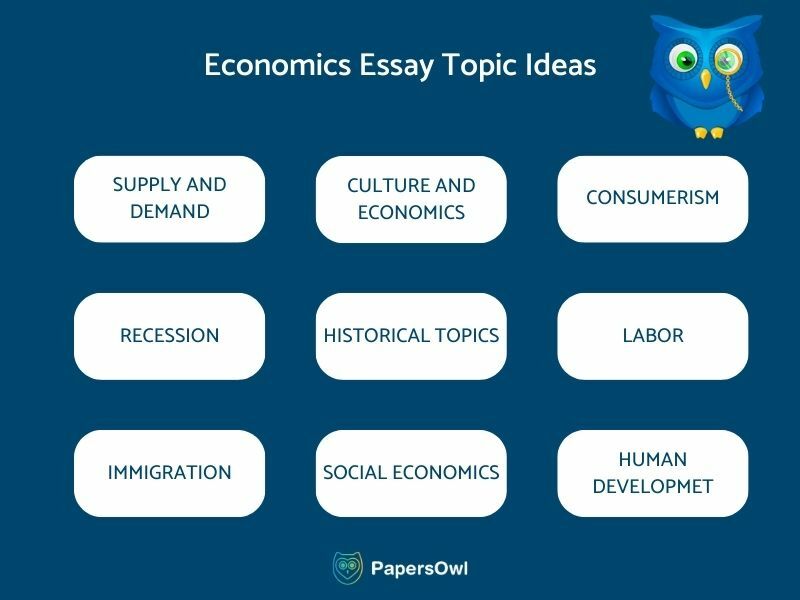
Economic history topics
Economic history connects past turning points to the systems we live in today. The best topics in this field don’t just describe what happened — they ask why it still matters.
- The Industrial Revolution and the origins of modern income inequality.
- How the Great Depression reshaped the relationship between governments and financial markets.
- The economic legacy of colonialism: why wealth gaps between nations persist 60 years later.
- Bretton Woods and the dollar: how one 1944 agreement still shapes global trade today.
- The oil shocks of the 1970s and the birth of stagflation as an economic concept.
- How World War II accelerated women’s entry into the labor market — and what happened after.
- The economic collapse of the Soviet Union: planned economy failure or deliberate dismantling?
- Japan’s lost decade: what two decades of stagnation teach us about monetary policy limits.
- The 2008 financial crisis: did regulatory failure or market greed cause it — and does the distinction matter?
- How the Marshall Plan shaped Western Europe’s postwar economic development model.
- The economic roots of the Arab Spring: inequality, unemployment, and food prices.
- How hyperinflation in Weimar Germany created the political conditions for fascism.
- The economic transformation of China 1978–2010: state capitalism or controlled liberalization?
- What the Black Death taught us about labor markets: wages, scarcity, and worker bargaining power.
- The role of the slave trade in financing Britain’s Industrial Revolution.
Microeconomics and macroeconomics essay topics
Macroeconomics looks at the whole engine — growth, inflation, unemployment, monetary policy. Microeconomics zooms into individual decisions: firms, households, markets. Both matter for understanding how economic systems actually work.
- Why central banks struggle to control inflation without triggering recession.
- The limits of GDP as a measure of national economic well-being.
- How quantitative easing reshaped wealth distribution in developed economies.
- Fiscal policy in a low-interest-rate world: does government spending still stimulate growth?
- The economic consequences of aging populations on pension systems and labor markets.
- How housing market crises transmit into broader financial crises and economic recessions.
- Why emerging markets are more vulnerable to global financial crises than developed ones.
- How information asymmetry creates market failures in insurance and credit markets.
- The economics of platform monopolies: network effects, lock-in, and consumer welfare.
- Why minimum wage laws produce different outcomes in different labor market structures.
- Small business survival in the age of e-commerce: market structure and competitive dynamics.
- The economics of addiction: rational choice theory meets behavioral reality.
- Monopsony in modern labor markets: Amazon warehouses, fast food chains, and wage suppression.
- How market failures in education justify — or complicate — government intervention.
- The economics of attention: social media platforms, behavioral economics, and consumer behavior trends.
Managerial economics topics
Managerial economics applies economic theory to real business decisions — pricing, production, risk, and strategy. It’s one of the most practical fields in the discipline, and one that most topic lists skip entirely.
- How airlines use dynamic pricing to extract maximum consumer surplus — and what it reveals about price discrimination.
- The economics of subscription models: why companies are abandoning one-time sales.
- Cost-benefit analysis in corporate climate commitments: when ESG is strategy and when it’s signaling.
- How firms set prices in oligopoly markets — and why price wars are usually rational.
- The economics of talent retention: why paying above market rate can reduce total labor costs.
- Make-or-buy decisions in global supply chains: transaction cost economics in practice.
- How behavioral economics shapes product design — default options, friction, and conversion.
- The economic logic behind loss-leader pricing in retail and e-commerce.
- Risk management and economic uncertainty: how firms hedge against exchange rate volatility.
- The economics of brand value: what makes intangible assets worth billions on a balance sheet.
- Vertical integration vs. outsourcing: economic trade-offs in manufacturing and tech.
- How firms in emerging markets compete against multinational corporations — and sometimes win.
- The economics of corporate lobbying: rent-seeking, regulatory capture, and market outcomes.
- Capacity utilization and pricing decisions in capital-intensive industries like aviation and energy.
- The economic case for — and against — paying CEOs 300x the median worker salary.
Behavioral economics essay topics
Behavioral economics studies why people make irrational economic decisions — and how that irrationality is actually predictable. It’s one of the fastest-growing fields in economics, with direct applications in public policy, product design, and financial markets.
- Why default options are more powerful than incentives in shaping economic behavior.
- The economics of procrastination: why people undersave for retirement even when they know better.
- How loss aversion explains consumer resistance to dynamic pricing.
- Nudge theory in public policy: what works, what backfires, and why context matters.
- The psychology behind buy-now-pay-later schemes and household debt accumulation.
- How social comparison drives consumer spending — keeping up with the Joneses as an economic force.
- Confirmation bias in financial markets: how it creates bubbles and delays corrections.
- The economics of gambling: why people consistently make statistically losing bets.
- Sunk cost fallacy in corporate decision-making: when firms throw good money after bad.
- How subscription fatigue is reshaping consumer behavior and revenue models.
- The economic impact of choice overload: when more options reduce consumer welfare.
- Anchoring effects in salary negotiations and real estate pricing.
- How scarcity messaging drives impulse purchases — and what it costs consumers long-term.
- The behavioral economics of climate action: why people support green policy but don’t change behavior.
- Dark patterns in UX design: how tech companies exploit cognitive biases for profit.
Healthcare economics essay topics
Healthcare markets don’t behave like normal markets — and that’s exactly what makes them worth studying. Information asymmetry, third-party payment, and inelastic demand create economic dynamics you won’t find anywhere else.
- Why healthcare costs keep rising faster than inflation in developed economies.
- The economics of pharmaceutical patent protection: innovation incentive or monopoly abuse?
- Single-payer vs. multi-payer healthcare systems: what the economic evidence actually shows.
- How an aging population is reshaping healthcare spending and labor market outcomes in the EU.
- The economic cost of mental health neglect: lost productivity, disability, and public spending.
- Medical tourism as a market response to healthcare price disparities between countries.
- How health insurance market failures justify — or complicate — government intervention.
- The economics of preventive care: why governments underfund it despite strong cost-benefit data.
- Drug pricing in the US vs. Europe: the same molecule, very different market outcomes.
- The economic consequences of long COVID on labor force participation and productivity.
- How hospital consolidation affects pricing, quality, and access to care.
- The economics of vaccine development: public funding, private profit, and access inequality.
- How socio-economic status predicts health outcomes — and what that costs national economies.
- The economic impact of obesity as a public health crisis: healthcare spending and labor productivity.
- Telemedicine and healthcare economics: does remote care reduce costs or just shift them?
Labor economics essay topics
Labor economics sits at the intersection of individual decisions and structural forces — wages, automation, migration, and the changing nature of work are all reshaping labor market outcomes in real time.
- How automation is reshaping labor market outcomes in manufacturing vs. knowledge work.
- The gender pay gap in 2026: what remains after controlling for occupation and hours worked.
- Remote work and urban labor markets: who benefits and which cities are losing tax base.
- The economics of labor unions in a gig economy: declining membership, rising relevance.
- How immigration policy shapes labor market outcomes in aging economies.
- Child labor in global supply chains: economic incentives, enforcement failures, and trade policy.
- The economic case for — and against — a four-day work week.
- How minimum wage laws interact with automation decisions in low-wage industries.
- Labor market monopsony beyond Amazon: hospital systems, universities, and wage suppression.
- The long-run economic consequences of youth unemployment on lifetime earnings.
- How parental leave policies affect women’s labor force participation and wage trajectories.
- The economics of occupational licensing: consumer protection or entry barrier?
- Brain drain in developing countries: who loses when skilled workers emigrate?
- Zero-hours contracts and economic precarity: measuring the real cost to workers and governments.
- How AI-powered hiring tools reproduce labor market discrimination at scale.
Socio-economic essay topics
Socio-economic analysis connects financial systems to social outcomes — inequality, mobility, access, and power. These topics examine how economic structures shape the lives of real people across different communities and countries.
- How economic inequality affects social mobility across generations — and why it compounds.
- The economic roots of political polarization: stagnant wages, precarious work, and distrust.
- Why universal basic income experiments produce different results in different social contexts.
- The economics of education access: how socio-economic background predicts lifetime income.
- How urban-rural economic divides shape national politics and policy outcomes.
- The economic impact of incarceration on communities, families, and long-run development.
- Social welfare programs and labor supply: do benefits reduce work incentives or enable them?
- The socio-economic consequences of declining marriage rates in high-income countries.
- How corruption affects economic development differently in democratic vs. authoritarian states.
- The economics of loneliness: social isolation as a productivity and public health cost.
- How refugee integration affects host country labor markets and public finances.
- The economic consequences of food insecurity on educational outcomes and lifetime earnings.
- Gender economic empowerment in fragile states: what works and what doesn’t.
- How social capital affects economic development in low-income communities.
- The economics of indigenous land rights: sovereignty, resource extraction, and development.
Finance essay topics
Financial markets sit at the heart of how modern economies allocate capital. These economics paper topics cover everything from behavioral finance to the role of central banks in preventing financial crises.
- How interest rate hikes transmit through financial markets into the real economy.
- The economics of venture capital: does risk capital allocation actually drive innovation?
- Crypto assets in 2026: store of value, speculative instrument, or systemic risk?
- How ESG ratings are gamed — and what that means for sustainable investing credibility.
- The economic consequences of private equity buyouts on firm productivity and labor outcomes.
- Central bank independence under political pressure: economic implications for price stability.
- How algorithmic trading amplifies market volatility and raises systemic risk.
- The economics of financial contagion: how crises spread across borders through global markets.
- Fintech and financial inclusion: does mobile banking reach the unbanked or just the underserved?
- The long-run economic impact of student loan debt on housing markets and consumer spending.
- The economics of initial public offerings: why companies go public and who actually benefits.
- How central bank digital currencies will reshape commercial banking and monetary policy transmission.
- The economic consequences of private pension fund decline and the shift to defined contribution schemes.
- Shadow banking in 2026: systemic risk, regulatory gaps, and lessons not learned from 2008.
- How microfinance institutions balance social mission against financial sustainability — and where they fail.
Taxation essay topics
Taxation is where economics meets politics. These topics examine how tax systems shape behavior, distribute income, and fund public goods — and where they fail to do any of the above.
- Progressive vs. flat tax: which system produces better economic outcomes and for whom?
- The economics of tax havens: how offshore avoidance undermines government revenue globally.
- Carbon taxes as fiscal policy: revenue recycling, distributional effects, and political viability.
- How inheritance taxes affect wealth concentration and intergenerational economic mobility.
- The Laffer curve in practice: does cutting corporate tax rates actually increase revenue?
- VAT vs. sales tax: economic efficiency, compliance costs, and distributional consequences.
- How digital economy taxation is reshaping international tax law and corporate behavior.
- Sin taxes on alcohol, tobacco, and sugar: do they change behavior or just raise revenue?
- Property taxes and housing affordability: how local tax structures shape urban economic development.
- The economics of tax compliance: why people pay taxes — and under what conditions they stop.
- Wealth taxes in practice: why they work in Norway and failed in France.
- The economics of tax amnesties: short-term revenue gain vs. long-term compliance culture.
- How corporate tax avoidance through transfer pricing shifts the burden to individual taxpayers.
- The economic case for land value tax: why economists love it and politicians avoid it.
- Pillar Two global minimum tax: what a 15% floor on corporate tax actually changes — and what it doesn’t.
Public economics essay topics
Public economics examines how governments raise revenue, allocate spending, and regulate markets. It’s where economic theory meets real policy trade-offs — and where the gap between what works in models and what happens in practice is widest.
- The economics of government procurement: inefficiency, corruption, and reform.
- How public debt sustainability concerns constrain fiscal policy in developing countries.
- The economic case for universal pre-K: returns on early childhood investment.
- Infrastructure spending as economic stimulus: what the evidence says about multiplier effects.
- How government subsidies distort markets — and when distortion is the point.
- The economics of decentralization: when local governments outperform central ones.
- Public pension systems under demographic pressure: reform options and political constraints.
- How governments price public goods — and why they consistently underprice them.
- The economic consequences of austerity: what a decade of cuts taught Europe.
- Universal healthcare as public economics: financing models, efficiency, and equity trade-offs.
- The economics of public education funding: property taxes, inequality, and outcomes.
- How sovereign wealth funds shape national economic strategy in resource-rich countries.
- The economic logic of antitrust regulation — and why enforcement keeps falling behind markets.
- Government failure vs. market failure: when intervention makes outcomes worse.
- The political economy of subsidies: why inefficient support programs survive long after they should end.
International economics essay topics
International economics examines how countries trade, compete, and depend on each other — and what happens when those relationships break down. In 2026, with rising protectionism, sanctions, and supply chain fragmentation, this field has never been more relevant.
- How the US-China trade war reshaped global supply chains — and who filled the gap.
- The economics of economic sanctions: do they change behavior or just hurt civilians?
- Rising protectionism in 2026: who benefits from tariffs and who pays the hidden cost.
- How the dollar’s reserve currency status gives the US a structural economic advantage.
- The Belt and Road Initiative: development finance or geopolitical leverage?
- Trade agreements in the post-globalization era: are they still worth negotiating?
- How currency manipulation affects international trade competitiveness and global markets.
- The economics of brain drain: what happens to developing countries when talent leaves.
- Foreign direct investment in Africa: genuine development driver or resource extraction?
- How the EU single market creates economic winners and losers among member states.
- The economic consequences of Brexit five years on: trade, investment, and labor mobility.
- Supply chain regionalization as a response to geopolitical risk: costs, benefits, and limits.
- How international trade agreements interact with domestic labor market outcomes.
- The economics of dollarization: when countries abandon monetary sovereignty and why.
- Global tax competition and the race to the bottom on corporate tax rates.
Environmental economics essay topics
Environmental economics sits at the intersection of market failure, policy design, and long-run sustainability. These topics matter because climate change, resource depletion, and pollution are fundamentally economic problems — caused by incentives, and only solvable through them.
- Carbon pricing vs. regulation: which approach reduces emissions more efficiently and at lower cost.
- The economics of net-zero commitments: who pays, who benefits, and over what time horizon.
- How the green economy transition affects employment in fossil fuel-dependent regions.
- The economic case for biodiversity conservation — beyond ethics, what does nature actually produce.
- Greenwashing as a market failure: information asymmetry, consumer harm, and regulatory gaps.
- The economics of plastic pollution: why voluntary corporate action consistently falls short.
- How climate change affects agricultural productivity and global food security economics.
- The circular economy model: economic opportunity or expensive compromise with growth.
- Environmental justice and economic inequality: why pollution burdens fall hardest on the poor.
- The economics of water scarcity: pricing, allocation, and conflict in a resource-constrained world.
- How natural disaster frequency driven by climate change affects sovereign credit ratings.
- The economic viability of nuclear energy in a decarbonizing world.
- Voluntary carbon markets in 2026: credibility crisis, reform, and the price of a ton of CO2.
- How environmental regulations affect firm competitiveness and foreign direct investment flows.
- The economics of rewilding: can restoring ecosystems generate measurable economic returns.
Consumerism essay topics
Consumerism drives economic growth — but it also creates inequality, environmental strain, and financial fragility. These topics examine the economic forces behind consumption and what happens when consumer behavior trends shift.
- How advertising creates demand that wouldn’t otherwise exist — and what that costs society.
- The economics of fast fashion: true cost accounting from cotton field to landfill.
- Buy now, pay later schemes and household debt: a behavioral economics analysis.
- How social media influencer culture reshaped consumer behavior and brand economics.
- The economics of planned obsolescence: why products are designed to fail.
- Ethical consumerism as a market force: does consumer pressure actually change corporate behavior.
- How streaming platforms changed the economics of entertainment consumption.
- The economic consequences of overconsumption on natural resource depletion and sustainable development.
- Luxury goods economics: why demand increases as prices rise — and what Veblen got right.
- How e-commerce concentration is reshaping retail labor markets and local economies.
- The economics of food delivery platforms: convenience, cost, and what restaurants actually earn.
- Consumer debt and economic stability: when personal finance becomes a macroeconomic problem.
- How generational shifts in consumption — boomers vs. Gen Z — are reshaping market structures.
- The sharing economy six years on: did Airbnb and Uber deliver their economic promise.
- How consumer boycotts affect firm value and whether economic pressure produces lasting change.
Human development essay topics
Human development economics looks beyond GDP to ask what economic growth actually delivers — in health, education, capability, and opportunity. These economic research paper topics connect macro trends to individual lives.
- Why GDP growth and human development diverge — and what better metrics reveal.
- How early childhood economic deprivation affects cognitive development and lifetime earnings.
- The economics of girls’ education in developing countries: returns, barriers, and policy levers.
- How access to clean water affects economic productivity and development outcomes.
- The economic returns on public health investment: immunization, sanitation, and workforce capacity.
- Human capital theory in 2026: does education still predict economic outcomes the way it used to.
- How economic development affects fertility rates — and what that means for long-run growth.
- The economics of disability: exclusion, accommodation costs, and the case for inclusion.
- How social protection programs affect human development outcomes in fragile economies.
- The relationship between economic freedom and human development across different political systems.
- How urbanization drives human development — and when it stops doing so.
- The economics of nutrition: malnutrition as a development trap and its measurable economic cost.
- How climate change reverses human development gains in vulnerable economies.
- The economic impact of conflict on human development: education, health, and lost decades.
- Digital access as a human development driver: economic returns on internet infrastructure investment.

What Is an Economics Essay?
An economics essay is a structured academic paper where you analyze a real economic question, back your argument with data, and draw a clear conclusion.
It’s not a summary — it’s a position.
- A good economics essay starts with a focused thesis. You need one central claim your whole paper defends.
- From there, each paragraph builds the case: evidence, analysis, counterargument, response.
- The conclusion doesn’t just restate what you said — it tells the reader why it matters.
What separates a strong paper from a weak one is specificity.
“Inflation is bad” isn’t a thesis.
“Supply-side inflation disproportionately harms low-income households because wage growth consistently lags price increases” — that’s a thesis.
Fields of economics at a glance
| Field | Key Areas |
|---|---|
| Macroeconomics | GDP, inflation, unemployment, fiscal and monetary policy |
| Microeconomics | Consumer behavior, pricing, market structures, supply and demand |
| Behavioral Economics | Decision-making, cognitive biases, nudge theory |
| International Economics | Trade policy, exchange rates, globalization, sanctions |
| Environmental Economics | Carbon markets, green finance, sustainability policy |
| Labor Economics | Wages, employment, automation, unions |
| Healthcare Economics | Insurance systems, drug pricing, public health spending |
| Managerial Economics | Firm decisions, cost analysis, pricing strategy |
How to Choose Your Economics Essay Topic
Picking the right topic saves you hours of frustration later.
I’ve seen students write themselves into a corner because they chose something too broad, too narrow, or simply too boring to sustain 2,000 words of genuine analysis.
Here’s what actually works:
- Start with a real question, not a subject. “Inflation” is a subject. “Why did inflation hit low-income households harder than wealthy ones after COVID-19?” is a topic. The question form forces you to take a position.
- Check source availability before you commit. A brilliant topic with no data behind it is a dead end. Run a quick search in Google Scholar or your university database first.
- Pick something you can argue, not just describe. Economics essays require a thesis — a claim someone could disagree with. If your topic only has one possible answer, it’s not an essay topic, it’s a definition.
- Match scope to word count. A 1,500-word essay needs a tight, specific question. A 5,000-word research paper can handle broader economic systems. Trying to cover global trade policy in three pages produces surface-level analysis every time.
- For presentations, prioritize visual data. If you’re looking for economics topics for presentation, choose something with strong charts and real-world cases — inequality data, market crash timelines, or policy outcome comparisons land better with an audience than abstract theory.
- For projects and extended essays, go where the debate is live. The best economics topics for project work are ones where experts still disagree — behavioral economics applications, carbon pricing design, UBI effects. Live debates mean recent sources and genuine analytical space.
The Bottom Line
There’s no shortage of economics essay topics — the real challenge is finding one that gives you something genuine to say.
The best papers I’ve seen don’t start with a topic list. They start with a question the writer actually wanted answered.
Use this guide as a starting point, not a finish line. Pick a topic that sits inside a live debate, narrow it to a specific claim, and make sure the data exists to back you up.
If you’re still stuck, you can develop your topic into a full outline before you write a single word.