

People, places, memories, food, nature, and everyday objects — organized by category and grade level, with writing tips and sensory detail guidance.
A great descriptive essay starts with the right topic. The best topics are specific. Not “a park” — but “the park near my grandmother’s house in August.” Not “a person I admire” — but “my coach the morning after we lost.” That kind of detail makes the description natural. It gives you something real to see, smell, and feel.
This guide covers 150+ descriptive essay topics sorted by theme and grade level. You’ll also find a clear definition, a step-by-step writing guide, sensory detail tips, and a topic selection checklist. Browse any section below and pick the topic that gives you the most to say.
What Is a Descriptive Essay?
A descriptive essay is a type of writing that aims to provide a vivid picture of a person, place, thing, event, or concept, focusing on sensory details and emotional resonance. The primary goal is not to persuade the reader but to create a clear and engaging image through detailed descriptions that appeal to the senses. Strong descriptive essays rely on sensory details — sights, sounds, smells, textures, and tastes. Effective descriptive essays utilize a variety of adjectives and sensory details to engage the reader’s senses of sight, smell, touch, taste, and sound, enhancing the emotional impact of the writing. A good descriptive essay puts the reader inside the moment, and if crafting that kind of sensory detail doesn’t come naturally, an online essay writer can help you find the right words to make readers feel like they are there.
Topics can range from personal experiences, such as “My first love” or “My best friend,” to imaginative scenarios like a space journey or the beauty of the starry sky. They can also include reflections on significant historical events, such as the tragedy of Pearl Harbor or Julius Caesar as a legendary commander. Descriptive essay topics can be categorized into various themes, including memories, geography, professions, and daily life, allowing writers to explore a wide range of subjects.
How to Choose a Good Descriptive Essay Topic
Not all topics work for descriptive essays. Some are too broad. Some don’t give you enough sensory material to work with. Use this checklist to pick a strong topic.
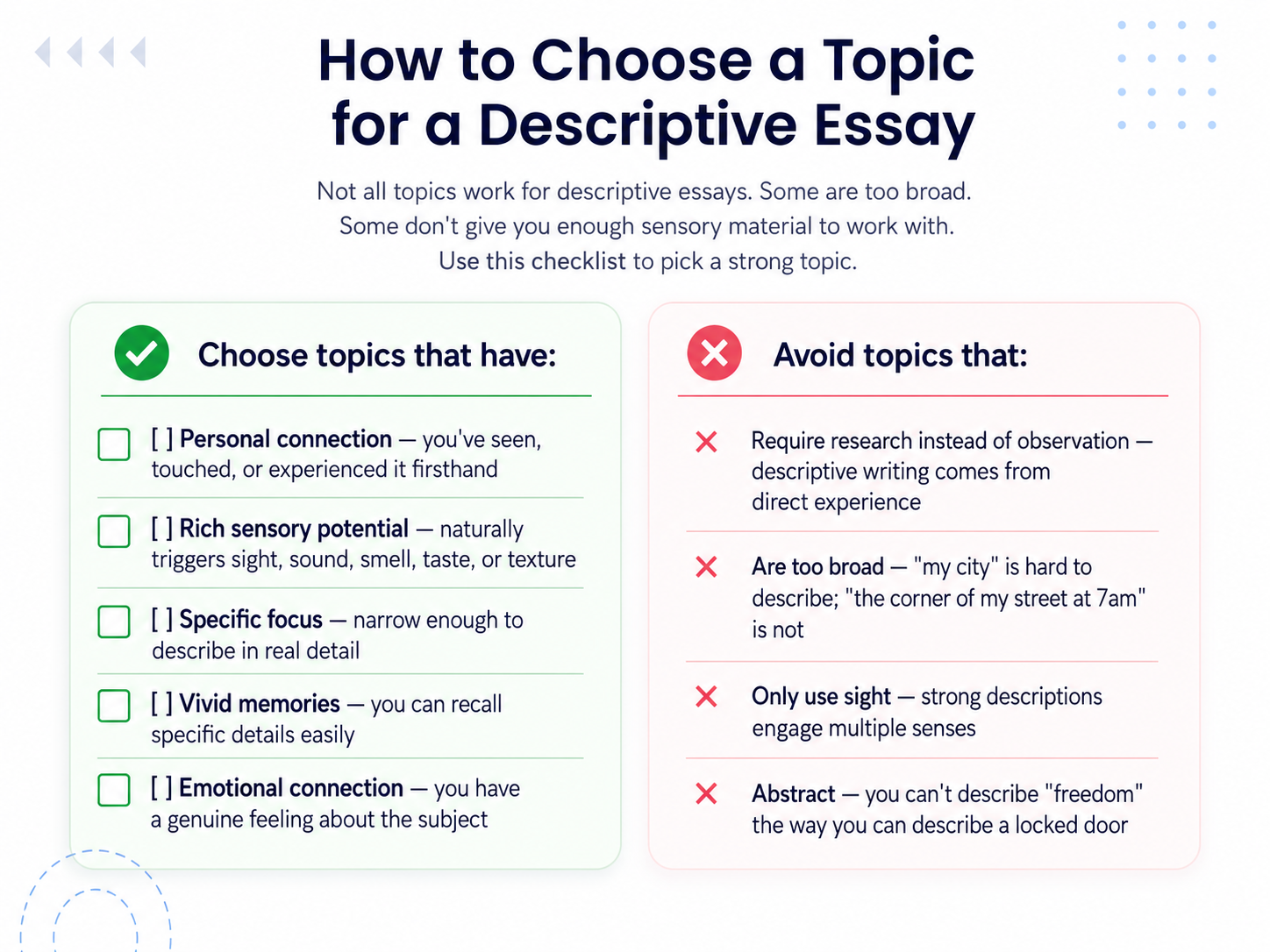
One practical tip: Close your eyes and picture the subject. If you can see, hear, and smell it clearly, it’s a good topic. If you get a vague blur, pick something else.
What Makes a Descriptive Essay Strong?
Strong descriptive essays share a few key traits. Knowing them before you write saves time and improves your grade.
Sensory details are the backbone of descriptive writing. Don’t just say “the kitchen smelled good.” Say “the kitchen smelled like burnt butter and brown sugar.” Use all five senses: sight, sound, smell, taste, and touch. Describing specific experiences or sensations can create a vivid portrayal of moments, such as a thunderstorm or a childhood toy box. A well-crafted description can evoke emotions and memories, offering a more immersive experience for the reader.
Show, don’t tell. Don’t say “she was nervous.” Say “she kept folding and unfolding the program in her lap.” Let the details do the work.
Specific language beats vague language. “A tall man” is weak. “A man who had to duck through every doorway” is strong.
Dominant impression is the overall feeling you want your reader to take away. Every detail you choose should support that impression. If your essay is about how peaceful your grandmother’s kitchen was, cut any detail that contradicts that.
Organization matters. You can describe a place from near to far, top to bottom, or by moving through it. You can describe a person from face to hands to posture. Whatever order you choose, be consistent.
Descriptive Writing Prompts
Descriptive writing prompts can stimulate creativity and encourage writers to paint vivid pictures with words, allowing them to tap into their own experiences, perceptions, and emotions. Prompts that describe hypothetical scenarios can be engaging, as they allow writers to use their imagination and explore creative possibilities. Descriptive writing prompts can include a variety of themes, such as personal events, food, and random scenarios, which help build students’ writing skills. Resources like the Purdue OWL Descriptive Essays guide can provide further insights into the mechanics of sensory writing. Sensory writing techniques can be applied to everyday scenarios, such as morning routines or street performances.
- Describe your morning routine using only sensory details — no thoughts, only what you see, hear, smell, and feel.
- Describe a street performer you once watched, or imagine one in detail.
- Describe the beauty of a starry sky from a place with no city light.
- Describe what a space journey might look, sound, and feel like at the moment of launch.
- Describe a childhood toy box — every object, smell, and texture you remember or imagine.
- Describe the moment before a thunderstorm breaks — the air, the light, the quiet before the sound.
How to Write a Descriptive Essay Step by Step
Writing descriptive prose is different from writing an argumentative or research paper. The process focuses on observation, not argument. For a deeper look at structure, tone, and technique, see our full guide on how to write a descriptive essay.
Step 1: Pick a specific subject. Use the checklist above. Narrow your focus before you write a single sentence.
Step 2: Brainstorm sensory details. List everything you can observe about your subject. What does it look like? Sound like? Smell like? Feel like? Taste like? Don’t edit — just list.
Step 3: Decide on your dominant impression. What is the one feeling or idea you want readers to leave with? Everything in your essay should support this.
Step 4: Write your introduction. Open with a vivid detail or image — not a definition or a general statement. Pull the reader in right away.
Step 5: Write body paragraphs. Each paragraph should focus on one aspect of the subject. Use your sensory details here. Organize them logically.
Step 6: Write your conclusion. Don’t just summarize. Reflect on the significance of what you described. Why does it matter to you? What does it make you feel?
Step 7: Revise for vividness. Read each sentence. Can you replace a vague word with a specific one? Can you add a sensory detail? Cut anything that doesn’t serve the dominant impression.
How to Use Sensory Details in Descriptive Writing
Sensory details are what separate a flat description from one that puts the reader inside the moment. Sensory details include sights, sounds, smells, tastes, and textures that enhance the writing experience. Descriptive writing can capture various settings, emotions, and objects through detailed imagery. Here’s how to use each sense effectively.
Sight is the most used sense in writing — and the most overused. Don’t rely on it alone. Use color, shape, size, movement, and light: “the yellow streetlamp reflected in a puddle shaped like a handprint.”
Sound brings a scene alive. Include background noise, not just prominent sounds. “The refrigerator hummed behind the silence” is more vivid than “it was quiet.”
Smell is the most emotionally powerful sense. Smells trigger memory. Use them when you want to create an emotional connection: “the smell of chlorine that meant summer was starting.”
Taste works best for food essays but can appear elsewhere: “the air tasted metallic before the storm.”
Touch and texture ground the reader physically: “the vinyl seat burned the back of my thighs” or “the old map felt like tissue paper.”
A practical rule: Aim for at least three senses in every descriptive essay. Aim for all five in longer pieces.
Person Descriptive Essay Topics
Describing a person requires more than physical appearance. The best person descriptions show how someone moves, speaks, reacts, and occupies a room. Physical details alone don’t create a person. Behavior and habit do.
Elementary (Grades 3–5):
- Your grandmother or grandfather
- Your best friend
- Your favorite teacher
- A family member who makes you laugh
- Someone who helped you when you needed it
- Your pet’s personality and behavior
- A younger sibling or cousin
- Your parent doing their favorite hobby
- The school bus driver
- A neighbor you know well
Middle School (Grades 6–8):
- A coach or mentor who influenced you
- Someone with an unusual hobby or talent
- A person who always wears interesting clothes
- The oldest person you know
- Someone with distinctive mannerisms or gestures
- A street performer you observed for a long time
- Someone who always tells the same stories
- A person with a memorable laugh or voice
- A friend’s parent who made a strong impression
- Someone whose appearance contrasts with their personality
High School (Grades 9–12):
- A stranger you observed in detail at a public place
- A person who represents a particular profession perfectly
- Someone who changed significantly over time
- A local character everyone in town knows
- Someone with hands that tell their life story
- A person whose presence changes the room
- Someone you misjudged based on first appearance
- A person you admire but have never spoken to
Place Descriptive Essay Topics
A strong place description captures atmosphere, not just layout. What does the place feel like to be in? What time of day changes it? What sounds define it? These questions produce better descriptions than any list of visual features.
Elementary (Grades 3–5):
- Your bedroom at night versus in the morning
- Your favorite place to play
- The school cafeteria during lunch
- Your backyard in summer
- A grandparent’s house
- The public library
- Your classroom
- A park you visit often
- Your family’s kitchen
- A fort or hideout you built
Middle School (Grades 6–8):
- A crowded shopping mall during the holidays
- An empty school building after hours
- Your town’s main street on a Saturday morning
- A doctor’s waiting room
- The gym during a big game
- A local restaurant’s atmosphere
- The school hallway between classes
- A movie theater before the show starts
- Your favorite bookstore
- A place that looks different at different times of day
High School (Grades 9–12):
- A coffee shop during morning rush
- An abandoned building you explored
- A city intersection at midnight
- The ocean, lake, or river at sunset
- A concert venue before, during, and after the show
- Your town from a high vantage point
- A train or bus station during rush hour
- A historical site in your area
- A place where two different worlds meet (urban/rural, old/new)
- Your car’s interior and what it reveals about you
College Level:
- A place that exists only in memory versus in reality
- A workspace that reflects its occupant’s personality
- A place in transition — being demolished, renovated, or abandoned
- Somewhere that means different things to different people
- A place that embodies your culture or family history
Experience Descriptive Essay Topics
The best experience descriptions capture one specific moment, not a whole day or trip. Focus on the minutes before something important. Or the exact sensory moment when something changed. That specificity creates intensity.
Elementary (Grades 3–5):
- Your first day at a new school
- Learning to ride a bike or swim
- A birthday party you remember clearly
- Getting caught in a rainstorm
- Visiting a zoo or aquarium
- Camping for the first time
- A family road trip
- Building a snowman or sandcastle
- Your first sleepover at a friend’s house
- Watching fireworks from a specific spot
Middle School (Grades 6–8):
- Your first live concert or performance
- Learning a new skill that challenged you
- A moment when time seemed to slow down
- Being in a crowd of celebrating people
- Your first long journey or flight
- Performing in front of an audience
- A moment of fear that turned out fine
- Experiencing a different culture’s food or tradition
- The minutes before something important began
- A time you felt completely alone
High School (Grades 9–12):
- The morning after a big event
- A moment when you understood something new about yourself
- Being in nature during extreme weather
- Your first job interview or first work shift
- A conversation that changed your perspective
- Driving for the first time
- A moment of intense embarrassment
- Saying goodbye to someone important
Object Descriptive Essay Topics
Objects carry stories. The best object descriptions explain what the object means, not just what it looks like. A worn shoe tells you more about a person than a new one. A broken toy tells you more about a childhood than a perfect one.
Elementary (Grades 3–5):
- Your favorite stuffed animal or toy
- A special gift someone gave you
- Your school backpack and what’s inside it
- A family heirloom you’ve seen or touched
- Your favorite book as a physical object — not the story
- A piece of sports equipment you use
- Something you made yourself
- A musical instrument in your house
- Your most comfortable shoes or piece of clothing
Middle School (Grades 6–8):
- An object that belonged to a grandparent
- Your phone and what it says about you
- A worn piece of furniture in your home
- Something you’ve had since childhood
- An object someone in your family collects
- A broken item that hasn’t been thrown away
- The oldest object in your house
- Something that smells like a specific memory
High School (Grades 9–12):
- An object that represents a gap between generations
- Something valuable that isn’t expensive
- An everyday object examined in extreme detail
- Something whose purpose isn’t immediately obvious
- An object that’s been repaired many times
- A watch, wallet, or set of keys and their significance
- Something that changed meaning over time
Food and Culinary Descriptive Essay Ideas
Food descriptions combine all five senses better than almost any other subject. Smell and taste are front and center. Texture and sound (the crack of a crust, the sizzle in a pan) are just as important. A strong food description makes the reader hungry — or at least vividly aware of what it would feel like to eat.
All Levels:
- A family meal during the holidays
- A farmer’s market — the smells, sounds, and crowd
- Your favorite restaurant’s atmosphere and signature dish
- Baking or cooking something with a family member
- A cultural food experience that was new to you
- A diner or café at different times of day
- School cafeteria food and the environment around it
- A dessert that connects to a specific memory
- Your favorite meal — every detail of it
- Street food from a stall or truck
Nature and Outdoor Descriptive Essay Topics
Nature gives writers unlimited sensory material. Wind, light, temperature, sound, smell — outdoor settings engage every sense at once. The challenge is not finding details but choosing the right ones. Focus on what makes your specific moment or place different from any other.
All Levels:
- A garden in different seasons
- The beach at sunrise or sunset
- A forest trail during autumn
- Your yard after fresh snowfall
- A thunderstorm from beginning to end
- A mountain view from multiple perspectives
- A city park that feels like wilderness
- Wildlife observed in a natural habitat
- The night sky in a rural area versus a city
- A river or stream moving through a landscape
Weather and Seasons Description Ideas
Weather is one of the most immediate sensory experiences we have. It changes how everything looks, smells, sounds, and feels. It changes how people behave. Describing weather well means capturing those changes — not just stating the temperature.
All Levels:
- The first day that feels like spring
- A summer evening — heat, sound, and light
- Autumn’s transformation of a familiar place
- Winter’s effect on your daily environment
- A foggy morning’s altered world
- The minutes before and after a storm
- The hottest or coldest day you remember
- How rain changes the smell of everything
Childhood Memory Descriptive Essay Topics
Memory descriptions work best when they anchor in physical details rather than feelings. Instead of “it was a happy time,” show the specific objects, smells, and sounds that made it happy. Let the reader feel the emotion through the details.
All Levels:
- A specific room from your childhood home
- A hiding spot you loved as a child
- Your elementary school playground
- A vehicle you remember from childhood
- A relative’s house you visited often
- Your childhood bedroom and how it changed over the years
- A place you were afraid of as a child
- Where you used to play pretend games
Current Descriptive Essay Topics
Descriptive writing can also engage with real-world topics. These prompts ask you to describe what you see, observe, or experience around a current issue — not argue about it. The goal is vivid, honest observation.
College and High School:
- Describe the reality of climate change as you see it where you live
- Describe a moment you witnessed someone face discrimination
- Describe your response to a humanitarian crisis you learned about
- Describe the physical experience of a protest or public gathering
- Describe what economic inequality looks like in your city or town
Last updated: June 2026. Descriptive essay topics list reviewed and updated for current student needs.