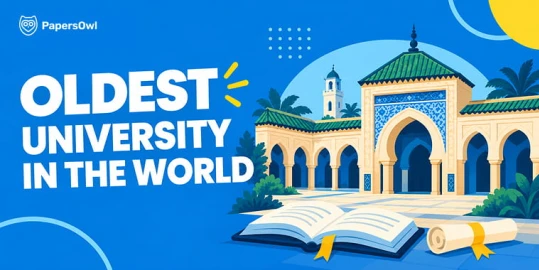
The oldest university in the world is the University of al-Qarawiyyin in Fez, Morocco. Fatima al-Fihri founded it in 859 AD, and it still admits students today. Guinness World Records lists it as the oldest existing and continually operating educational institution.
There is one catch, though. Historians who define a university by the medieval European model (charters, faculties, and degrees) give the title to Bologna, founded in 1088. So the answer to “what was the first university ever?” depends on the definition you use.
I’ve guided students through enough research projects to know that a definition matters as much as a date. Below, I rank 20 historic universities by founding year, explain the criteria behind the ranking, and profile each one.
Which Are the Oldest Universities in the World?
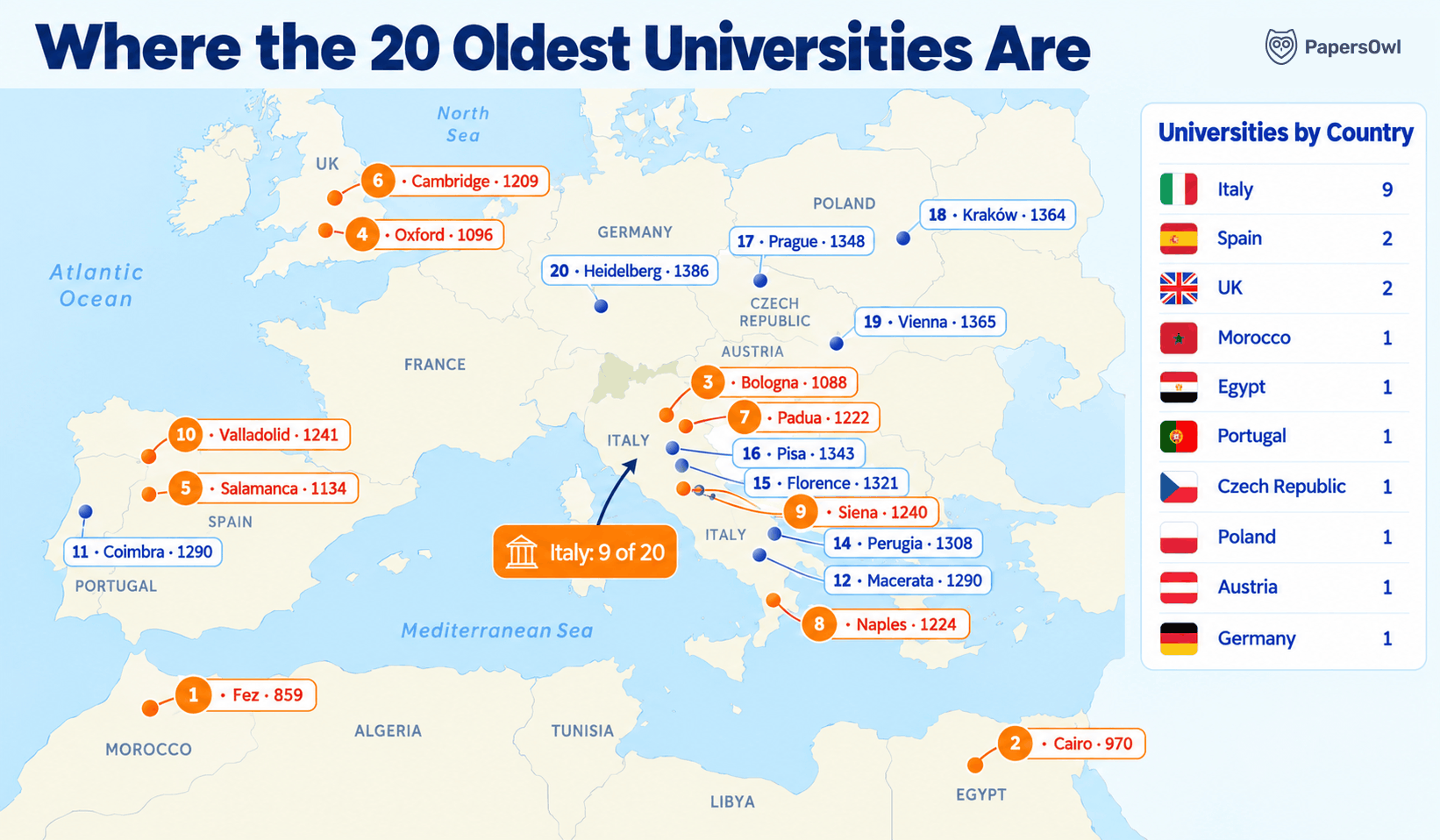
The 20 oldest universities still operating today were founded between 859 and 1386. Two of them are in North Africa, and the other 18 are in Europe. Al-Qarawiyyin and Al-Azhar open the list, followed by Bologna, Oxford, and Cambridge.
Italy dominates the oldest universities in world history, with nine of the 20 schools below. Medieval Italian city-states needed trained lawyers, doctors, and officials. That’s why so many of them built a studium of their own.
| Rank | University | Location | Founded | Known for |
|---|---|---|---|---|
| 1 | University of al-Qarawiyyin | Fez, Morocco | 859 | Founded by Fatima al-Fihri |
| 2 | Al-Azhar University | Cairo, Egypt | c. 970 | Major center of Sunni Islamic scholarship |
| 3 | University of Bologna | Bologna, Italy | 1088 | Oldest university in Europe |
| 4 | University of Oxford | Oxford, England | c. 1096 | Oldest in the English-speaking world |
| 5 | University of Cambridge | Cambridge, England | 1209 | Started by scholars who left Oxford |
| 6 | University of Salamanca | Salamanca, Spain | 1218 | Oldest operating university in Spain |
| 7 | University of Padua | Padua, Italy | 1222 | Galileo taught here |
| 8 | University of Naples Federico II | Naples, Italy | 1224 | Founded by Emperor Frederick II |
| 9 | University of Siena | Siena, Italy | 1240 | Medieval school of law and medicine |
| 10 | University of Valladolid | Valladolid, Spain | c. 1241 | Papal recognition in 1346 |
| 11 | University of Coimbra | Coimbra, Portugal | 1290 | UNESCO World Heritage Site |
| 12 | University of Macerata | Macerata, Italy | 1290 | Law teaching since the 13th century |
| 13 | Sapienza University of Rome | Rome, Italy | 1303 | Founded by Pope Boniface VIII |
| 14 | University of Perugia | Perugia, Italy | 1308 | Papal charter in 1308 |
| 15 | University of Pisa | Pisa, Italy | 1343 | Galileo studied and taught here |
| 16 | Charles University | Prague, Czech Republic | 1348 | Oldest in Central Europe |
| 17 | University of Pavia | Pavia, Italy | 1361 | Alessandro Volta taught here |
| 18 | Jagiellonian University | Kraków, Poland | 1364 | Copernicus studied here |
| 19 | University of Vienna | Vienna, Austria | 1365 | Oldest in the German-speaking world |
| 20 | Heidelberg University | Heidelberg, Germany | 1386 | Oldest university in Germany |
Before you use these dates in a history research paper or essay, keep one thing in mind. Medieval schools rarely had a single “birthday.” Some dates mark the first recorded teaching, while others mark a royal or papal charter.
I use the date that is most widely accepted, which is usually the one the university cites itself. That’s why my top 20 oldest university in the world ranking may differ from other lists by a few years.
How Do Historians Decide Which University Is Oldest?
Historians rank old universities by four tests, and a school has to pass all of them to make my list. By these rules, al-Qarawiyyin is the oldest continuously operating university in the world, and Bologna is the oldest in Europe.
- Continuous operation. The school still teaches students and never closed for good.
- Institutional continuity. Today’s university grew out of the original school. It isn’t a new institution that simply shares the name.
- Accepted founding date. This is either the first recorded teaching or the first official charter.
- Higher-learning status. The school taught advanced subjects such as law, theology, or medicine, not just basic literacy.
The second test removes some famous names. The University of Paris dates to about 1150, but France abolished it in 1793. Modena claims 1175, yet its medieval university had disappeared by 1338 and only returned in the 1680s.
Some historians add a fifth test: the medieval European model of faculties and degrees. Under that stricter rule, al-Qarawiyyin and Al-Azhar were madrasas until the 1960s, when Morocco and Egypt reorganized them as modern universities. I still include both, because each has taught higher learning without a break for more than a thousand years.
What Are the Top 10 Oldest Universities?
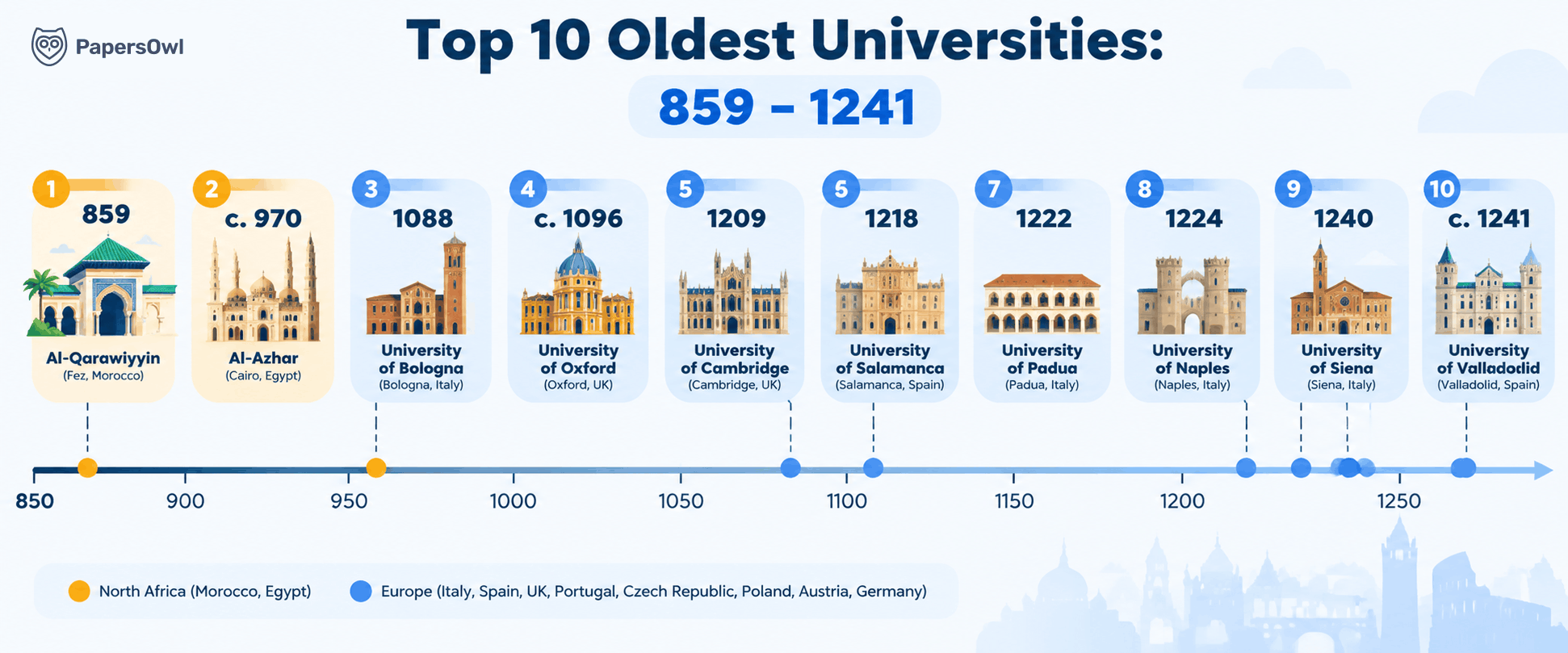
The top 10 oldest university in the world ranking covers almost four centuries, from Fez in 859 to Valladolid around 1241. Each profile below covers the founding story, what the school changed in education, and a few famous names.
1. University of al-Qarawiyyin, Morocco (859)
Al-Qarawiyyin is the oldest university in the world still operating, with roots in Fez going back to 859 AD. The traditional account says Fatima al-Fihri, a merchant’s daughter, spent her inheritance on a mosque for her community. Some historians question the details, since an inscription from 877 names a different patron.
The mosque soon added a madrasa. Over time, teaching grew beyond the Quran and Islamic law to include grammar, logic, medicine, mathematics, and astronomy. For centuries, the school helped sustain the Maliki tradition of Islamic law across North Africa.
Its library, founded in 1349 by Sultan Abu Inan, is often called the oldest library still open. Fez also linked two worlds: European scholars such as Nicolas Cleynaerts and Jacobus Golius visited it while learning Arabic. In 1963, a royal decree brought al-Qarawiyyin into Morocco’s state university system, and it still teaches Islamic higher education today.
Famous names: Ibn Khaldun, who studied and lectured here, and Maimonides, who by tradition studied here while living in Fez.
2. Al-Azhar University, Egypt (c. 970)
Al-Azhar traces its origins to 970, when the Fatimid dynasty began building the al-Azhar Mosque in Cairo. Teaching started soon after the mosque opened in 972.
The Fatimids were Shia, but the school turned to Sunni teaching under Saladin’s dynasty. Over the centuries, it became a leading center for Islamic law, theology, and Arabic. Students arrived from across Africa and Asia, and many went home as judges and teachers.
Al-Azhar became a modern university in 1961. A reform law added faculties of medicine, engineering, and agriculture, and a college for women followed. Today, it remains one of the most respected voices in Sunni scholarship.
Famous names: Muhammad Abduh, a 19th-century reformer, and Ibn Khaldun, who lectured in Cairo.
3. University of Bologna, Italy (1088)
Bologna, founded in 1088, is the oldest university in Europe and the model for most Western universities. Calling the University of Bologna the oldest university in the world is accurate only in the European sense. Still, Bologna gave us the word itself: its students formed a guild, or universitas, to hire teachers and set rules.
The school grew around law. The jurist Irnerius taught Roman law here, and in 1158 Emperor Frederick Barbarossa protected traveling scholars with a decree called the Authentica Habita. Students held real power, and they could even fine teachers who started lectures late.
Bologna’s system of studies and degrees shaped European higher education. In 1988, rectors signed the Magna Charta Universitatum here, and the 1999 Bologna Process took the city’s name.
Famous names: Nicolaus Copernicus, Pope Alexander VI, and Petrarch, all of whom studied law here.
4. University of Oxford, England (c. 1096)
Is Oxford the oldest university in the world? No, but it is the oldest in the English-speaking world, with teaching recorded from 1096. Oxford has no founding charter. It grew quickly after 1167, when Henry II banned English students from the University of Paris.
Oxford’s biggest gift to education is the collegiate system. Students live and study in self-governing colleges such as Balliol and Merton, while the university sets exams and awards degrees. Cambridge, Durham, and the residential colleges at Harvard and Yale all borrowed this model.
On my list, it ranks as the fourth oldest university in the world. It also trains leaders: Oxford counts 30 British prime ministers among its students.
Famous names: Oscar Wilde, Margaret Thatcher, and J.R.R. Tolkien, who taught English here.
5. University of Cambridge, England (1209)
Cambridge began in 1209, when a group of scholars left Oxford after a deadly conflict with townspeople. King Henry III placed the new school under royal protection in 1231. Peterhouse, its first college, followed in 1284.
Like Oxford, Cambridge runs on a collegiate system, and today it has 31 colleges. Over time, it became a powerhouse of mathematics and science.
Isaac Newton studied at Trinity College and later held the Lucasian chair of mathematics. Charles Darwin studied at Christ’s College before his voyage on the Beagle.
Famous names: Isaac Newton, Charles Darwin, and Stephen Hawking.
6. University of Salamanca, Spain (1218)
Salamanca is Spain’s oldest university still operating, founded in 1218 by King Alfonso IX of León. Some lists give 1134, but the university itself dates its founding to 1218. In 1255, Pope Alexander IV recognized its degrees across Christian Europe.
By the 16th century, Salamanca was one of Europe’s great intellectual centers. Francisco de Vitoria and the School of Salamanca laid early foundations for international law and economic theory.
The school also shaped the Spanish language. In 1492, Antonio de Nebrija, a Salamanca professor, published the first grammar of Castilian. It was one of the first grammars of any modern European language.
Famous names: Francisco de Vitoria, Fray Luis de León, and Miguel de Unamuno, who served as rector.
7. University of Padua, Italy (1222)
Padua was founded in 1222 by students and professors who left Bologna to find greater academic freedom. Its motto still says so: Universa universis patavina libertas, or “Paduan freedom is complete, and for everyone.” Under the Republic of Venice, Padua welcomed students of different faiths and nations.
The school led European medicine for centuries. Andreas Vesalius taught anatomy here, and in 1594 Padua opened the first permanent anatomical theater, which still stands. Galileo Galilei taught mathematics at Padua from 1592 to 1610.
In 1678, Elena Lucrezia Cornaro Piscopia earned a doctorate here. She is widely recognized as the first woman to receive a doctoral degree.
Famous names: Galileo Galilei, Andreas Vesalius, and Nicolaus Copernicus, who studied medicine here.
8. University of Naples Federico II, Italy (1224)
Naples was founded in 1224 by Emperor Frederick II, and it was one of the first universities created by a ruler as a state institution. Frederick wanted lawyers and officials trained at home rather than in papal-leaning Bologna. He even banned his subjects from studying elsewhere.
From the start, Naples focused on law and public administration, which made it a model for secular, state-run higher education. The school was refounded several times and closed from 1490 to 1507, but it always came back. Today, it carries its founder’s name.
Famous names: Thomas Aquinas, who studied here and later taught, and philosopher Giambattista Vico.
9. University of Siena, Italy (1240)
Siena traces its start to December 26, 1240. On that day, the city’s chief magistrate, Ildebrandino Cacciaconti, signed a decree that taxed residents who rented rooms to students and used the money to pay teachers. That makes Siena one of Italy’s first publicly funded universities.
Law and medicine became its strongest fields. Pietro Ispano, later Pope John XXI, taught medicine here. After 1355, Emperor Charles IV raised the school to a Studium Generale.
Napoleon’s government closed it from 1808 to 1815, but it reopened. Today, about 16,000 students attend, nearly a third of Siena’s population.
Famous names: Pope John XXI, who taught medicine, and Pope Julius III, who studied law here.
10. University of Valladolid, Spain (c. 1241)
Valladolid dates to around 1241, and historians link it to the older University of Palencia. Alfonso VIII of Castile founded Palencia between 1208 and 1212. When that school faded, its studies are believed to have moved to Valladolid.
Pope Clement VI formally recognized the university in 1346. Valladolid was home to the Royal Chancery, the high court of Castile, so law and the training of royal officials shaped its early identity.
Today, the university’s Baroque façade from 1715 is one of the city’s best-known landmarks.
Which Universities Rank 11 to 20?
Universities 11 to 20 show how the university model spread across Europe in the 1300s, from Portugal to Poland. Most of them began with a royal or papal charter, not with a group of students.
- University of Coimbra, Portugal (1290). King Denis founded it in Lisbon, and it moved between Lisbon and Coimbra until it settled for good in 1537. Its historic campus is a UNESCO World Heritage Site. Bats living in its Joanina Library eat the insects that would damage the books.
- University of Macerata, Italy (1290). Records show a law school under city protection in Macerata in 1290. The full university came later, with Pope Paul III’s bull in 1540. Law and the humanities remain its core today.
- Sapienza University of Rome, Italy (1303). Pope Boniface VIII founded it for the papal city. Today, Sapienza is one of Europe’s largest universities, with more than 100,000 students. Physicist Enrico Fermi taught here in the 1920s and 1930s.
- University of Perugia, Italy (1308). Teaching in Perugia goes back to the 1270s, and Pope Clement V granted it university status in 1308. The jurist Bartolus de Saxoferrato taught here. His legal commentaries shaped European law for centuries.
- University of Pisa, Italy (1343). Pope Clement VI founded it, but the school closed around 1360 and revived in the 15th century. Galileo Galilei enrolled here as a medical student in 1581 and later taught mathematics.
- Charles University, Czech Republic (1348). Emperor Charles IV founded it in Prague as the first university in Central Europe. Reformer Jan Hus served as its rector, and Albert Einstein taught here in 1911–1912.
- University of Pavia, Italy (1361). Charles IV also granted Pavia its charter, at the request of the ruling Visconti family. Alessandro Volta, inventor of the electric battery, taught physics here.
- Jagiellonian University, Poland (1364). King Casimir III the Great founded it in Kraków. In 1400, King Władysław Jagiełło refounded it with funds that Queen Jadwiga left to it. Nicolaus Copernicus studied here in the 1490s.
- University of Vienna, Austria (1365). Duke Rudolf IV founded the oldest university in the German-speaking world. Gregor Mendel studied science here before his pea-plant experiments, and Sigmund Freud trained here as a doctor.
- Heidelberg University, Germany (1386). Elector Rupert I founded Germany’s oldest university, which began teaching in 1386. Sociologist Max Weber taught here, and Hannah Arendt earned her doctorate under Karl Jaspers.
What Was the First University in History?
The first university in history depends on how you define a university. Several ancient schools came long before Fez or Bologna, but none of them survived, so they sit outside my ranking.
- Plato’s Academy, Greece (c. 387 BC). Plato taught philosophy and mathematics in a grove outside Athens. It was a school of thought, not an institution that granted degrees.
- Taxila, Pakistan (from around the 5th century BC). Students traveled here to learn from individual teachers. Taxila had no central administration or formal curriculum.
- Nalanda, India (5th century AD). This Buddhist monastery-university had libraries, dormitories, and students from across Asia. Invaders destroyed it around 1193, and a new Nalanda University opened nearby in 2014.
So what is the oldest institution in the world for higher learning that still teaches? Guinness World Records gives that title to al-Qarawiyyin.
So, Which University Is Truly the Oldest?
The oldest university in the world is al-Qarawiyyin, founded in Fez in 859 and still teaching today. Bologna (1088) is the oldest in Europe, and Oxford (c. 1096) leads the English-speaking world.
When you cite any of these dates, check whether it marks the first teaching or the first charter. In my experience, that one detail separates a careful history paper from a rushed one.
- Guinness World Records. Oldest higher-learning institution. https://guinnessworldrecords.com/world-records/oldest-university
- Wikipedia. List of oldest universities in continuous operation. https://en.wikipedia.org/wiki/List_of_oldest_universities_in_continuous_operation
- Wikipedia. University of al-Qarawiyyin. https://en.wikipedia.org/wiki/University_of_al-Qarawiyyin
- University of Oxford. British Prime Ministers. https://www.ox.ac.uk/about/our-people/famous-oxonians/prime-ministers
- Encyclopaedia Britannica. University of Salamanca. https://www.britannica.com/print/article/518901
- Wikipedia. University of Siena. https://en.wikipedia.org/wiki/University_of_Siena
- Wikipedia. University of Valladolid. https://en.wikipedia.org/wiki/University_of_Valladolid
- Wikipedia. University of Modena and Reggio Emilia. https://en.wikipedia.org/wiki/University_of_Modena_and_Reggio_Emilia
- University of Macerata. Origins–1824. https://www.unimc.it/en/the-university/history/origins-1824