
Wondering how many universities in the world there are? The most reliable count is about 21,500 recognized higher education institutions in 190 countries and territories. That figure comes from the World Higher Education Database (WHED). Broader web-based counts, which include smaller colleges, reach almost 32,000.
I’ve guided many students through university choices, and this number always surprises them. It also explains why rankings feel confusing at first.
Here’s the plan. First, I’ll break down the total number of universities and the countries with the most of them. Then we’ll look at the top 50 ranked schools and how rankings work. By the end, you’ll know how to read these numbers wisely.
What Is the Total Number of Universities Worldwide?
The total number of universities worldwide ranges from about 14,000 to 32,000. The answer depends on who counts and what they count as a university.
WHED is the strictest source. The International Association of Universities runs it in partnership with UNESCO. To make the list, a school must be recognized by its national authority, award at least a four-year degree, and have taught at least three student cohorts.
Web-based databases cast a wider net. Webometrics tracks almost 32,000 institutions with an online presence. CWUR assessed 21,291 institutions for its 2026 ranking. uniRank lists over 14,000 recognized universities and colleges in more than 200 countries.
| Source | Number of institutions | What it counts |
|---|---|---|
| WHED (IAU and UNESCO) | About 21,500 | Recognized institutions offering at least a four-year degree, 190 countries and territories |
| Webometrics (2025) | Almost 32,000 | All higher education institutions with a web presence |
| CWUR (2026) | 21,291 | Institutions assessed for the Global 2000 list |
| uniRank (2026) | 14,000+ | Officially recognized universities and colleges, 200+ countries |
Why do the numbers differ so much? Definitions change from country to country. Some systems call every degree-granting school a university. Others split higher education into universities, colleges, and universities of applied sciences.
Germany is a good example. In winter 2025/26, it had 421 higher education institutions. Only 112 were full universities, while 206 were universities of applied sciences.
You may also see estimates of 25,000 to 50,000 institutions online. I couldn’t trace them to an official database, so treat them as rough guesses.
My advice: when you quote a number in an essay, always name the source and its definition.
Which Countries Have the Most Universities?
India has the most higher education institutions of any country. Webometrics data for January 2026 lists 5,288 of them. Indonesia (3,689) and the United States (3,124) come next.
Seven of the top 10 countries are in Asia or Europe. This fits the global pattern, since Europe and the Asia-Pacific region hold the largest concentrations of universities.
| Rank | Country | Total institutions | In the global top 5,000 |
|---|---|---|---|
| 1 | India | 5,288 | 333 |
| 2 | Indonesia | 3,689 | 79 |
| 3 | United States | 3,124 | 768 |
| 4 | China (incl. Hong Kong and Macao) | 2,460 | 634 |
| 5 | Brazil | 1,289 | 164 |
| 6 | Mexico | 1,061 | 50 |
| 7 | Japan | 1,041 | 182 |
| 8 | Russia | 957 | 110 |
| 9 | France | 610 | 149 |
| 10 | Germany | 514 | 125 |
Source: Ranking Web of Universities (Webometrics), January 2026 edition
Now look at the last column. India has the most institutions, but only 333 make the Webometrics top 5,000. The US places 768. A large system isn’t always a strong one, so check both numbers.
National statistics often show different totals because each government counts in its own way:
- India. The AISHE 2023-24 survey lists 1,289 universities, 48,246 colleges, and 15,221 standalone institutions. Most Indian colleges are affiliated with a university, which is one reason global databases count far fewer.
- United States. NCES counted 3,896 degree-granting institutions in 2022-23. Count every school eligible for federal student aid, including certificate-only ones, and the total reaches 5,819 in 2023-24. That’s why US estimates range from about 3,100 to over 5,800.
- China. The Ministry of Education listed 3,196 institutions in June 2026. That includes 1,412 undergraduate universities, 1,540 vocational colleges, and 244 adult education schools.
If you compare countries in a paper, use one database for all of them. Mixing national and global sources will skew your results.
How many universities are ranked in Latin America?
Times Higher Education’s Latin America University Rankings 2026 include 223 universities from 16 countries. The University of São Paulo in Brazil took first place for the second year in a row.
QS covers more ground. Its 2026 Latin America and the Caribbean ranking includes almost 500 universities in 26 locations.
How many universities are ranked in the Arab region?
Times Higher Education’s Arab University Rankings 2026 list 268 universities from 18 countries and territories. King Abdullah University of Science and Technology (KAUST) in Saudi Arabia ranks first for the third year running.
The QS Arab Region ranking is bigger. Its 2026 edition features 298 universities across 20 countries, 52 more than the year before.
How Many Universities Make It Into Global Rankings?
The biggest global university rankings list 1,000 to about 2,300 universities. That’s roughly 5% to 10% of the world’s recognized institutions. Here’s how the main lists compare:
- THE World University Rankings 2027 ranks a record 2,297 universities from 118 countries and territories. The US has the most entries (168), followed by India (143).
- QS World University Rankings 2027 feature 1,504 institutions across 106 higher education systems.
- CWUR 2026 assessed 21,291 institutions and published its Global 2000 list.
- ShanghaiRanking (ARWU) 2026 evaluates more than 2,500 universities but publishes only the top 1,000. That’s under 5% of the institutions in WHED.
- uniRank tracks over 14,000 schools, yet its main world list shows the top 200.
Why are these lists so selective? Most world university rankings rely on research papers, citations, and reputation surveys. Many teaching-focused colleges and young universities don’t produce enough data to qualify. Some simply choose not to submit it.
So treat “unranked” as “not measured,” not “not good.” I’ve seen students skip strong local universities only because they weren’t on a famous list. Don’t make that mistake.
What Are the Top 50 Universities in the World?
The University of Oxford tops the THE World University Rankings 2027 for the 11th year in a row. In the QS World University Rankings 2027, MIT holds first place.
The table below shows THE’s top 50 next to each school’s QS position. The United States holds 22 places, the United Kingdom 7, and mainland China 5.
Compare the two rank columns, and you’ll see how much leading institutions can move between lists. Princeton is joint 3rd in THE but 27th in QS. Georgia Tech ranks 49th in THE and joint 142nd in QS. The next section explains why.
| THE 2027 rank | University | Country | QS 2027 rank |
|---|---|---|---|
| 1 | University of Oxford | United Kingdom | 4 |
| 2 | Massachusetts Institute of Technology (MIT) | United States | 1 |
| =3 | Princeton University | United States | 27 |
| =3 | Stanford University | United States | =2 |
| 5 | University of Cambridge | United Kingdom | 6 |
| 6 | Harvard University | United States | 5 |
| 7 | California Institute of Technology (Caltech) | United States | 7 |
| 8 | Imperial College London | United Kingdom | =2 |
| =9 | University of California, Berkeley | United States | =20 |
| =9 | Yale University | United States | =16 |
| 11 | Tsinghua University | China | 14 |
| 12 | ETH Zurich | Switzerland | =8 |
| 13 | Peking University | China | 13 |
| 14 | University of Pennsylvania | United States | 15 |
| 15 | National University of Singapore (NUS) | Singapore | 10 |
| 16 | University of Chicago | United States | 24 |
| =17 | Johns Hopkins University | United States | =20 |
| =17 | University College London (UCL) | United Kingdom | =8 |
| 19 | Columbia University | United States | =43 |
| 20 | University of California, Los Angeles (UCLA) | United States | 49 |
| 21 | Cornell University | United States | =16 |
| 22 | University of Toronto | Canada | 32 |
| 23 | University of Michigan | United States | 51 |
| 24 | Carnegie Mellon University | United States | 55 |
| 25 | Technical University of Munich | Germany | 25 |
| 26 | University of Washington | United States | =92 |
| 27 | The University of Tokyo | Japan | 39 |
| 28 | Nanyang Technological University (NTU) | Singapore | 12 |
| =29 | New York University (NYU) | United States | 58 |
| =29 | Northwestern University | United States | =45 |
| =29 | University of Edinburgh | United Kingdom | 35 |
| 32 | Duke University | United States | 70 |
| 33 | University of Hong Kong | Hong Kong | 11 |
| =34 | The University of Melbourne | Australia | =22 |
| =34 | Zhejiang University | China | 47 |
| 36 | EPFL (École Polytechnique Fédérale de Lausanne) | Switzerland | =22 |
| 37 | University of California San Diego | United States | 81 |
| 38 | Fudan University | China | 26 |
| 39 | Shanghai Jiao Tong University | China | 36 |
| 40 | King’s College London | United Kingdom | 37 |
| 41 | LMU Munich | Germany | 61 |
| 42 | Chinese University of Hong Kong | Hong Kong | 18 |
| 43 | McGill University | Canada | 30 |
| 44 | University of British Columbia | Canada | =45 |
| =45 | KU Leuven | Belgium | 59 |
| =45 | Heidelberg University | Germany | 86 |
| 47 | London School of Economics and Political Science (LSE) | United Kingdom | 62 |
| 48 | University of Illinois Urbana-Champaign | United States | 74 |
| 49 | Georgia Institute of Technology | United States | =142 |
| 50 | Delft University of Technology | Netherlands | 48 |
Sources: THE World University Rankings 2027 (September 2026); QS World University Rankings 2027 (June 2026). “=” marks a shared rank.
Outside the top 50, the University of Auckland is New Zealand’s highest-ranked school, placing 67th in QS 2027.
How Do University Rankings Measure Quality?
University rankings measure quality mainly through reputation surveys and research citations. Each ranking weighs these factors differently. That’s why one school can be 3rd on one list and 27th on another.
Here are the main criteria you’ll see:
- Academic reputation. QS surveys academics worldwide and gives this indicator 30% of the score. THE runs its own teaching and research reputation surveys.
- Citations per faculty. This measures research impact per staff member and counts for 20% in QS. THE gives citation impact 15%.
- Employer reputation. QS asks employers which universities produce the best graduates (15%), plus 5% for employment outcomes.
- Extra factors. THE scores industry income and patents. QS adds international networks and sustainability.
- Web metrics. uniRank uses only online data, such as links from other websites and traffic. It doesn’t use data from universities and doesn’t claim to measure teaching quality.
| Ranking | Biggest factors | What makes it different |
|---|---|---|
| QS 2027 | Academic reputation (30%), citations per faculty (20%), employer reputation (15%) | Scores sustainability and employment outcomes |
| THE 2027 | Research quality (30%), teaching (29.5%), research environment (29%) | Scores industry income and patents |
| uniRank 2026 | Referring domains (55%), Similarweb traffic rank (35%) | No surveys or university-submitted data |
One more thing to know. Citation-heavy rankings favor medicine, physics, and engineering. Social sciences, humanities, and cultural studies publish more books and get fewer citations, so universities strong in the arts can rank lower.
My advice: pick the indicator that matches your goal. If you want a job after graduation, check employer reputation. If you plan a PhD, look at research quality.

How Has the Number of Universities Grown Over Time?
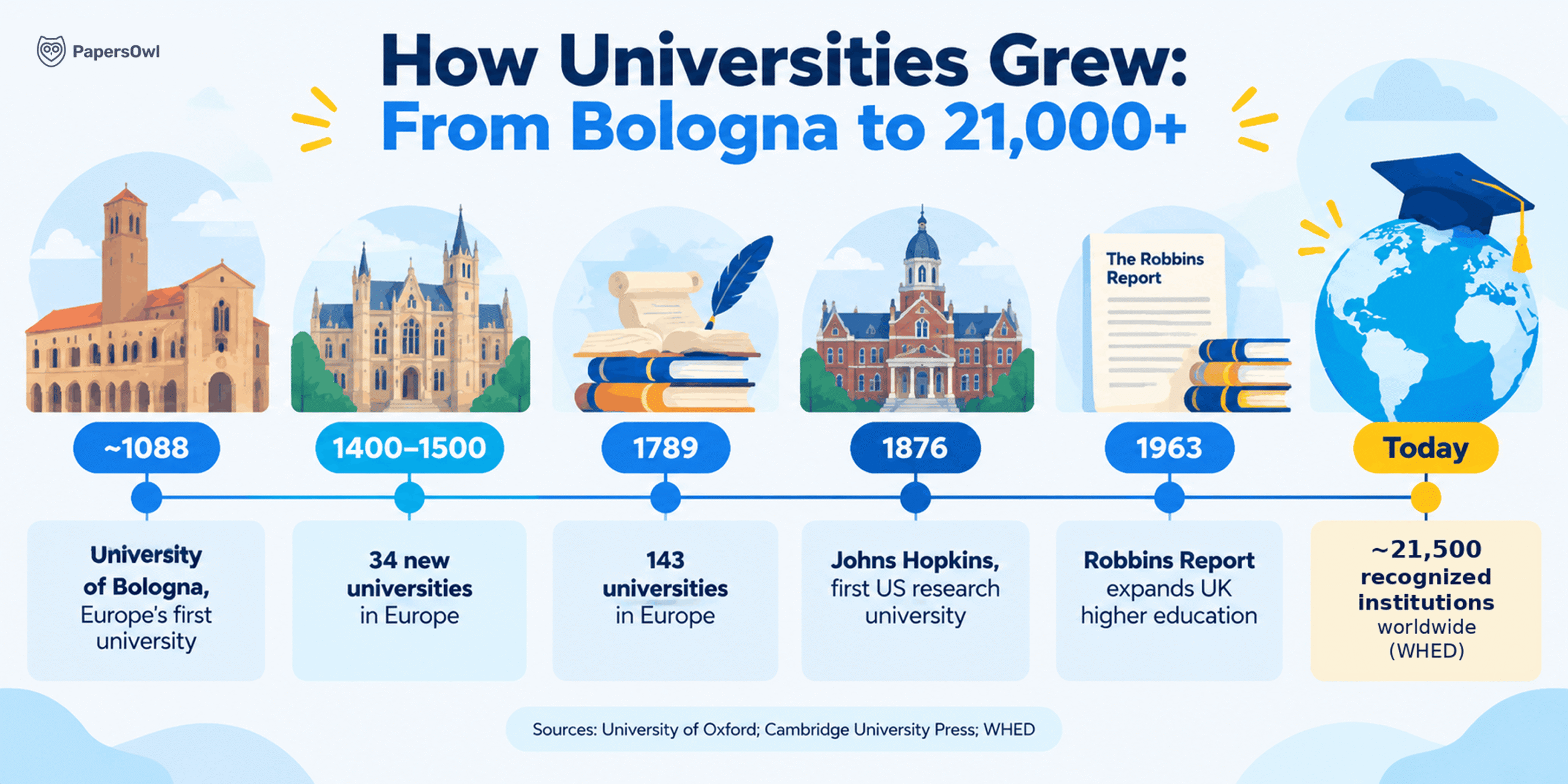
Universities grew from a handful of medieval schools to over 21,000 institutions today. Most of that growth happened in the last century.
The University of Bologna, founded around 1088, is traditionally seen as Europe’s first university. Soon after, the University of Paris became a model for faculty governance. Its masters ran the school as a guild, and northern universities like Oxford copied this structure.
Growth was slow but steady. Europe gained 34 new universities in the 15th century alone. By 1789, it had 143 universities. Wars and revolutions then cut that number to 83 by 1815.
In the 19th century, German universities linked teaching with research and protected academic freedom. Johns Hopkins University brought this model to the US in 1876 and became America’s first research university.
In 1963, the UK’s Robbins Report set four aims for higher education: teaching useful skills, developing the mind, advancing learning, and passing on a shared culture. It led to a major expansion of UK universities.
Today, many universities also act as innovation hubs, from artificial intelligence labs to new forms of online learning.
How Many Students Attend Universities Worldwide?
About 269 million students were enrolled in higher education worldwide in 2024, according to UNESCO. That’s up from roughly 100 million in 2000.
Today, 43% of college-age people study at the tertiary level. Access still varies widely by region. Enrollment reaches 80% in Western Europe and North America but only 9% in sub-Saharan Africa.
Student mobility is growing fast, too. The number of international students rose from 2.1 million in 2000 to almost 7.3 million in 2023. Still, that’s only about 3% of all students.
If you plan to study abroad, start early. I usually tell students to give themselves 12 to 18 months for research, language tests, applications, and scholarship deadlines.
What Do These Numbers Mean for Students?
So, how many universities in the world are there? About 21,500 recognized institutions, or close to 32,000 if you count every college with a web presence. Only 5% to 10% of them appear in global rankings.
That gap matters when you choose where to study. Here’s the plan I suggest:
- Start with your goal: the course, career, and budget you have in mind.
- Build a long list from national databases, not only from rankings.
- Compare two rankings and focus on the indicators that fit your goal.
- Check recognition in WHED or with your country’s education ministry.
Rankings are a useful map, but they don’t show every road. Use them as one tool, and you’ll make a calmer, smarter choice.
- International Association of Universities. World Higher Education Database: About (2026). https://whed.net/About.html
- Pappas, J. D. Countries arranged by number of universities in top ranks, Webometrics January 2026 (2026). https://zenodo.org/records/18440225
- Center for World University Rankings. CWUR 2026 Edition (2026). https://cwur.org/2026.php
- uniRank. About uniRank University Ranking (2026). https://www.unirank.org/about/index.htm
- National Center for Education Statistics. Digest of Education Statistics, Table 317.10 (2023). https://nces.ed.gov/programs/digest/d23/tables/dt23_317.10.asp
- Times Higher Education. Asia Overtakes Continental Europe in THE World University Rankings 2027 (2026). https://www.timeshighereducation.com/node/745160
- Times Higher Education. World University Rankings 2027: Methodology (2026). https://www.timeshighereducation.com/node/744885
- QS. QS World University Rankings 2027: Full Results Revealed (2026). https://newsletters.qs.com/qs-world-university-rankings-2027-full-results-revealed-east-asia-and-the-middle-east-make-gains-china-adds-13-universities/
- Times Higher Education. Latin America University Rankings 2026 (2025). https://www.timeshighereducation.com/world-university-rankings/2026/latin-america-university-rankings
- Times Higher Education. Arab University Rankings 2026: Out Now (2025). https://www.timeshighereducation.com/node/740186
- Rüegg, W. (ed.). A History of the University in Europe, Vol. III. Cambridge University Press (excerpt). https://assets.cambridge.org/052136/1079/excerpt/0521361079_EXCERPT.HTM
- UNESCO. Number of Students in Higher Education More Than Doubled in 20 Years, but Inequalities Remain (2026). https://www.unesco.org/en/articles/number-students-higher-education-more-doubled-20-years-inequalities-remain
- Carnegie Classifications. Carnegie Classifications Release 2025 Research Activity Designations (2025). https://carnegieclassifications.acenet.edu/news/carnegie-classifications-release-2025-research-activity-designations-debut-updated-methodology/