
The answer to how many school days in a year is about 180 for most US public schools. That’s the most common state requirement: 31 states and Washington, D.C. require at least 180 days of instruction. On a five-day schedule, that equals about 36 weeks spread across nine to ten months.
The exact number still depends on where you live. Your state sets the minimum, and your school district builds the actual calendar. Colorado requires only 160 days, while Kansas sets the bar at 186.
I’ve helped many students map out a full academic year, and this number shapes every plan. Below, I’ll turn days into weeks, months, and hours. I’ll also explain breaks, compare states and countries, and show you how to count the days you have left.
How Many School Days Are in a Typical US School Year?
A typical US public school year has 180 instructional days. No federal law sets this number. Each state writes its own rule, and 180 days is simply the most popular choice.
A 2023 Pew Research Center analysis found that 38 states set a minimum number of school days. Among them, the average requirement is 179 days. Many states also set minimum hours, so schools can sometimes meet the rule in two ways.
Here’s the detail people often miss: the legal minimum and the real calendar are not the same thing. Districts usually add a few buffer days for snow and emergencies. Colorado law requires 160 days, yet most of its five-day-week districts run 173 to 175.
So when you check the number of days in a school year for your own school, treat 180 as a solid baseline, not a guarantee. Private schools usually set their own calendars. Charter school rules depend on the state.
| Measure | Typical figure | What it means |
|---|---|---|
| School days | About 180 | The most common state minimum |
| Instructional weeks | About 36 | 180 days ÷ 5 days a week |
| Calendar span | 9–10 months | Late August or early September to late May or June |
| Annual hours (state minimums) | About 998 (grade 4) to 1,035 (grade 11) | The average among states that set hour rules |
| Summer break | 10–12 weeks | Varies by district |
I use these figures as a planning baseline. Your district’s official calendar gives you the exact count.
How Many Weeks and Months Are in a School Year?
A 180-day school year equals 36 weeks of classes. The math is simple: 180 days ÷ 5 days per week = 36 weeks. The calendar from the first bell to the last one, though, runs longer.
Most US schools start in late August or early September and finish in late May or June. That span covers about 40 calendar weeks, or nine to ten months. The extra weeks go to holidays, breaks, teacher training days, and other days off.
So the answer to how many weeks are in a school year has two parts:
- Instructional weeks: about 36, counting only class days
- Calendar weeks: roughly 38 to 42, from the first day to the last
- Months: nine to ten
Most high schools split those 36 weeks into two semesters of about 18 weeks each. Others use trimesters of about 12 weeks or quarters of about 9 weeks.
I suggest planning big assignments around these checkpoints. If a research paper is due in week 15 of an 18-week semester, start it in week 9 or 10, not week 14. Long projects reward an early start.
How Long Does a School Year Last in the US?
A typical US school year lasts nine to ten months, running from August or September to May or June. Within that span, students attend about 180 days of classes. Weekends, holidays, and breaks fill the rest of the calendar.
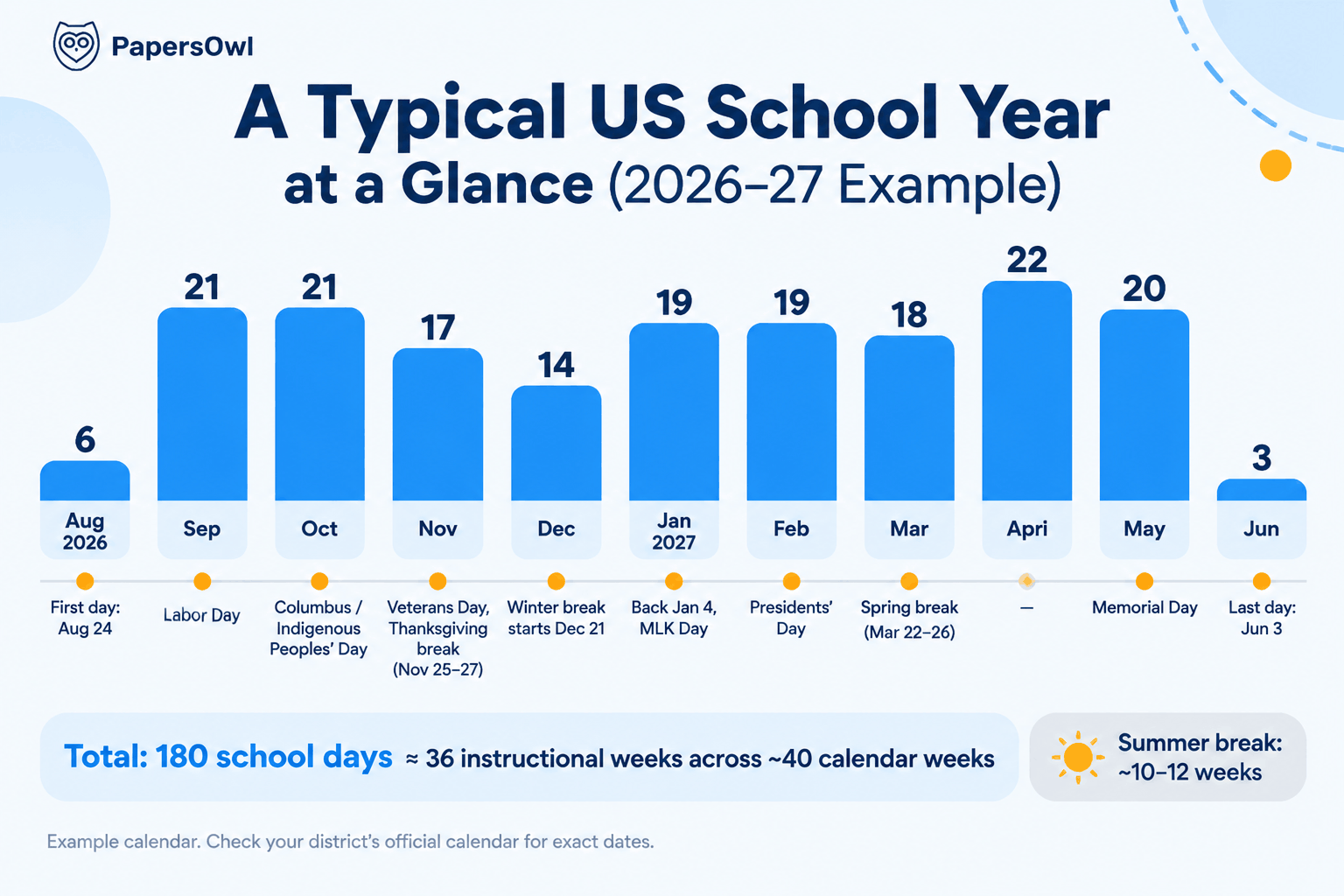
When does the school year start and end?
Start dates follow a rough regional pattern. Many districts in the South and Southwest open in early August. Clayton County Public Schools in Georgia, for example, starts its 2026–27 year on August 3. Many districts in the Northeast and Midwest wait until after Labor Day.
Some states put the rules into law. Minnesota bars most public schools from starting before Labor Day. Overall, 15 states set some limits on start or end dates, while 27 leave the choice to local districts, according to the Education Commission of the States.
An early start usually means an early finish. A district that opens in early August often wraps up in mid-to-late May. A school that starts after Labor Day may run until mid-June.
Which breaks shape the school calendar?
Breaks don’t count as school days. That’s why 36 weeks of classes stretch across about 40 calendar weeks. These are the main ones:
- Summer vacation: usually 10 to 12 weeks, or about two and a half to three months
- Thanksgiving break: two to three days in many districts, a full week in others
- Winter break: about two weeks, covering Christmas and New Year’s Day
- Spring break: typically one week in March or April
- Other days off: federal holidays, teacher training days, parent conferences, and weather closures
Some districts also add a fall break in October or a mid-winter break in February. Each extra week off pushes the last day of school further into June.
When I help students build a study plan, I mark these breaks first. They are natural checkpoints for rest and catch-up. Once you subtract them, you can see how many weeks per school year you actually have for steady work.
How Many School Days Does Each US State Require?
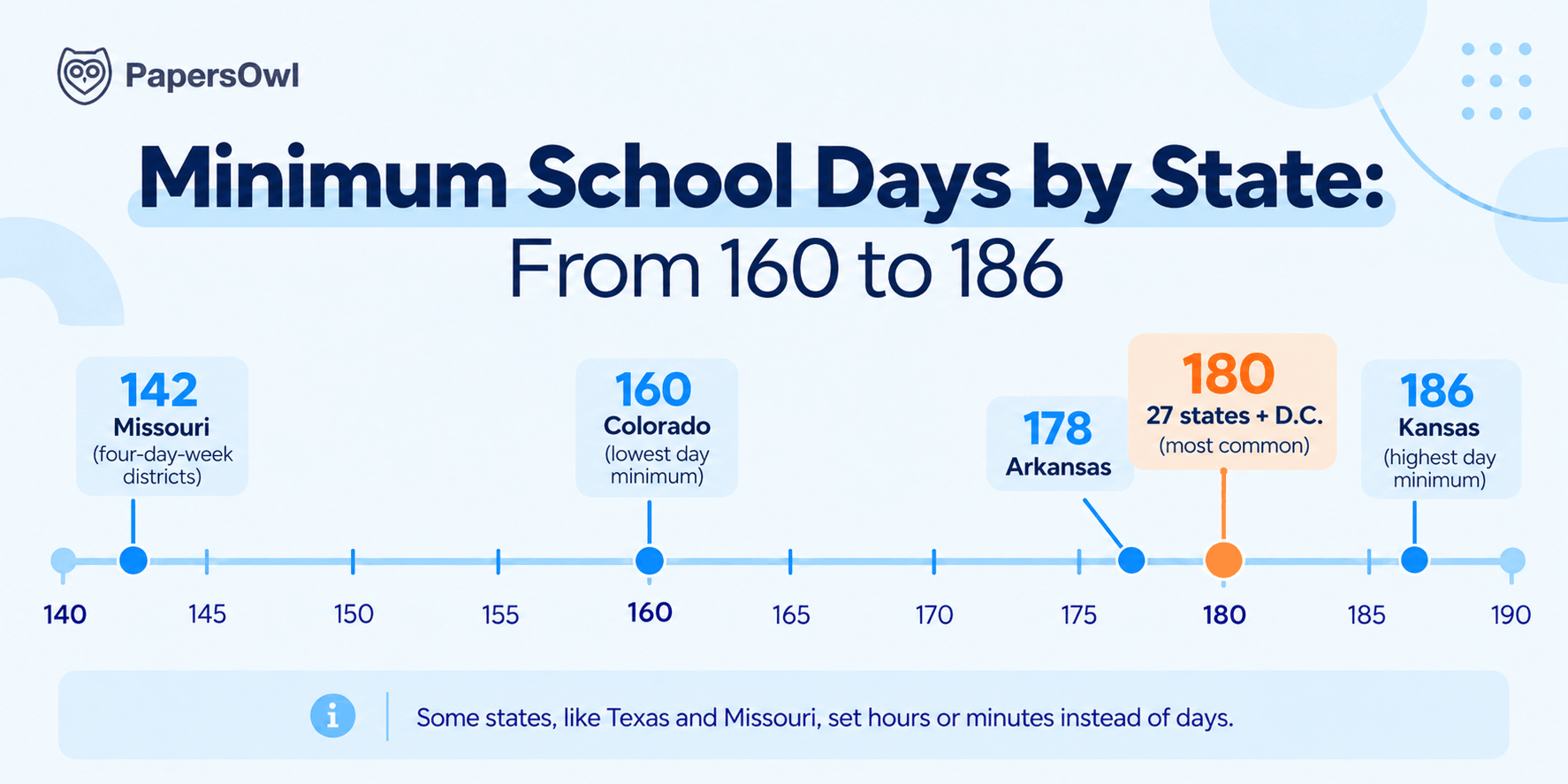
State minimums range from 160 days in Colorado to 186 days in Kansas. In between, 180 days is the most common rule: 27 states and Washington, D.C. set exactly that number. The other states either use different day counts or measure school time in hours.
That spread matters more than it looks. If you’re asking how many school weeks in a year your state requires, the answer runs from 32 weeks in Colorado to more than 37 in Kansas. That’s a gap of over five weeks of classes.
Many states also give districts a choice between days and hours. Arkansas accepts 178 days or 1,068 hours. Kansas districts can drop the 186-day rule and plan 1,116 hours instead. Some states skip days entirely: Texas counts 75,600 minutes a year, including recess.
| State | Minimum requirement | What to know |
|---|---|---|
| Colorado | 160 days | The lowest day minimum; four-day weeks are common |
| Arkansas | 178 days or 1,068 hours | Districts pick the model |
| Most states (27 + D.C.) | 180 days | The most common US rule |
| Oklahoma | 180 days or 1,080 hours | The hours must cover at least 165 days |
| Kansas | 186 days (K–11), 181 (grade 12) | The highest day minimum; 1,116 hours allowed instead |
| Texas | 75,600 minutes | Counted in minutes, not days |
| Missouri | 1,044 hours | Four-day-week districts may plan as few as 142 days |
What happens when schools close for snow?
Most states require schools to make up lost time when closures push them below the minimum. That’s why districts build spare days into their calendars. Missouri’s model policy, for example, requires districts to make up the first 36 hours lost to bad weather.
More states now allow remote learning days instead. Missouri calls these Alternative Methods of Instruction (AMI). With an approved plan, a closure doesn’t have to be added to the end of the year.
How Many Hours Do Students Spend in School Each Year?
Most US students spend about 1,000 to 1,200 hours in school each year. State minimums sit at the lower end. In 2023, Pew found that states with hour rules required an average of about 998 hours for 4th graders and 1,035 for 11th graders.
Actual schedules often run longer than the minimum. NCES data puts the average public school day at about 6.6 hours. Multiply that by 180 days, and you get close to 1,200 hours, though lunch, recess, and passing periods take part of that time.
That’s why days alone don’t tell the full story. Two schools can agree on how many weeks are in a typical school year and still differ by 100 hours or more. Colorado proves the point: it has the fewest required days, yet its 1,080-hour rule for high schools beats the national average of state minimums.
| Measure | What it counts | Typical US figure |
|---|---|---|
| School days | Days with classes | About 180 |
| Hours per school day | Length of the daily schedule | About 6.5 to 7 hours |
| Required annual hours | Minimum learning time set by the state | About 1,000 (average of state minimums) |
| Scheduled annual hours | Days × daily schedule | Up to about 1,200 |
When I plan a semester with students, I count hours, not just days. Hours show how much real class time you have for a tough subject before the final exam.
How Does the US School Year Compare With Other Countries?
The US school year is slightly shorter than in most developed countries. OECD school systems run about 38 school weeks a year on average, while a 180-day US year equals 36. Worldwide, most school years fall somewhere between 170 and 200 days.
| Country or group | School days per year | Context |
|---|---|---|
| United States | 160–186, depending on the state | 180 days is the most common rule |
| Canada | About 180–190, depending on the province | Each province sets its own calendar |
| England | 190 | Schools are open to pupils 190 days; teachers work 195 |
| Brazil | At least 200 | National law also requires at least 800 hours a year |
| OECD average | About 38 school weeks | About 805 hours in primary, 916 in lower secondary |
More days don’t always mean more learning time. Some countries pack more hours into fewer days. France is a clear case: primary students get 864 hours a year over 36 weeks, and many schools teach only four days a week. That adds up to fewer than 150 school days, yet more hours than the OECD primary average.
The US shows the opposite pattern. American students have fewer days than peers in Brazil or England, but longer school days. The average state minimum for 4th grade, about 998 hours, sits well above the OECD primary average of 805. Countries count instruction time differently, so treat this as a rough comparison.
Breaks differ too. OECD students get about 14 weeks of vacation a year in total. In the US, summer break alone takes 10 to 12 of those weeks.
If you’re planning to study abroad or switch school systems, I recommend comparing hours, not just days. A shorter calendar can still deliver more class time.
How Can You Find Your School’s Calendar and Count the Days Left?
Your district’s official calendar is the most accurate way to find out how many days left in school you have. Online countdown tools rely on generic dates, so they often miss local holidays and snow make-up days.
Follow these steps:
- Go to your school district’s website and open the “Academic Calendar” or “School Calendar” page.
- Pick the right school year, since districts often post two years at once.
- Find today’s date and the last day of school.
- Count only the weekdays between them.
- Subtract holidays, breaks, teacher training days, and other no-school days.
- Check again after winter, because snow days can push the last day later.
Here’s how it works with the example calendar above. From March 1 to June 3, 2027, there are 95 calendar days. Only 69 of them are weekdays. Remove spring break (5 days) and Memorial Day (1 day), and you’re left with 63 school days.
That gap between 95 and 63 is why I tell students never to plan by calendar days. Count school days instead, and your study schedule will match reality.

The Bottom Line on School Days
So, how many school days in a year should you expect? In most US public schools, the answer is about 180 days, or 36 weeks of classes spread across nine to ten months. That’s the most common state rule, though requirements range from 160 days in Colorado to 186 in Kansas.
Days are only part of the picture. Hours, breaks, and snow days shape how much class time you actually get. Your district’s calendar is the one source that gives the exact count.
Open that calendar at the start of the year, mark every break, and plan big assignments around them. A long school year feels much shorter when you have a clear map.
- Pew Research Center. In the U.S., 180 days of school is most common, but length of school day varies by state (2023). https://pewresearch.org/short-reads/2023/09/07/in-the-u-s-180-days-of-school-is-most-common-but-length-of-school-day-varies-by-state//
- Education Commission of the States. 50-State Comparison: Instructional Time Policies. https://www.ecs.org/50-state-comparison-instructional-time-policies
- Kansas State Department of Education. 1,116 Hours Statute FAQ. https://www.ksde.gov/Portals/0/School%20Finance/guidelines_manuals/1116hrs%20statute%20FAQ.pdf
- CPR News. Why Colorado has the shortest school year in the US (2025). https://www.cpr.org/2025/03/31/why-colorado-has-shortest-school-year-in-us/
- Missouri Consultants for Education. Policy P 1210: School Year and School Day. https://www.moconed.com/policy.php?action=ind&polID=2718&catID=2
- Minnesota Office of the Revisor of Statutes. Minnesota Statutes §120A.40: School Calendar (2025). https://www.revisor.mn.gov/statutes/cite/120A.40
- Clayton County Public Schools. School Year Calendars: 2026–2027. https://www.clayton.k12.ga.us/about/calendars/school-year-calendars
- National Center for Education Statistics. Schools and Staffing Survey 2007–08: Average Number of Days and Hours in the School Year. https://nces.ed.gov/surveys/sass/tables/sass0708_035_s1s.asp
- National Center for Education Statistics. National Teacher and Principal Survey 2015–16: Length of the Student School Week. https://nces.ed.gov/surveys/ntps/tables/ntps1516_20180125001_t1n.asp
- OECD. How Is the School Year Organised in OECD Countries? (2024). https://www.oecd.org/en/publications/how-is-the-school-year-organised-in-oecd-countries_a6385722-en
- OECD. Education at a Glance 2023, Indicator D1: How Much Time Do Students Spend in the Classroom? (2023). https://read.oecd.org/10.1787/8008b7a1-en
- Suffolk County Council. School Term and Holiday Dates. https://www.suffolk.gov.uk/children-families-and-learning/schools/school-term-and-holiday-dates/
- Presidência da República (Brazil). Lei nº 9.394/1996: Lei de Diretrizes e Bases da Educação Nacional, Art. 24. https://www.planalto.gov.br/ccivil_03/leis/l9394.htm
- Service-Public.fr. Rythmes scolaires à l’école primaire. https://sites.service-information-publique.fr/vias/guide-particuliers/F24490.html
- New York State Education Department. Chronic Absenteeism. https://www.nysed.gov/innovation-school-reform/chronic-absenteeism