Levels of education are the stages a student moves through, from early childhood to college and beyond. Each one builds on the last. In the US, most people use five: early childhood, elementary school, middle school, high school, and postsecondary education.
The map can look messy at first. Age cutoffs and grade ranges change by state and district. Take it one step at a time, and it gets clear fast.
I’ll walk you through every stage. You’ll get a table of grades by age, a table of degrees, and a short guide to listing your education on forms.
- Preschool to graduate school fits into five clear stages.
- Most students move through K–5, 6–8, and 9–12, though districts vary.
- After high school, you can earn a degree or train for a trade.
- Higher education levels link to higher pay and lower unemployment.
How Do You Define Level of Education?
Here’s the level of education meaning in plain words: it’s the stage of schooling you’re in or have finished. The scale runs from early childhood to postgraduate study.
The term works in two ways. In school, it names your current stage. On forms and resumes, it names the highest stage you have completed.
Take a college junior working toward a bachelor’s degree. Their current level is undergraduate. If they hold no other degree, their highest completed level is a high school diploma.
Many forms ask for the second one. Read each question twice before you answer.
What Are the 5 Levels of Education in the US?
Most people split the US system into five levels. It’s a handy model, not an official federal classification. Other sources group the stages differently.
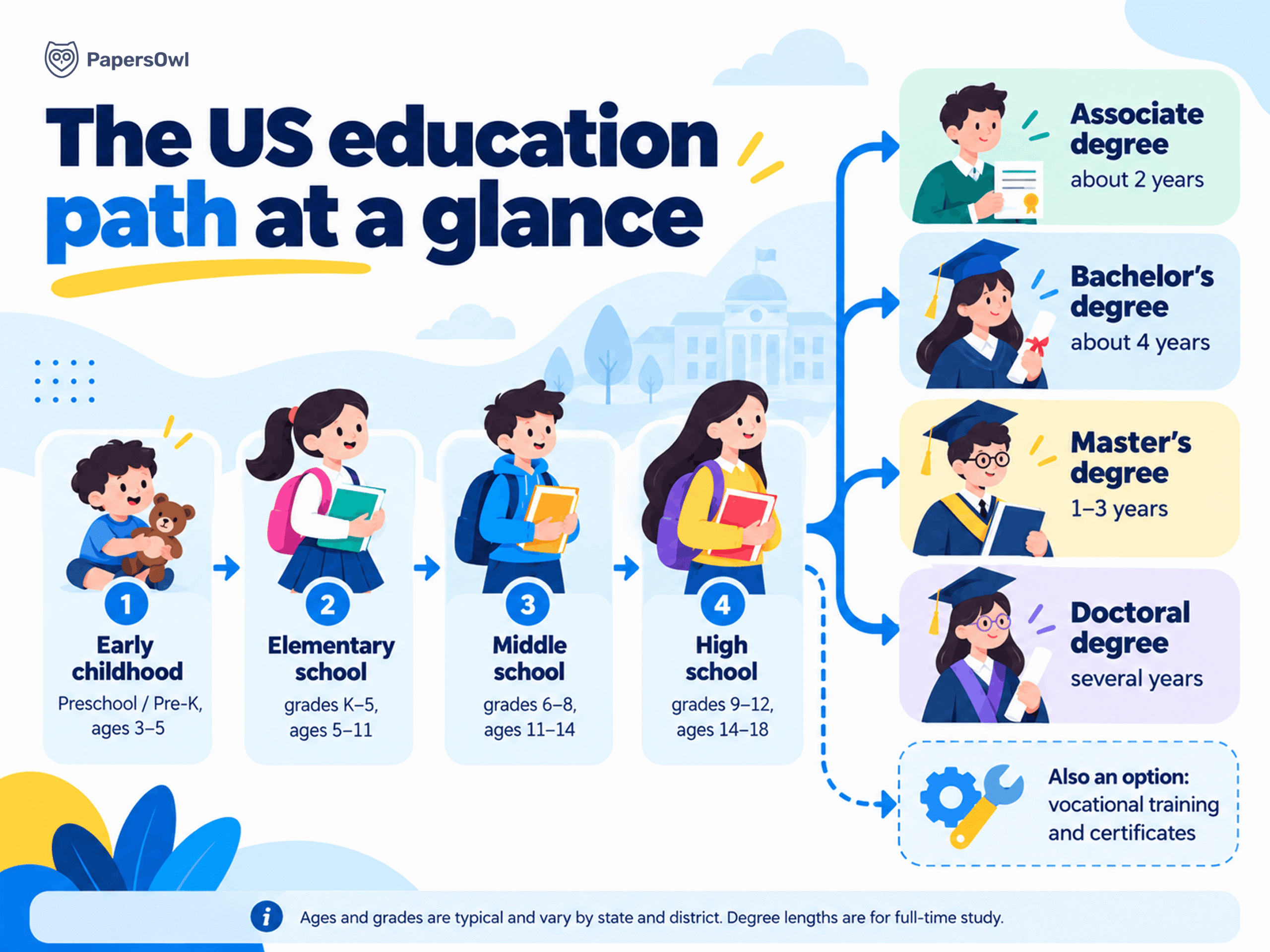
Here is the order, from first to last:
- Early childhood education: preschool and pre-K, where kids build social and early learning skills.
- Elementary school: kindergarten through grade 5, where core skills take shape.
- Middle school: grades 6 to 8, the bridge to high school.
- High school: grades 9 to 12, ending with a diploma.
- Postsecondary education: any study after high school, from certificates to doctorates.
The next section adds typical ages and grades for each stage.
Education Levels in the US by Age and Grade
Most US students go from preschool at about age 3 to grade 12 at about age 18. The table below shows each stage in order.
Table 1. US education levels by age and grade:
| Education level | Typical grades | Typical age | Main purpose |
|---|---|---|---|
| Early childhood | Preschool / Pre-K | 3–5 | Social, thinking, and school-readiness skills |
| Elementary school | K–5 | 5–11 | Foundational academic skills |
| Middle school | 6–8 | 11–14 | Subject-based learning and a bridge to high school |
| High school | 9–12 | 14–18 | Graduation requirements and prep for the next step |
| Postsecondary education | After grade 12 | Varies | Degrees, credentials, and career training |
Treat these ages as a guide. A child’s birthday, state cutoff dates, and district rules can shift the timeline. Kindergarten starts near age 5, so preschool and elementary ages overlap a little.
Early Childhood Education: Ages 3 to 5
Early childhood education is the first learning stage, and it usually covers ages 3 to 5. Most kids spend these years in preschool or pre-K. Options include public pre-K, private preschools, and Head Start for eligible families.
At this age, kids build social, language, emotional, and thinking skills. They learn to share, follow directions, and take turns. They also start to spot shapes, letters, sounds, and numbers.
Kindergarten is the bridge to formal school. I count it as the first year of elementary school. It adds early reading and number skills before grade 1.
These years matter. Strong routines, curiosity, and comfort in a group build the base for every stage that follows. If you’re choosing a program, look for play, routine, and caring teachers.<h2>2. Elementary School</h2>
Elementary School: Grades K to 5
Elementary school is the first stage of formal schooling. In most US districts, it runs from kindergarten through grade 5. Kids are usually 5 to 11 years old, and students in grades 1 to 5 are typically 6 to 11.
Core subjects stay steady through these years: reading, writing, math, science, and social studies. Many schools add art, music, and physical education. The goal is to build basic skills every later class relies on.
Skills from these years carry forward. If your child struggles with reading or math, act early and ask the teacher about support. Small gaps are easier to fix now than in middle school.
Some districts stretch elementary school to grade 6, so check your local setup. Many schools mark the end of grade 5 with a small ceremony, but it’s not a requirement.
Middle School: Grades 6 to 8
Middle school is the bridge between elementary and high school. In the typical US model, it covers grades 6 to 8. Students are usually 11 to 14 years old.
The big change is structure. Kids move between classes and meet different teachers for math, science, English language arts, and social studies. Homework grows, and so does the freedom.
This is where students learn to manage their time. I’d start a simple planner habit early. It pays off in high school.
Some districts call it junior high school, and grade ranges can differ. Broader systems also count middle school as secondary education.
What Level of Education Is High School?
High school is secondary education. In the typical US model, it covers grades 9 to 12. It ends with a high school diploma once the student meets the school’s requirements.
Most students finish around age 18 after four years. Each year has a name: freshman (grade 9), sophomore (10), junior (11), and senior (12).
Classes mix required subjects with electives. Students choose some of their own courses, from art to coding. This is a good time to test interests.
High school prepares you for college, vocational training, or work. I tell students to plan early. By grade 10, check what your next step requires.
Some broader systems count middle school as secondary education too. Definitions differ, so check the source.
After High School: Postsecondary Options
Postsecondary education means any study after high school, and it’s wider than most people think. You can choose a university degree, a trade program, or a short certificate. No single path fits everyone, so let your goals, budget, and timeline guide you.
Community colleges and associate degrees
Community colleges offer associate degrees and short career programs. A full-time student usually finishes an associate degree in about two years. Certificate programs run on their own timelines, often shorter than two years.
Some students use this path to transfer to a four-year school and finish a bachelor’s degree. Others train for a job right away. Fees are often lower than at four-year schools, so check current tuition.
Bachelor’s degrees at four-year universities
A bachelor’s degree is the typical first four-year degree in the US. It usually takes four years of full-time study. Many professions and graduate programs require one.
You’ll take general education courses and classes in your major. Part-time study, extra majors, or a change of plan can add time. Transfer or summer credits can save it. Map your credits early, and you’ll avoid surprises.
Master’s and doctoral degrees
A master’s degree usually comes after a bachelor’s degree. Many programs take about two years. Students use it to deepen their field or switch careers.
A doctoral degree, such as a PhD, goes further. It trains you for advanced research, teaching, or professional work. Programs often take several years after a bachelor’s or master’s degree.
Across graduate programs, time spans run from about one to eight years. Ask each school how long its path takes.
Here are the different levels of education after high school, side by side. Lengths are typical for full-time study.
Table 2. US degrees at a glance:
| Degree | Typical length | Where you study | What comes next |
|---|---|---|---|
| Associate | About 2 years | Community colleges, some universities | Transfer to a bachelor’s program or start work |
| Bachelor’s | About 4 years | Colleges and universities | Graduate study or a career |
| Master’s | 1–3 years | Universities | A doctorate or advanced work |
| Doctoral | Several years | Universities and research institutions | Research, teaching, or senior professional roles |
Vocational and technical schools
Vocational and technical schools teach hands-on skills for a specific job. Programs can prepare you for trades, healthcare support, technology, or service roles. Many take a few months to a few years, depending on the field.
You may finish with a certificate or diploma. Some jobs also require an exam or a license. Check your state’s rules before you enroll.
Certificates, diplomas, and professional licenses
A certificate or diploma shows you finished a program. A professional license gives you the legal right to work in a regulated job once you meet set requirements. A license is not an academic degree.
Some jobs accept a certificate. Others need a degree plus extra credentials. Check what your target job requires before you choose a path.
How the US Education System Works
In the US, states and local districts run most schools, not one national office. That’s why rules, calendars, and grade ranges differ from place to place. Here’s how the main pieces fit.
- Public schools. Public schools get most of their funding from state and local sources. They usually charge no tuition for K–12 students.
- Private schools. Private schools can charge tuition, and some are religious or independent. Each one sets its own admission rules and curriculum.
- Charter schools and homeschooling. Charter schools are public schools that run under a charter, a contract with the state or another body. They get more freedom in return for meeting set goals. Homeschooling follows state law, and requirements vary.
- Who sets the rules. States and local districts set standards, enrollment rules, and graduation requirements. Compulsory attendance ages differ by state, so check your state’s law. Your district office can confirm the details.
Learn your local setup early. It shapes your options more than you’d expect.
Education Level and Career Outcomes: What the Data Shows
Higher education levels link to higher pay and lower unemployment. The US Bureau of Labor Statistics (BLS) tracks this every year.
In 2025, full-time workers age 25 and over with a bachelor’s degree earned a median $1,578 a week. Those with only a high school diploma earned $966.
Table 3. Earnings and unemployment by education level, 2025:
| Highest level completed | Median weekly earnings | Unemployment rate |
|---|---|---|
| High school diploma | $966 | 4.3% |
| Associate degree | $1,135 | 3.0% |
| Bachelor’s degree | $1,578 | 2.8% |
| Master’s degree | $1,876 | 2.6% |
Source: BLS, “Education pays, 2025.” Workers age 25 and over; earnings are for full-time wage and salary workers.
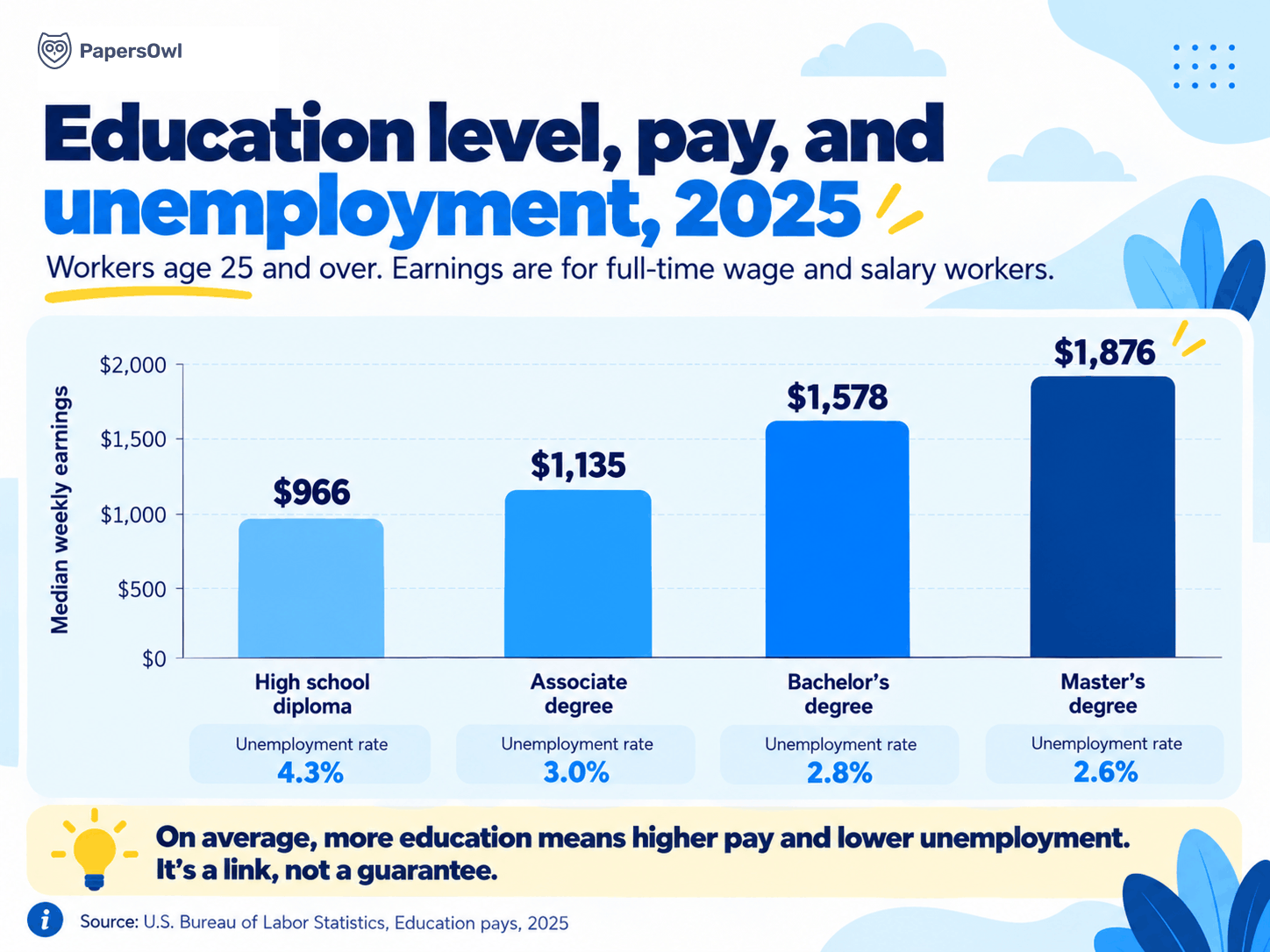
The numbers show a link, not a promise. Experience, location, hours worked, and your field also shape pay. BLS notes that apprenticeships and other training aren’t counted in these categories, yet they can affect pay.
Pick a path that fits your goals, not just the top row of a table.
School Levels vs. Highest Level of Education Completed
School levels in the US name the stage a student is in now: elementary, middle, or high school. Highest level completed names the last stage you finished. They answer two different questions. Mixing them up is a common mistake on forms.
Here’s an example for a master’s student:
- Currently studying: master’s program, year 1
- Highest completed: bachelor’s degree
On a form, list the degree you hold, not the one you’re working on. If the question is unclear, check the form’s instructions or ask the school.
Sum Up: Where Each Level Leads
Education moves in steps. It starts with early learning, runs through school, and can lead to college, trade training, or graduate study. No step is wasted, and each one opens new doors.
After high school, you can earn an associate or bachelor’s degree, train for a trade, or aim for a graduate degree. Let your career goals, job requirements, budget, and timeline pick the route.
It’s a long road, but it has clear checkpoints. Breathe, plan your next step, and you’ve got this.
- U.S. Bureau of Labor Statistics, Education pays, 2025
- National Center for Education Statistics, Fast Facts: Charter schools
- National Center for Education Statistics, Revenues for public elementary and secondary schools, by source of funds and state: 2018–19
- Education Commission of the States, 50-State Comparison: Free and Compulsory School Age Requirements
- Office of Head Start, Head Start Services
- College Board BigFuture, How many years do you have to be in college to achieve certain degrees?
- EducationUSA, What is a U.S. undergraduate student?
- New York State Higher Education Services Corporation, College Words to Know