
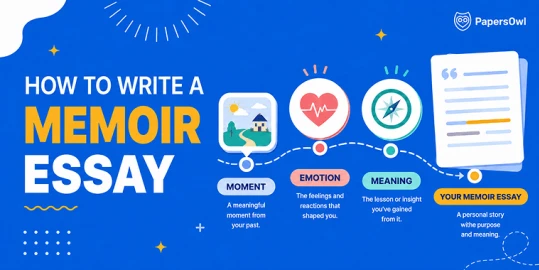
A memoir essay tells one true story from your life. It’s not your whole life story—it’s one moment, seen up close, with a lesson attached. Think of it like a photograph, not a photo album.
In this guide, I’ll walk you through what makes a memoir essay work: how to structure it, how to start it, and how to avoid the mistakes that make readers stop reading. We’ll look at a real example, too, broken into parts, so you can see the craft in action.
Grab a coffee. Let’s get your story on the page.
What is a memoir essay?
A memoir essay is a short piece of true writing about one specific moment from your life. It focuses on a single scene, not your entire biography. The goal is to show what that moment meant, not just what happened.
Most memoir essays run 500 to 2,000 words. They read like a story, with a clear beginning, middle, and end. But every detail in them is real—no invented characters, no fictional twists.
A strong memoir essay does one thing well: it turns a personal memory into something a stranger can feel. That’s the whole craft.
What’s the difference between a memoir essay and a personal essay?
A memoir essay looks backward at a specific memory. A personal essay can explore any idea, opinion, or experience, past or present.
Memoir stays close to a scene: a kitchen, a hospital room, a car ride home. Personal essays often move outward, using a story to argue a point or explore a theme.
Here’s a simple way to remember it: a memoir shows a moment, personal essay makes an argument. Memoir essays can be personal essays, but not every personal essay is a memoir.
How is a memoir essay different from an autobiography?
An autobiography covers your whole life, from childhood to the present day. A memoir essay covers one moment, told in full detail.
Length is the clearest signal. Autobiographies run hundreds of pages. Memoir essays run a few hundred to a couple thousand words.
Autobiographies also move in order, year by year. A memoir essay skips the timeline and zooms into a single scene, the way a photograph captures one second instead of a whole year.
What is the structure of a memoir essay?
A memoir essay follows a simple arc: a hook, a scene, a turn, and a reflection. Each part has a job, and skipping one usually weakens the whole piece.
The hook pulls the reader into the moment right away, often mid-action. The scene builds detail—sound, place, tension. The turn is where something shifts, a realization or a change. The reflection closes the essay by naming what that moment taught you.
Here’s how a memoir essay compares to two writing forms people often confuse it with:
| Feature | Memoir Essay | Personal Essay | Autobiography |
|---|---|---|---|
| Scope | One moment | One idea or theme | Whole life |
| Length | 500–2,000 words | 500–2,500 words | Full book |
| Timeline | Single scene | Flexible | Chronological |
| Main goal | Show a meaningful moment | Make a point or argument | Document a life |
| Tense | Often past, close-up | Past or present | Mostly past |
The structure matters because readers look for a clear shape. A memoir essay with a hook, scene, turn, and reflection is easy to follow and easy to remember.
How do you write a memoir essay in 7 steps?
Writing a memoir essay gets easier when you break it into steps instead of staring at a blank page. Here’s the process, start to finish.
- Pick one moment, not your whole life. Choose a single scene you remember clearly—a conversation, a decision, a day that changed something. If you can’t picture the room it happened in, pick a different memory.
- Ask what it taught you. Before you write a word, name the lesson or shift the moment gave you. This becomes your reflection at the end, so it’s worth knowing early.
- Build a simple memoir essay outline. A working outline for a memoir essay looks like this:
- Hook: the moment starts, mid-scene
- Setting: where and when, in a few sharp details
- Rising action: what builds the tension
- Turn: the moment things shift
- Reflection: what you understand now that you didn’t then
- Write the hook first. Open in the middle of the action. Skip the throat-clearing (“I’ll never forget the day…”) and drop the reader straight into the scene.
- Fill in sensory detail. Add what you saw, heard, and felt. One sharp detail—a smell, a sound—does more work than five vague ones.
- Write the turn and reflection last. These are the hardest lines to get right, so write them after the scene is already on the page. You’ll know more about what the moment means once it’s written out.
- Cut anything that doesn’t serve the moment. Memoir essays are short. If a sentence doesn’t build the scene or the meaning, cut it.
Follow these steps in order the first time. Once you’ve written a few memoir essays, you’ll start skipping around—but the structure holds either way.
How do you choose a topic worth writing about?
Pick a moment that still feels vivid, even years later. If you can remember small details—what someone said, what the room smelled like—that’s usually a sign the moment matters.
Skip the “big” events just because they sound impressive. A quiet moment, like a phone call or a walk home, often makes a better essay than a dramatic one. What matters is how much the moment changed you, not how loud it was.
A good test: can you picture the exact scene right now? If yes, you have your topic.
Memoir essay topics to try
Not sure what to write about? Here are 18 moments worth exploring, if you’re looking for memoir essay examples of your own to draw from.
- The day you learned a hard truth about someone you admired
- A conversation that changed how you saw a parent or grandparent
- The first time you felt truly alone
- A moment you got caught in a lie
- The last time you saw a place before it changed forever
- A small act of kindness from a stranger
- The day you stood up for yourself for the first time
- A tradition your family let go of
- The moment you realized you’d outgrown a friendship
- A time you broke a rule and don’t regret it
- The first time you disagreed with a parent out loud
- A place that felt safe when nothing else did
- The day you had to grow up faster than you wanted to
- A mistake that taught you more than any success did
- The moment you forgave someone who never apologized
- A memory tied to a specific smell or sound
- The last conversation you had with someone before they left
- A moment you chose silence over speaking up
Pick the one that still feels vivid when you think about it. That’s usually the one worth writing.
How do you start a memoir essay?
Start with one image or line of dialogue from the scene itself, not a general lead-in. The first sentence should feel like the reader walked into the middle of something already happening.
A strong hook often uses one specific detail. “The phone rang at 3 a.m.” tells the reader more, faster, than a paragraph of setup.
Cut your first sentence in half. If it still makes sense, cut it again. Most hooks get stronger the shorter they are.
How do you write about emotions without sounding dramatic?
Show what you felt through action and detail, not labels. Instead of writing “I was devastated,” describe what devastated looked like—shaking hands, a silent car ride, staring at a wall.
Readers trust specific details more than big emotional words. “I couldn’t eat for two days” says more than “I was heartbroken.”
One rule helps here: if a sentence could apply to anyone’s sad day, it’s too generic. Make it specific to your moment.
How do you use dialogue effectively?
Use dialogue when the exact words matter, not for every conversation. A single sharp line often does more than a page of summary.
Keep it short. Real conversations ramble, but memoir dialogue should cut straight to the moment that counts. One or two lines are usually enough.
Skip dialogue you don’t remember word-for-word. Paraphrasing what someone said (“she told me to leave”) works fine when the exact wording isn’t essential.
What’s a strong memoir essay example?
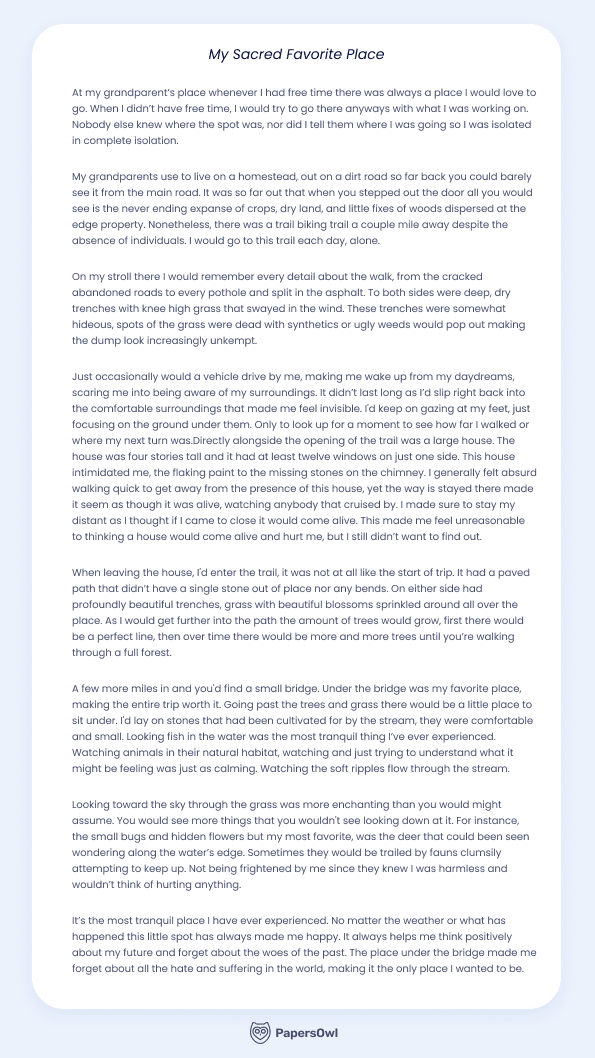
Let’s look at a real memoir essay and break down what works, part by part. Here’s an excerpt about a hidden spot near a stream, told from the writer’s own childhood.
The opening:
“At my grandparent’s place whenever I had free time there was always a place I would love to go… I was isolated in complete isolation.”
This opening sets the scene, but it starts before the story really begins. We don’t land in a moment yet—we’re still in setup. A stronger version would drop us straight into the walk itself, mid-motion.
The scene-building:
“To both sides were deep, dry trenches with knee high grass that swayed in the wind… spots of the grass were dead with synthetics or ugly weeds would pop out.”
This is where the essay gets strong. The details are specific and a little unglamorous—cracked asphalt, dead grass, weeds. That’s what makes it feel real. Generic memoir writing says “the path was pretty.” This essay shows you the exact texture of it.
The missing turn:
The essay moves from the road, to the intimidating house, to the trail, to the spot under the bridge. Each part is vivid. But there’s no clear moment where something shifts—no line where the writer realizes something new. Right now the essay describes a place. A turn would show what that place changed in the writer, and pin it to one specific moment, not just a feeling that builds slowly.
The reflection:
“It’s the most tranquil place I have ever experienced… it made me forget about all the hate and suffering in the world.”
This closes the essay, but it stays broad. “Hate and suffering in the world” is a big claim without a specific anchor. A sharper reflection would tie back to one detail from the scene—the deer, the stream, the stones—and say exactly what that detail taught the writer.
Takeaway: strong scene-building can carry an essay a long way, but a memoir essay needs a turn and a specific reflection to land. Description alone isn’t enough—the reader needs to know what the moment meant.
What does a weak opening vs a strong opening look like?
Here’s the same essay’s opening line, before and after.
Before:
“At my grandparent’s place whenever I had free time there was always a place I would love to go. When I didn’t have free time, I would try to go there anyways with what I was working on.”
This tells the reader about a habit, not a moment. It’s true, but it’s summary—there’s no scene yet, nothing happening right now.
After:
“The dirt road stretched so far back you couldn’t see it from the highway. I walked it alone, the way I did most afternoons, eyes on the cracked asphalt, already counting the miles to the bridge.”
This version drops the reader into the walk itself. It keeps the same facts—the isolation, the habit, the dirt road—but shows them happening instead of explaining them.
The fix is almost always the same: find the moment buried in your setup, and start there instead. Cut the “whenever” and “usually” language. Replace it with one specific walk, one specific day.
A quick test: if your opening sentence could describe five different days, it’s still summary. If it could only describe one, you’ve found your hook.
How do you revise a memoir essay?
Revising a memoir essay means checking for scene, not just checking for errors. Read through once for grammar, then read again just for craft.
Here’s a simple revision checklist to run through:
- Cut the setup. Does your essay start with a moment, or with background about a moment? Cut anything before the action starts.
- Check for a turn. Is there one clear point where something shifts or you realize something new? If every paragraph feels the same, the turn is missing.
- Replace labels with detail. Find words like “sad,” “happy,” or “peaceful.” Replace each one with an action or image that shows that feeling instead.
- Read your reflection out loud. Does it name something specific, or does it stay general (“it changed my life”)? Tie it back to one detail from the scene.
- Trim anything that repeats itself. If two sentences say the same thing in different words, cut one.
- Check your verb tense. Memoir essays usually stay in one tense. Jumping between past and present without reason confuses the reader.
Revise in this order: structure first, then sentences, then grammar last. Fixing commas in a paragraph you’re about to cut wastes time.
How do you end a memoir essay?
End a memoir essay by naming what the moment taught you, tied to one specific detail from the scene. Avoid closing with a broad statement that could apply to any story.
A weak ending sounds like this: “That day changed my life forever.” It’s true, but it’s generic—it could end almost any essay.
A strong ending stays specific: it points back to the image, object, or line of dialogue that carried the essay, and shows what it means now. If your essay was about a stream under a bridge, end with the stream—not with a general lesson about life.
One trick: reread your first paragraph before you write your last one. The strongest endings often echo an image from the opening, just seen differently the second time.
What are common mistakes to avoid?
The biggest mistake is writing a summary instead of a scene. If your essay explains what usually happened instead of showing one specific moment, it reads flat.
A few other mistakes show up often:
- Trying to cover too much time. A memoir essay works best zoomed into one day, one hour, even one conversation—not a whole summer or a whole relationship.
- Explaining the feeling instead of showing it. Lines like “I was scared” tell the reader what to feel instead of letting them feel it through detail.
- Skipping the reflection. A memoir essay without a clear “here’s what I understand now” ending can feel unfinished, even if the scene itself is strong.
- Overusing dialogue. Long back-and-forth conversations slow the pace. One sharp line usually does more than a full exchange.
- Vague endings. Closing with “it changed everything” or “I’ll never forget it” without specifics undercuts an otherwise strong essay.
The fix for most of these is the same: get more specific, not less. Name the exact detail, the exact line, the exact moment.
How do you make a memoir essay stand out?
A memoir essay stands out when it trusts small details instead of big claims. One precise image—a smell, a sound, an object—usually says more than a page of explanation.
Specificity does the heavy lifting here. “The stones were still warm from the sun” tells a reader more than “the spot was peaceful.” Readers remember details, not summaries.
Voice also sets essays apart. Two people can write about the same event, but the one with a clear, consistent voice—their own rhythm, their own way of noticing things—is the one that stays with the reader.
Last, a strong memoir essay picks its moment carefully. Not the biggest event in your life, necessarily, but the one where you can still recall the smallest details. That’s usually a sign it’s the right story to tell.
Quick recap
Writing a memoir essay comes down to one idea: show one true moment, up close. A few things to keep in mind as you write:
- Pick a scene you can still picture clearly, not your whole life story
- Open mid-action—skip the setup and drop the reader into the moment
- Build the scene with specific, sensory detail
- Include a clear turn: the point where something shifts
- End with a reflection tied to one detail, not a broad statement
- Revise for structure first, then sentences, then grammar
A memoir essay isn’t about covering everything that happened. It’s about showing one moment well enough that a stranger can feel it too.