
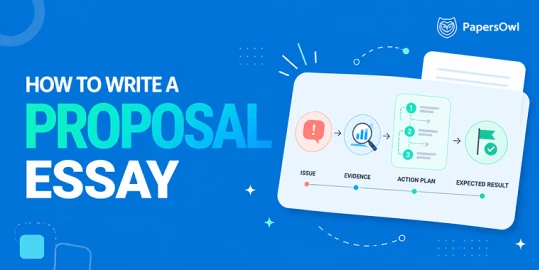
A proposal essay names a problem. Then it argues for one clear solution. You state the issue, pick your audience, write a strong thesis, and back it up with evidence. You explain how the solution would work, answer objections, and show the payoff.
One quick note first: a proposal essay isn’t a research proposal. They’re different assignments. This guide walks you through the structure, outline, format, and real examples for both.
Proposal essay checklist
Run through this list before you submit.
If you can check every box, your proposal is ready to go.
Your proposal essay FAQ guide
What is a proposal essay?
A proposal essay is a type of argumentative writing. It answers one question: what should be done? You pick a problem or opportunity. Then you argue for a specific action.
Every proposal essay has six parts:
- A problem or opportunity.
- A proposed action.
- Justification for that action.
- Evidence to back it up.
- Proof that it’s feasible.
- And an audience who can make it happen.
Skip a piece, and your proposal stops being convincing. It just becomes an opinion.
Is a proposal essay the same as a paper or research proposal?
No. They overlap, but they are not the same assignment. Mixing them up is a mistake I see a lot.
A proposal essay argues for one solution. It wants readers to say yes to your plan. A paper proposal asks for approval on a paper you haven’t written yet. A research proposal explains a study you plan to run.
| Assignment | Main Purpose | Typical Content |
|---|---|---|
| Proposal essay | Convince readers to adopt a solution | Problem, solution, evidence, feasibility, benefits |
| Essay/paper proposal | Get approval for a future paper | Topic, working argument, approach, sources |
| Research proposal | Explain a planned study | Research question, literature, methods, significance |
Academic guides back this up. Purdue focuses on problem, background, and methodology for academic proposals. Yale adds hypothesis and specific aims for research proposals.
Know your assignment first. Then you’ll write the right document.
How is a proposal essay different from a persuasive or problem-solution essay?
A proposal essay goes one step further. It asks a specific audience to take a specific action. That’s the key difference.
A persuasive essay can argue for almost any position. It doesn’t need next steps. A problem-solution essay explains a problem and its fix, then often stops there. A proposal essay pushes past that. It names who should act. It proves the action is realistic. It shows why it’s worth doing. Here’s the formula:
Problem → Proposed Action → Reasons → Feasibility → Benefits
That last step — feasibility — is what sets a proposal essay apart.
What are the main parts of a proposal essay?
A proposal essay has eight core parts. Each one plays a different role.
| Part | Purpose |
|---|---|
| Introduction | Introduce the issue and proposal |
| Problem | Show what needs to change |
| Proposal | State the solution |
| Justification | Explain why it should work |
| Implementation | Show how it can be done |
| Counterargument | Address objections or alternatives |
| Benefits | Explain expected results |
| Conclusion | Reinforce the proposal and action |
Justification and counterargument matter most.
Justification proves your solution isn’t just an idea — it can actually work. Counterargument shows you’ve thought past your own view. Skip either one, and readers will find the gap themselves.
How do you write a proposal essay step by step?
Follow seven steps, in order. Each one builds on the last.
- Understand the assignment and audience.
- Choose a specific problem.
- Research the issue.
- Decide on a realistic solution.
- Build a proposal essay outline.
- Draft and support the proposal.
- Revise for feasibility and persuasion.
That’s the whole process, start to finish. No step is optional. Skip step 5, the outline, and your draft will wander. Skip step 7, revision, and weak spots in your feasibility case will slip through.
What makes a good proposal essay topic?
A strong topic needs six things: a real problem, clear stakeholders, room for disagreement, a practical solution, enough evidence, and a scope you can actually cover.
Here’s a quick test. Can you name who should do what, why, and how? If you can’t answer that in one sentence, your topic is too broad. Try narrowing it down.
A few solid starting points: campus food waste, textbook costs, student parking, recycling programs, or AI-use policies. Each one has real stakeholders and room for a specific fix.
How do you write a topic proposal for an essay?
A topic proposal is a short document you write before the actual essay. It’s not the same as a proposal argument — it just pitches your plan.
Use this template:
- Topic: …
- Research question/problem: …
- Working thesis: …
- Why it matters: …
- Planned sources/approach: …
Fill in each line in one or two sentences. Your instructor uses this to approve your direction before you write a single paragraph of the full essay.
How do you start a proposal essay?
Start by naming a specific problem. Show your reader why it matters, right away.
Three hooks work well: a relevant fact, a short scenario, or a direct statement of the problem. Skip generic openers like “Since the beginning of time…” They don’t hook anyone.
Try something specific instead: “More than 2,000 students use the campus library after 8 p.m., yet it closes at 10.” You don’t need a real statistic.
A realistic example works too — just label it as an example.
What makes a strong proposal essay thesis?
Use this formula: who should do what, and why it helps. Name the actor, the action, and the benefit — all in one sentence.
Here’s an example: “The university should extend library hours during finals week to give commuting students reliable access to study spaces.”
Compare that to a weak version: “Colleges should help students.” It names no actor and no action. A strong thesis always does both.
What belongs in a proposal essay problem statement?
Your problem statement answers four questions:
- What’s happening?
- Who’s affected?
- Why does it matter?
- What happens if nothing changes?
Answer all four, and move on. Don’t spend half your essay describing the problem — that’s a common mistake.
Your proposal essay is about the solution. The problem just sets up why that solution matters.
What makes a proposed solution strong?
A strong solution is specific, actionable, and tied directly to your problem. It also has to be realistic.
Compare these two: “Schools should improve education” is a goal, not a proposal. “The district should introduce weekly tutoring sessions” is an actual proposal — specific and doable.
Know the difference. A goal states what you want. A proposal states exactly how to get there.
How do you prove a proposal is feasible?
Feasibility means your solution can actually happen. You prove it by answering a few key questions.
Who will implement it? What will it cost? What resources does it need? How long will it take? Are there legal or practical barriers? Can the responsible group actually pull it off?
Answer these clearly, and your proposal moves from “nice idea” to “realistic plan.” Skip them, and readers will doubt you can back up your solution.
What evidence should you use in a proposal essay?
Match your evidence to your claim. Different claims need different proof.
| Claim | Useful Evidence |
|---|---|
| Problem exists | Statistics, reports, studies |
| Problem matters | Consequences, expert research |
| Solution can work | Case studies, comparable programs |
| Solution is feasible | Cost, timeline, resources |
| Solution is better | Comparisons with alternatives |
Use this table as a checklist. If you’re missing evidence for any row, your proposal has a weak spot. Strong proposals cover all five. Weak ones usually only prove the problem exists and stop there.
Does a proposal essay need counterarguments?
Yes, when real objections or alternatives exist. Address them — don’t skip them.
Pick the strongest objection, not a weak one you can easily knock down. Answer it with evidence. Then compare your solution to any reasonable alternatives, and show why yours wins.
Here’s how that sounds in practice: “Extending library hours costs money; however, the cost is small compared to the drop in late-night study space complaints.” That’s a real objection, answered directly.
How do you write an implementation plan?
An implementation plan answers five things, in order: who, what, when, what resources, and how you’ll measure success.
Use this template:
- Responsible stakeholder — who acts first
- First action — the initial step
- Next steps — what follows
- Timeline — when each step happens
- Resources needed — what it takes to run
- Success measure — how you’ll know it worked
Fill in each line with one short phrase. That’s a full implementation plan — no vague “explain how it works” needed.
How do you explain the benefits and expected outcomes?
A benefit isn’t a vague promise that everything will improve. It’s a measurable outcome tied directly to your proposal.
Think in concrete terms: lower cost, greater access, less waste, fewer delays, higher participation. Pick outcomes you can actually point to, not feel-good claims.
Then connect each one back to your specific solution. “Extended library hours mean more study access during finals” works. “This will help students” doesn’t — it’s too vague to mean anything.
How do you write a proposal essay conclusion?
Your conclusion does four things: restate the proposal, reinforce why it’s justified, summarize the main benefit, and end with a call to action.
Keep it tight. Don’t introduce new evidence here — that belongs earlier. And don’t just repeat your introduction word for word; readers will notice.
End with something active: “It’s time the university extended library hours” hits harder than “In conclusion, this issue matters.”
What does a proposal essay outline look like?
Use this template. Copy it, and fill in each line with your own topic.
- Introduction
- Hook
- Context
- Proposal thesis
- Problem
- Scope
- Causes/consequences
- Evidence
- Proposed Solution
- What should happen
- Why this solution
- Implementation and Feasibility
- Steps
- Resources
- Timeline
- Alternatives or Counterarguments
- Main objection
- Response
- Benefits
- Conclusion
Seven sections, in this order, cover every part a proposal essay needs. Follow it top to bottom, and you won’t miss a step.
What format should a proposal essay follow?
There’s no single universal proposal essay format. Your instructor’s assignment always comes first — check it before you format anything.
Most proposal essays share a few basics: a clear title, standard academic paragraphs or headings, MLA or APA style if required, in-text citations, and a references or Works Cited page. Keep the formatting clean and easy to scan.
Here’s a simple way to remember the difference: structure is what you say. Format is how you present it. You can nail the structure and still lose points on format — so double-check both.
How long should a proposal essay be?
Follow your assignment requirements first — length always depends on what’s asked.
As a rough guide: a short classroom assignment runs about 500–1,000 words. A developed proposal argument often reaches 1,000–2,000 words or more. A paper or topic proposal is usually much shorter.
These ranges vary a lot by course and instructor, so treat them as a starting point, not a rule.
What goes into a research paper proposal?
A research paper proposal includes nine parts: working title, topic or problem, research question, working thesis or hypothesis, significance, brief background, proposed method, preliminary sources, and a timeline if required.
That structure lines up with what most academic guides recommend — problem, background, methodology, expected findings, and significance. Student templates often follow the same core: research question, why it matters, method, and planned sources.
Don’t add a methodology section just because you saw it in a research proposal template. If your instructor assigned a proposal argument essay, not a research proposal, you don’t need one. Check your assignment first. The two documents look similar, but they’re not interchangeable.
What does a good proposal essay example look like?
Here’s a full annotated example. Topic: extending campus library hours during finals.
- Problem: The library closes at 10 p.m. during finals week. More than 2,000 students study on campus after that time, based on recent ID-swipe data. Many have nowhere else to go once it closes.
- Proposal thesis: The university should extend library hours to 2 a.m. during finals week to give commuting and residential students reliable access to quiet study space.
- Evidence/justification: Three peer institutions already offer 24-hour finals-week access, with usage data showing steady turnout past midnight. Student surveys at this campus also rank “more study hours” as a top finals-week request.
- Implementation: The library could staff two additional shifts using existing part-time student workers. Extended hours would run for the two weeks before finals through the exam period, funded through the library’s existing overtime budget.
- Counterargument: Extending hours costs money in staff pay. However, the cost is small compared to the drop in late-night study complaints and the boost in library usage data from peer schools.
- Expected benefit: Students get reliable, quiet study space when they need it most. The library also gains usage data that could support permanent hour changes.
- Conclusion: The university should extend library hours during finals week. It’s a low-cost change with a clear, measurable payoff for students who need it most.
Why this example works:
- Names a specific, provable problem
- Points to one clear decision-maker
- Proposes a realistic, fundable action
- Ends with a measurable benefit
What does a paper proposal example look like?
Here’s a sample paper proposal. Topic: how AI feedback tools affect college writing revision.
- Working title: Does AI Feedback Change How Students Revise Their Writing?
- Research question: How do AI feedback tools affect the number and type of revisions college students make to their essays?
- Working argument: AI feedback tools likely increase surface-level revisions—like grammar and word choice—more than they improve structural changes, such as argument or organization.
- Significance: Writing instructors increasingly assign AI tools without knowing their real effect on revision quality. This research could help instructors decide how to use these tools in class.
- Approach: Compare revision drafts from two student groups: one using AI feedback tools, one using peer review only. Code each draft for revision type, then compare results.
- Preliminary sources: Recent studies on AI writing feedback, peer review research, and composition studies on revision behavior.
Notice something: this sample proposes a future paper. It doesn’t ask anyone to implement a solution. That’s why its structure looks so different from the library-hours example above—same word “proposal,” different job entirely.

Expertise: Essay Writing • Writing Tips • English Grammar
I am an academic writing expert with an MA in Creative Writing and a BA in English Literature. I specialize in breaking down complex literary and academic topics into actionable guides for students. My goal is to help you master linguistic precision and practical writing strategies for academic success.
Expertise: Essay Writing • Writing Tips • English Grammar
I am an academic writing expert with an MA in Creative Writing and a BA in English Literature. I specialize in breaking down complex literary and academic topics into actionable guides for students. My goal is to help you master linguistic precision and practical writing strategies for academic success.