
Want to know how to write a personal narrative essay? Start small. Pick one moment, not your whole life story.
A personal narrative essay tells a true story from your own experience—something that actually happened to you. The best ones don’t try to cover everything. They zoom in on one meaningful event and show why it mattered. Think storytelling plus reflection: what happened, and what it taught you.
Below, we’ll cover the definition, structure, outline, format, writing steps, strong introductions, topic ideas, and real examples. Let’s fix this together.
What is a personal narrative essay?
A personal narrative essay is a nonfiction story about a real experience from the writer’s life, told from a personal point of view and shaped around a clear meaning or insight.
It’s usually written in first person, and it needs the same building blocks as any good story—characters, a setting, a sequence of events, and a turning point. But don’t just list what happened. Every personal narrative needs a purpose. Reflection is what shows readers why the experience mattered.
How is a personal narrative different from a narrative essay or memoir?
A personal narrative focuses on one real experience, while a narrative essay can tell any story—personal or not—to make a point, and a memoir explores memories tied to a theme or period of life.
| Type | Main Focus | Scope |
|---|---|---|
| Personal narrative | One real personal experience | Narrow |
| Narrative essay | A story used to communicate an idea | Can be personal or broader |
| Memoir | Memories around a theme or life period | Broader |
Here’s the easy way to remember it: a personal narrative is usually a type of narrative essay. It just always comes from your own life.
What are the key elements of a personal narrative?
A strong personal narrative needs six core elements working together: a focused experience, setting, characters, conflict, a turning point, and reflection.
- Focused experience — one event or short period, not your whole life.
- Setting — where and when it happens.
- Characters — the people involved.
- Conflict or challenge — what creates tension.
- Turning point or climax — the key moment.
- Reflection — what you understood or learned.
Here’s the balance to strike: a good personal narrative works as a story and as a reflection at the same time. Miss either half, and the essay falls flat.
What is the structure of a personal narrative essay?
A personal narrative essay structure follows five parts: beginning, middle, turning point, resolution, and reflection.
Here’s how each part works:
- Introduction — hook, setting, and the situation you’re in.
- Body — events, conflict, characters, and details.
- Climax or turning point — the most important moment of the story.
- Resolution — what happened afterward.
- Conclusion — reflection, lesson, and how your perspective changed.
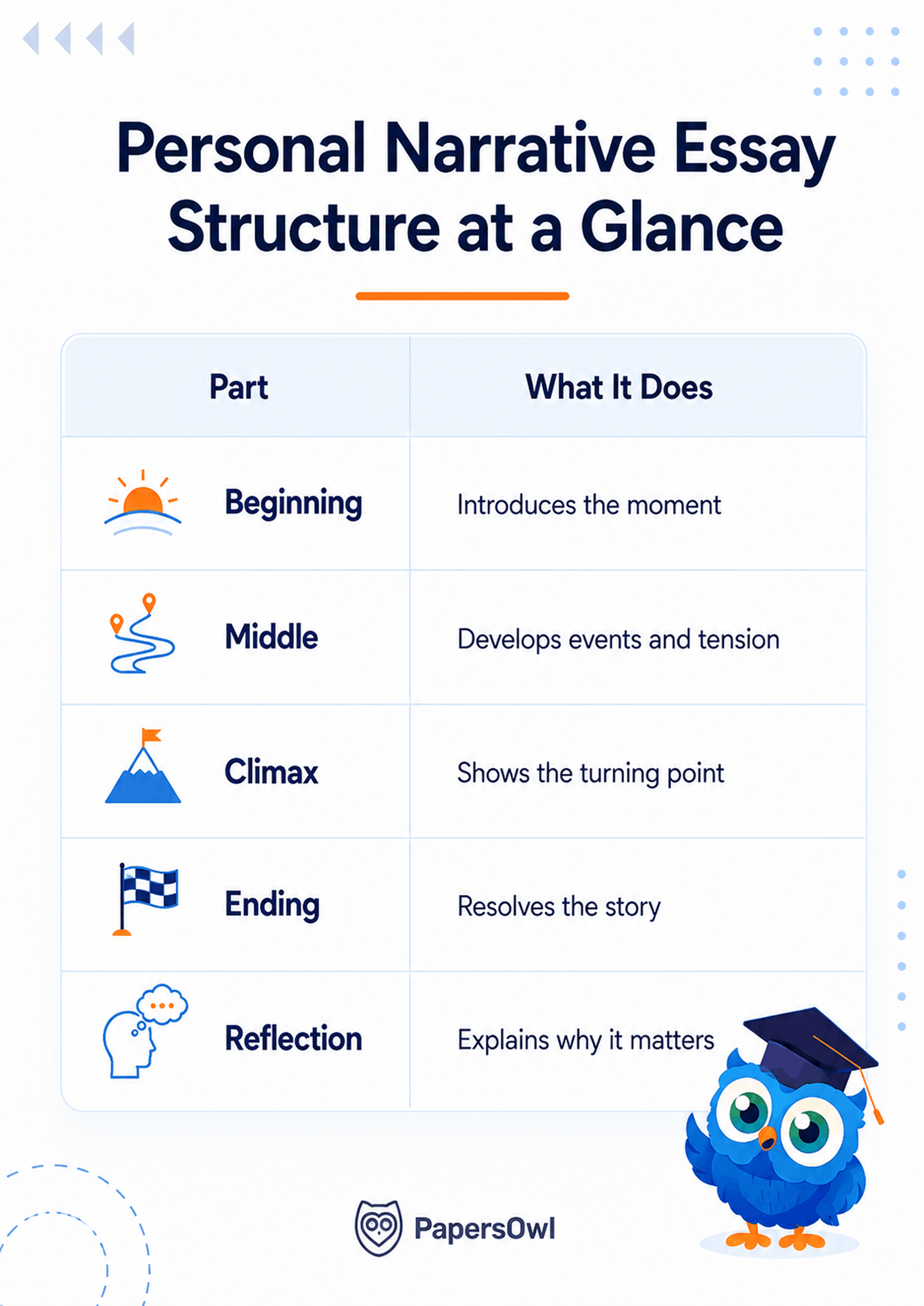
Follow this order, and your reader always knows where they stand.
What does a personal narrative outline look like?
A personal narrative outline breaks your story into five sections: opening, build-up, turning point, resolution, and reflection.
- Opening
- Hook
- Where and when the story begins
- Main situation
- Build-Up
- Important people
- Events leading to the conflict
- Turning Point
- Most important decision or event
- Resolution
- Immediate result
- Reflection
- What changed
- What you learned
Remember: this outline is a guide, not a cage. Don’t let it turn your narrative into a rigid five-paragraph essay.
What format should a personal narrative essay follow?
Personal narrative format and structure aren’t the same thing. Structure is your story’s shape. Format is how it looks on the page.
A personal narrative essay usually:
- uses first-person point of view;
- uses paragraphs, not headings, within the essay itself;
- sticks to past tense;
- may include dialogue;
- follows chronological order, unless a flashback serves the story.
For MLA, APA, font, or margins, always check your instructor’s assignment sheet. There’s no single universal academic format—so don’t guess. Ask.
What is narrative style in a personal essay?
Narrative style is how you tell your story, not just the order of events. It’s your voice on the page.
Strong narrative style uses:
- a first-person voice;
- vivid, relevant details;
- sensory description;
- dialogue where it helps;
- active verbs;
- varied pacing;
- emotions shown through action, not just named.
Here’s the difference in action:
Tell: “I was nervous.”
Show: “My hands shook as I reached for the door.”
See? The second one lets the reader feel it too.
How do you choose a good personal narrative topic?
Your experience doesn’t need to be dramatic. It needs to reveal something meaningful.
Ask yourself these four questions to test any idea:
- Did something change?
- Did I make a decision?
- Did I learn something?
- Can I recreate one specific moment with real details?
If you answer yes to most of these, you’ve got a topic worth writing.
Everyday experiences often work better than “the biggest event of my life.” A quiet moment with real detail beats a big moment you can barely remember.
How do you write a personal narrative essay step by step?
Writing a personal narrative essay takes seven clear steps, from picking your moment to polishing the final draft.
7 steps to write a personal narrative:
- Choose one meaningful experience.
- Identify the main point or insight.
- List the people, setting, events, and sensory details.
- Create a simple narrative outline.
- Write an engaging opening.
- Build toward the turning point and resolution.
- Revise for clarity, pacing, voice, and reflection.
Don’t try to describe every single detail. Each scene should do one of two jobs: move the story forward, or help your reader understand why it matters.
Follow these steps in order, and you’ll never stare at a blank page wondering where to start.
How do you start a personal narrative essay?
Skip the long background. Start your personal narrative essay right in the moment, with action, dialogue, or a sharp detail.
Here are four strong openings that work:
| Opening Type | Mini Example |
|---|---|
| In the middle of action | “The bus doors closed before I realized my phone was still on the bench.” |
| Dialogue | “You have five minutes,” my coach said. |
| Sensory detail | The room smelled of coffee and wet coats. |
| Unexpected statement | Failing that exam was exactly what I needed. |
Remember: your hook should lead naturally into the event, not just grab attention and stall.
How do you make the body of a personal narrative engaging?
An engaging personal narrative body recreates the experience instead of just reporting it.
Here’s how to do that:
- tell events in a clear sequence;
- build tension toward the turning point;
- use specific sensory details;
- add dialogue selectively;
- show reactions through actions;
- cut details that don’t affect the story.
Don’t report the experience. Recreate the important moments.
Watch your pacing too. Important scenes deserve more space on the page. Less important periods? Summarize them in a sentence or two and move on.
How much reflection should a personal narrative include?
Enough reflection to answer one question: so what? Your reflection should show why the event mattered.
Good reflection answers:
- Why did this event matter?
- What did you understand afterward?
- How did your perspective change?
Don’t save all your reflection for the last sentence. Weave short bits in after key turning points too.
But watch the balance. Too much reflection, and your narrative turns into a reflective essay with no story left in it.
How do you end a personal narrative essay?
A strong ending resolves the story, connects to its deeper meaning, and shows how you changed.
Your conclusion should:
- resolve the immediate story;
- connect back to its deeper meaning;
- show change, realization, or a shift in perspective.
Skip “in conclusion.” Skip repeating your introduction word for word too.
Instead, answer two questions: what changed, and why does this experience still matter? Do that, and your ending will land.
What are some good personal narrative essay topics?
Here are 10 topics that give you room for real story and real reflection:
- A mistake that taught you something
- Overcoming a personal challenge
- Your first day in a new place
- A friendship that changed
- A difficult decision
- A family tradition you understand differently now
- An unexpected success
- A failure that changed your approach
- A moment you stood up for yourself
- An ordinary day that became memorable
Pick a topic with a clear before → event → after shift. That transformation is what makes readers care.
Where can you find personal narrative essay examples?
Reading complete examples helps students see how real narratives handle openings, conflict, pacing, and reflection. A good example shows you the whole picture—not just isolated tips.
Below is one full example: a personal narrative about volunteering at an animal shelter. Watch how it opens in the middle of a moment, builds toward a turning point, and closes with real reflection instead of a forced lesson.
How Volunteering Grew Me Up as a Person
[Opening — Hook + Setting + Situation]
The shelter smelled like wet dog and bleach, and I almost walked back out.
I signed up to volunteer at the animal shelter because my school required 20 community service hours. That’s it. No noble reason. I picked the shelter because it was close to my house, and I figured petting dogs would be easy.
[Middle — Events, Conflict, Characters, Details]
My first shift, the coordinator handed me a mop and pointed at a cage. Not a dog. A cage that needed scrubbing. I stood there holding the mop, annoyed. This wasn’t the job I signed up for.
Then I met Biscuit.
Biscuit was an old beagle with cloudy eyes and a limp. Nobody wanted him. He’d been at the shelter for eight months. The coordinator, a woman named Diane, told me his story while I cleaned his cage. Owner passed away. Family didn’t want him. He just sat there, waiting.
I started showing up early to walk him. Just him. Every Tuesday and Thursday, rain or shine.
[Turning Point — Most Important Moment]
One Thursday, a family came in looking for a puppy. They walked past Biscuit’s kennel without a glance. He watched them go, then looked at me. That’s when it hit me: I wasn’t there for the hours anymore. I was there for him.
I asked Diane if I could put together a flyer. Something better than the standard shelter card. I wrote about his gentle nature, his favorite spot in the sun, the way he leaned into your hand when you scratched his ears. I posted it everywhere I could think of.
[Resolution — Immediate Result]
Three weeks later, a retired teacher named Mr. Alvarez saw the flyer. He came in specifically for Biscuit. I was there the day they met. Biscuit walked right up to him, tail going, like he already knew.
[Reflection — What Changed, What You Learned]
I finished my 20 hours in October. I kept volunteering until June.
I didn’t grow up because I mopped floors or walked dogs. I grew up because I stopped seeing the work as a task and started seeing Biscuit as someone who needed me specifically. That shift changed how I show up everywhere else now—at home, with friends, at my part-time job. I look for the person nobody’s paying attention to.
Volunteering didn’t just fill a requirement. It taught me that showing up consistently, for one person or one dog, matters more than showing up loudly, once.
What is the most important rule for writing a personal narrative?
Focus on one meaningful experience and show why it mattered.
A good personal narrative doesn’t try to cover your whole life. It picks one moment, recreates it through scenes and details, and leaves your reader with a clear sense of what changed.