
Quick answer: No independent, peer-reviewed test has matched the accuracy numbers vendors advertise. A 2023 study of 14 tools found none topped 80% overall accuracy, and results fell to 42% after manual editing and 26% after automatic paraphrasing. A newer 2025 study found much stronger separation on clean, unedited academic abstracts. The honest takeaway isn’t “detectors don’t work” — it’s that their reliability swings hard depending on what you feed them.
I’ve spent enough time reading these studies line by line that I no longer trust a single accuracy percentage from anyone — vendor or otherwise — without knowing what it was tested on. That’s the real subject of this piece.
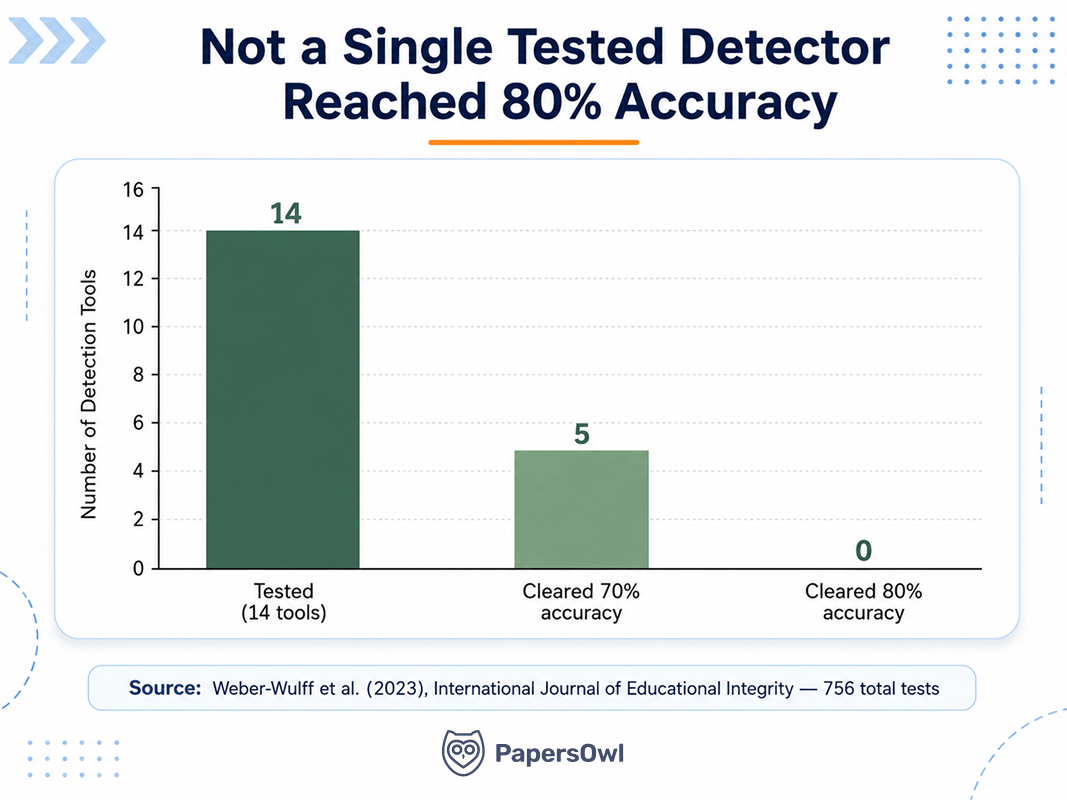
GPTZero, Originality.ai, and Copyleaks advertise numbers in the high 90s. Independent, peer-reviewed testing tells a messier story, and the mess itself is informative. A 2023 study in the International Journal for Educational Integrity ran 14 detection tools through 756 individual tests and found that not one cleared 80% accuracy (Weber-Wulff et al., 2023, doi.org/10.1007/s40979-023-00146-z). A separate Stanford paper found that several widely used detectors misclassified more than half of the non-native TOEFL essays in its sample as AI-generated, while the US eighth-grade essays in the same comparison were classified with near-perfect accuracy (Liang et al., 2023, doi.org/10.1016/j.patter.2023.100779).
A more recent 2025 study adds a needed qualification rather than a contradiction. Researchers tested GPTZero, ZeroGPT, and Corrector App on 1,000 academic texts — 250 human-written articles published before ChatGPT existed, and 750 abstracts and introductions generated by GPT-3.5, GPT-4, and GPT-4o. On that narrower, controlled dataset, the tools performed far better than in the broader 2023 tests, with AUC values ranging from 0.96 to 1.00 across the three detectors. The authors still warned that none of the detectors was fully dependable and that false positives could cause real academic and reputational harm — a concern that applies just as much to student misconduct cases as to the researchers and academic authors the study focused on. I built this update around all three studies so the numbers reflect where the evidence actually stands, not a vendor’s marketing page.
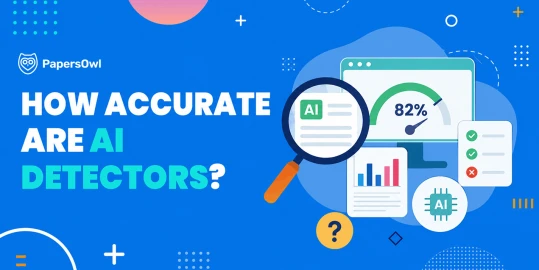
How Accurate Are AI Detectors?
Every major detection company publishes an impressive figure. GPTZero, Originality.ai, Copyleaks, and Winston AI all advertise accuracy in the high 90s, and those figures typically come from controlled, in-house benchmarks — using datasets and thresholds the vendors selected themselves.
Independent research paints a more complicated picture, and the complication is the point. Weber-Wulff et al. (2023) ran 14 detection tools through 54 test documents covering clean human writing, raw AI text, machine-translated text, and AI text that had been edited or paraphrased. Across three separate scoring methods, the outcome stayed consistent: no tool topped 80% accuracy, and only five crossed 70% (doi.org/10.1007/s40979-023-00146-z). The researchers’ conclusion was direct — these tools, they wrote, shouldn’t serve as the sole basis for an academic-misconduct case. That’s a statement from a peer-reviewed source, not a detector’s own homepage. If you want a quick gut check before submitting, pairing an AI detector with an AI plagiarism checker free tool gives a fuller picture than relying on either one alone.
However, that 80% ceiling applied to a specific 2023 test involving deliberately hard conditions — translated, edited, and paraphrased text mixed in with clean samples. It isn’t a permanent verdict on every detector available today.
What Does “Accuracy” Actually Measure?
Before comparing any two numbers, it helps to know what “accuracy” is actually counting. A single overall percentage can hide a lot.
- Accuracy — the share of all results, human and AI combined, that the tool classified correctly.
- False-positive rate — the share of genuine human writing wrongly flagged as AI.
- False-negative rate — the share of real AI writing that slipped through as human.
- Precision — of everything the tool flagged as AI, how much actually was AI.
- Recall — of everything that actually was AI, how much the tool caught.
A tool can report 99% accuracy on a balanced test set and still carry a false-positive rate high enough to flag one honest student out of every twenty. Overall accuracy, on its own, tells you almost nothing about which kind of mistake you’re likely to hit.
Before you check if the text was written by AI, make sure you know what these metrics mean. This can reduce the risk of false flags. Even text from Claude can contain patterns that a detector may spot and mark, which gives you time to fix weak phrases before you submit the text.
Why AI Detector Studies Produce Such Different Results
This is, in my view, the most useful thing to understand in the whole conversation about AI detection: the test conditions decide the result almost as much as the tool does.
A detector performs well when the dataset contains clean human writing on one side and untouched ChatGPT output on the other. That’s a far easier task than spotting a real student paper that blends original writing, grammar corrections, a translated paragraph, some AI-assisted editing, and a few rewritten sentences.
The 2025 study is a clear illustration. Researchers used published academic articles as the human control group and generated matching abstracts and introductions from standardized prompts. They didn’t edit, paraphrase, translate, or blend the AI output with human writing. Under those tightly controlled conditions, GPTZero, ZeroGPT, and Corrector App separated the two groups effectively.
That doesn’t contradict the weaker Weber-Wulff numbers — it shows that detector performance is dataset-specific. Strong results on clean, unedited scientific abstracts don’t guarantee the same accuracy on personal essays, translated work, short passages, or documents where a human and a model both had a hand.
There’s a further wrinkle worth flagging: newer language models aren’t automatically harder to catch. In the 2025 study, all three detectors assigned equal or higher AI-likelihood scores to GPT-4o than to GPT-3.5, and GPTZero showed a strong positive relationship between model recency and detection score. That might say more about the standardized academic format than about detectors in general, but it pushes back on the common assumption that each new model release quietly defeats detection.
What the 2025 study found, in numbers: GPTZero produced an average AI-likelihood score of 5.88% for the published human texts, versus 81.71% for GPT-3.5, 96.83% for GPT-4, and 99.58% for GPT-4o. ZeroGPT and Corrector also scored the AI-generated texts much higher than the human ones, though their average scores for genuine human writing ran noticeably higher too — 27.55% for ZeroGPT and 36.90% for Corrector. GPTZero separated this particular pair of groups cleanly; the other two tools gave real academic writing much higher AI scores on average. That doesn’t crown a universal winner — it shows that two detectors can read the same human paragraph very differently.
Laid side by side, the three studies make the pattern easy to see:
| Study | Dataset | Tools tested | Editing included? | Main result |
|---|---|---|---|---|
| Weber-Wulff et al., 2023 | Human, AI, translated, edited, and paraphrased text | 14 | Yes | No tool exceeded 80% overall accuracy |
| Liang et al., 2023 | TOEFL essays and US school essays | 7 | No | Severe bias against non-native writing |
| 2025 academic-text study | Published scientific abstracts/introductions vs. matched ChatGPT output | 3 | No | Strong separation (AUC 0.96–1.00) under controlled conditions |
The tools that struggled most in 2023 were being tested against edited and translated text on purpose. The tool that performed best in 2025 was tested against text nobody had touched after generation. Neither result is wrong — they’re answering different questions.
Vendor Claims vs. Independent Testing
Vendor accuracy numbers change about as often as a homepage redesign, and each vendor tends to report a different metric — sometimes overall accuracy, sometimes a detection rate, sometimes a false-positive rate — under a dataset and threshold the vendor chose itself. GPTZero, Originality.ai, Copyleaks, and Winston AI all currently advertise accuracy in the high 90s, but none of those figures come from a peer-reviewed, independently reproduced test as far as the published literature shows. That’s not an accusation of dishonesty — it’s a reminder that a benchmark the vendor designed is a different kind of evidence than a study run by researchers with no stake in the outcome. Before citing any specific vendor percentage, check the company’s current documentation directly; these numbers shift with every model update and aren’t reliably captured in a static table.
What Third-Party Testing Says About Originality.ai
Originality.ai markets itself heavily on precision, and it’s one of the more established names in the category.
Third-party testing on false-positive behavior found that once a detector’s false-positive rate is pushed below 1%, most tools become far weaker at catching genuine AI text. In that same testing, Originality.ai’s false-positive rate plateaued around 0.62% — better than several competitors, though still not proof of overall accuracy (proofademic.ai/blog/false-positives-ai-detection-guide). This result comes from third-party testing rather than a peer-reviewed study, so it shouldn’t be read as a definitive accuracy estimate. A low false-positive rate is only half the picture; it says nothing about how often the tool misses real AI text in the first place.
Do AI Detectors Actually Work After Editing or Paraphrasing?
This is where accuracy falls apart fastest, and it’s the part students ask me about most.
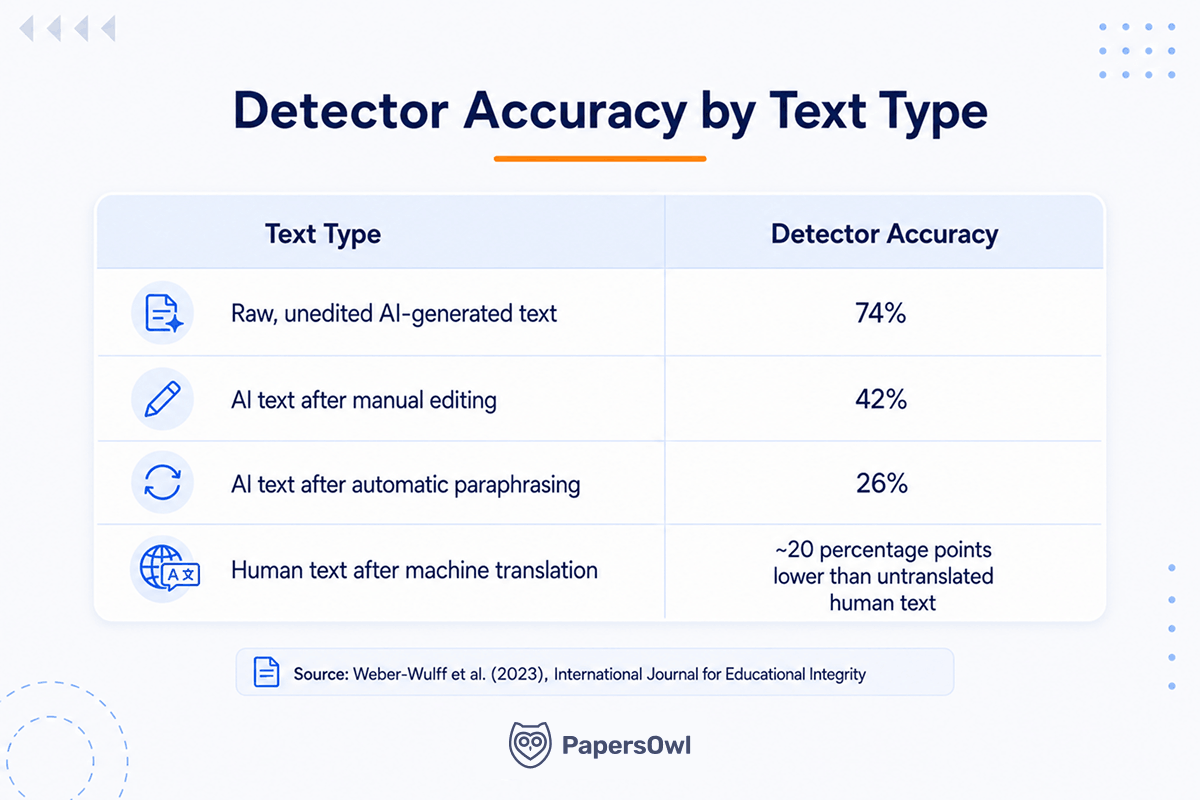
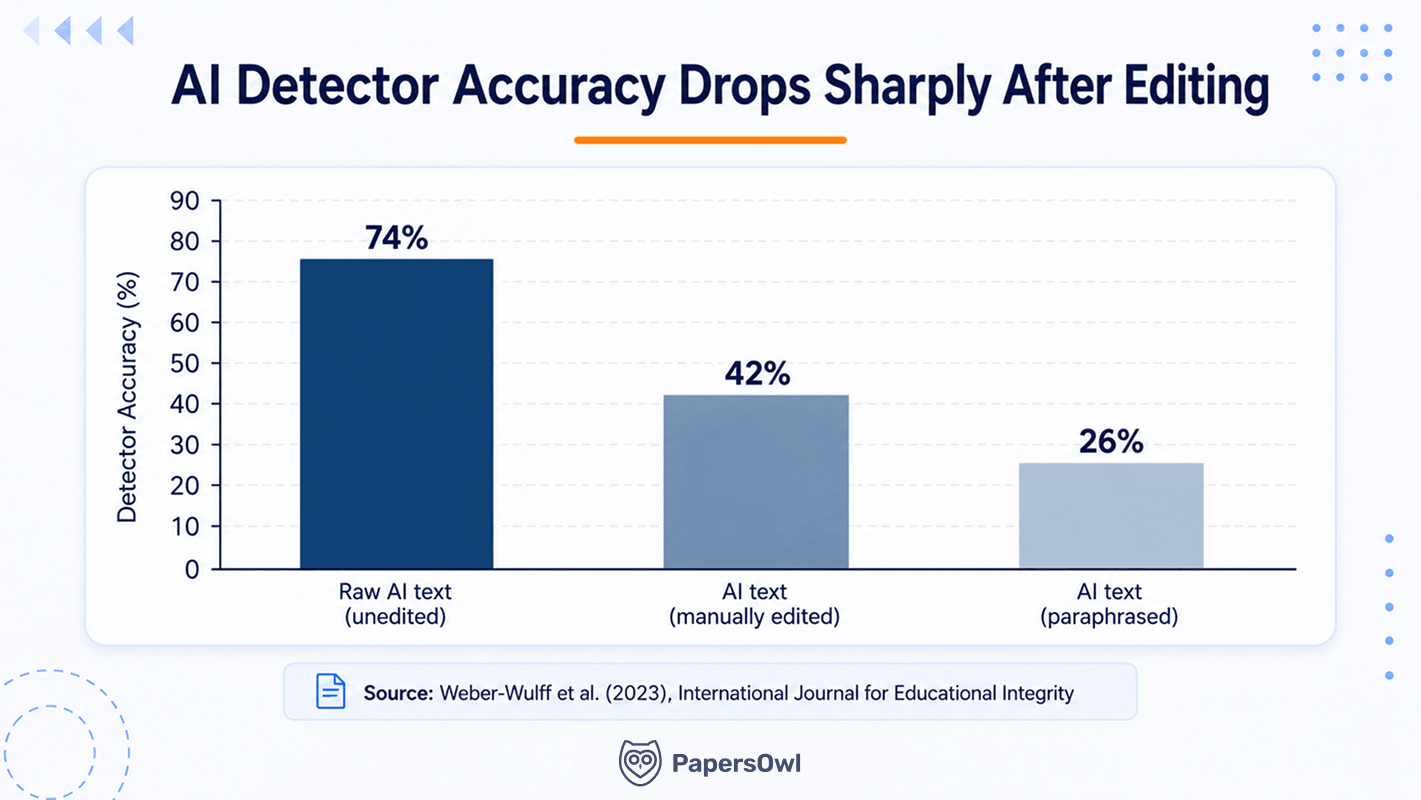
Weber-Wulff et al. found detectors correctly identified 74% of raw, unedited AI text. Once a person manually edited that same text — swapped a few words, moved a sentence — accuracy dropped to 42%. Run it through a paraphrasing tool, and accuracy fell to 26% (doi.org/10.1007/s40979-023-00146-z).
In plain terms: in the Weber-Wulff test, most manually edited or automatically paraphrased AI text was no longer identified correctly. A tool that catches 95% of raw ChatGPT output can still miss most of that same text after a five-minute edit. Machine translation causes a related problem — human-written text translated into English was around 20 percentage points harder for the tools to classify correctly than untranslated human writing. Translation alone can make honest writing look artificial to a detector that’s really just reading surface patterns, not intent.
AI Detection Is Not the Same as Plagiarism Detection
A plagiarism checker looks for matching language from existing sources. An AI detector looks for statistical patterns associated with generated writing. These are separate tasks, and a document can pass one test while failing the other.
In the 2025 study, 84.9% of the 750 ChatGPT-generated academic texts received a 100% originality score from the plagiarism checker, with average originality scores near 99% across GPT-3.5, GPT-4, and GPT-4o. The texts read as original because they were newly generated rather than copied — even though a model still wrote every word of them. That’s why a clean plagiarism report never proves human authorship on its own, and why an AI flag shouldn’t be described as “plagiarism” unless a school’s policy explicitly defines unauthorized AI use that way.
Why AI Detectors Struggle With Non-Native English Writing
This is the most serious fairness problem in the field, and I don’t think it gets discussed enough.
Liang et al. (2023) tested seven widely used GPT detectors on TOEFL essays written by non-native English speakers and found that detectors misclassified more than half of these essays as AI-generated. Essays from a comparison group of native-English-speaking eighth graders, meanwhile, scored near-perfect. The researchers dug into why, studying 1,574 abstracts accepted at a major AI conference, drawn from submissions written before ChatGPT existed. Authors from non-native-English-speaking countries wrote abstracts with measurably simpler sentence structure than authors from native-English-speaking countries, even when review scores matched. Detectors read that simpler structure as a marker of AI writing. It isn’t — it’s a different, entirely legitimate way of writing English.
A flagged paper doesn’t mean a student did anything wrong. It can just mean the tool wasn’t built with their writing style in mind, and that’s part of a larger conversation about what fair use of AI in education actually looks like.
False Positives vs. False Negatives: How Reliable Are AI Detectors, Really?
Two failure types show up in every detector test, and they carry different consequences for a student.
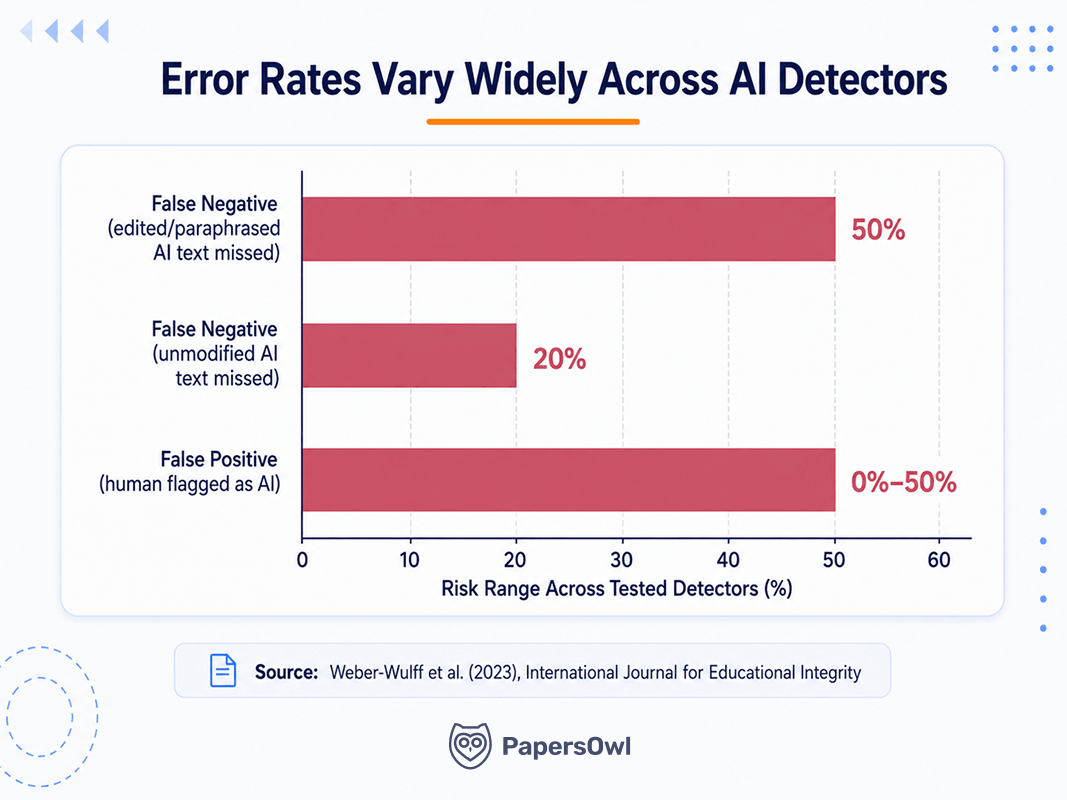
A false positive flags real human writing as AI-generated — the scenario that can get an honest student accused of cheating. In the Weber-Wulff study, the false-positive rate ranged from 0% to 50% depending on the tool. Newer research shows how differently tools behave on this exact question: in the 2025 study, 30.4% of the 250 known human-written articles scored above 50% in Corrector and 16% did so in ZeroGPT, while GPTZero didn’t score a single human article above that mark. It’s worth noting that a flat 50% cutoff isn’t necessarily how these tools are meant to be read — the study’s own optimized classification thresholds were different for each tool (roughly 79 for Corrector, 75 for ZeroGPT, and 31 for GPTZero), so the 30.4%/16%/0% figures describe behavior at one shared reference point, not each tool’s actual measured false-positive rate. Either way, the same texts looked clearly human to one detector and suspicious to another.
A false negative misses real AI-generated text and lets it pass as human — the scenario that hands a student an unfair edge. Across the Weber-Wulff tools, roughly 20% of unmodified AI text got wrongly credited to a human author, climbing to about 50% once the text had been edited or paraphrased. That’s how a tool can advertise 99% accuracy while still getting a real answer wrong one time in every five raw, unedited AI submissions it reviews.
There’s no universal percentage that proves AI use. A score of 40%, 50%, or higher means something different in every tool, because each detector runs its own training data, scoring model, and threshold.
Can Detectors Tell the Difference Between AI Writing and AI-Assisted Editing?
Most real student work doesn’t sort neatly into a “human” or “AI” box. A student may write the argument independently, then use Grammarly, Google Docs, a translation tool, or an AI assistant to revise a few sentences. Another student may use AI for an outline but write the entire final draft without it.
A detector score can’t reliably reconstruct that process. It might identify statistical patterns in the finished text, but it can’t prove who developed the ideas, which sentences changed, or whether a given use was allowed under the course policy. That’s why disclosure rules end up more useful than detector scores alone — a school needs to define whether brainstorming, translation, grammar correction, rewriting, and full-text generation are treated differently. Without those distinctions, a student and an instructor can end up arguing about “AI use” while describing two completely different activities.
How Good Are AI Detectors at Explaining Their Results?
One issue rarely shows up on a vendor’s homepage: most detectors hand back a score with little visible reasoning behind it. A tool might report “87% likely AI-generated” without showing why, beyond vague terms like “perplexity” or “burstiness.” Unlike a plagiarism report, which can point to matching passages and named sources, an AI detector often provides only a percentage and a few highlighted sentences. Educators themselves frequently can’t audit the result — they can’t reproduce the model’s reasoning, inspect its training data, or see exactly why a threshold triggered.
Turnitin’s own public statements illustrate the tradeoff well. The company has said its system may miss roughly 15% of AI-generated text because it prioritizes keeping the false-positive rate near 1%. That’s a defensible design choice, but it also proves something important: reducing false accusations inevitably means letting more AI text through undetected. There’s no setting that eliminates both risks at once.
This gap is part of why Weber-Wulff et al. reached the conclusion they did — a detection score can start a conversation. It shouldn’t end one.
Do Universities Trust AI Detectors?
There’s no single university-wide standard here. Some schools use tools such as Turnitin as one signal within a broader academic-integrity review. Others have limited or discouraged detector use altogether because of false-positive risk and the lack of an auditable evidence trail. As reported in 2024, Montclair State University, Vanderbilt University, the University of Texas at Austin, and Northwestern University were among the institutions that had restricted or advised against Turnitin’s AI-detection feature. The concern wasn’t that AI misuse doesn’t happen — it was that a probabilistic score could wrongly accuse a student without producing enough evidence to support the claim.
The safest reading isn’t either extreme. A university may use a detector, ignore it, or leave the decision to individual instructors. Check the exact policy at your own school rather than assume every flagged score carries the same weight, since these policies shift and the list above may already be out of date by the time you’re reading this.
What Students Should Do After a False Flag
A false flag can feel alarming, especially when your academic standing is on the line — but a detector score is a starting point for a conversation, not a verdict. A few steps make a real difference if you’re worried about a false flag:
- Keep your drafts. Version history in Google Docs or Word is some of the strongest evidence you can produce.
- Save your research notes and outlines. They show your process, not just your finished product.
- Ask which tool flagged your work, and what score triggered it. You have a right to know.
- Ask for a human review. No detector score should stand alone as proof.
- Check your school’s AI policy before assuming a flag means trouble.
- Be ready to explain your work. If questioned, you should be able to discuss your argument, sources, structure, and drafting choices in your own words.
- Document any permitted AI use. If your course allows grammar correction, brainstorming, or translation tools, keep the prompts, outputs, and policy language that show exactly how you used them.
Don’t rewrite a genuine paper just to satisfy several public detectors. Different tools return different scores for identical text, and repeated simplification can hurt your writing without proving anything. Your drafting history and your ability to explain the work in your own words are stronger evidence than a second detector score.
What Current AI Detector Research Still Cannot Tell Us
No single study reproduces the full range of writing a real classroom sees. Some tests use short academic abstracts; others use full essays, translated writing, or paraphrased AI output. Detector versions change, the underlying language models change, and the same tool can behave differently across subjects and text lengths.
The 2025 academic-text study, for instance, tested only ChatGPT outputs from one standardized prompt, used without editing or paraphrasing, and focused on abstracts and introductions from one field rather than complete student essays. Those conditions make the results useful but not universally transferable to a personal essay, a lab report, or a mixed-authorship document.
That’s why the evidence doesn’t support either extreme. It’s too broad to claim AI detectors never work, and just as unjustified to treat a high score as proof of misconduct. Reliability depends on the detector, the dataset, the threshold, the language, the writing genre, and how much a human touched the final draft.
The Real Answer for 2026
The research doesn’t show that every AI detector is useless. It shows that performance shifts sharply with the test conditions. Some tools can separate clean human academic writing from untouched ChatGPT output with high accuracy under controlled conditions. The same tools grow far less dependable once text is edited, paraphrased, translated, shortened, or partly written by a person — which describes most actual student writing.
That’s the honest answer in 2026: an AI detector can work as a screening signal, but its score isn’t proof of authorship. Any serious academic decision still needs context — drafts, version history, an oral explanation, and a transparent policy — not a single percentage.