
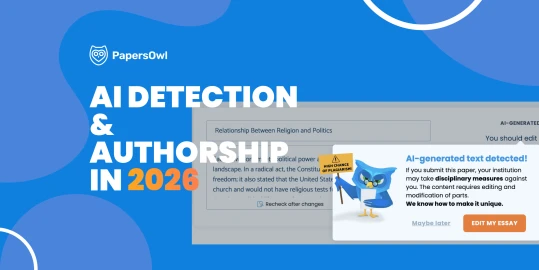
Academic writing didn’t slowly go into the AI era — it shifted almost overnight. Tools powered by artificial intelligence and LLMs (Large Language Models) can now draft paragraphs, suggest structure, and reshape ideas almost instantly.
That shift raised real concerns about fairness, authorship, and plagiarism.
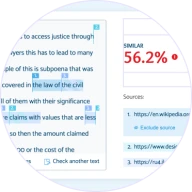
At PapersOwl, we couldn’t ignore the problems caused by professors’ doubts and students’ fear of being accused of cheating. Therefore, we introduced an AI detector to protect human-written work and reinforce scholarly ethics in a rapidly changing environment.
- The AI detector protects authorship, not creativity.
- Fairness and reduced false positives guide development.
- Writers gain confidence before submission.
We Consider AI as a Supportive Tool, Not a Replacement
We think that AI should help people learn, not take the position of the person who wrote the text. Indeed, academic work is more than producing text. It builds reasoning, reflection, critical thinking, and analytical skills that students carry beyond one assignment.
The authentic voice is what makes a strong paper strong. It shows what the writer thinks, what he has been through, and how he sees things. It is important to protect that voice because no machine should ever take away from human innovation or uniqueness.
Our guiding principle is simple: we stick to a human-centric approach.
Technology should assist, not take control. An AI checker offers a moment to pause and review a submission before it is shared. That pause encourages responsibility and awareness of authorship.
“At PapersOwl, we have always believed that technology should strengthen human creativity, not substitute it.
We saw that many students were worried their honest work could be misunderstood by automated systems. That concern led us to develop our AI Detector so writers can confirm their authentic voice and submit their work with confidence.”
— The PapersOwl Product Team
We also believe in openness.
We clearly explain how detection works and the signals it analyzes. This includes stylistic details and predictive patterns that distinguish AI-generated text from human writing.
When writers understand the process, it builds accountability and helps them make informed choices.
This AI detection technique is important since it gives feedback, not judgment. Students can review a page before submission, discuss results with teachers, and refine their essays. That loop strengthens honesty and improves the writing process.
Clear explanations support necessary transparency, giving educators and researchers confidence that the system works fairly and consistently. Everyone deserves a tool they can understand and trust!
Here’s How We Made It Fair and Accurate
Academic writing follows recognizable structures — formal tone, citations, and consistent style. A shallow AI detector might confuse disciplined writing with automation. Avoiding that mistake was essential, so reducing false positives became a central design goal. Students can also save time and ensure accuracy by using a citation generator for all their references.
Our aim was to apply Natural Language Processing (NLP) in a way that safeguards scholarly ethics and allows writers to preserve their authorship in a time shaped by large language models.
The system evaluates context, rhythm, and stylistic variation rather than relying on simple markers. Through careful fine-tuning, the model learned to distinguish academic conventions from machine-generated output.
To be fair, we had to keep constant testing. For that purpose, we have reviewed the findings to ensure that writers from varied linguistic or educational backgrounds do not suffer from algorithmic bias.
We believe this focus on the little things helps make academic practices more open to everyone.
Our Mission
Why put so much effort into a free detection service? Because fairness in education belongs to everyone.
Students should have tools that protect their work and encourage honest writing, not create more stress.
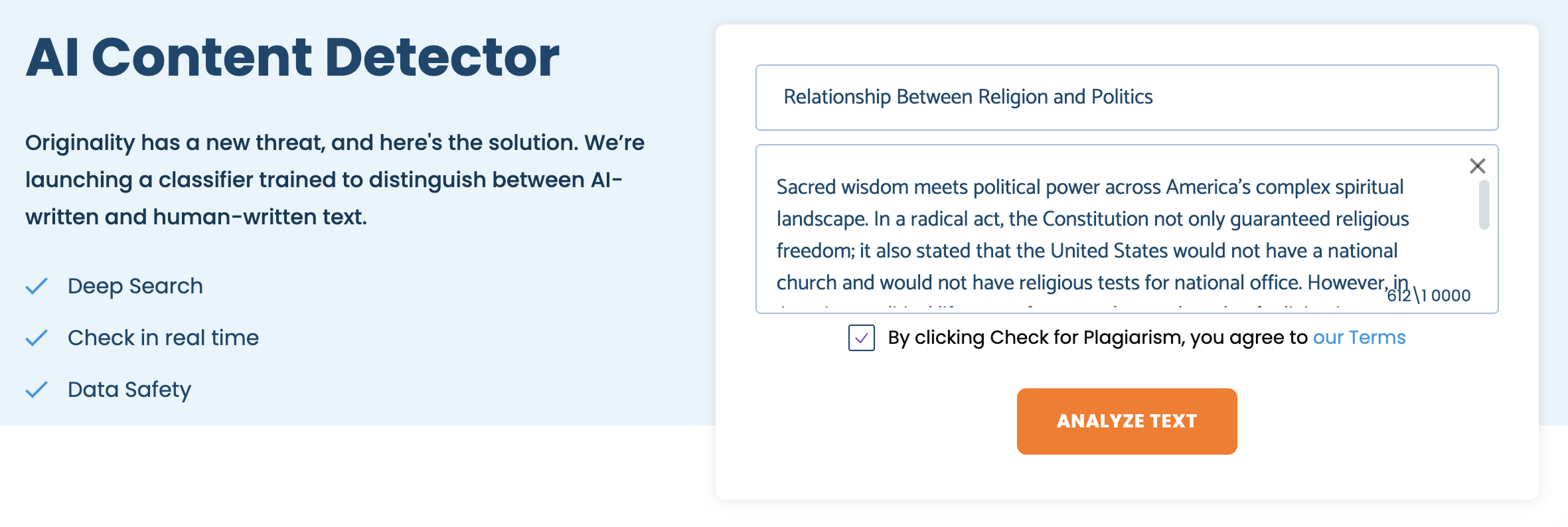
Writers may think about their ideas, make cautious changes, and turn in their papers with ease and confidence when they are in a secure environment. For formatting and front-page setup, an apa title page generator can make the process fast and stress-free.
Thus, we built an AI checker that works well for all kinds of learners. It helps maintain high standards, protects the work people have written, and promotes academic integrity at every stage of the writing process.
Let’s look at the table below for the core features of our AI checker:
| Feature | Why it’s essential |
|---|---|
| Review before submission | It reduces stress and builds confidence |
| Quality assurance | It keeps essays and assignments consistent |
| Fair evaluation | It lowers false positives and protects authors |
Here is what that looks like in real life:
Review Before Submission
Before turning in a paper, students can take a quick final look.
This small step makes a big difference. It helps them feel calm and confident that their work shows real effort and meets academic standards.
It also gives them a chance to fix small mistakes and improve weak spots. We keep improving the review process to make it feel smooth, helpful, and easy to use.
Quality Assurance
We follow clear, consistent quality standards for essays, assignments, and academic writing. Every paper receives the same level of care and attention. Details matter, and we treat each text with focus and respect.
Fair Evaluation
We carefully designed our system to reduce false positives. We know how bad it can be to make false claims. That’s why we focus on fair, balanced evaluations that safeguard writers and support fairness.
Our mission reflects empowerment. Writers don’t just address AI technologies; they actively use them. They become knowledgeable participants who can distinguish between helping and writing.
Our internal innovation plan invests in education, resources, and technology that can be explained to help students develop good habits early in their academic careers.
The Future of Writing with PapersOwl
Artificial intelligence will keep evolving, and so will our approach.
Each update improves accuracy, expands contextual understanding, and aligns more closely with real academic expectations. We monitor emerging AI-generated text patterns and refine evaluation methods to stay relevant.
Yet our focus remains human 🧑🎓. A paper or essay shows what a person thinks, how hard they work, and what they know. It is very important to protect academic integrity and that voice.
That’s why we continue to create a space where original work really matters by combining thorough research, intelligent design, and straightforward feedback.
We see the future of writing as a partnership, not a conflict. We believe that technology should support learning. This way, it will maintain judgment, honesty, and accountability.
AI tools should help students, professors, and researchers think critically, not replace them.
People should come first in technology.
Our work moves forward with that principle: protect the human voice, reinforce trust, and support a culture where integrity is foundational to every submission!