What do academic requests sent over the last two years tell us about student life? A great deal!
At first glance, this data appears to be a simple list of assignments. But it provides us with something more useful: WHERE STUDENTS MOST OFTEN GET STUCK.
Many people assume academic help is mostly about writing papers. Our findings tell a different story. Students often come to us when directions are unclear, topics are too broad, formatting feels confusing, or deadlines are closing in.
🧩 Writing is not the only form of academic help. Often, it means turning vague requirements into a clear plan, an organized draft, or a polished piece of academic work that follows expectations.
How and When We Collected This Data
This analysis is based on a part of placed orders — service requests initiated by students through PapersOwl’s website and other service channels. We reviewed a part of the academic requests submitted through our platforms over the last few years.
The dataset covers 72 different assignment types, grouped by paper type, subject area, citation style, topic length, and overall requested length. Percentages were calculated from available order details; as a result, some categories may not add up to 100%.
This report reflects placed orders only. Completed order volumes were not included in this analysis.
All data was reviewed only in aggregate form. No personal information, identifying details, or individual user data were accessed or disclosed at any stage of this study. Privacy and data security remained a priority throughout the entire research process.
Key Takeaways You Will Find Interesting
Our team set out to analyze what that volume really means for student life — and the findings are striking:
- Essays make up 48.1% of all requests — but students also ask for a wide range of other tasks: assignments (15.9%), discussion posts (11.3%), research papers (5.3%), case studies, presentations, reflections, and more.
- Weekly assignments and discussion posts together account for 27.2% of all requests — keeping the pressure on throughout the entire semester.
- APA appeared in 82% of all citation-style mentions — still a major challenge for many students.
- 7.6% of all orders started with “Read Instructions” — meaning thousands of students struggle to interpret what’s being asked before they even begin writing.
- Even for short assignments (250–500 words, which make up 25.1% of requests), planning, structure, and focus are always needed.
Together, these findings show that academic stress often starts before students write the first sentence of a new assignment.
We See the Big Pattern: Students Need Help with Structure More Than Anything Else
Many assignments look completely different. Essays, discussion posts, research papers, and presentations all have unique requirements. Yet they often create the same problem.
🧭 Students do not always struggle with writing itself. They struggle with not knowing where to start.
Think about the last assignment that stressed you out. Was writing really the hardest part? Or was it figuring out what the professor actually wanted? Our data points toward the second answer.
4 Most Requested Assignment Types
| Assignment Type | Share of Requests |
| Essay | 48.1% |
| Assignment | 15.9% |
| Discussion Post | 11.3% |
| Research Paper | 5.3% |
These numbers matter because they show where confusion begins, not just what students order most.
Nearly half of all requests were essays. Thousands more involved assignments, discussion posts, and research papers. Students are not simply asking for words on a page. They are often looking for a roadmap.
Think about your own coursework. Have you ever spent more time figuring out the new assignment than actually writing it? The data suggests that structural problems often create more stress than writing itself.
Essays Are the Most Common Because “Essay” Can Mean Almost Anything
Essays account for 48.1% of all requests. That sounds simple at first. However, it is actually a bit misleading.
Because the word “essay” is used for many different tasks. Professors can often expect completely different work under the same label. That is where confusion starts.
An essay can be:
- An argument;
- A reflection;
- A literary analysis;
- A compare-and-contrast paper;
- A response paper;
- A personal statement;
- A source-based assignment.
The word itself does not give a clear direction. And this is where many students quietly get stuck.
Here is a question worth thinking about: How many times have you started writing an “essay” without fully knowing what kind it was?
That small uncertainty can change everything. Indeed, you might be writing in the wrong direction from the very first paragraph. Two essays with the same name can look completely unrelated. One may need a personal opinion. Another may require strict evidence. Same label. Totally different logic.
And that is why essays are often underestimated. Not because they are easy. But because they look familiar.
🎯 First advice: clarify the purpose of the essay to avoid the dilemma we described above.
| Type of essay | Main Requirement |
| Argumentative Paper | Clear argument and evidence |
| Reflective Essay | Personal insight relating to course concepts |
| Analytical Essay | Evidence-based interpretation |
| Compare-and-Contrast Essay | Meaningful criteria of comparison |
| Source-Based Essay | Effective citation planning |
Usually, students start writing the introduction right away. It feels like progress. But here is a more useful move: pause and identify the essay’s purpose first.
Because the real difficulty is not writing the essay, it is about writing the right kind of essay. Once that becomes clear, everything else starts to fall into place much faster.
Weekly Assignments Can Create More Daily Pressure Than Big Papers
Large research papers get most of the attention. But smaller assignments often create more day-to-day stress. Why? Because they never stop coming.
Students frequently juggle multiple courses, jobs, internships, commuting, family responsibilities, and extracurricular activities. Even a simple weekly assignment becomes difficult when several arrive at once.
Typical Weekly Workload Requests
| Type | Share |
| Assignments | 15.9% |
| Discussion Posts | 11.3% |
| Combined | 27.2% |
More than one in four requests are weekly tasks like these. That number matters because these are not one-time projects. They return again and again. Each week brings a new set.
A discussion post may look simple. Maybe 200–300 words. But now imagine three courses doing it at the same time. That is already close to a full essay every week.
📌 Helpful Templates to Keep
This is where a small system makes a big difference. Instead of starting from zero every time, students can reuse simple structures. It will reduce stress and save your time.
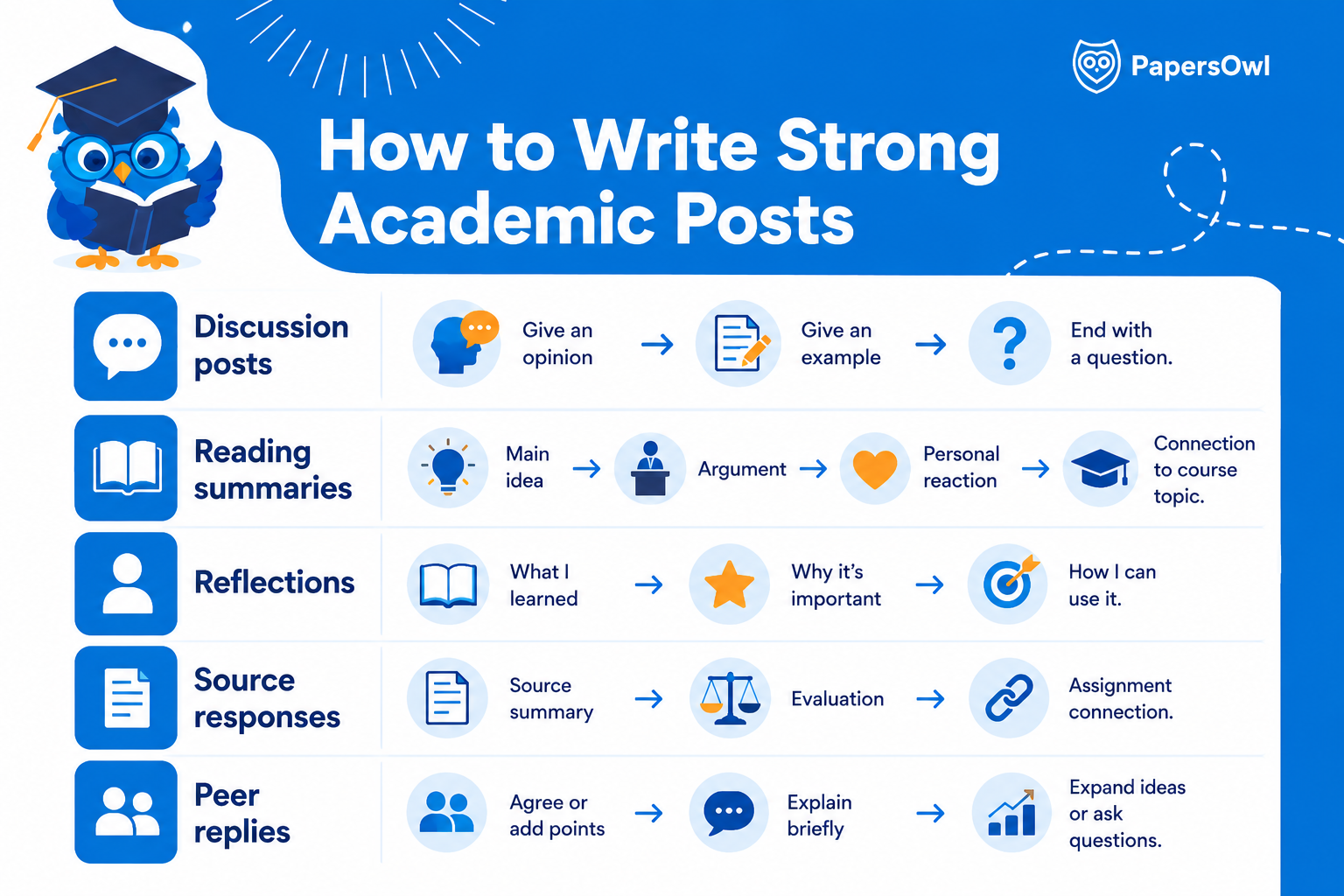
It might be that every week is something new for a student. But in practice, the structure is typically the same.
Once that pattern is visible, the workload feels less chaotic. And assignments become more predictable, even when they keep coming.
“Read Instructions” Requests Show the Hidden Problem
One of the most surprising findings in the dataset is not a paper type. It is the phrase: “Read Instructions.” It appears in 7.6% of all orders.
We suggest students struggle to interpret what’s being asked before they even begin writing. Many are basically saying: “Can someone help me understand what this assignment actually wants?”
And that is a different kind of problem! It is not about writing skills yet. It is about interpretation.
Here is something to reflect on. How often do students actually read the full instructions carefully before starting? And how often do they assume they already understand it?
That gap is where a lot of stress begins. Sometimes the hardest part is not writing at all. It is figuring out what “good” even means in that task.
✅ Before writing, it helps to check quickly:
- What type of paper is this?
- What is the main question?
- What sources are required?
- What citation style is needed?
- What is the word count?
- When is it due?
- What does the rubric emphasize?
- Are there hidden instructions?
Most students skip this step when they feel rushed. But that is often when mistakes happen. A few minutes of clarity at the start can save hours of rewriting later!
Very Short Topics Point to a Lack of Focus
Another interesting pattern appears in topic length. More than 10,000 topics contained fewer than 30 characters. That represents 12.8% of all requests. The average topic length was only 58 characters.
Many students begin with topics like:
- Nursing ethics;
- Climate change;
- AI in education;
- Leadership;
- Mental health.
The problem? Those are not topics but assignment plans. A topic like “nursing ethics” may sound specific. But it can lead in dozens of directions. The same is true for “AI in education” or “climate change.”
In many cases, students receive very short prompts. Sometimes Canvas instructions are vague. Sometimes professors intentionally leave topics broad. A short prompt may look simple, but it can still require a complex paper. That is why narrowing the topic matters.
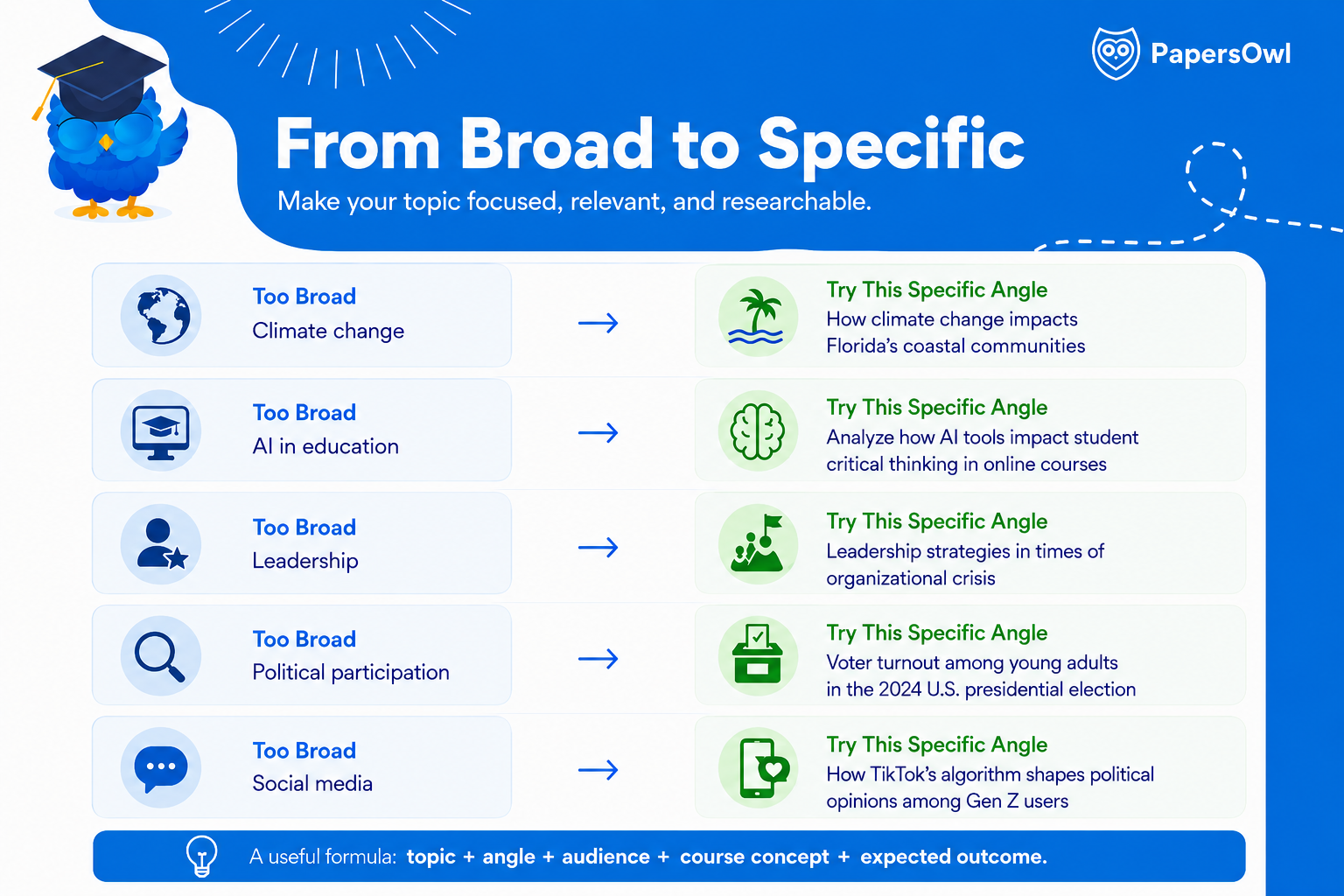
✏️ For example, instead of Nursing ethics, try: Ethical challenges nurses face when patient autonomy conflicts with family requests during end-of-life care.
The second topic immediately provides direction. The first leaves too many questions unanswered.
The narrower the focus, the easier the paper becomes to plan, research, and write.
APA Dominates Because Formatting Is Part of the Grade
Many students treat citations as something to fix at the end. The data suggests that the approach may create more problems than it solves.
The most frequently mentioned citation styles were:
| Style | Mentions |
| APA | 1,500+ |
| MLA | 200+ |
| Chicago | 30+ |
📊 APA accounted for about 82% of all citation style mentions!
That makes sense when you consider how many students study nursing, healthcare, psychology, education, and other social science subjects.
What is interesting is that students are not only worried about references; they are worried about grades. A paper may contain strong ideas, but formatting mistakes can still cost points.
That is why APA works best when it is set up before writing begins. So, create your title page, heading structure, in-text citation format, and reference page first. It also helps track publication dates, DOIs, and URLs as you research.
Many students leave formatting until the final hour. Then they spend more time fixing citations than improving the paper itself. A few minutes of preparation at the start can prevent a lot of frustration later.
The Top Subjects Show Where Writing Becomes More Than Writing
Different subjects create different types of work. A history paper is not written like a nursing assignment. A business case study requires a different approach than a psychology paper.
The data show that the most requested subjects were:
- History and Literature (9.23% orders);
- Technology and IT (7.91%);
- Nursing and Healthcare (4.72%);
- Business and Management (3.93%);
- Education and Teaching (3.72%).
Several other fields also appeared regularly, including Criminal Justice, Psychology, and Finance.
What makes this interesting is that students are not only learning content. They are also learning how each discipline communicates ideas.
What Do Students Typically Find Challenging About Subjects?
| Subject | Common Challenge |
| History / Literature | Making arguments and interpreting evidence |
| Technology / IT | Explaining technical concepts in a clear way |
| Nursing / Healthcare | Clinical reasoning, research, and APA formatting |
| Business / Administration | Case study analysis and practical advice |
| Education / Teaching | Linking theory to classroom practice |
| Criminal Justice / Law | Policy analysis and legal reasoning |
| Psychology / Mental Health | Research support and exact terminology |
| Finance / Economics | Data interpretation and logical explanation |
Have you ever been good at one subject but bad at another? Often, the problem is not a lack of knowledge. It is adapting to a different style of thinking and writing.
The subject changes, but one thing stays the same. Students need a precise structure. Strong ideas can be difficult to communicate well without it.
Short Papers Are Not Always Easier Than Long Papers
Many students assume shorter assignments are easier. It sounds logical. Fewer pages should mean less work. However, that is not always true.
A 250-word response leaves very little room for mistakes. Every sentence needs a purpose. Every example needs to support the main point. There is no space for long explanations or unnecessary details.
Most Requested Lengths
Interestingly, some of the most common requests involved short assignments.
| Length | Orders |
| 3 pages | 26.03% |
| 2 pages | 24.44% |
| 5 pages | 24.35% |
| 500 words | 13.13% |
| 250 words | 12.04% |
The average requested length was 4.8 pages. Yet some of the most common requests involved very short assignments.
Why Do Short Papers Feel Difficult?
Short assignments require:
- A focused thesis;
- Clear organization;
- Strong evidence;
- Concise writing.
In some ways, writing less demands more discipline.
📝 Think about it: it is often easier to write three pages about a broad topic than 250 words about one specific idea.
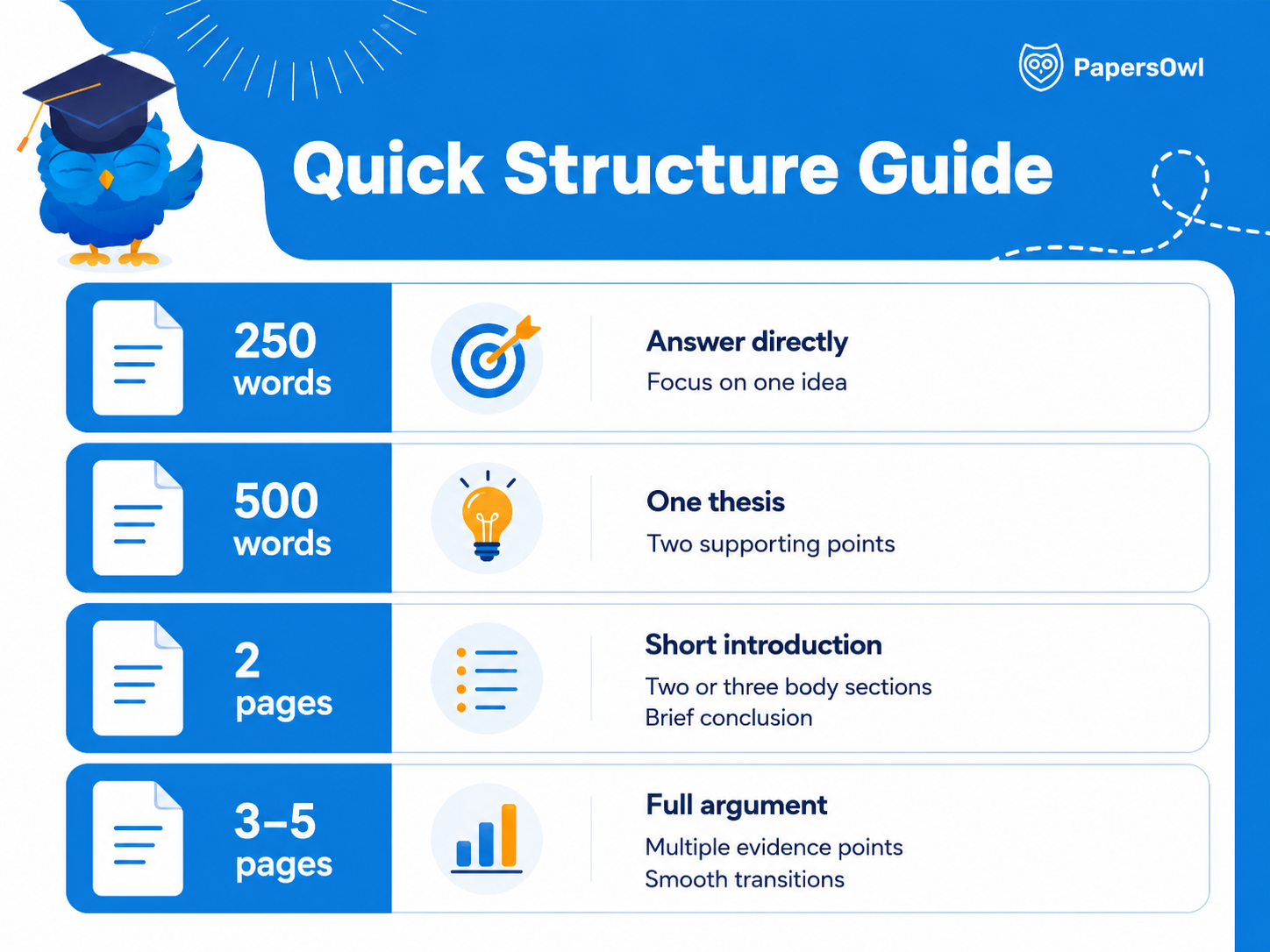
So, the shorter the assignment, the more focused the topic should be!
So What or What Students Can Learn From the Most Common Orders
When you look at the most common requests, you start to see patterns. And those patterns reveal what many students in your classes are dealing with, too.
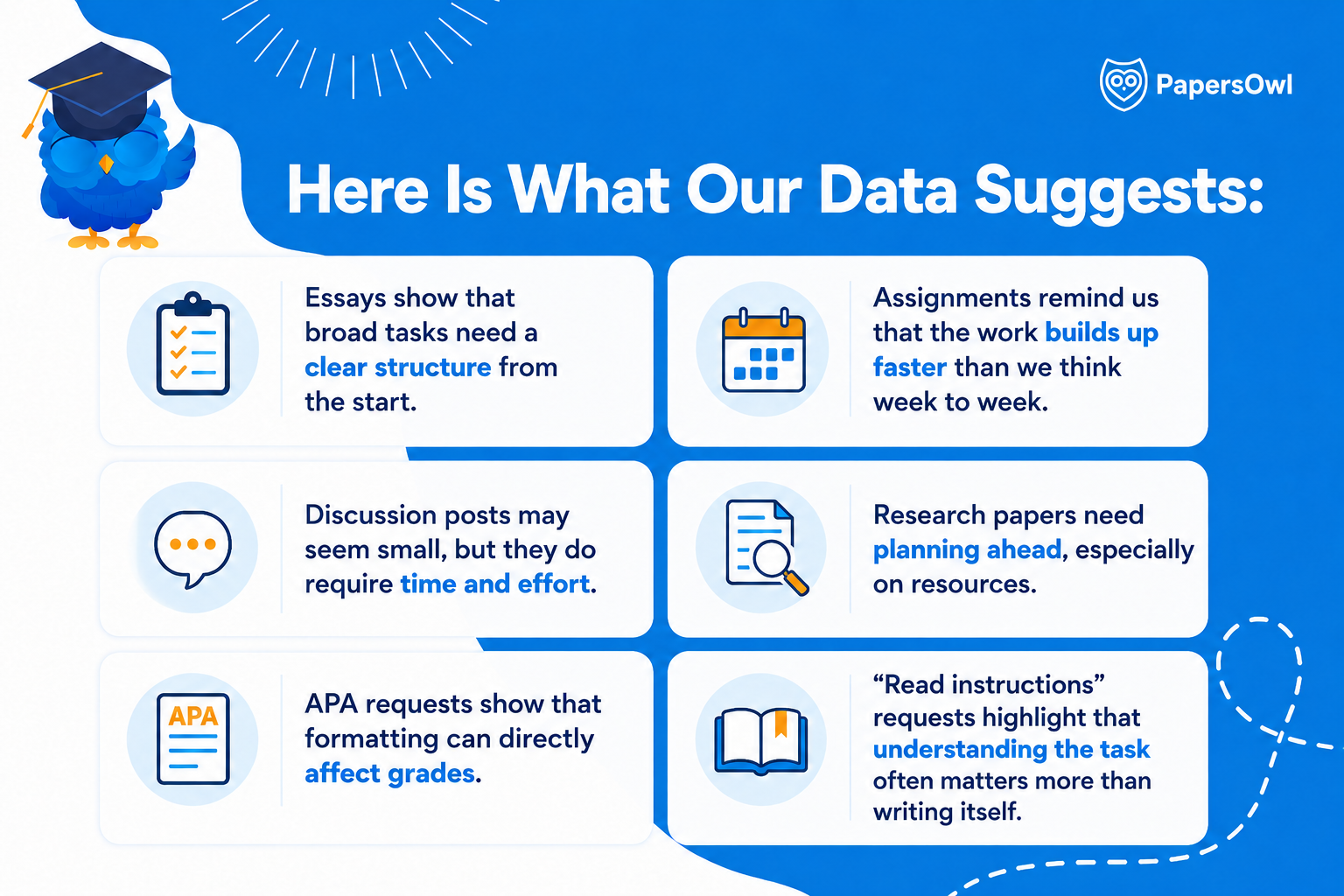
The real lesson is not to wait until stress builds up. It is important to notice the problem early.
Sometimes the issue is research. Sometimes it is a structure. Sometimes it is just unclear instructions. And that is OK!
But once you can name the problem, it becomes much easier to fix. That is also why the way students ask for help matters. A clear request does not just help the writer. It helps the student understand the assignment better, too.
How to Write a Better Assignment Request Before You Ask for Help
Students often ask for our assistance without providing enough information. That creates confusion from the start.
🧠 The golden rule: the more context you provide, the better the support you receive.
A lot of academic stress comes from missing details, not just difficult assignments. So, take a minute to gather the key information. That can save time and avoid misunderstandings later.
Here’s a simple template to make it a lot easier to ask for help:
|
✅ Assignment Request Template (Checklist)
|
So, the more you tell us at the beginning, the better our guidance will be and the more accurate and helpful it will be.
Conclusion: The Most Ordered Assignments Reveal a Bigger Picture
Essays are the most requested assignment type. But that is not the most important finding.
🧩 The bigger story is that students often struggle long before they begin writing. They need help understanding instructions and organizing ideas. They struggle with managing deadlines. They also need help with formatting, research, and structure.
The lesson from academic requests is not that students avoid writing. It is that academic work often becomes challenging before the first sentence is even written. And once students understand that, they can focus on solving the real problem instead of treating every assignment as just another paper.
Methodology
This analysis is based on 80,000+ placed academic orders submitted through PapersOwl’s website and other service channels over the last two years. We reviewed available order details across 72 assignment types, including paper type, subject area, citation style, topic length, and requested length.
Percentages were calculated from the available data, so some categories may not total 100%. The report reflects a part of placed orders, not completed orders. All findings were reviewed in aggregate form, with no personal information, identifying details, or individual user data accessed or disclosed.