
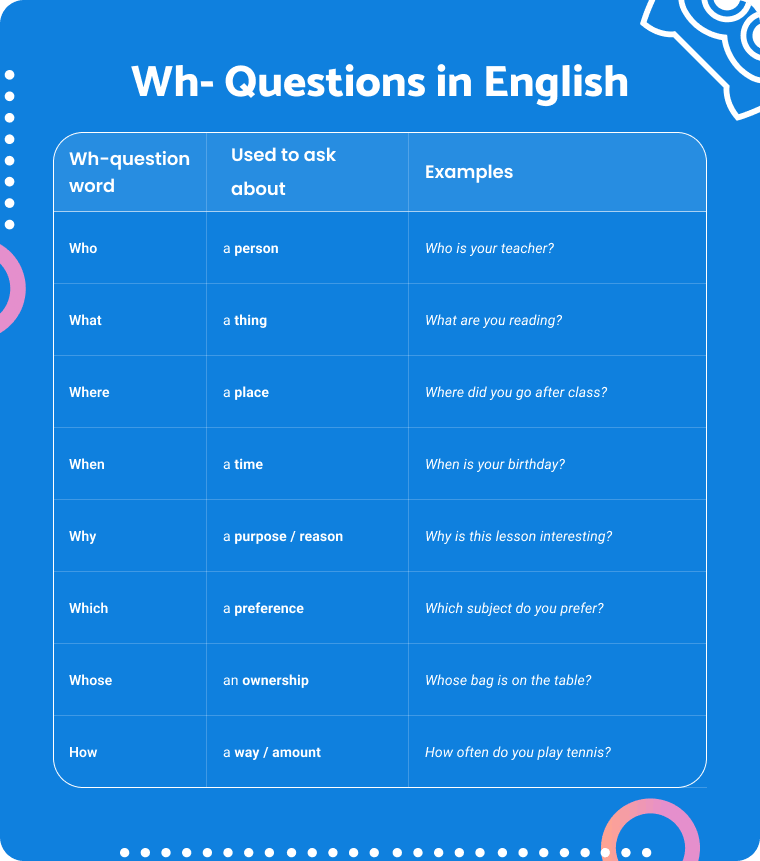
Wh questions are queries that start with the letters “wh” (who, what, where, when, why, which, whose), and how. We use them to ask about a person, place, time, reason, or manner.
Examples:
- Who is your teacher?
- What is your favorite movie?
- Where is your house?
- When is your birthday?
- Why are you late?
- Which is your dress?
- Whose bag is this?
- How does this work?
Key takeaways:
- Wh questions in English are open interrogatives used to request information.
- They are common in spoken English, at school, work, and in conversation.
- Most follow the form: Wh word + auxiliary verb + subject + main verb.
The Meaning of Wh Questions
These interrogatives begin with a word like who, what, where, when, why, which, whose, or how. Their main purpose is to request information. Instead of short answers, they encourage detailed responses and help learners explain actions, events, reasons, or choices in more depth. That same depth is exactly what a custom article review service looks for when evaluating whether a piece of writing actually answers the question it set out to ask.
Open vs. Closed Questions
Open, or Wh questions, are great when you want more details than just a “yes” or “no.”
For example, if someone asks, “What are you writing?” you could say, “I’m writing an article about time management for students.”
Or if they ask, “How was the meeting?” you might reply, “It went really well, and we sorted out the new class schedule.”
Closed questions, on the other hand, just need a simple “yes” or “no.”
“Are you a student?” → “Yes, I am.”
“Did you finish the essay?” → “Not yet.”
The big difference is that Wh questions with answers let you explain things, share ideas, and give details, while closed questions are short and simple.
Using both types makes your English sound natural in class, at work, or just chatting with friends.
Wh Question Words
Below are the most common Wh starters in English.
Each one asks for a different type of information, helping you request information, explain ideas, and communicate in spoken English, school lessons, or everyday conversation.
Who (Asking about people)
Think about the last time you asked, “Who is this man?” or “Who is coming to the party?” If you’ve ever wanted to know more about a person, you were already using who. I use who when I’m asking about people, names, or roles in class, conversations, or everyday situations.
| Question | Answer |
| Who called you after class? | Maria called me after class. |
| Who is going to the cinema? | My friends Alex and Sara are going. |
| Who helped you with the homework? | Our teacher helped us understand the topic. |
What (Asking about things, actions, or information)
Need to ask about objects, actions, or information? Then, add what in your conversation. It lets you get details about events, ideas, or activities, and is very popular in spoken English and writing.
| Question | Answer |
| What are you writing in your article? | I am writing about time management strategies for students. |
| What happened at the meeting? | We decided on the new class schedule and homework assignments. |
| What is your favorite cartoon? | My favorite cartoon is The Lion King. |
Where (Asking about places)
We use where to talk about location and place, and it’s one of the most common words you’ll hear in where questions examples in everyday conversation.
| Question | Answer |
| Where is the nearest market? | The nearest market is two blocks away. |
| Where did you leave your bag? | I left my bag on the kitchen table. |
| Where are your parents right now? | They are at the supermarket. |
When (Asking about time & dates)
If you’ve ever checked, “When is your birthday?” you were already using when. We include this word to ask about time, dates, and moments, especially when planning, scheduling, or talking about what happened.
| Question | Answer |
| When is this party? | This party is on July 12. |
| When did you hear the news? | I heard the news yesterday afternoon. |
Why (Asking for reasons & purposes)
Think about how often you ask, “Why?” as a student or at work. I use it when I want a reason, a purpose, or an explanation. It’s perfect for conversations, essays, and any time you want to understand actions or decisions better.
| Question | Answer |
| Why are you learning English? | I am learning English to improve my career opportunities. |
| Why did you change your job? | I changed my job to gain new skills and experience. |
Which (Asking about choices)
Which is used when there is a choice or preference between two or more options. It helps learners decide, compare, and describe their preferences.
| Question | Answer |
| Which lesson do you like most? | I like History the most. |
| Which house is yours? | The blue house at the end of the street is mine. |
| Which post should I read first? | You should read the article about essay writing. |
Whose (Asking about possession)
This word often connects closely to who questions. We use whose to talk about ownership or belonging. It helps us figure out who something belongs to in everyday conversations and writing.
| Question | Answer |
| Whose phone is on the table? | That phone belongs to Anna. |
| Whose idea was this? | The idea came from our teacher. |
| Whose lunch is in the bag? | The lunch belongs to my brother. |
How (Asking about manner, condition, or quantity)
I use how to talk about the way something happens, how someone feels, or how much of something there is. It is one of the most versatile Wh words in English.
| Question | Answer |
| How does this work? | This works by pressing the button and following the instructions. |
| How old are you? | I am 16 years old. |
| How much money do we need? | We need about forty dollars for the supplies. |
How to Form Wh Questions
Let’s see how to create wh-question forms using simple grammar patterns and clear examples.
Basic sentence structure
Wh word + auxiliary verb + subject + main verb
Examples:
- What did you write?
- Where are they meeting?
With the verb “to be”
When the main verb is to be, we do not use another auxiliary.
Wh word + am / is / are / was / were + subject
Examples:
- Where is your house?
- Who are those students?
- Why was the class canceled?
With auxiliary verbs (do / does / did)
We use do, does, and did for most interrogatives in the present and past simple, which is a key part of understanding “What are Wh questions?”
Wh word + do / does / did + subject + main verb
Examples:
- What do you want for lunch?
- Where does she work?
- Why did they leave early?
With modal verbs
Modal verbs include can, should, must, will, and might.
Wh word + modal verb + subject + main verb
Examples:
- When should we start the lesson?
- How can I improve my writing?
- Why must he finish today?
Subject vs. object questions
Sometimes the Wh word is the subject of the sentence. Then, we do not use an auxiliary verb. Compare these examples.
Subject question:
- Who called you?
Object question:
- Who did you call?
This is a common mistake that gets easier once you see the pattern.
Passive voice
Wh queries can also be in the passive voice.
Wh word + auxiliary verb (be) + subject + past participle + by agent (optionally)
Examples:
- When was the article written?
- Why is this house called “Green Home”?
Quick quiz
Try to answer these questions for practice:
- Who is your favorite teacher, and why?
- What are you learning in class right now?
- Where do you usually do your homework?
- When did you last go to a party?
- Why do people learn a second language?
- Which subject helps you decide on your future job?
- Whose idea was your last school project?
- How do you prepare for a meeting?
Make Wh questions work for you!
Wh-based inquiries and who, what, when, where, why, how examples are a key part of everyday conversation, school lessons, and work communication. They help us request information, share ideas, and understand what people mean.
From asking about a class start time to talking about a new job, a meeting, or essay topics, open-ended questions make conversations clearer and more interesting. They allow us to learn more about people, places, and events instead of stopping at simple yes or no answers.
The more you practice them in speaking and writing, the more natural they will feel over time.
But formulating the correct questions is only the first step. Turning those answers into a strong paper is another challenge. If you get stuck, PapersOwl can help turn your Wh queries into a well-written assignment without the stress.
Useful resources
- Cambridge Dictionary & Grammar – Explanation of Wh questions and forming rules.
- Teaching English at British Council – Lesson ideas and Wh question grammar explanations.
- English EFL – Wh question words with examples and grammar notes.
- Woodward English – Simple list of question words with examples.
- Randall’s ESL Cyber Listening Lab – Exercises to practice Wh questions with listening examples.