
A strong paragraph normally has between 5 and 8 sentences. That’s long enough to support one point, yet short enough to maintain people’s attention.
They wonder, “How long is an essay paragraph?” The real answer is: long enough to make a point with evidence and explanation, but neither padded nor rushed.
Length is important because teachers look at how clear, well-structured, and logical your work is. A well-shaped text feels intentional and easy to read.
- One paragraph = one clear idea.
- Length depends on the task and the goal.
- The structure is more important than the word count.
- Flow breaks guide the reader.
Further, I’ll explain the core principles of effective text structure.
The General “Burger” Rule for Organizing Sentences
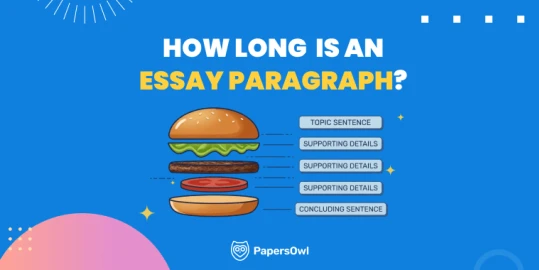
Most people learn the classic model: a paragraph contains a topic sentence, several supporting lines, and a transition sentence. That structure mirrors the burger metaphor — bun, filling, bun. The idea isn’t an absolute rule, but it’s a helpful starting format.
I recommend thinking of your structure like a burger 🍔 you build carefully:
- The first sentence introduces the central idea.
- The middle layers add explanation and evidence.
- The final sentence connects to the next section.
Students often ask me, “How long is a paragraph in college?” I tell them to think in terms of purpose, not math. A text block isn’t measured only by the number of words or strict word length. Instead, it’s measured by whether it fully answers a question or supports a thesis.
In college essays or academic papers, instructors expect depth. A writing block must contain enough evidence to support the claim without drifting into a new point. If your idea spills over, that’s a signal to start a new section. Each paragraph should be a contained unit of reasoning — one burger, one idea.
Step-by-Step Guide to Burger Components
Think of writing like building a burger. Each part has a job, and when you put them together carefully, your ideas make sense and are easy to follow.
Here’s how I like to structure my writing.
Step 1. The top bun: topic sentence
The first sentence introduces the main idea. It shows the reader what this section is about and keeps the focus clear. If you’re wondering how many sentences are in an essay, start with just one strong opening. Keep it simple and direct. Don’t mix in other points yet.
Example:
This top bun holds the whole section together, giving the reader a clear start.
Step 2. The filling: support and explanation
Next is the filling — the main content. This is where you give examples, explain ideas, or add evidence. Each sentence should strengthen the main point. Use facts, quotes, or small stories to make your idea real.
Example:
The filling makes your writing rich and believable.
Step 3. The bottom bun: closing/transition
Finally, wrap up the idea and guide the reader to what comes next. This sentence makes everything fit together. It’s easier for the reader to follow your train of thought when you clearly end your sentences, even when you’re talking about something like how long law school takes.
Example:
How and When to Vary Your Writing Blocks?
Rules are helpful when you’re learning, but strong writers know when to adjust structure. Length is a tool, not a cage. The goal is always clarity and purpose.
- 📌 Short paragraphs can create emphasis. A single sentence block can slow the reader down and spotlight an important idea. I often see this in creative work, transitions, or moments that need emotional weight. Used too often, though, it loses impact. Think of it as a pause — strong yet on purpose.
- 📌 Longer sections are useful when ideas need further clarification. Sometimes, academic arguments need more than one layer of reasoning, evidence, and context. When you ask yourself, “How long is an essay in paragraphs?” keep in mind that length should serve clarity. As long as every sentence supports the same focus, extended length works. If the text starts to feel dense, I suggest looking for a natural point to split it.
- 📌 Assignment type matters more than fixed rules. Analytical tasks require growth. Descriptive writing relies on imagery and description. Structured writings frequently prefer balance. Your purpose should guide your choices, not habits.
At the end of the day, variation exists to serve meaning. Adjust the length to make it easier for the reader, not to fit a pattern.
| Situation | Best approach | Why it works |
|---|---|---|
| Emphasis or transition | Short block | Highlights key ideas |
| Complex explanation | Longer block | Allows deeper reasoning |
| Structured assignment | Balanced size | Maintains clarity and flow |
Tips to Achieve the Perfect College Paragraph Length
- Focus on one idea. Every text block should answer a single question or claim. If you start drifting into another idea, break it. This prevents overload and keeps your argument sharp.
- Check balance, not numbers. Ignore strict word limit thinking. Instead, read your text aloud. Does it fully explain the idea? Does it stay readable? Writing quality matters more than counting words.
- Use flow breaks strategically. A break signals a shift in reasoning. A clean structure makes your document easier to read and improves comprehension. Think of it as guiding the audience step by step.
Need an example paragraph built to match your assignment? You can always order one at PapersOwl — sometimes a model makes the process clearer and saves time!
Before making a decision, you can also read various Paperowl reviews to see how other students have benefited from using such writing models.
Final Thoughts
Perfect paragraph structure isn’t about memorizing rules. It’s about learning a process you can repeat. Writing is resilience. If you ponder upon “How long is a paragraph in an essay?”, remember that clarity matters more than numbers.
Some paragraphs feel messy at first — that’s normal. Over time, you learn when to expand, when to break, and how to shape ideas.
Try writing your own “burger” paragraph today. Start with a claim, layer an explanation, and finish with a smooth connection. That outline is an essential part of effective writing.
Need an example paragraph built to match your assignment? You can always order one at PapersOwl — sometimes a model makes the process clearer and saves time!
- Tacoma Community College. The Hamburger Technique of Writing. https://tacomacc.libguides.com/nursing/hamburger
- Pressbooks. The Paragraph Structure. https://pressbooks.pub/eng100/chapter/chapter-3-paragraph-structure/
- Reading Rockets. Classroom Strategies: Paragraph Hamburger. https://www.readingrockets.org/classroom/classroom-strategies/paragraph-hamburger
- Teachers Notes. How to Write a Great Paragraph — Writing Lessons. https://www.youtube.com/watch?v=ys5ktS4JvKk