
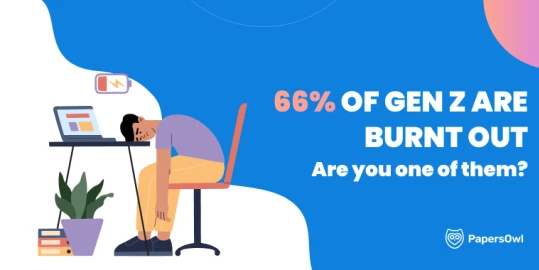
Z workers report burnout — the highest of any generation, and it doesn’t clock out at the office. Take the free three-minute test to see where you land.
Exhausted after the long weekend. Running on caffeine and a to-do list that never gets shorter — or a group chat, three deadlines, and a shift that starts at six. For a lot of Gen Z Americans, this is just called Tuesday.
But at what point does “tired” tip into something more serious?
It’s not a new question for us — PapersOwl has already studied this territory in our research on balancing pressure and mental health. And the most recent national data suggests the line has already been crossed for much of an entire generation — most of them just don’t know it yet.
Before the numbers, the practical part. You can find out where you stand right now — PapersOwl built a free burnout test, grounded in the two most validated instruments clinicians use (the Maslach and Oldenburg Burnout Inventories) and built on established clinical research. It’s genuinely free: no sign-up, no email, no catch — just a few minutes for a personalized score and specific guidance on what to do next. And it isn’t only for the 9-to-5 crowd: if you’re a student, it’s built for you too.
And if you already sense the answer is “yes” — if this has been building for months and you’re deep in it — you won’t be left with just a number. The recovery guidance further down follows what clinicians actually recommend, laid out by severity: from protecting what’s working to what to do when burnout needs real intervention.
The Numbers Are Hard to Ignore
Burnout has reached a six-year high across the U.S. workforce — and no group is carrying more of it than the youngest. Here’s what the most recent research actually shows:
- 66% of Gen Z workers are experiencing burnout — the highest rate of any generation in America.
- The generational gradient is stark: 58% of millennials, 53% of Gen X, and 37% of Baby Boomers report the same. The rate runs almost perfectly with age — the newest into work and school are carrying the heaviest load.
- 55% of U.S. workers overall are currently burned out — the highest figure recorded in six years.
- In other words, this isn’t a fringe problem for anyone. It’s just worst for the young.
- 76% of U.S. workers report some level of burnout; 53% describe it as moderate to severe.
- Burned-out employees are nearly three times more likely to say they’ll leave within the year.
- Burnout isn’t just a wellness issue. It’s a retention crisis hiding in plain sight — and only 42% of burned-out workers have even told their manager.
- Burnout costs businesses an estimated $322 billion a year globally in turnover and lost productivity.
At the individual level the price tag gets specific: burnout costs employers between $4,000 and $21,000 per employee a year depending on the role, per a 2025 study from the CUNY Graduate School of Public Health in the American Journal of Preventive Medicine. For a 1,000-person company, that’s roughly $5 million in losses annually. At least.
These are workforce numbers — but Gen Z doesn’t only burn out at work. The same generation is stretched across lecture halls, part-time jobs, and summers that never quite become a break. Academic burnout runs on the same three engines as the job kind — exhaustion, cynicism, and the creeping sense that nothing you do is landing — and students carry it right alongside their working peers.
What Burnout Actually Feels Like (It’s Not What You Think)
Most people wait for the crash — the can’t-get-out-of-bed, staring-at-the-ceiling moment. By the time it arrives, burnout has usually been building for months.
The real early warning signs are subtler — and far easier to wave off.
The first red flag is rarely the exhaustion people expect; that comes later. What comes first is a gradual emotional flattening: the things and people that used to bring pleasure start to feel muted. Favorite rituals stop rewarding you, conversations with people you love turn into effort — all while you keep performing at a high level. The quiet sense that any of it matters simply goes dim.
By the time exhaustion shows up, burnout has often been developing for a year or more.
Other overlooked early signals include:
– Waking up unrefreshed after a full night’s sleep
– Irritability that feels out of proportion to the trigger
– Difficulty making simple decisions
– Cynicism about work or study that once felt meaningful
– A creeping sense that effort yields nothing
This is how burnout differs from ordinary stress — and why the distinction matters.
The line between stress and burnout runs through meaning, not energy. Stress is having too much to do; burnout is no longer knowing why any of it is worth doing. Many people can name the exact moment their sense of purpose went quiet — often months before they reached for help.
Burnout also differs from clinical depression in an important way. Depression tends to color every part of life. Early-stage burnout is often specific: you can feel completely depleted by your job or your degree while still finding pleasure elsewhere. That specificity fades as burnout deepens, which is exactly why catching it early matters.
Who Is Most at Risk
The data points the same way from every angle: the youngest carry a disproportionate share.
Gen Z — born roughly between 1997 and 2012 — reports burnout at rates that top every other generation. Eagle Hill’s 2025 survey puts working Gen Z at 66%, against 58% of millennials, 53% of Gen X, and 37% of Baby Boomers. The gradient runs with age, and against seniority, autonomy, and pay: the newest arrivals are carrying the most.
The reasons are structural, and they don’t stop at the office door. Gen Z came up through pandemic disruption, economic whiplash, and the collapse of any clean line between “on” and “off.” For those still in school it’s the same machinery — always-available coursework, financial pressure, a job or two on the side, and the quiet expectation to be productive even over the summer. Add documented anxiety about AI reshaping the very jobs they’re studying for, and you get a generation that reached burnout earlier than any before it.
PapersOwl’s own original research, conducted with young American workers, found that the way this generation relates to work has fundamentally shifted. The “job situationship” — technically employed but emotionally checked out, uncommitted, quietly keeping options open — maps almost exactly onto the clinical profile of moderate burnout. It isn’t apathy. It’s a protective response to an environment that stopped being sustainable.
→ Take the Test: How Burned Out Are You?
PapersOwl built a research-backed burnout assessment on indicators from the Maslach Burnout Inventory and the Oldenburg Burnout Inventory — the two most validated instruments clinicians use to measure burnout — and built it on established clinical research. Twelve questions. About three minutes. A personalized score and specific, actionable guidance for where you land. It’s completely free, and your results show up the moment you finish — no sign-up, and no email required to see them.
And it isn’t only for people with a 9-to-5. Students — this means you, even in summer. A side job or two, family obligations, catching up on credits, the quiet pressure to “make the most” of the break: none of it comes with a manager, but all of it drains the same battery. Burnout doesn’t check your employment status — and neither does the test.
Take the Burnout Assessment
Recovery Takes Longer Than Anyone Wants to Hear
Here’s the part most burnout articles skip. A long weekend doesn’t fix burnout. Neither does a two-week vacation — or a semester break — though they help. Clinically, recovery usually runs several months, a year or more in severe cases, and the relapse rate when people return to unchanged conditions is high: about 50–60% within a year.
What to do next depends on where your score lands. Level by level:
If you scored Low (0–25): protect what’s working
– Keep the routines, people, and rituals that keep you grounded. They’re the reason your score is low — and the first things to quietly vanish when the load grows.
– Learn the earliest warning sign clinicians describe: favorite things starting to feel flat, conversations with people you love starting to feel like effort. If that shows up, don’t wait for exhaustion to confirm it.
– Build a small buffer for harder weeks: even a 15-minute weekly check-in with yourself keeps small problems from becoming big ones.
If you scored Moderate (26–50): course-correct now, while it’s still cheap
– Reset sleep first. A consistent bedtime held for two weeks is the fastest reset there is — and quality matters as much as quantity.
– Run a responsibility audit: list everything on your plate and mark what can be declined, delegated, shortened, or dropped. Saying no is a skill; this is the stage to practice it.
– Notice whether it’s your energy that’s low or your sense of why. If hobbies feel flat and the “why” is fading, that’s the line where stress turns into burnout.
– Put 20 minutes of something purely enjoyable into every day — not as a reward, as maintenance.
If you scored High (51–75) or Severe (76–100): this needs intervention, not willpower
– Speak with a mental-health professional or your doctor — soon, not after the next deadline. Campus counseling services (usually free) and Employee Assistance Programs exist for exactly this.
– Plan in months, not weekends. Recovery from established burnout typically takes several months, and relapse risk sits around 50–60% within a year when people return to unchanged conditions.
– Actually reduce the load. We need to reduce the volume and pace of demands before anything else can work; hard conversations about scope and deadlines are part of the process, not an optional extra.
– Change the structure before returning to full capacity: rebuild boundaries, identify what depleted you, and create new patterns. Returning to identical conditions is the most reliable predictor of relapse.
– Reconnect with meaning. Burnout is, at its core, the loss of the sense that what you do matters — recovery means actively rebuilding that, inside or outside of work or school.
– If you’re at Severe and in crisis: the 988 Suicide and Crisis Lifeline (US) is available by call or text, 24 hours a day.
When to Seek Professional Help
If you’ve been exhausted for more than a few weeks, if rest no longer restores you, if work or study that once felt meaningful now feels pointless — these aren’t signs of weakness or bad time management. They’re clinical signals that deserve attention.
If your score lands in the High or Severe range, talking to a therapist, counselor, or your doctor is worth prioritizing soon — not after the next project or exam. Campus counseling is available at most U.S. universities, often at no cost. Employee Assistance Programs (EAPs) are available through most large employers and provide confidential mental-health support, also often free.
If you are in crisis, the 988 Suicide and Crisis Lifeline (US) is available by call or text, 24 hours a day.
Methodology
Additional workforce statistics cited in this article are drawn from: Eagle Hill Consulting / Ipsos Workforce Burnout Survey (November 2025, n=1,400+); Mind Share Partners 2025 Mental Health at Work Report; Gallup / World Health Organization burnout cost estimates; and the CUNY Graduate School of Public Health study published in the American Journal of Preventive Medicine (2025).