
Is Gen Z the “always online” generation? Sure. But they’re also the generation that laces up, shows up, and keeps going.
Not because they have to. Not because it’s trending. Because for most of them, movement has become identity.
According to a February 2026 PapersOwl survey of 3,000 young adults aged 18–28, 95% report doing physical activity at least once per month over the past year. That alone should retire the ‘lazy Gen Z’ narrative for good.
But what they do, why they do it, how much they spend, and how it shapes their daily lives tells a much bigger story. Let’s dig in.

Key Insights
- 95% of Gen Z did physical activity at least once a month in 2025
- Running (65%) and strength training (54%) are the top regular activities
- 1 in 4 train competitively — professionally, on a team, or in events
- 49% participate in non-professional competitions like 5Ks, HYROX, or recreational leagues
- 68% say the gym or their sport space is their “third place”
- Half have cut back on other spending to afford fitness
- The #1 reason for not doing a dream sport? Lack of motivation — not money, not time
- 6 in 10 plan to exercise even more in 2026
🏃 Running Leads. Strength Stays Strong. And Don’t Underestimate Walking.
If you picture Gen Z fitness as gym selfies and aesthetic smoothie bowls, think wider.
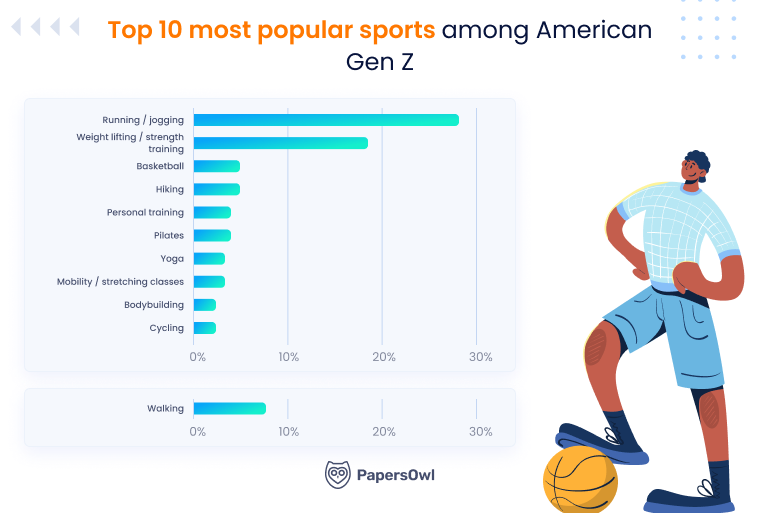
Running is the single most common primary sport at 65%, with strength training close behind at 54%. But the long tail of activities tells the real story.

Basketball shows up over and over. So does soccer, cycling, swimming, Pilates, hiking, boxing, MMA, Brazilian jiu-jitsu, kickboxing, wrestling, skiing, surfing, pickleball, golf, horseback riding — even parkour.
And then there’s walking.
Walking appears dozens of times in open responses. Walking a mile a day. Walking with kids. Walking as rehab. Walking while going through chemo. Walking because it’s affordable. Walking because it’s simply possible.
💡 This isn’t a fitness trend. We’ve got ourselves a movement culture.
The picture that emerges isn’t a generation obsessed with aesthetics. It’s a generation that has built physical activity into the texture of everyday life.
📅 How Often They Train — And How Much Time It Actually Takes
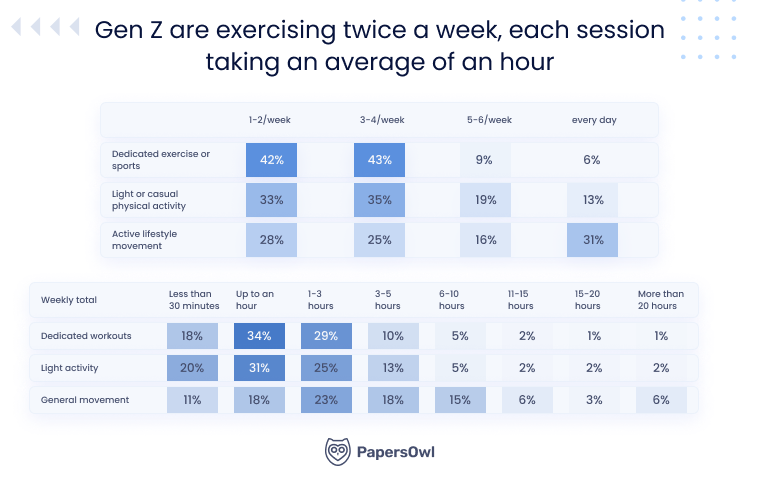
Gen Z doesn’t treat movement as one single habit. It comes in layers.
There’s the “real workout” bucket — gym sessions, runs, team practices, classes. Most people cluster in the middle zone here, training a few days per week rather than daily or almost never.
Then there’s light activity: stretching, easy rides, short home workouts. More flexible, more spread across the week — the kind of movement you squeeze between work, study, and life.
Finally, there’s everyday movement: walking to get places, being on your feet, general daily activity. This is where consistency jumps. A much larger share reports moving every single day when this category is included.
The time breakdown shows the same pattern. Dedicated workouts tend to stay in the “manageable” range — short to moderate sessions for most. General movement is where real volume quietly stacks up across the week, sometimes accounting for a bigger share of total active time than the “workouts” themselves.
Not Just Casual. A Quarter of Gen Z Train Competitively.
For most, training is personal. Health. Stress relief. Self-improvement.
But for a significant minority, it goes further.
Roughly 1 in 4 either train professionally, compete on school or college teams, or balance competition with personal performance goals. And beyond structured teams and professional paths, nearly half of Gen Z participate in non-professional competitions — 5Ks, marathons, CrossFit, HYROX, recreational leagues — at least occasionally.

So yes, most train for themselves. But many still sign up for races, show up to arenas, and test themselves publicly.
🏅 Gen Z may value personal growth over trophies. But they still show up to compete.

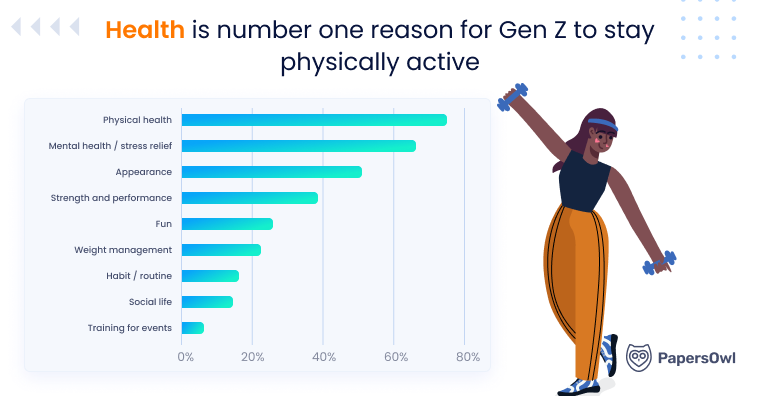
What motivates them? Health comes first. Mental well-being sits right behind it. Aesthetics still matter, but they’re not the primary driver. After that, motivations split across performance, routine, fun, weight management, and social connection.
💸 How Much Gen Z Spend on Sports — And Whether It Feels Worth It
Fitness isn’t free for most Gen Z, but it’s also not extreme.
The biggest group stays on the lower end of the annual spending scale. A smaller but visible segment crosses into four figures. Only a tiny fraction goes beyond that. And some spend nothing at all.

Where does the money go? Mostly to access and basics. Gym memberships take the top spot. Gear and apparel come next. Supplements, apps, studio classes, event fees, and coaching trail behind.
In other words, Gen Z is paying for entry and equipment — not elite-level services.

But here’s where it gets interesting.
When asked how they feel about their spending, roughly half say they might be spending a little too much. A smaller group openly admits to overspending. And only a minority say it causes real financial stress.

About half say they’ve cut back on other expenses — at least occasionally — to afford sports or training. That means fewer nights out. Fewer impulse buys. Maybe fewer subscriptions.

💡 For this generation, fitness isn’t a leftover expense. It’s a line item that comes before leisure — not after.
More Than a Hobby. For Many, It’s Identity.
For about 1 in 4 Gen Z, sports aren’t just something they do. They describe it as a key part of their identity and lifestyle.

For the largest group, sports are still framed in practical terms — mostly health, mostly fitness. Another segment sees it as goal-driven self-improvement. A smaller share say it’s not a big part of their life at all.
But even among those who don’t call it an identity marker, the data tells a different story.

When asked how much their main sport affects their schedule, spending, and recovery, most land in the middle. Not extreme. Not minimal. About one in six say it shapes most of their routine or affects them “a lot.” A much larger share admit it affects them at least moderately. Only one in four say it doesn’t touch their life much.
Translation: even if Gen Z don’t label sports as their identity, it still structures their calendar.
🏠 The Gym as Third Place
Home is one place. Work or school is another.
For roughly two-thirds of Gen Z, the gym or main sport space is at least somewhat their “third place.” Over a quarter say yes outright. Another large group say somewhat. Only about a quarter reject the idea.

Fitness spaces aren’t just functional. They’re social environments. Routine anchors. For many, they’re community.
❤️ Sports, Social Life, and Relationships
The stereotype says training isolates you. The data says otherwise.
More than half report that sports improved their social life — either a little or a lot. Around four in ten say it made no difference. Only a tiny fraction say it hurt their relationships.
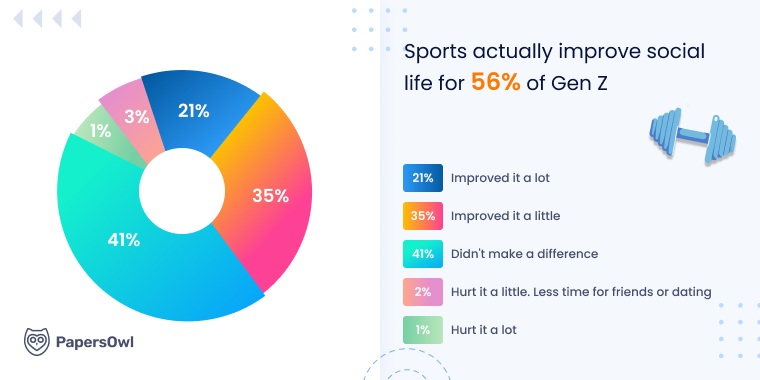
For most, training doesn’t shrink their world. It either expands it, or at least leaves it intact.
And what about romantic compatibility? For about half of Gen Z, a partner who trains matters. Some say it’s very important. Others say somewhat important. For another third, it’s a nice bonus but not essential. A smaller group say it doesn’t matter at all — and a few prefer to train solo entirely.

Shared workouts aren’t mandatory. But they’re clearly valued.
🌙 From Nightlife to Night Runs
Has training replaced other leisure activities?
For a meaningful share, yes. Some go out less to prioritize training. Others say fitness has directly replaced nightlife. Another group say somewhat. About a third report no real change.

This doesn’t mean Gen Z stopped socializing. It means the form shifted. The party might start earlier — or happen at the track.
The Pressure Side of Fitness
Training builds discipline. But sometimes it also builds pressure.
More than half of Gen Z admit they’ve skipped social plans at least occasionally to train or recover. Not once. Not rarely. Regularly.
And it doesn’t stop there.
Roughly half say they’ve continued training despite being injured — at least from time to time. Soreness isn’t always a reason to pause. Sometimes it gets ignored entirely.
Then there’s the social comparison spiral.
Around half report feeling pressure to train because people around them are working out or posting about it. Not always. But often enough to matter.
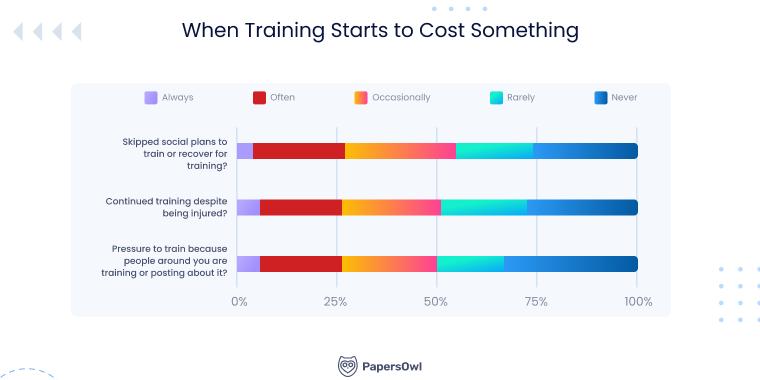
⚠️ When fitness becomes identity, the line between healthy motivation and quiet compulsion can blur. The data hints that Gen Z is navigating this tension in real time.
🚫 Why the 5% Don’t Train
Only about 5% of respondents said they don’t regularly do sports or fitness. So who are they — and what’s in the way?
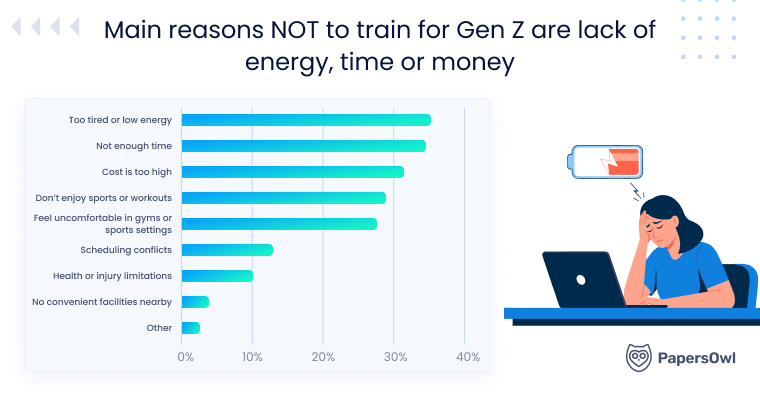
The barriers are mostly practical, not philosophical. Low energy leads the list, followed closely by not enough time and cost. After that come emotional and environmental factors: not enjoying workouts, feeling uncomfortable in gyms, scheduling conflicts, health limitations, and a lack of nearby facilities.
None of those are abstract or ideological reasons. They’re real friction points — the kind that better access, lower prices, and more welcoming spaces could meaningfully reduce.
The Sport They Wish They Did
Gen Z is already active. Very active.
And still, about one in three say there’s a sport or fitness activity they wish they did regularly but currently don’t. Another third says maybe. Only a third are fully satisfied with what they’re already doing.

When asked what they wish they did more of, basketball takes the top spot. Running and jogging follow. Walking and hiking show up strongly. Swimming holds steady. Soccer and football — both global and American — remain popular aspirations. Strength training, yoga, Pilates, tennis, pickleball, volleyball, combat sports, cycling. All in the mix.

The pattern is telling. The wish list mirrors the current activity landscape. Team sports. Endurance. Strength. Mind-body formats. Outdoor movement. These aren’t extreme sports or niche aspirations.
💡 It’s not about wanting something exotic. It’s about access, consistency, and bandwidth.
So Why Aren’t They Doing It?
The barriers are less dramatic than you might expect.

Lack of motivation tops the list. Close behind: being already busy with other training, not knowing where to start, and lacking convenient facilities. Health limitations and fear of the skill gap play a role. Fear of injury and not having friends to join in matters too. Cost and schedule conflicts appear, but they’re not dominant.
Gen Z doesn’t lack interest in sports. They lack bandwidth. Or confidence. Or simply a front door to walk through.
6 in 10 Gen Z Plan to Exercise More in 2026
If there’s one thing this data shows clearly, it’s momentum.
Nearly two-thirds of Gen Z say they want to increase their physical activity in 2026. About a quarter aim for a significant jump. An even larger group plans a smaller step up. Only a tiny share plan to reduce activity. One-third have no specific goal.

Even after a year where most are already active, competing, and spending on sports — many still feel there’s room to do more.
That’s not dissatisfaction. That’s drive.
What Does This All Say About Gen Z and Sports?
Gen Z aren’t passive spectators of their own health. They’re building fitness into daily life, making real financial trade-offs for it, and using movement as a way to manage stress, build identity, and connect with others.
The challenges are real — pressure, comparison, the occasional injury pushed through, the social event skipped. But the direction is clear.
This is a generation that moves. And in 2026, they plan to move even more.
Methodology
Researchers from PapersOwl surveyed 3,000 Americans aged 18–28 to compile this study. The survey was conducted in February 2026. Randomly selected participants were asked to discuss their experiences, with no emphasis on a specific gender, ethnicity, or social background.