
The Job Situationship Is Real
If you ask a Gen Z worker how they feel about their job, there’s a good chance their answer will sound more like a dating profile than an HR survey: “It’s complicated.” Or maybe, “It’s a situationship — convenient for now, but not long-term.” This comparison is actually quite accurate.
The way younger workers talk about their jobs has shifted from career planning terms to words about emotional connection. Whether that’s good or bad, it reveals a lot about today’s workplace.
The results don’t show a generation that’s lazy or disengaged. Instead, Gen Z has learned a new set of rules about loyalty, being seen, and what work really means.
🤔 So, does this make Gen Z wiser, more careful, or just harder to win over? That’s what employers need to figure out in 2026.
6 Key Insights on Gen Z’s Relationship With Work
- 40% of Gen Z work fully in-office — the fully remote lifestyle is less common than the cultural conversation suggests.
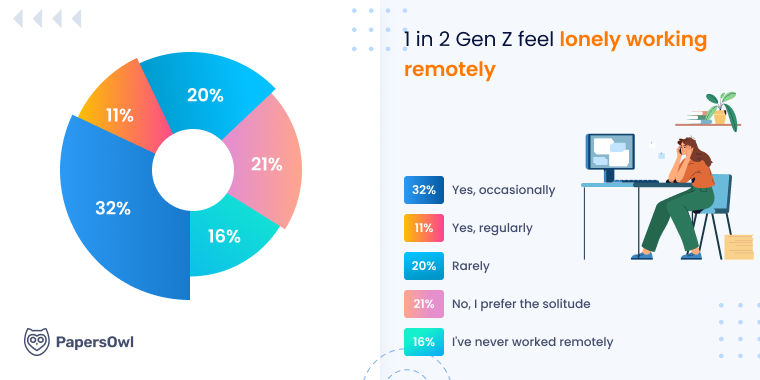
- 1 in 2 Gen Z workers have felt lonely while working remotely — isolation is a real cost of WFH flexibility.
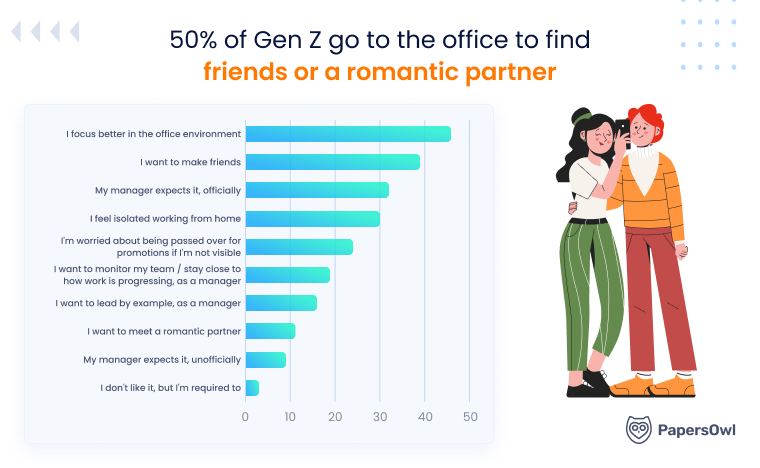
- 50% cite making friends as a reason they go to the office; 10% name meeting a romantic partner.
- 65% believe remote workers are overlooked for promotions — yet many still prefer to work from home.
- Nearly 6 in 10 Gen Z workers (59%) have used AI on the job without their employer’s knowledge.
- 76% view leadership as part of their career path, and it makes them the most career-ambitious generation yet!
Gen Z Is Back in the Office, But Not for the Reason Hr & Bosses Think
For years, the return-to-office debate has sounded pretty simple: executives want people back at their desks, and employees want freedom. However, this survey complicates that story.
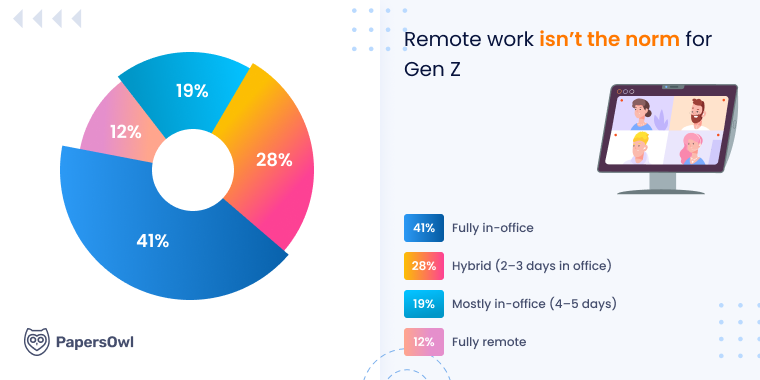
➡️ 41% of Gen Z workers are fully in-office, and another 19% are there four to five days a week.
This means most Gen Z workers spend their time in a physical workplace. What’s surprising is that many of them actually want to be there.
Gen Z is changing what the office means, and they’re doing it their way. While 46% say they focus better at the office, the social aspect matters too: 39% come in to make friends, and 43% feel isolated at home.
For many young workers, the office is now more than just a place to work. It’s a social hub, a spot for networking, and even a kind of community center — with comfortable chairs.
💙 11% even say they hope to meet a romantic partner at work. And no, that is not just a funny footnote.
This makes sense for a generation that grew up during COVID isolation. Many missed out on campus life, early networking, and everyday social moments. Now, they use every chance to rebuild those lost connections.
This changes how we think about returning to the office. For Gen Z, it’s not just about getting work done or being watched — it’s about feeling like they belong. Companies that get this will connect better with young workers than those that see office time as just a rule.
What do they actually do in the office, you might wonder?
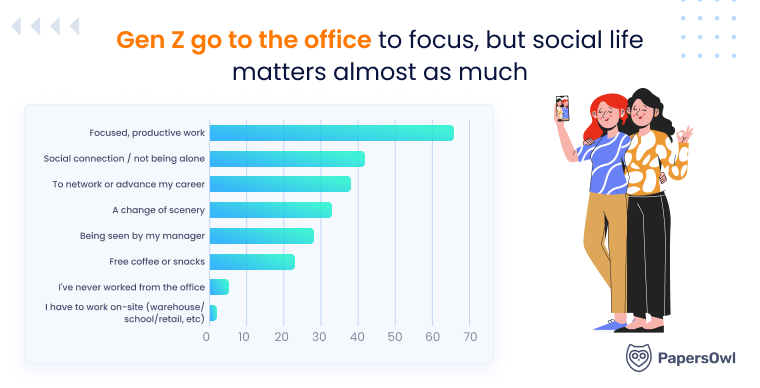
🔸 The most common answer was focused, productive work (66%) — which is real. So yes, the work is getting done.
🔸 Social connection came next at 42%, narrowly ahead of networking and career advancement.
Put simply, the office is now a place where work and personal life mix in ways that remote work can’t match.
💅 BTW, Gen Z is not apologizing for wanting both.
The Remote Work Catch: Flexibility Comes With a Promotion Tax
Gen Z has mixed feelings about remote work, and the data shows this clearly.
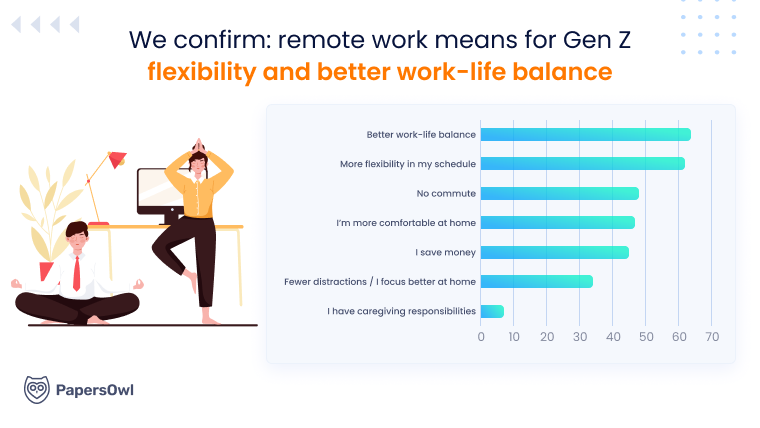
🏡 On one hand, Gen Z genuinely values the benefits of working from home:
- 64% cite better work-life balance;
- 62% appreciate schedule flexibility;
- Nearly half value the lack of a commute.
These are the bare minimum benefits. They show that Gen Z cares about work-life balance: more rest, more personal time, and more control. For them, work shouldn’t mean being watched just to prove you’re working.
💎They’re simply different. Gen X, Millennials, and Boomers must accept it.
👀 On the other hand, they also know the workplace still rewards being seen:
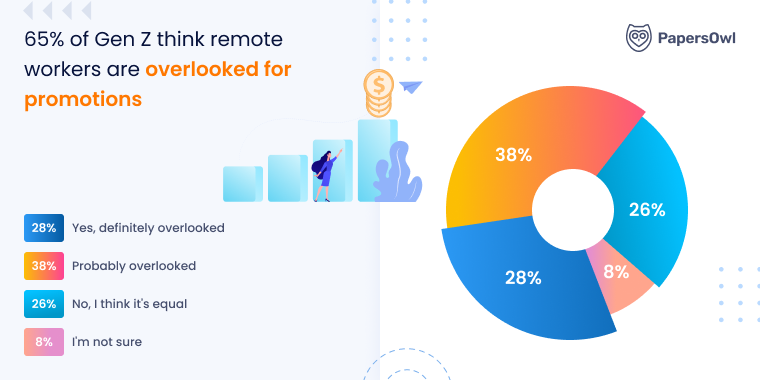
- 65% believe that remote workers are overlooked for promotions;
- only 26% believe the playing field is equal.
This isn’t paranoia — it’s reality. Gen Z knows that in many companies, results matter, but BEING SEEN MATTERS too. The people who get promoted are often the ones who are present and involved, even if they don’t make a big deal about it.
That creates a difficult trade-off. Gen Z wants the flexibility remote work offers, but they also want the career growth that office visibility can support.
That’s why 24% say they come to the office because they worry about missing out on promotions. Most aren’t there for the lights or the small talk — they know that not being present can have a cost.
Remote work gives Gen Z freedom, but the office gives them visibility. For a generation trying to build careers in an uncertain economy, that’s a hard choice.
Gen Z Is Using AI at Work, But Not Telling HR
Here is the number that should make every HR department pause:
- 59% of Gen Z workers have used AI tools on the job without their employer’s knowledge. 22% do so regularly, 38% have done it a few times, and 8% who have tried it once. Only 33% have never used AI at work without disclosure.
This isn’t unusual anymore. Quietly, it’s becoming normal in many jobs and industries.
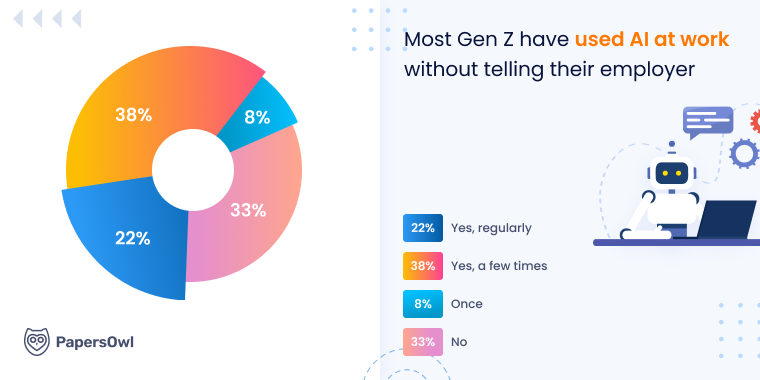
The psychology behind this secrecy is worth a closer look.
📱Gen Z didn’t grow up with digital restrictions — they grew up knowing how to use technology. For many, using AI to write an email, summarize a document, or brainstorm ideas feels normal, just as using a calculator did for older generations.
So the secrecy is not always about guilt. Often, it is about self-protection.
Many workplaces have banned AI, discouraged it, or treated it as suspicious before employees even had a chance to explain how they use it. No wonder some workers have learned that disclosure can invite scrutiny, while good results rarely do.
🤝This is a trust gap, and it goes both ways. Employers who want to understand their workforce’s actual behavior cannot obtain accurate data due to costly policies. Meanwhile, employees who use AI to work faster, think through problems, or improve everyday tasks can be framed as rule-breakers rather than early adopters.
The companies that get the most from Gen Z’s tech skills won’t be the ones that treat AI use as a problem. Instead, they’ll set up:
- clear rules;
- realistic guardrails;
- honest conversations about where AI helps, where it harms, and where human judgment still has to lead.
In other words, AI is already inside the workplace. The real question is whether employers want it hidden in the shadows or brought into the open with rules people can actually follow.
The Job Situationship: Why Gen Z Keeps Employers at Arm’s Length
The “job situationship” may sound like a TikTok trend. However, the data suggests it is a pretty accurate way to describe how many Gen Z workers feel.
💔 When asked to describe their current job as a relationship, Gen Z said:
- 45% said it’s a great match, and they’re committed.
- 32% said it’s complicated.
- 21% called it a situationship: convenient, but not long-term.
- 2% said they are ready to break up and just waiting for the right moment.
Taken together, more than half of Gen Z workers are in an emotionally mixed relationship with their employer.
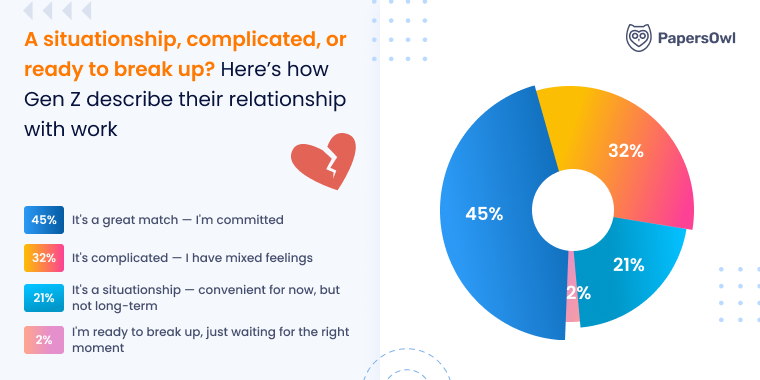
This ambivalence is not apathy. It is a caution.
Gen Z has seen companies lay people off, change remote-work policies overnight, and ask for loyalty while offering little certainty in return. Because of this, many young workers have learned not to invest too much emotionally in a workplace that might not give back.
🛡️The emotional distance behind the “situationship” label is a way to protect themselves. It helps them stay ready to move on if the market, the company, or their role changes quickly.
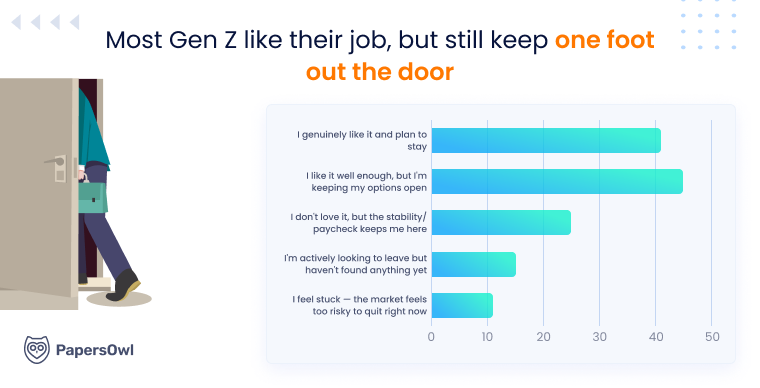
The job satisfaction data tells the same story:
- 41% genuinely like their job and plan to stay.
- 45% like it well enough while keeping their options open.
That’s the job situationship in action: real effort, real engagement, and real satisfaction, but always with one eye on the exit sign.
Now, here’s the uncomfortable part for employers. Gen Z may be working hard, joining meetings, hitting goals, and even liking the job. But that doesn’t mean they have given their loyalty for free. 🤷♀️
It’s not disloyalty. It’s self-protection that looks like a career strategy.
What Would Make Gen Z Stay? Pay, Growth, and a Reason to Trust
The most important question any employer can ask right now is also the simplest: what would make this person commit?
Gen Z’s answers are not mysterious. They are not unreasonable. In fact, they are the same things that have driven retention for decades. The difference is that Gen Z says the quiet part out loud:
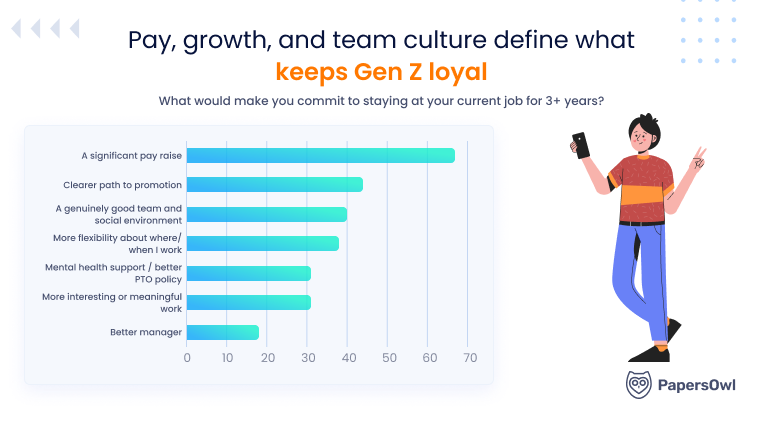
- 67% said a major pay raise would make them stay 3+ years.
- 44% want a clearer path to promotion.
- 40% want a genuinely good team and social environment.
- Flexibility (38%) and mental health support (31%) round out the top five.
💸 Before the ping-pong table, the wellness stipend, or the purpose-driven mission statement, there’s a number on a paycheck. Gen Z is clear that this matters most.
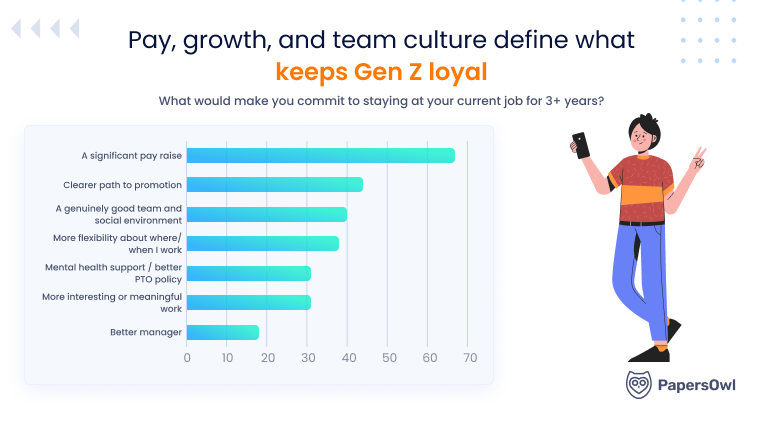
The data describe a generation that wants:
- a fair deal, not a fantasy workplace;
- see where their career is going;
- like the people around them;
- have some control over where and when they work
- to know when their activity is being monitored.

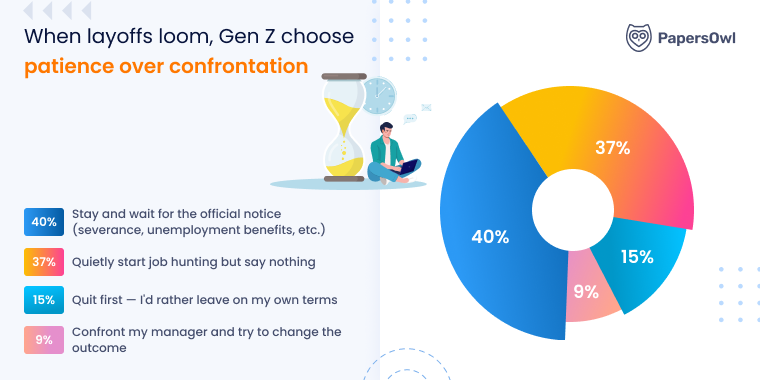
- Unlike some opinions, that is not an idealistic wish list. It is basic dignity at work. Companies that treat these demands as excessive may lose talent to the companies that treat them as table stakes. Gen Z is not asking employers to reinvent work from scratch. They are asking them to stop pretending that loyalty can be built on free coffee and vibes alone.The layoff data adds another layer. When rumors start to spread, Gen Z does not exactly rush into a brave confrontation:
🔹40% say they would stay and wait for official notice (severance, benefits, documentation).
🔹37% would quietly start job hunting without saying anything.
🔹Only 9% would confront their manager directly.
This isn’t cowardice. It’s a survival strategy in 2026.
For Gen Z, staying quiet during layoff rumors doesn’t mean they trust their employer. It often means they are watching, thinking things through, and protecting themselves. This shows that psychological safety around job security remains absent in many workplaces.
🧩 If employers want Gen Z to stay, the formula is simple: pay them fairly, show them a future, build a team they want to join, and stop treating transparency as a risk.
-
Gen Z Is Becoming the Boss, and It’s Complicated
A detail that often gets lost in the conversation about Gen Z at work: many of them are no longer just being managed. They are managing other people.
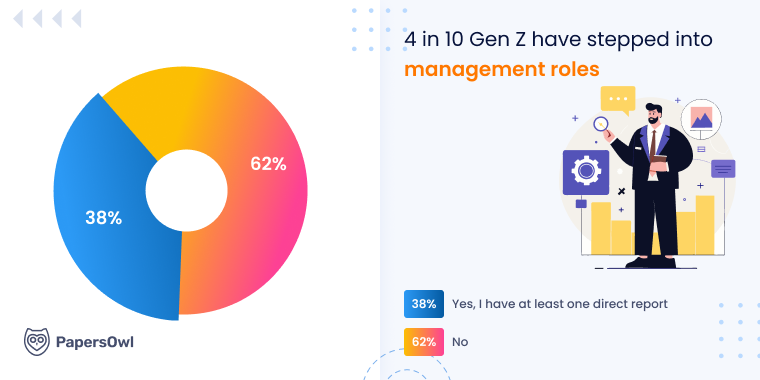
38% of Gen Z survey respondents have at least one direct report. That’s not a minor detail. It means the generation often seen as a workplace challenge is already becoming a NEW GENERATION OF MANAGERS.
And from the manager’s seat, work looks different.
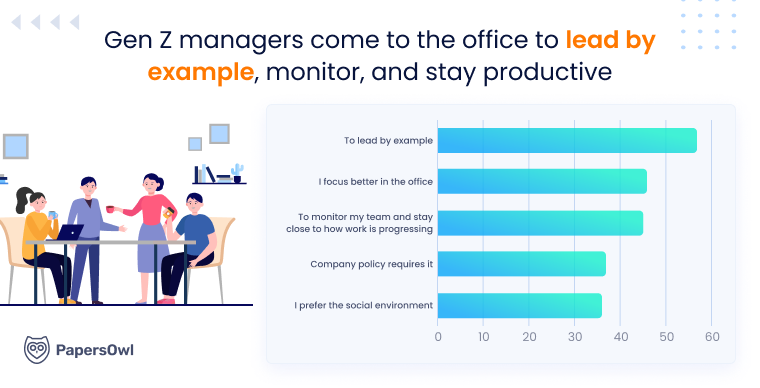
- Gen Z managers come to the office for reasons that are not quite the same as their non-managing peers:🔸57% come in to lead by example, a motivation that implies a clear-eyed awareness of their own symbolic role.🔸45% come in to monitor their team and stay up to date on progress.
That second number is where things get interesting.
This generation, often skeptical of workplace surveillance, is now facing the same tension as managers. That’s not hypocrisy. It’s the classic manager twist: accountability feels different when you’re responsible for the outcome.
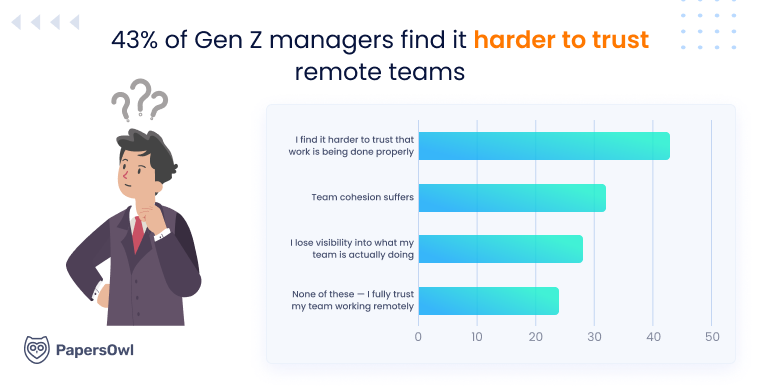
- Remote work makes that tension even clearer. 43% of Gen Z managers say it is harder to trust that work is being done properly in remote settings. Another 32% say team cohesion suffers. These concerns are not unique to Gen Z managers. Still, they matter because they show how quickly workplace ideals become more complicated once someone has to lead a team, protect performance, and keep people connected.
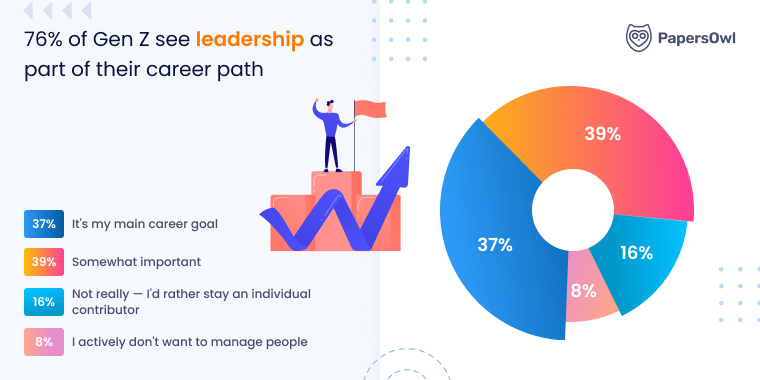
- As individuals, Gen Z wants flexibility. As leaders, they need visibility. And that tension isn’t just a Gen Z problem. It’s one of the biggest questions the modern workplace still needs to solve. What stands out most is that Gen Z is not rejecting leadership. Quite the opposite.76% say leadership is part of their career path:
🔹 37% call it their main goal.
🔹 39% say it is somewhat important.
So, Gen Z isn’t avoiding ambition. They’re just trying to redefine it without following all the old management rules.
They want flexibility and accountability. They question being watched, but they still need trust. They want to work to feel human, but they know teams need more than just good feelings and free coffee to succeed.
That may be the real story of Gen Z leadership: they are NOT avoiding the boss seat. They are trying to make it look different once they get there.
-
The Bottom Line: Gen Z Will Commit, But Not Blindly
The data doesn’t show a generation in crisis, or one that has given up on ambition.
🌪️ It is a generation that has learned to survive in a job market that asks for loyalty but often gives back only uncertainty.
- They show up at the office, but partly for connection.
- They use AI, but often keep it quiet.
- They like their jobs, but keep their résumés ready.
- They want to lead, but they are watching closely to see whether their employer deserves their commitment.
That’s why calling it a “job situationship” fits so well. It shows how Gen Z puts in real effort and ambition, but also protects themselves at work.
Importantly, Gen Z isn’t pretending to care. They just don’t want to give too much to employers who might not give back.
🔑 For employers, the message is simple: loyalty has to be earned. Companies that pay fairly, address layoff worries, offer clear career paths, and are open with employees have the best chance of building real commitment.
Methodology
This study surveyed 3,000 Americans aged 18–28 residing in the United States. The survey was conducted in May 2026. Participants were recruited via online panels using Random Device Engagement (RDE) to ensure a diverse and representative sample. The study did not target specific ethnicities or social backgrounds.