
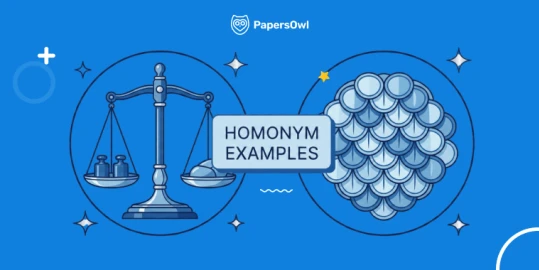
Homonym examples help us see how one word can carry multiple meanings in English. Some words have the same spelling and pronunciation but mean different things. Others only sound alike or look alike.
This guide clears up that confusion fast.
- Homonyms — same spelling, same sound, different meanings.
- Homophones — same sound, spelled differently.
- Homographs — same spelling, pronounced differently (sometimes).
- Context decides the correct meaning in a sentence.
Let’s fix the triangle of terms together from the start!
Classification of Homonyms with Examples
True Homonyms
These words have the same spelling and pronunciation but different meanings. Nothing changes in how they look or sound. Only the meaning shifts.
Take a bat.
- A bat flew out of the cave at night. (animal)
- He hit the ball with a wooden bat. (sports tool)
Or ring.
- She wore a silver ring on her finger. (circle)
- I heard the phone ring twice. (sound)
Another example of a homonym in a sentence is park.
- The children played in the park after school.
- Please park the car near the tree.
Context-Dependent Homonyms
These words also keep the same spelling. The pronunciation usually stays the same. But their meaning changes depending on whether the word is a noun or a verb.
Look at the bear.
- The bear lives in the forest. (noun, animal)
- I can’t bear this noise anymore. (verb, carry or tolerate)
Or ground.
- The kids sat on the ground. (noun, earth)
- She ground the coffee beans this morning. (verb form)
Consider the deal.
- We made a fair deal. (noun, agreement)
- The teacher will deal the cards. (verb, distribute)
Here, grammar and sentence structure guide the reader. Mixing these up is a common mistake even strong writers make. Which is why some students ask someone to do my paper for me when a tricky sentence needs a second pair of eyes. When you identify the part of speech, the meaning becomes clear.
Homonym Examples List
Top 20 Most Common Homonyms
Here are the most popular lexical twins you’ll see in everyday English. These words often appear in speech, school texts, and writing.
| Word | Meaning A | Meaning B | Example sentences |
|---|---|---|---|
| Bat | Flying animal | Sports tool | A: The bat slept in the tree.
B: He swung the bat hard. |
| Bear | Wild animal | To carry | A: The bear lives in the forest.
B: I can’t bear this noise. |
| Bank | Money institution | River edge | A: I went to the bank.
B: We sat by the river bank. |
| Ring | Circular object | Sound | A: She wore a gold ring.
B: I heard the phone ring. |
| Park | Public green area | Leave a car | A: The kids played in the park.
B: Please park here. |
| Letter | Alphabet symbol | Written message | A: The letter A is first.
B: I sent a letter. |
| Ground | Earth | Crushed surface | A: The ground is wet.
B: The coffee ground is dark. |
| Course | Class | Direction | A: I took a math course.
B: The ship changed course. |
| Light | Not heavy | Illumination | A: This bag is light.
B: Turn on the light. |
| Watch | Time device | Look at | A: My watch stopped.
B: Watch the child. |
| Rock | Stone | Music genre | A: The rock is heavy.
B: I like rock music. |
| Fair | Just | Festival | A: That decision is fair.
B: We went to the fair. |
| Spring | Season | Jump | A: I love spring.
B: Cats can spring high. |
| Kind | Type | Caring | A: What kind of story?
B: She is kind. |
| Right | Correct | Direction | A: Your answer is right.
B: Turn right. |
| Match | Game | Pair | A: The soccer match was fun.
B: This shirt is a good match. |
| File | Folder | Smooth with the tool | A: Open the file.
B: File your nails. |
| Tie | Neckwear | Equal score | A: He wore a tie.
B: The game was a tie. |
| Nail | Metal pin | Body part | A: Hammer the nail.
B: She painted her nails. |
| Wave | Water movement | Hand motion | A: A big wave hit us.
B: She gave a wave. |
Homonyms Alphabetical Chart
This extended chart gives you a broader view of examples of homonyms words. As you review them, you’ll notice a clear pattern: context is everything.
The spelling and pronunciation stay the same, but the meaning changes depending on the situation and grammar.
| Word | Meaning A | Meaning B |
|---|---|---|
| Address | Location details | Speak to |
| Anchor | Boat device | News presenter |
| Arm | Body part | Weapon |
| Arrow | Pointed weapon | Symbol on screen |
| Back | Rear side | Return |
| Band | Music group | Ring-shaped object |
| Base | Bottom support | Military camp |
| Bell | Metal sound object | Flower shape |
| Bill | Money statement | Bird beak |
| Block | Solid piece | Stop movement |
| Bolt | Metal fastener | Run suddenly |
| Boot | Shoe | Start a computer |
| Bowl | Round dish | Rolling a ball in sport |
| Branch | Part of tree | Office division |
| Bridge | Structure over water | Card game |
| Brush | Cleaning tool | Light touch |
| Button | Clothing fastener | Control switch |
| Cable | Thick wire | TV service |
| Calf | Young cow | Lower leg part |
| Capital | City | Money resources |
| Case | Container | Legal matter |
| Cast | Actors in a play | Throw |
| Cell | Small room | Biological unit |
| Chest | Body part | Storage box |
| Chip | Small piece | Fried potato snack |
| Clock | Time device | Measure speed informally |
| Coat | Jacket | Cover layer |
| Collar | Shirt part | Capture |
| Column | Pillar | Section in newspaper |
| Cone | Ice cream holder | Traffic marker |
| Contract | Legal agreement | Become smaller |
| Copy | Duplicate | Imitate |
| Corn | Grain | Small hard area on foot |
| Court | Legal place | Sports area |
| Cross | Religious symbol | Move across |
| Current | Flow of water | Present time |
| Cycle | Series | Ride a bicycle |
| Dash | Short run | Small mark |
| Deck | Ship floor | Set of cards |
| Dial | Phone control | Clock face |
| Drill | Tool | Practice exercise |
| Drop | Small liquid | Fall |
| Edge | Border | Slight advantage |
| Engine | Machine motor | Motivate |
| Face | Front of head | Confront |
| Field | Open land | Area of study |
| Figure | Number | Shape |
| Firm | Company | Solid |
| Flag | National symbol | Signal warning |
| Frame | Structure | Border |
| Glass | Drinking cup | Transparent material |
| Grant | Give formally | Financial award |
| Grave | Burial place | Serious |
| Grip | Hold tightly | Strong understanding |
| Handle | Part to hold | Manage |
| Harbor | Port | Keep secretly |
| Head | Body part | Leader |
| Heel | Back of foot | Shoe bottom |
| Hollow | Empty space | Not sincere |
| Host | Organizer | Large number |
| Issue | Problem | Publish |
| Iron | Metal | Remove wrinkles |
| Joint | Body connection | Shared place |
| Judge | Court official | Form opinion |
| Just | Fair | Only |
| Lane | Road part | Bowling track |
| Last | Final | Continue |
| Level | Flat surface | Rank |
| Line | Rope | Sentence row |
| Lock | Secure fastener | Hair curl |
| Postal letters | Armor | |
| Mark | Spot | Grade |
| Mass | Large amount | Religious service |
| Mean | Unkind | Average |
| Meter | Measuring device | Rhythm in poetry |
| Mold | Fungus | Shape form |
| Mood | Feeling | Grammar category |
| Net | Fishing tool | Final result |
| Note | Short message | Musical tone |
| Order | Command | Purchase request |
| Page | Sheet of paper | Call over speaker |
| Palm | Hand part | Tropical tree |
| Panel | Group of experts | Flat surface section |
| Passage | Corridor | Text section |
| Patient | Sick person | Calm tolerance |
| Pitch | Throw | Tone of sound |
| Plate | Dish | Metal sheet |
| Plot | Story outline | Secret plan |
| Pole | Long stick | North or South extreme |
| Pool | Water area | Grouped resource |
| Post | Mail item | Job position |
| Press | Push | Media |
| Prize | Award | Value highly |
| Pump | Machine for liquid | Athletic shoe type |
| Quarter | One fourth | Area of city |
| Rail | Bar | Complain strongly |
| Range | Variety | Cooking stove |
| Record | Store information | Best achievement |
| Refuse | Reject | Garbage |
| Rest | Relax | Remaining part |
| Roll | Turn over | Bread item |
| Root | Plant base | Support strongly |
| Row | Line | Argument |
| Rush | Hurry | Strong emotion |
| Scale | Measurement tool | Fish skin layer |
| School | Educational place | Group of fish |
| Screen | Display | Hide from view |
| Set | Collection | Put in place |
| Shade | Shadow | Slight difference |
| Shift | Change | Work period |
| Shot | Fired bullet | Small drink |
| Sign | Symbol | Write name |
| Slam | Close loudly | Criticize strongly |
| Slip | Slide | Small paper |
| Soil | Earth | Dirty |
| Source | Origin | Reference |
| Staff | Employees | Long stick |
| State | Condition | Government region |
| Store | Shop | Keep for later |
| Subject | Topic | Student course |
| Suit | Clothing set | Be appropriate |
| Swing | Playground seat | Move back and forth |
| Tail | Animal back part | Follow secretly |
| Tank | Large container | Military vehicle |
| Target | Aim | Goal |
| Temple | Religious building | Side of forehead |
| Track | Path | Follow |
| Trial | Court test | Attempt |
| Turn | Rotate | Opportunity |
| Type | Category | Print letters |
| Unit | Single item | Measurement |
| Value | Worth | Moral principle |
| Volume | Loudness | Book part |
| Ward | Hospital section | City district |
| Yard | Outdoor space | Measurement unit |
Homonyms vs. Homophones vs. Homographs
While figurative language plays with meaning, these three categories play with form and sound. It’s easy to use them interchangeably, but mixing them up is like using a metaphor where you need a literal fact. It confuses the reader.
To master English, you need to see the fine line between how a word looks, how it sounds, and what it actually represents.
Homophones
Homophones share the same pronunciation but are spelled differently, which often leads to writing mistakes. Students may mix them up because they rely on sound instead of checking the word on paper.
Unlike homonyms with same spelling, homophones look different, so careful proofreading matters.
Examples:
- Night / Knight
- Write / Right
- Sea / See
- Flower / Flour
- Buy / By
Homographs
Homographs are words that are spelled the same but may be pronounced differently. The way you say the word changes depending on its meaning. A small shift in stress or sound can signal a different idea. That’s why reading carefully and paying attention to context is so important.
Examples:
- Lead (to guide) / Lead (metal)
- Tear (rip) / Tear (cry drop)
- Wind (air) / Wind (turn)
- Object (thing) / Object (oppose)
- Present (gift) / Present (now)
Homonyms
Homonyms combine the same spelling and pronunciation but carry different meanings. They look identical on the page and sound identical when spoken. The only thing that changes is the meaning.
That meaning depends on context, which is why homonyms examples with sentences are so helpful for understanding the word correctly.
Examples:
- Bat
- Bear
- Bank
- Ring
- Park
Effective Tips for Distinguishing Homonyms
Here is how I explain it to my students for the first time.
- Check the sound. If two words have the same sound but different spellings, they are homophones.
- Check pronunciation changes. If the spelling is the same but pronounced differently, they are homographs.
- Check both spelling and sound. If both match, you likely have true homonyms.
- Look at the sentence. Context solves most problems.
| Wrong | Right |
|---|---|
| “I went to the river bank to get money.” | “I went to the bank to get money.” |
The surrounding words create meaning. That is why reading for comprehension matters more than memorizing lists.
With steady practice, the homonyms meaning and examples stop feeling tricky. They start feeling natural.
So, read stories. Write short sentences. Play with words. Language becomes less confusing when you actively use it.
Final Thoughts
Homonyms are not a trap. They show how flexible and creative the English language can be. Many words share the same name, but context gives each one its own meaning. When you understand the small differences between homonyms, homophones, and homographs, your writing becomes clearer and more confident.
If you see a tricky word like lead, tear, or bear, pause for a second. Read the full sentence. Let the context guide you. Most of the time, the answer is right there. Keep practicing. And if you need extra support, PapersOwl can help you sort out those tricky language details.